

5 Advantages Of Turbochargers You Should Know About
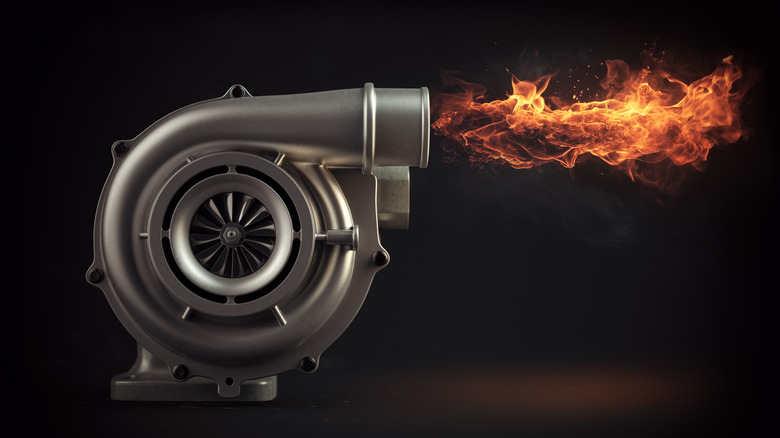
Not much evokes the image of performance and sportiness in a car more than hearing the word "turbo" in the name. In fact, the word has transcended well beyond automotive culture over the past five decades or so, now being used to label anything to do with going fast. A turbo button on your controller, turbo boosters on sci-fi rocket ships, doing work at turbo speeds, the list goes on. It's a bit of a stereotype that anything turbo is fast, but there's actually a lot of truth to that.
Turbochargers are complicated, somewhat convoluted devices to understand at a glance. They essentially take a car's exhaust gases and turn it into power, somehow. The devices have a long and storied history of improving performance, with the first production turbo car being the 1962 Oldsmobile Jetfire — these early turbos, like all innovative designs, had plenty of teething issues. Modern turbos, by comparison, are far more efficient, precisely-built, and deliver more power out of smaller packages than ever before. If you see a car with over 1,000 hp, chances are it's got at least one turbo under the hood.
On paper, turbochargers are the greatest thing since sliced bread. They reclaim free energy that would otherwise be wasted as exhaust; that's an amazing concept. Sure, nothing is perfect, especially in older or more niche setups. Turbos have a lot of cons; they're somewhat finicky, complicated, and generally have specific requirements like certain grades of gas or oil. But there's a reason why they're so desirable — several, actually. From power to modern anti-lag systems, let's discuss these all in detail.
All of the power
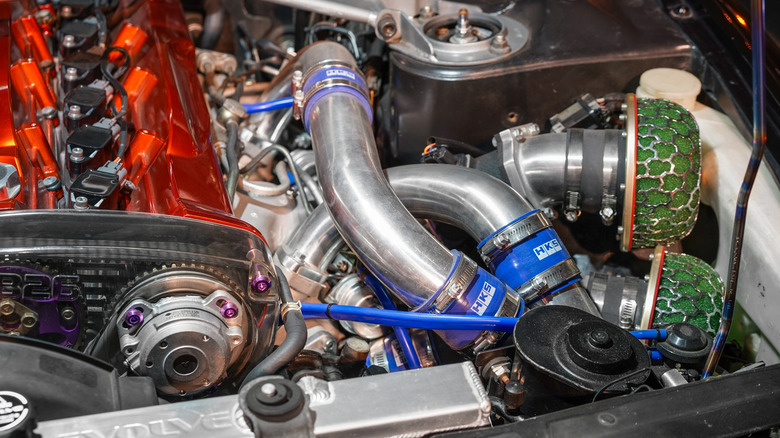
How else can we possibly start a series about the pros of turbocharging apart from the power aspect? That's largely the whole reason why turbos are a thing in the first place. You're taking a small, otherwise underpowered engine and packing it with as much pressurized air as humanly possible, hence the term "forced induction." It basically makes the engine do the same work as two. Obviously the amount of power varies significantly, but generally that little turbine makes the engine produce around 30-40 percent more power than it otherwise would.
How does it do that, though? In simple terms, it takes a bunch of that exhaust gas, pressurizes it, and forces it back into your car's intake. This effectively raises the amount of available combustible air for the fuel to use, and more burn means more power. That pressure is what we call "boost," and it's produced whenever the turbine is spinning (which you can hear by that whistling sound coming from turbo cars and trucks).
More power is good for many reasons, but we'll focus on the simple angle for now — more power means, well, more power. Sometimes a lot more; you will never, ever get 1,000 hp in a production car and make that engine a practical size without some sort of forced induction. That's why you see so many LS swaps use turbos. In short, if you're into tuning and have a car with a modest power figure that you want to improve, a turbocharger is often a crucial upgrade to making those ridiculous dyno numbers.
Turbo lag is largely a thing of the past
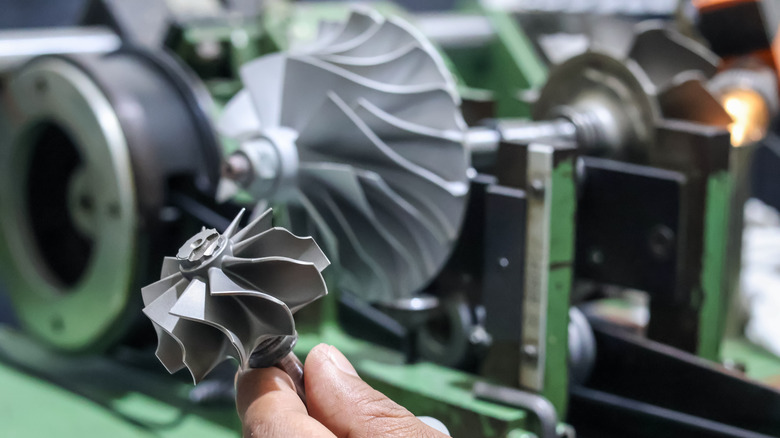
Turbo lag has a killer reputation, literally — it's one of the reasons why the classic Porsche 930 Turbo got the moniker "Widowmaker." High-powered turbo cars, especially older models, are notoriously tricky to drive hard. But why is that, exactly?
To understand turbo lag's dangers, first we must look at a typical car's peak horsepower. Most naturally-aspirated cars have a pretty rounded power band. As the car revs up, the power increases at a predictable rate, so you generally know exactly what the engine will do if you floor it. That doesn't really happen with a car that has a lot of turbo lag.
Remember, a turbocharger relies upon exhaust gases to build up pressure. The more pressure, the more power the turbo produces. But at low exhaust pressures, the turbo isn't able to do its job. You need to rev up the engine to produce higher-velocity winds, which in-turn spin up the turbo. How high largely depends on the car, but let's call it 2,500 RPM for simplicity's sake. At 2k, you have nothing, nothing, nothing — and suddenly you have all the power in the world when you hit 2.5k. That's why it's called turbo lag, and if you're not expecting that sudden kick, it'll catch you off-guard and you could easily lose control of the car.
Modern turbo systems often have built-in tools to mitigate that turbo lag to the point of negligibility. Variable-geometry turbos, twin-scroll and twin turbo setups, anti-lag systems, smaller and more efficient ball-bearing turbines, and more. Today's turbo tech is leagues above what came before, to the point where even basic three-cylinder city cars have them with no issues.
Smaller engines with similar power figures
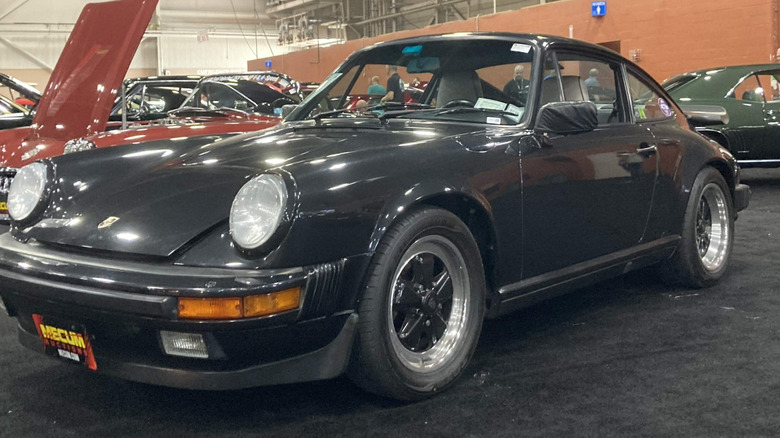
This falls in line with the power aspect of turbocharging — let's say you're a car manufacturer and you want to build a city car. You have two choices to power it: a three-cylinder or four cylinder engine, both of which have their own pros and cons. But you're going for miniaturization — building a small, nimble car to get around in the city, without the added mass and complication of a hybrid powertrain. The easiest solution to doing that while maintaining a decent power figure is, obviously, a turbo.
In the case of a three versus four-cylinder engine, imagine a turbo effectively replacing an entire cylinder, and then some. Smaller engines see bigger gains from having turbos fitted, so let's stay modest and say that you have a 33 percent performance gain, effectively an extra cylinder. That's one extra cylinder that doesn't take up extra space, doesn't need a spark plug or coil pack to run, and doesn't use valuable fuel.
The same rule applies to larger vehicles as well. Next, picture a hypercar manufacturer trying to build the next 1,000-plus hp production car. A 2017 Dodge Viper, by all accounts a fast car with some 645 hp, boasts an 8.4L naturally-aspirated V10. That's 8.4L, more than twice the displacement of, say, a 2017 Nissan GT-R with a 565-hp 3.8L twin-turbo V6. Nissan even produced one with 600+ hp from the factory, same 3.8L displacement and all. Think of how much engine it would take to produce those figures with a naturally-aspirated variant, or better yet, the 2,000-plus hp some people squeeze out of that particular engine. These numbers are simply impractical without the miniaturization a turbo provides.
Turbo engines can potentially sip gas and are easier to maintain
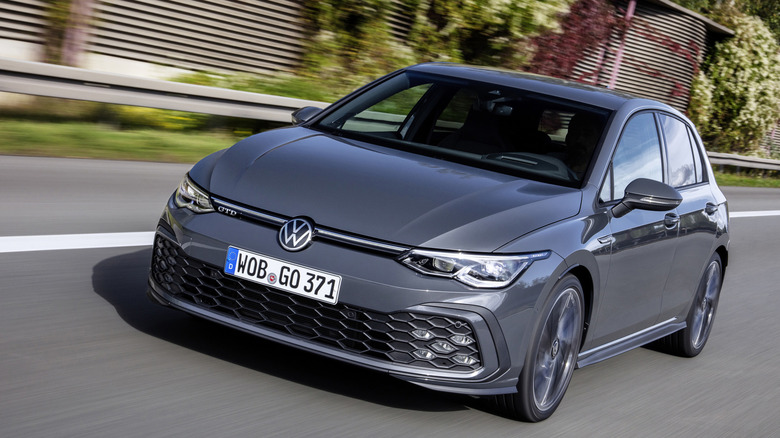
As mentioned previously, the whole principle behind a turbo engine is to use wasted energy to create basically free power. You're jamming all that air into a tiny engine, which yes, it'll use more fuel to burn that air, but that's only if you're hammering it all the time. The simple fact is that smaller engines consume less fuel to begin with, and thanks to a turbo's miniaturization capability, it means that you don't need a huge engine to produce adequate power. Hence why small turbo engines are so fuel-efficient.
This itself has cascading consequences. Smaller engines have three distinct benefits, one of which is primary and two secondary. The primary benefit is that, thanks to that turbo, you're only injecting a fraction of the usual fuel into a simpler engine block. A 1.0L turbo three-cylinder might produce as much power as, say, a 1.5L four-cylinder, but you only need to power three cylinders. That's one less spark plug, coil pack, injector, all of that. Sure, the turbo itself is complicated, but a turbo is cheaper to replace than a bricked engine block.
The other benefits relate to the car it's built around. You can place the turbos where you want (relatively speaking), meaning you can pack the car tighter and have more design freedom with the shape. It's far easier to make a car aerodynamic when it has a smaller turbo V6 versus a big V8, for instance, and it won't compromise capability by doing it because you have similar (or better) power and torque. Case in point: the 3.5L EcoBoost in the non-hybrid 2026 F-150 with more torque than some specs of the 5.0L Coyote V8.
You can slap a turbo on basically anything (within reason)
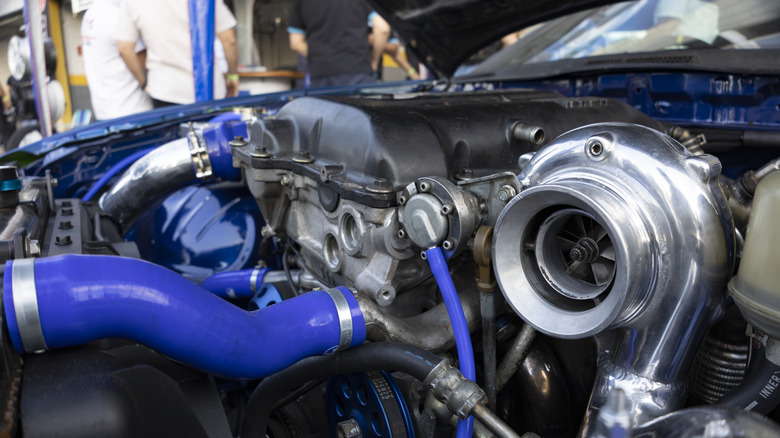
Okay, you can't turbocharge literally any car without substantial modifications, but the point still stands — a turbocharger's job is to convert exhaust gases into energy, and all combustion-powered cars produce exhaust.
This means that companies often build turbos meant for specific applications, ranging from smaller, more economy-focused stuff to hefty units with hefty power figures to match. Some companies even built their reputation off turbocharging regular cars. Take Hennessey, for example, the company which produced the Hennessey Venom 800 TT Viper in 1999 by fitting a production Viper with twin turbos and shooting it to 197 mph. Or the Callaway Sledgehammer, a C4 Corvette also equipped with twin turbos that managed an eye-watering 255 mph in 1988.
Either fitting or modifying turbos is something of a trope within the tuning community by this point. People fit all sorts of specialized equipment, ranging from wastegates that produce that distinctive stuttering sound you hear to even deleting headlights to make room for the giant intake. That style has even bled to some production cars, most notably the Dodge Challenger Hellcat that uses a functional headlight delete cold air intake for its massive supercharger.
Turbo culture has inadvertently given rise to an entire subgenre of automotive tuning. Search up almost any popular sports car and put "turbo kit" after it and you're almost guaranteed to find videos, posts, and sometimes components to fit a turbo. Is it easy? No, and you have to do a lot of work to these engines to make them reliable. But the lively subculture does make it accessible, and that helps prospective tuners get into turbo swaps so much easier.