

5 SUV Features To Look For If You Love Camping Or Other Outdoor Fun
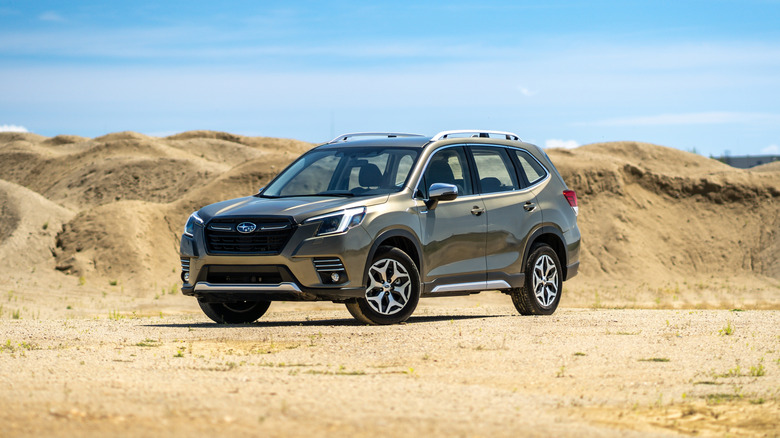
In 2024, SUVs accounted for 60% of the new vehicles sold in the U.S., and, despite being a utility vehicle, it might seem that the average SUV spends much of its time running errands around urban areas. However, sometimes it's nice to step away from the hustle and bustle of urban life and head for the hills, and this is where the SUV can come into its own; freed from the shackles of the school run or daily commute, the SUV thrives when it swaps the potholes and congestion of the city for rough terrain and empty vistas of the great outdoors.
This is when you truly appreciate the benefits of an SUV. The ability to carry more gear, head off-road, and do so while keeping you comfortable even after the pavement has ended, make it perfectly suited to outdoor adventures. However, not all SUVs are equally suited to the country life. A common SUV myth is that all SUVs are built for off-roading. This isn't the case. So, just what should you look for if you love heading into the wilderness? We've selected some choices that cover most of the bases.
From systems that help you to stay in control to features that keep you comfortable, and from underside protection to practical touches that make packing easier, here are five essentials that can transform an SUV from an urban runabout to a true outdoor trail-blazer.
AWD or 4WD

The benefits of having all four wheels providing traction can be useful in urban situations, especially when the weather decides to play up. However, it's when you leave the comfort of all that paving behind that the traction offered by all four wheels really comes into play. If you're heading off-road onto gravel tracks, muddy forest roads, wet grass paired with steep inclines, then you're going to want more than an SUV with basic front-wheel drive can offer.
There are really two options to consider. Although people often use the terms interchangeably, there are differences between AWD and 4WD. 4WD is a drivetrain that sends power to all four wheels for maximum traction on challenging terrain. This is not so common on modern SUVs, as 4WD systems were fine for off-road, but of limited use otherwise. Addiotionally, permanent 4WD systems certainly don't improve urban fuel economy.
More commonly found in today's SUVs are AWD systems. These also use all four wheels to supply traction, but the system automatically distributes to whichever wheels need it most. Ideally, any SUV that's going to leave the comfort of tarmac should have at least AWD. However, true 4WD drive systems have features like low-range gearing and differential systems that make them far more sure-footed when the going gets really tough. Ultimately, you'll need to consider all the factors before deciding whether AWD or 4WD is the better choice for your off-roading.
On the same score, all-terrain tires are a good pairing for such drivetrains, and will give you extra grip when the going starts to get knuckle-clenchingly tough.
Good ground clearance
With your drivetrain all sorted and all the wheels delivering sure-footed grip levels, it would be forgivable to think that your SUV is all kitted out for your camping adventure. However, there is one more question to answer before you tackle that innocent-looking trickle of a stream — can your SUV actually clear the obstacles in front of it? While there's more than just minimum ground clearance to safely off-road, it's a feature to be aware of if you're going to use your SUV for serious off-roading.
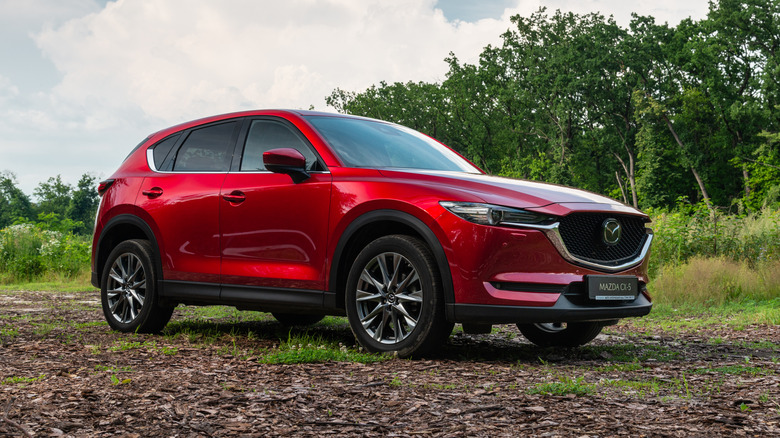
Most SUVs are capable, to one degree or another, of going off-road, but again this depends on how you classify off-roading. For instance, the Mazda CX-5 is a popular SUV and is more than capable of handling a few bumps on a rugged track, but not much more.
This simply isn't its comfort zone; this is a vehicle that thrives on the highways and not the byways. While this might not seem like something you need to know before buying a Mazda CX-5, its unladen ground clearance of 8.1 inches definitely restricts its off-road capabilities. This amount of clearance is fine for unpaved tracks and the like. For rougher ground, eight inches is the absolute minimum. It's also worth noting that this clearance is for unladen vehicles; cram in some camping gear and a few kids, and your ground clearance reduces.
Ideally, you want to make sure your SUV has a ground clearance of about 10 inches, even more if you really want to hit the really rough stuff. While a basic Jeep Wrangler just about makes this benchmark, there are other SUVs on the market with a higher clearance than the iconic Jeep.
Underbody protection/skid plates
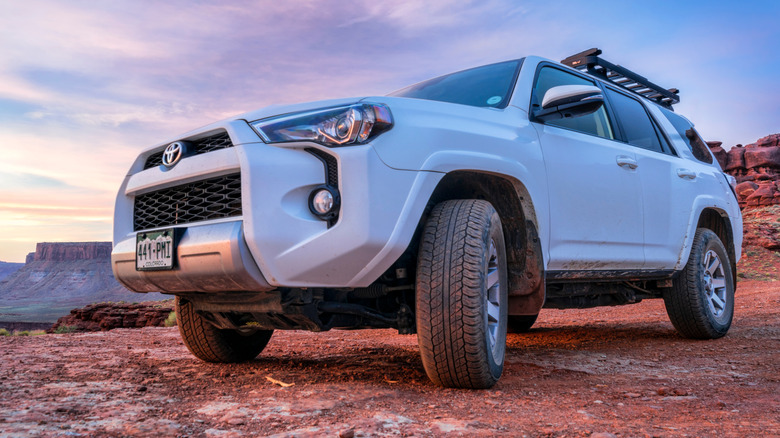
The thing about off-roading is that even when the 4WD is engaged and the ground clearance is ample, accidents can still happen. Camping routes aren't always willing to play ball and let you travel serenely to your chosen spot. They can be embellished with hidden rocks, sharp ridges, or entire sections of washed-out track. All of these have the potential to ruin your camping trip, leave you stranded in the wilderness, and — when you do eventually get home — face the possibility of a rather large repair bill.
This is why skid plates and/or other underbody protection are something you'd really want to consider for your SUV. However, even if you think that your SUV does have such a feature, it's worth checking that it is legitimate — many manufacturers incorporate fake skid plates as a design feature, which is there just to make the car look the part.
Skid plates are usually made from aluminum or steel and will protect crucial components like the exhaust, fuel tank, and transmission from all but the most severe impacts. The good news is that even if your SUV doesn't have a skid plate installed, aftermarket options are available for many SUV models.
Fold flat seats
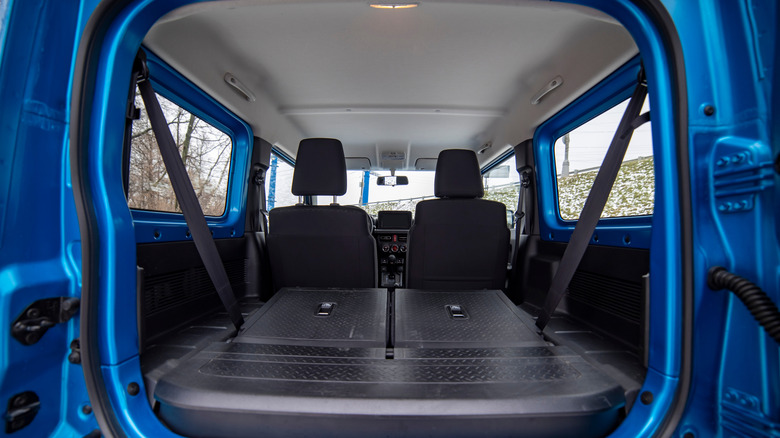
With your SUV ready to take on the wilderness, it's time to look forward to your camping trip. When we think of camping trips, the chances are you're thinking of a quiet day or two by deserted lakeside with nothing to do but wait for the fish to bite. However, what's equally likely is you find yourself sitting drenched in a biblical storm with mosquitoes being the only thing biting. Or perhaps, you're lying shivering in a leaky tent. It's at this point that you may find yourself thanking yourself for purchasing an SUV with fold-flat seats. With such a feature, you have a ready-made fallback option, perhaps not the most luxurious night, but it's dry, sheltered, and warm.
Of course, that's the worst-case scenario, but even when the camping trip itself goes according to plan, folding seats can be a useful feature. While going camping with a minimal amount of gear can be one of the attractions, for many people it's more of an exercise in logistics. Camping gear can quickly add up: tents, bedding, chairs, cooking equipment, the kitchen sink, and whatever other useful camping gadgets you usually take along for the trip.
In these situations, having folding seats allows you far more space to cram everything in without turning your camping trip into an outdoor version of Jenga. For instance, the 2021 Chevrolet Suburban has just over 41 square feet of storage with the seats up; fold these down and this mushrooms to nearly 145 square feet.
Advanced driver assistance systems

While the bulk of our choices have focused on keeping you safe off-road and getting the most from your camping time, there is another factor to consider — the drive home after a tiring weekend outdoors. Maybe you're driving home in the dark, peering into a monsoon on unfamiliar and windy country roads, or maybe you're churning through monotonous miles of highway driving — a long drive on either leg of the journey can be fatigue-inducing. This is why you might want to consider an SUV with the latest advanced driver assistance systems.
While off-roading is an adrenaline-filled adventure with enough bumps to make sure you don't fall asleep at the wheel, the drive home can be the exact opposite. Fatigue is a major cause of traffic accidents, and although precise figures are hard to pin down, the National Highway Traffic Safety Administration estimates that, in 2021, there were 91,000 crashes that could be attributed to drowsy driving.
That's why modern ADAS in your SUV could arguably be one of the most important features on the list. Features like lane departure warning, adaptive cruise control, and driver monitoring systems (DMS), although not a magic bullet, can substantially reduce the risk of fatigue-induced accidents. It's interesting to note that in the case of DMS, the feature is now mandatory in all new cars sold in the EU from July 2026. These features might not pitch your tent or let you escape the mosquitoes, but they might be the thing that makes sure your adventure ends well.