

Toyota's Tundra TRD Pro May Not Have A V8, But It Can Still Keep Up With Ford And Ram
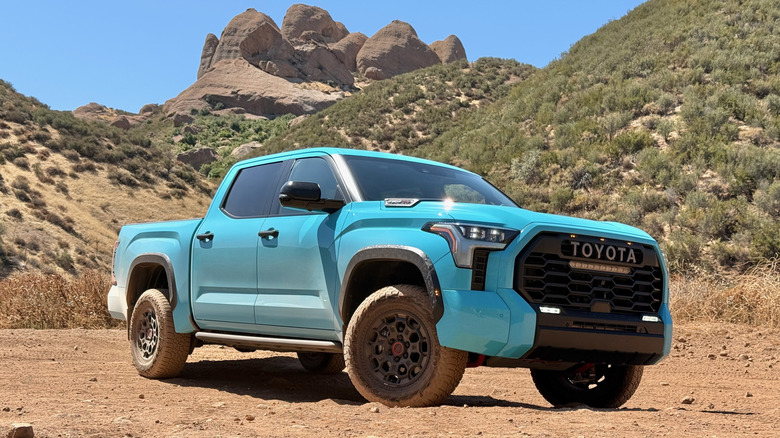
I've driven a lot of midsize pickup trucks lately, taking them on trails, moving couches around, and exploring campsites loaded up with gear. They're the sort of trucks that fit most city lifestyles, at least the lifestyles of people who want to add a bit of utility and adventure to the mix, and that's right up my alley. The 2026 Toyota Tundra TRD Pro has a skill set that meets right at the utility-and-adventure intersection, but it's much bigger than the sort of trucks I've been driving, testing, and enjoying these days. So when a Tundra became available for me to test, I decided to give it a go, with a specific mission in mind.
Sure, I've tested plenty of full-size trucks over the years, including a recent stint behind the wheel of the re-introduced TRX, and there are multiple trucks for the off-road gearhead who wants tire-shredding horsepower: the aforementioned Ram, or the F-150 Raptor R, for example. But I wanted to know if the TRD Pro could bridge the gap between ultra-capable mid-size-off-road rigs and ultra-price full sizers.
 Travis Langness/SlashGear
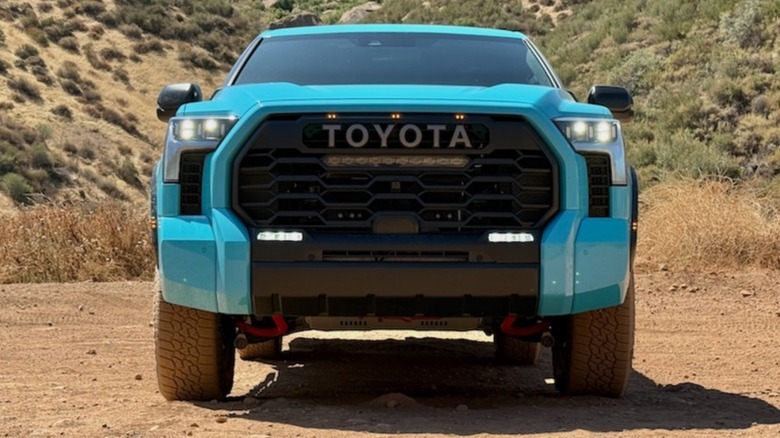
It's just as big as the other full-size pickups, but the Tundra is a little less expensive than some of those competitors, and until the rumored TRD Hammer arrives it's the best off-roader Toyota's got. Geared up and only slightly aired down, I took this particularly blue Tundra out to put it through its paces and see if it can occupy a special place in the truck world.
It's got all the power it needs
There are two available powertrains for the Tundra, which is limited compared to the choices that other full-size rivals get, but we'll come to those other trucks in a bit. The Tundra's standard engine is a turbocharged 3.4-liter V6 that's paired with a 10-speed automatic transmission. It makes a respectable 389 horsepower and 479 lb-ft of torque. The i-Force Max does even heavier lifting, and that's the one powering this TRD Pro model.
Paired with the same 10-speed, the i-Force Max also uses a twin-turbo 3.4-liter V6, but it dials things up via a hybrid system that brings the total to 437 hp and 583 lb-ft of torque. It doesn't match the fire-breathing 777 horses from something like the TRX or the 720 from the Raptor R, but the Tundra is neck-and-neck with the standard Ford F-150 Raptor at 450 hp and in a slightly larger deficit compared to the RHO at 540 hp.
 Travis Langness/SlashGear
Now, the choice part. The Tundra only offers two (really one, paired with a hybrid as the second) options for power. The F-150 has half a dozen choices if you count the multiple-output options for the 3.5-liter EcoBoost engine. The Ram's selection is similar, with all sorts of six- and eight-cylinder choices. So the Tundra's V6 gets the job done, but if you don't like it, there's not much in the way of alternatives.
It doesn't sound like a V8, and that's fine, but real-world mpg isn't great
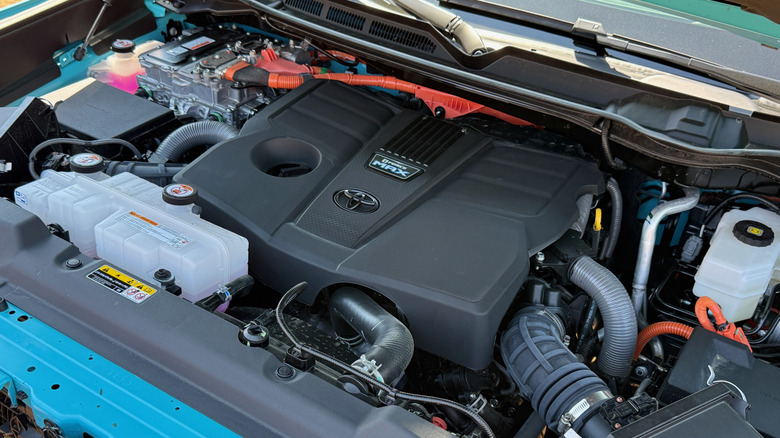
Even without a V8 option, the Tundra still feels strong. Torque comes on early thanks to the hybrid system, and it's motivated up to highway speeds in a hurry with snappy shifts from the 10-speed. It's properly entertaining when you mash the throttle, and it'll pass on the highway with very little delay.
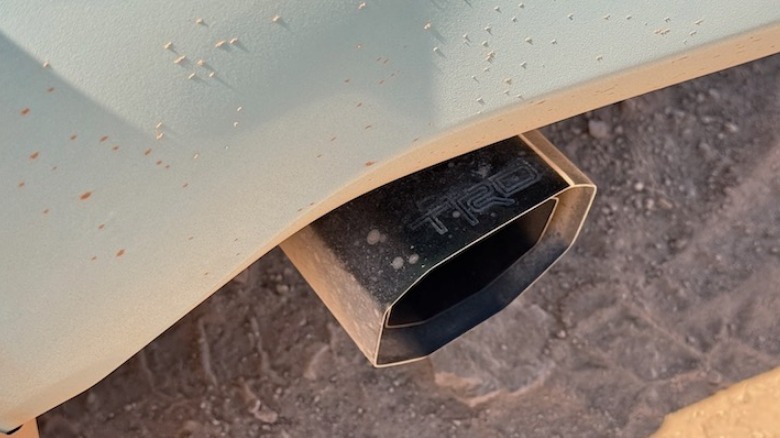
It might be missing a few cylinders by enthusiasts' counts, but the TRD Pro has a nice, low exhaust tone. It drones a bit on the highway at or above 70 mph, but it's not so noticeable that it would be worth swapping out the exhaust. It's also a noise you can drown out with a bit of music. And besides, what's a little off-road fun without some noise?
 Travis Langness/SlashGear
Unfortunately, all this power and romping about with a heavy right foot got me some pretty poor fuel economy: down around the 15 mpg mark is what I experienced on average, with off-road adventures being closer to 10. According to the EPA, the Tundra TRD Pro will only average 19 mpg combined, so the hybrid doesn't net much in the way of efficiency, though it's significantly better than the RHO at 15 mpg combined and the Raptor at 16.
It's serious about off-roading
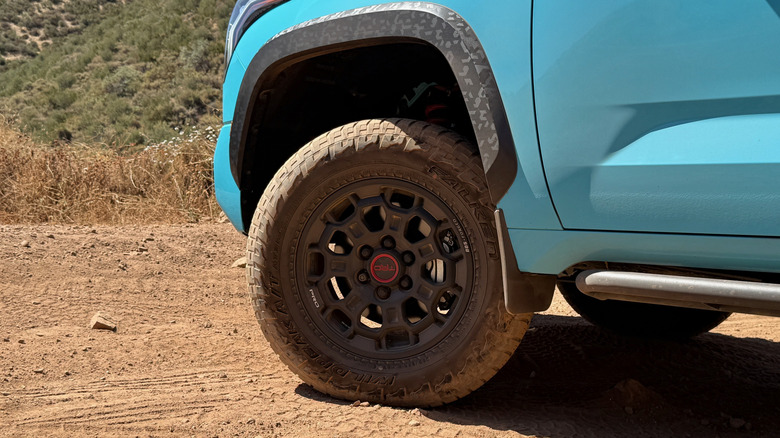
The TRD Pro doesn't have Baja vibes like the RHO and Raptor do. It doesn't feel like it was designed with high-speed desert-crushing weekends in mind. Sure, you can get the ISO Dynamic seats with technology from the Tacoma in the Tundra now, and it'll tackle some seriously rough terrain at speed, but what it feels most adept at is technical off-roading. The throttle control and slow-speed stuff is where it feels right at home.
On top of propelling it forward at a rapid pace when you hammer the throttle, the Tundra's i-Force Max powertrain provides torque in the right places to help you while off-roading, allowing for smooth, modular control of the throttle at low speeds: a rock-crawler's best friend. Naturally, Toyota's Multi-Terrain Select system helps with wheel slip in various scenarios, and the crawl control function will give you an assist when you can't quite get things right with your right foot.
 Travis Langness/SlashGear
There's also 10.9 inches of ground clearance, which is plenty to clear major obstacles. Off-road hardware includes an electronically locking rear differential, all-terrain tires, TRD off-road suspension, internal bypass coilovers, remote-reservoir shocks, and a TRD front stabilizer bar. And to keep your fluids in their important enclosures, there's also robust underbody protection for the engine, fuel tank, and transfer case. It might be big, and difficult to fit down tight trails, but the TRD Pro will otherwise go just about anywhere.
There are some sacrifices to be made
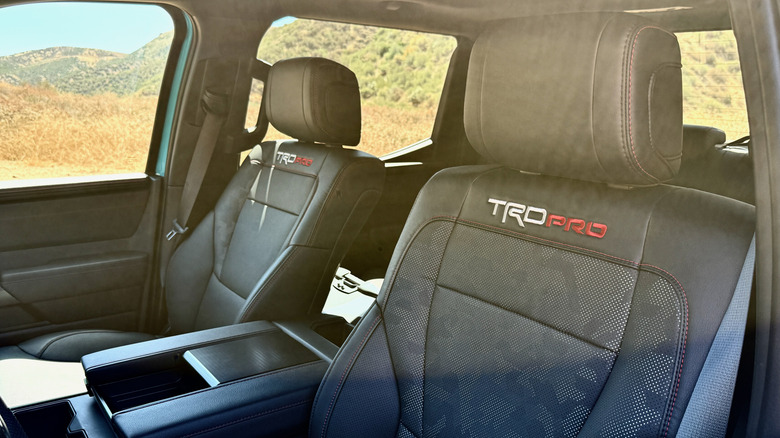
On top of having uninspiring fuel economy and some noise from the exhaust, the TRD Pro also isn't the most comfortable version of the Tundra. On city streets it does just fine, but over the expansion joints and uneven pavement that covers Los Angeles' freeways it feels pretty bouncy. It's not rough enough to scare me away from the Tundra, especially not with all its off-road prowess, but it's worth mentioning.
 Travis Langness/SlashGear
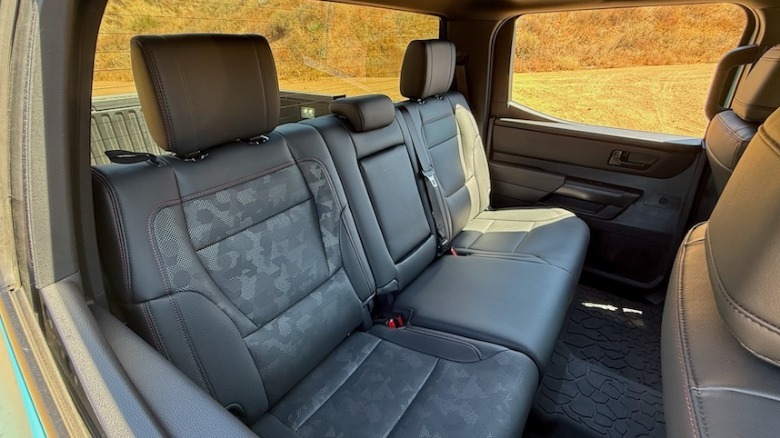
It also falls behind leaders like the F-150 and the Silverado when it comes to legroom, but the Tundra still has a cabin that'll fit just about any adult. In both the front and rear seats, there's enough headroom for six-footers (though anyone taller may have to duck down a bit in the back seat, thanks to the sunroof), and the seats are wide enough to accommodate just about any body size.
Tech could use some refinement, but the cabin is nice
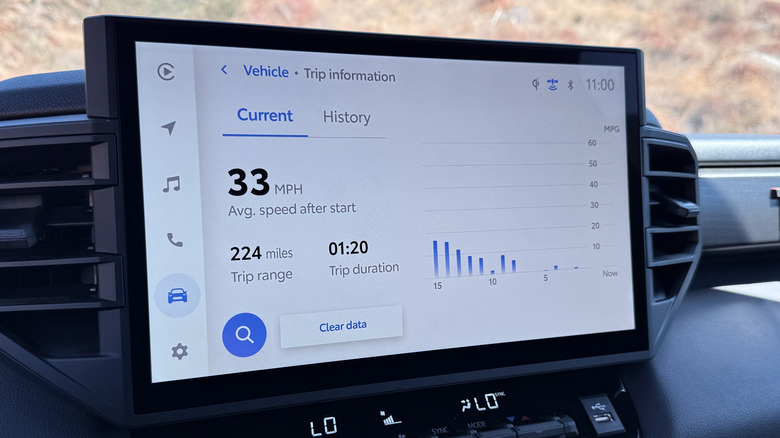
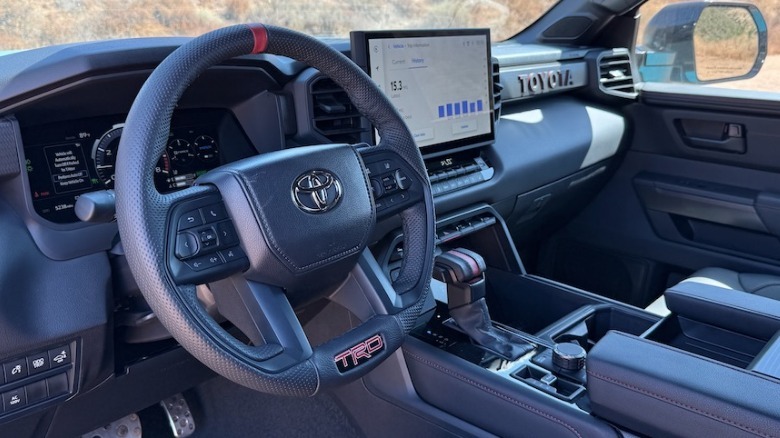
The centerpiece of the Tundra's dashboard is a big 14-inch touchscreen. While it's responsive, easy to read, and large enough to see at a moment's glance, I'd like it to have a bit more functionality. Other full-size off-roaders (like the F-150 Raptor, for example) offer trail cameras that operate at higher speeds. Sure, the TRD Pro has a 360-degree camera, but it deactivates at just 10 mph, and it doesn't automatically turn back on when you pass 10 mph and eventually slow back down.
With a truck as large as the Tundra, without the use of the camera, I found myself avoiding bushes and rocks, cringing at the thought of scraping a truck that wasn't mine because I couldn't be confident where the corners were. If a 360-degree camera is available at all speeds, then that tip-toeing around off-road areas becomes less of a problem.
 Travis Langness/SlashGear
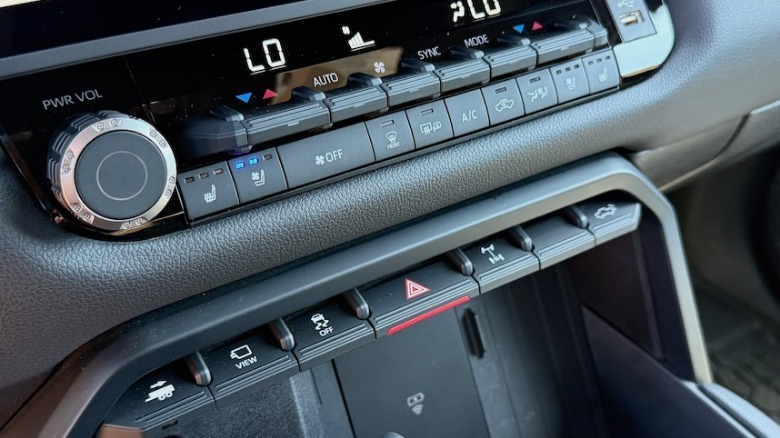
For the touchscreen-averse crowd, the Tundra has multiple rows of buttons, all of which are good at taking commands on the go without distracting the driver. The soft touch points in the cabin (where you place your elbows etc) are all comfortable and well-padded. The steering wheel has just the right diameter and thickness for a bulky pickup.
Pricing offers an opportunity
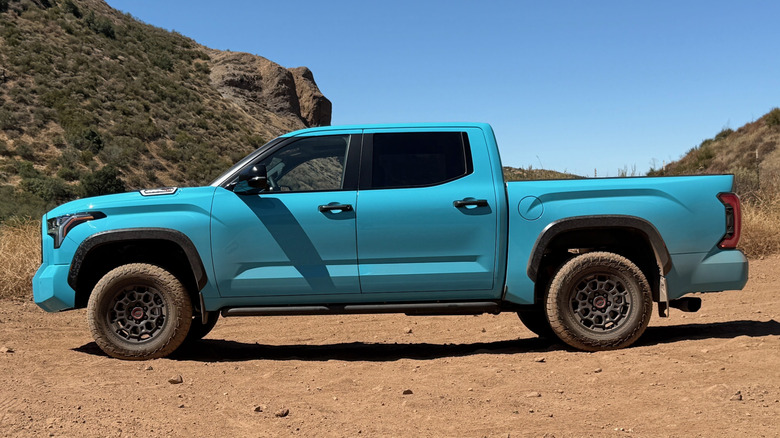
There's a pretty wide range of available prices for Tundra models. Like most full-size trucks, it's offered in all sorts of trim levels, with nearly as many options and configurations as you'd expect from a luxury sedan or SUV. And while it's near the top of the lineup, the TRD Pro isn't the most expensive version of the Tundra. Before we get there, though, let's work our way up the lineup and see just how the Tundra could bridge the gap between midsizers and V8-powered rivals.
The base Tundra SR starts at $43,455 (including a $2,195 destination fee), which is more than $20,000 less than a TRD Pro or Trailhunter Tacoma. As you'd probably expect, though, the SR isn't exactly ripe with features and creature comforts — so that's just a reference point. Further up the Tundra's ladder, the SR5 and Limited trim levels offer a bit more refinement, inching their way up above $50,000 and eventually (depending on options) towards $60,000.
 Travis Langness/SlashGear
The Platinum and 1974 Edition versions of the Tundra are even closer to $70,000 (or above it with the i-Force Max in the mix), while the TRD Pro has an MSRP of $74,760. That's a lot of coin for any vehicle, but it's $7,735 less than a standard Raptor, and $2,125 less than the Ram RHO.
2026 Toyota Tundra TRD Pro verdict
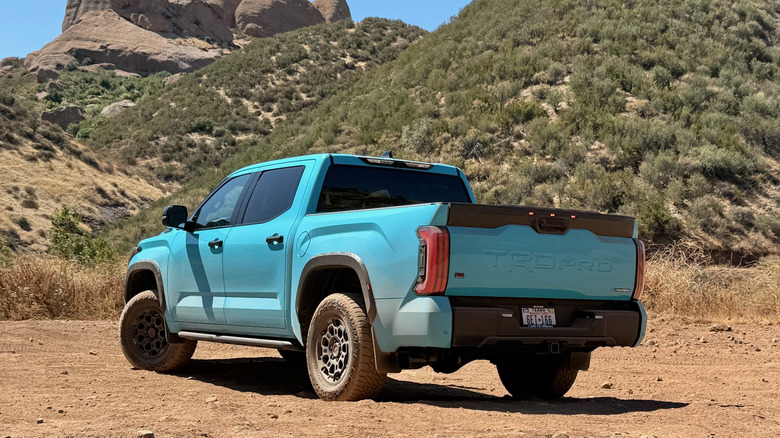
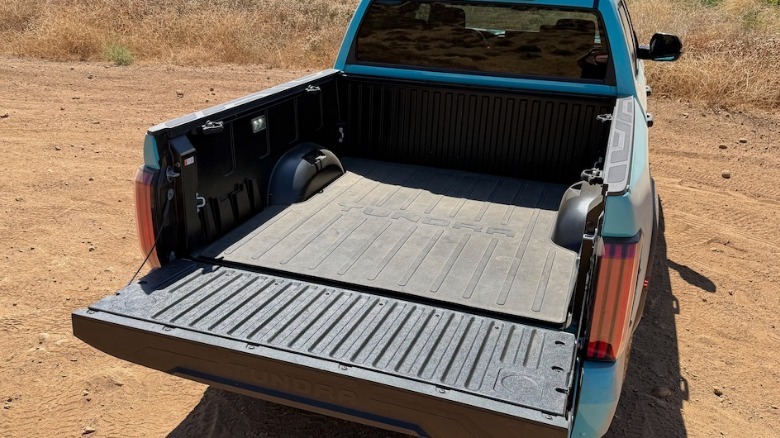
Okay, so it's not exactly a truck for buyers on an ultra-tight budget, but the Tundra can certainly save you money without trade-offs in the capability department. Does it bridge the gap between excellent mid-size off-roaders and more-extreme versions of full-size trucks that cost a lot more? I think so. It's got the space and full-size-pickup numbers to keep most towing and hauling enthusiasts happy (it'll tow as much as 12,000 lbs), plus there are a number of lower trim levels with TRD bits of equipment available if you don't want to go for the pricey TRD Pro trim.
It's a niche that's relatively small, but it's one that this particular version of the Tundra occupies well. The TRD Pro especially is strong enough to perform in just about any off-road environment, and well-built enough to keep you comfortable along the way. Tech and comfort quirks aside, I wouldn't mind spending a lot more time in the big Toyota.
Post Script: Lots of TRD logos to count
In my little ongoing series of "How many logos are on these cars?" the latest leader, and likely one of the top self-advertizing cars you'll find on the road today, is the Mercedes-Maybach S-Class. It's got over 80 representations of the word "Maybach" or the Maybach logo somewhere in or on the car. Clearly, the Tundra can't keep up with that, but it sure did try, and it did so in a pretty sneaky way.
 Travis Langness/SlashGear
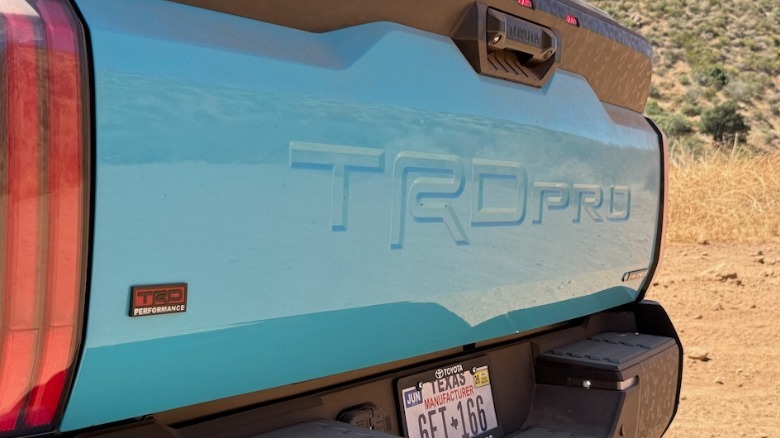
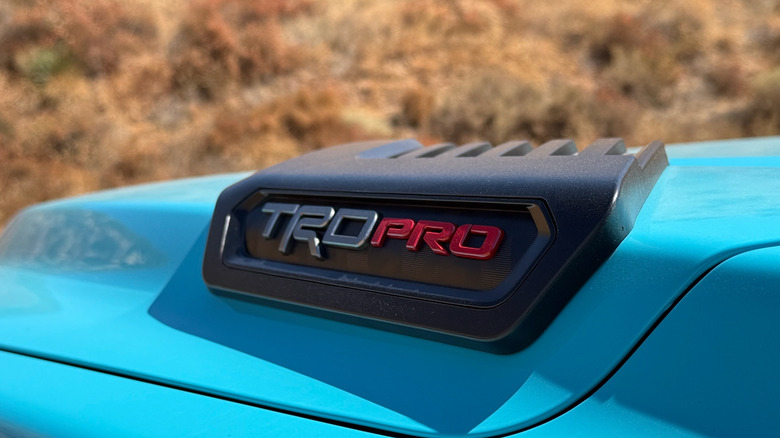
Naturally, all four wheels have the TRD logo. Then, the hood displays it on both sides, and there's the big TRD Pro stamping on the tailgate, paired with the TRD Performance badge. Add one on each of the dual exhaust tips. That's 10 on the outside, or so I thought.
 Travis Langness/SlashGear
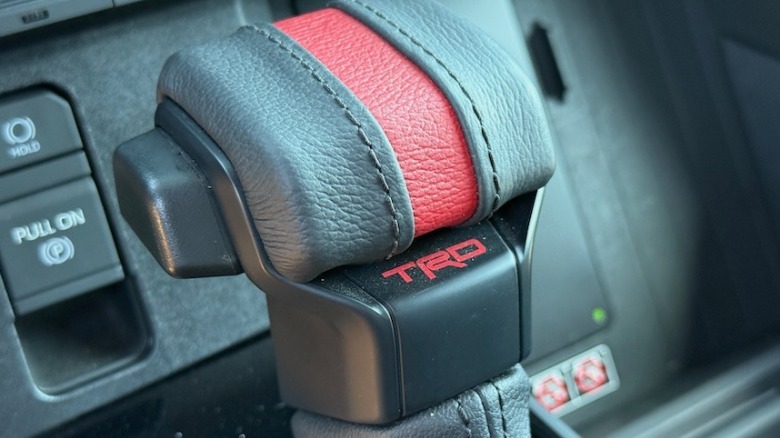
Under the hood, TRD is marked on top of the two intake boxes, and in the Tundra's cabin there's a TRD logo on each front floormat, plus the embroidered logos on each front seat, one on the steering wheel, and one on the shifter. That's 18. One logo on the button panel made it a total of 19, but I went for another pass on the outside to double check.
 Travis Langness/SlashGear
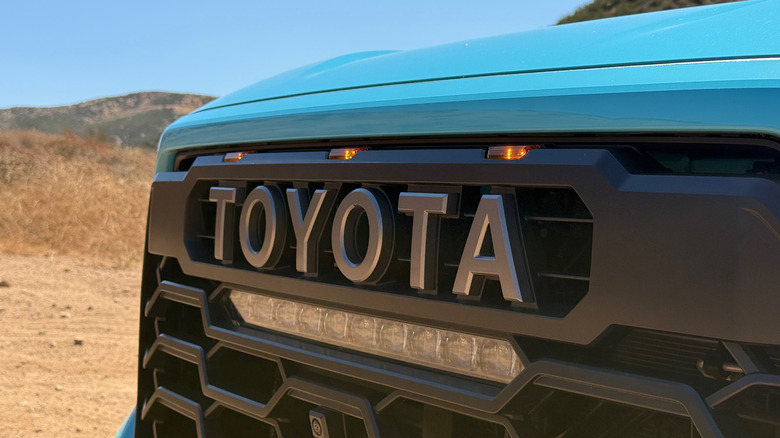
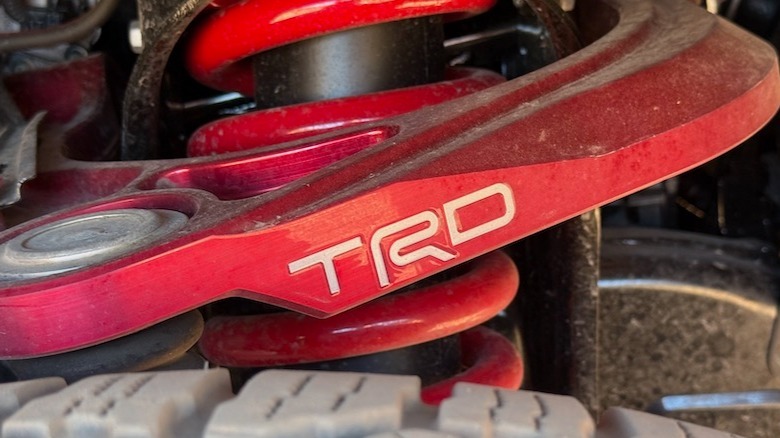
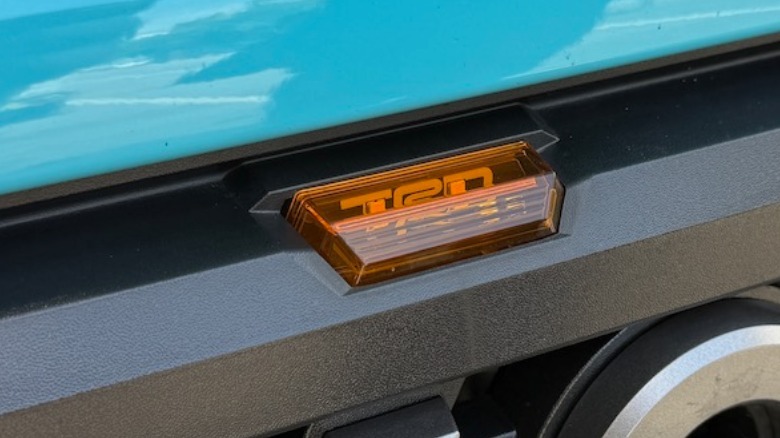
Yup, hidden underneath on the big front skid plate, there was another logo, totaling 20. Then, I noticed the TRD stamping on the suspension components at all four corners. That's 24. Oh, and lest we forget, every single orange indicator light on the Tundra's exterior said "TRD" on it. That's one on each fender, plus three in the grille for a total of 31 TRD logos. I didn't crawl under the bed or disassemble the engine to check for stamping on the pistons, but that's still a pretty good count.