

5 Truck Brands That Are Still Loyal To V6 Engines
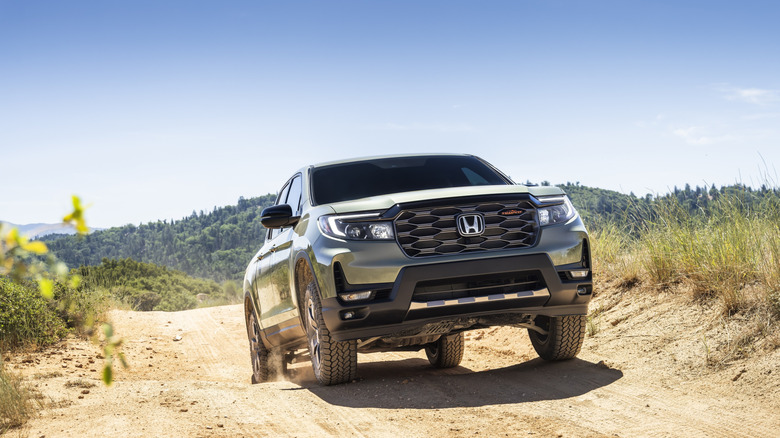
If you're in the market for a new truck in the U.S., you're spoiled for choice. Pickup trucks outsell just about anything else here by a country mile, and automakers are more than happy to feed this demand from families and working people alike. But then you go to a gas station and say to yourself, "A full-size V8? In this economy?" Thankfully, for those of us in such a position, several automakers offer six-cylinder trucks that offer better fuel economy while retaining the utility we've come to expect.
Sure, V6 engines have their own unique problems, and you will get less power because you have two fewer cylinders. But you also get a simpler, more compact design alongside the fuel economy benefits, and one that can accommodate forced induction or a hybrid powertrain to make up the difference. Moreover, especially in a family setting, these trucks will hardly ever need that much power anyway.
All that means that, for many people, a V6 is the objectively better option for a truck. Both foreign and domestic manufacturers have recognized this, filling the niche with plenty of options ranging from compact to full-size. Let's take a look at these automakers and their V6 engines.
Jeep
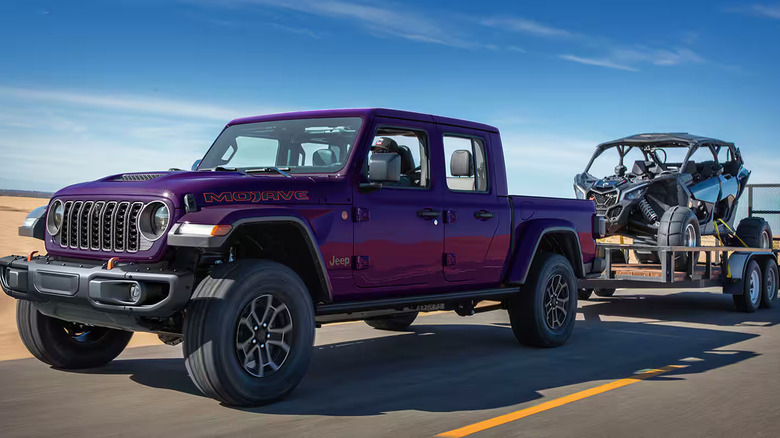
The Jeep pickup lineage is a remarkably long and storied one, and includes trucks like commercial FC-150 and 170, full-size J-series trucks, M-715 military trucks, the original Gladiator, the CJ-8 Scrambler, and the Comanche. The modern V6-powered Gladiator is the direct descendant of this lineage, and, like its predecessors, is based on a regular Jeep — in this case, the Wrangler. To put it more bluntly, it's a four-door Wrangler with a pickup bed, but that's not necessarily a bad thing. Well, sometimes.
Given its Jeep roots, you can drop the windshield and take the doors and roof off, at the predictable cost of wind noise. It's also more at home off-road, with a relatively unrefined ride on pavement. But if you enjoy venturing out into the rough stuff or frequently find yourself going down logging trails, this is easily one of the best midsize truck options out there. The Gladiator is also one of the few new trucks with a manual transmission, at least if you get a model year before 2026.
The Pentastar V6 is generally known as a robust powerplant, albeit one with only 285 hp and 260 lb-ft of torque. That said, a V6 Gladiator actually has remarkable towing capacity, capable of some 7,700 pounds with the right boxes ticked. But it's also niche, expensive, and relatively unrefined: a creature of extremes in the truck world.
Honda
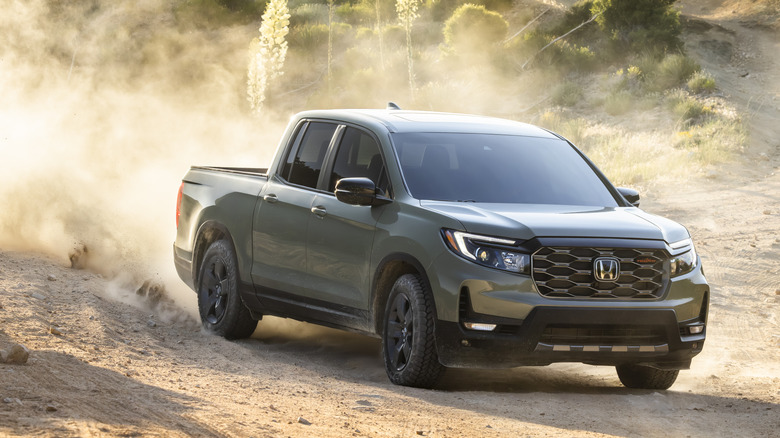
There's an inside joke about how emasculating the Honda Ridgeline is, and a glance is all that's needed to tell you why. It doesn't look like a traditional truck and, instead, resembles a crossover with everything behind the C-pillar lopped off. That's the way it handles as well; the Ridgeline, despite its promotional photography, is not a rough-and-tumble truck. It's a truck for trips to Home Depot and long, paved interstate drives carrying cargo. It's comfortable, family-friendly, and utilitarian.
To be frank, most pickup truck owners don't actually need all the capability afforded by the big stuff. The overwhelming majority use them for on-pavement duty and hardly tow anything. Sure, there are plenty of owners with the legitimate need for such a truck, but that's not what the Ridgeline was built for. The Ridgeline is meant to appeal to the most common uses of these trucks, with its 5,000-pound tow rating, crew cab-only body, and lack of performance variants.
Given that it's basically a car with a pickup bed, it comes as no surprise that it's powered by a car engine, specifically Honda's 280-hp J35 V6, the same engine you'll find in an Accord or Pilot, for example. This helps make the Ridgeline a remarkably comfortable and reliable vehicle in general, both huge perks for long-distance commercial work. The dual-action tailgate and cleverly designed bed help, too — Honda even put the spare tire in an odd place below the bed floor to maximize its carrying capacity.
Nissan
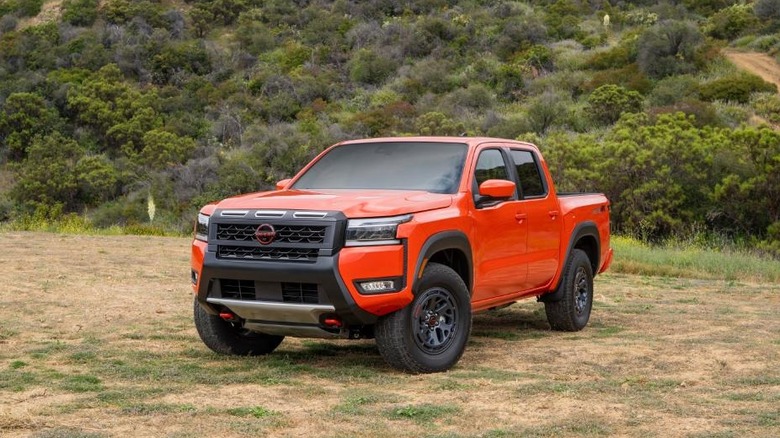
The Nissan Frontier represents a fair middle ground between the on-road, suburban-oriented Honda Ridgeline and the tougher Ford F-150, in part thanks to its 2025 facelift. Unlike many other midsize trucks, the Frontier apes the massive, slab-like front end look that full-size trucks favor, giving it by far the most intimidating look from the entire selection.
It isn't a full-size truck, though, which makes it easier to live with: Blind spots, for example, aren't as big of a problem here as they are on the full-size stuff. It's also quite an affordable truck, with a starting MSRP of just over $32,000. And if you get the fleet-spec S trim, you can opt for a king cab instead of a crew cab, one of the few pickups on the market that offers you such an option. Sure, it's still pretty big and nowhere near a minitruck, but that's what importing kei trucks is for.
Equipped with the VQ38 V6 pushing 310 hp and 281 lb-ft of torque, the Frontier is quite a capable midsize pickup with a 7,150-pound towing capacity in 4x2 trim. And, unlike the Ridgeline and Jeep Gladiator, the Frontier actually has a 6-foot bed with just over 49 cubic feet of cargo space. It's even got old-school knobs instead of those obnoxious touchscreens everywhere — basically, this is the perfect truck for someone looking for a traditional truck in a smaller package. Of course, that also makes it somewhat cramped in comparison, but the utility and budget certainly weigh in the Frontier's favor.
Toyota
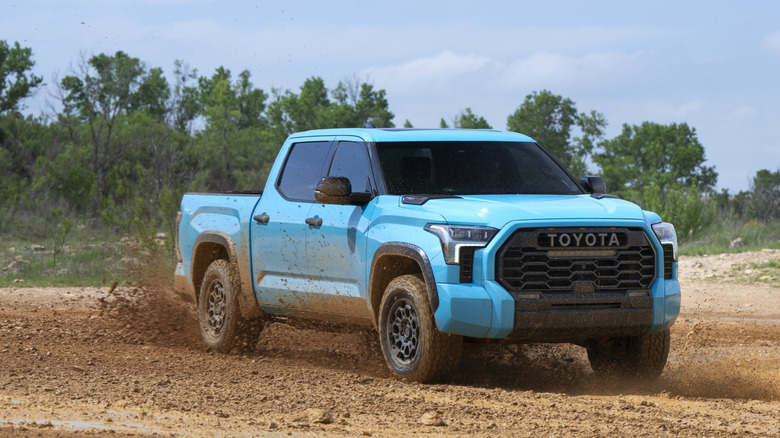
The Toyota Tundra represents the only actual full-size truck in North America still manufactured with a V6 engine, and it's quite a stout one indeed. Like other trucks of its class, this vehicle is all about the torque, further enhanced by the optional i-Force Max hybrid powertrain. In gasoline-only form, the Tundra's V6 makes 398 hp and 478 lb-ft, climbing. to 437 hp and 583 lb-ft in hybrid trim.
Unlike leaf spring-equipped trucks, the Tundra actually has remarkably smooth coil-over rear suspension to help smooth out the infamously rough unladen ride pickups have. It's also by far the most capable truck in terms of hauling stuff here, but that's no surprise given it's a full class above most other V6 trucks. That also means it's a full price segment higher, with MSRP of top trims exceeding $60,000 in top trims.
In essence, the V6 Tundra competes more against V8-powered full-size trucks than its V6 brethren. That's a mixed bag; some say it's amazing, while others say it's mediocre and too expensive for what you get, although that's arguably balanced out by the company's legendary resale value. The V6, however, has a history of eating crankshaft main bearings, staining Toyota's reputation for delivering consistent reliability.
Ford
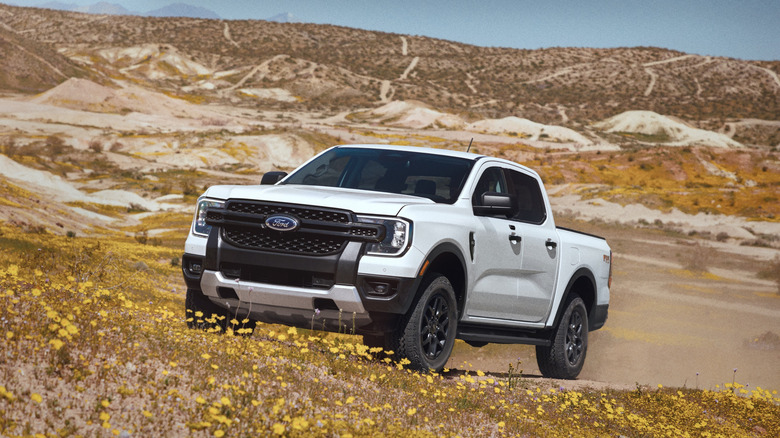
Ford makes two V6-powered trucks: the base-model F-150, and the Ranger — the peanut butter and jelly sandwich of midsize pickups. The Ranger in particular has a long and storied history, originally built as a competitor to Chevrolet's S10-platform for model year 1983.
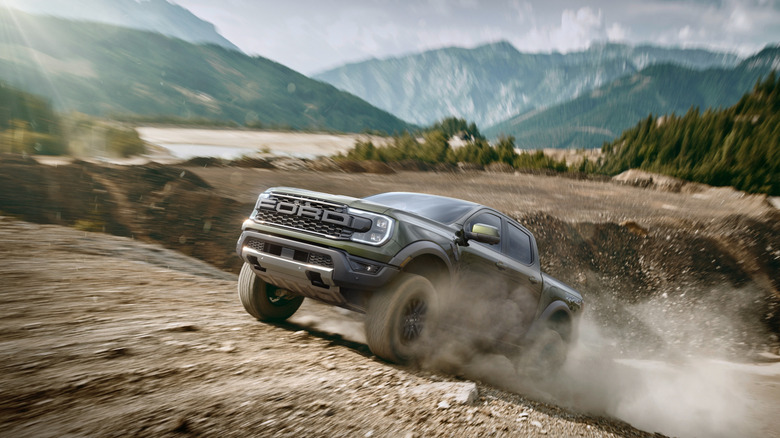
Of course, a lot's changed since the 2.8-liter Cologne V6 it originally came with, not the least of which is power and torque. A modern Ranger puts out a healthy 315 hp and 400 lb-ft from the twin-turbo 2.7 EcoBoost, with the Raptor model upping that to 405 and 430, making it the most powerful midsize truck, period. The strong engine is always a highlight of these trucks and lends it impressive performance figures, including its 7,500 pounds of towing capacity. They're also relatively compact by modern standards, making these a good option for working in urban environments.
The EcoBoost Ford F-150s are well-liked too, but that shouldn't come as a huge surprise, given Ford has fine-tuned its Modular and EcoBoost engines over decades now. The F-150 has so far been available with the 2.7- and 3.5-liter EcoBoost, but reports indicate that Ford is replacing the 2.7-liter with a 3.0-liter V6 for 2027 – more good news for full-size truck drivers looking to stay frugal without compromising on power. Sure, both trucks have their downsides, as every modern pickup truck crammed with electronics does today, but the engines historically haven't been among them. Well, unless you're talking about the 3.5-liter EcoBoost, which is one of the worst engines put into a Ford in recent times.
Our methodology
Our selection process focused on the brands themselves rather than specific models, ensuring that no brand shows up twice even if it has more than one V6-powered truck. Factors such as truck classification were ignored; if it's a utility vehicle with a pickup bed, it's fair game here, regardless of chassis configuration or size. We sourced specs such as power figures, capacity ratings, and other specifications directly from company websites and press kits, and also drew on reputable reviews to give readers an idea of how these engines (and the trucks they power) are regarded.