

5 Pro Tips For Driving A JDM Car In The US
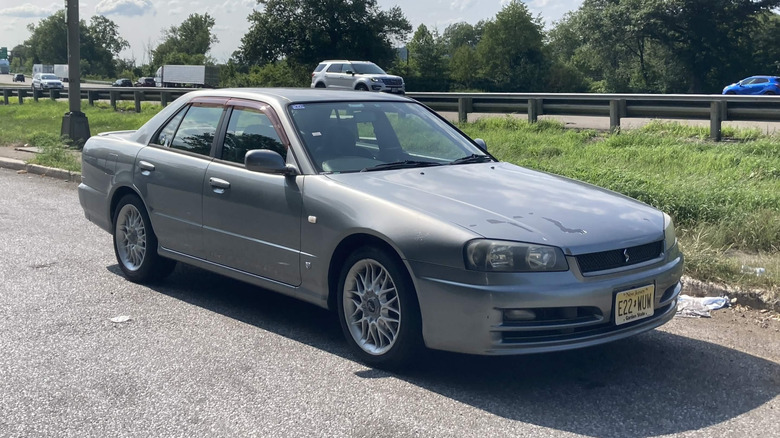
Anyone remember playing the original Gran Turismo games? I still have the first version for the PS1, resurfaced multiple times and somehow still works after 28 years of loyal service. It's a game famous for getting many of us deep down the popular JDM rabbit hole, featuring everything from Supras and NSXs to Imprezas and Evos. In my case, I gravitated towards the Skyline; for whatever reason, I just loved the look of them, especially in the sedan configuration, on those games. I loved them so much, in fact, that I swore to myself that one day, I would own one.
I tell this story because, over 20 years later, that girl who sat in front of her TV wishing to own such a car is all grown up. And today, I daily drive that very car — an R34 Skyline sedan I imported myself, which was an absolute nightmare of a process to deal with. Fast forward again to today and I've already put 10,000 kilometers (about 6,200 miles) on my car, gone through a timing belt, two oil changes, brakes and suspension work, tires, and so on. I've gotten to know my Skyline well, and by extension, the weird idiosyncrasies that come from driving a JDM car in New York City.
Meanwhile, I thought I knew all about these cars beforehand. But it really goes to show that you don't know it until you've experienced it yourself — these cars demand certain concessions be made, and I'm not just talking about shifting with your left hand. These are things I didn't think about that I had to learn as I went along in my journey of going JDM in a USDM world.
Infrastructure is a pain, and not just at the drive-through
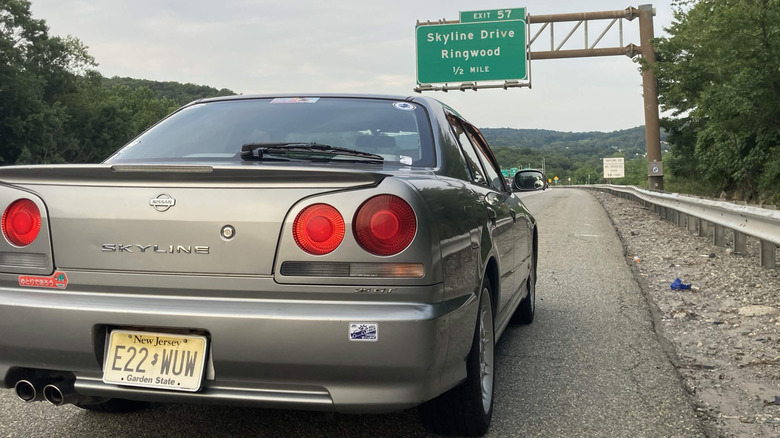
Alright, since I know it's a thing people wonder about — yes, I have reversed into the drive-through. And at first I thought it would be a neat little novelty, that people would laugh about it, and that's certainly true to an extent. But I've also nearly had an accident because someone didn't know that I was reversing into the drive-through and cut in line as I was backing up. I've even had other drivers come up to my door and yell at me. Just don't do it. Go inside and save yourself the headache.
Adaptation is the name of the game here. You have to bear in mind that this is a left-hand drive country, so people might not leave enough room for you to get into your car in parking lots. I have to get out and run to the parking garage ticket machine when I go to the mall because I can't reach it from inside. You can't use full-service tolls on the highway unless you want to anger literally everyone behind you. Stuff like that.
Mind you, there are ways to mitigate some of these. One rather humorous example is Matt Farah using a long grabber stick to reach over and collect stuff in his R32 GT-R, which costs a fair bit to buy and import. I personally just get out and get my steps in because I find it too awkward to reach over the handbrake, and I go inside of places with drive-throughs if that's an option. It's funny to do the reversing thing, sure, but people don't always know what you're doing and that can be dangerous.
Orientation and blind spots can be issues
A fun and rather embarrassing anecdote is the first time I drove my car, I nearly crashed into the rigging of one of the loader cranes on the Port of Newark because I instinctively hugged the left side of the path. Being one of the world's busiest shipping ports, I was in a hurry to get out of everyone's way. If I had given myself a minute to reorient myself, I probably would've saved myself an involuntary trip to the bathroom. So be careful when you're first getting used to the position. You're hugging the right side of the road now, not the left.
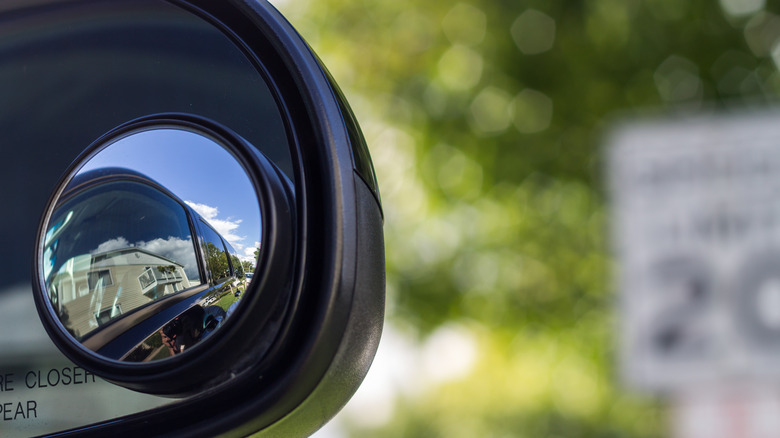
This brings up another continuous problem, and a common problem with most JDM cars — blind spots. Merging on the highway, for example, means looking past my seats, B and C pillars, and over the bodywork. I mitigate this with panoramic mirror inserts that I use religiously now, but I still keep my head on a swivel at all times. You absolutely must drive cautiously in these vehicles.
The same goes for city traffic. One street I live by is a 4+1 lane road, meaning the middle divider is used for left turns going both ways. So what happens if I'm turning left and someone else pulls up in front of me? In a left-hand drive car, I can just look to their left to see oncoming traffic. In my Skyline, I can't do that. I would have to inch out into oncoming traffic to see anything. Because I'm not reckless, I either wait until the middle lane is clear and I can see the cars again or I select a different route.
JDM cars can have different, sometimes downright obscure controls
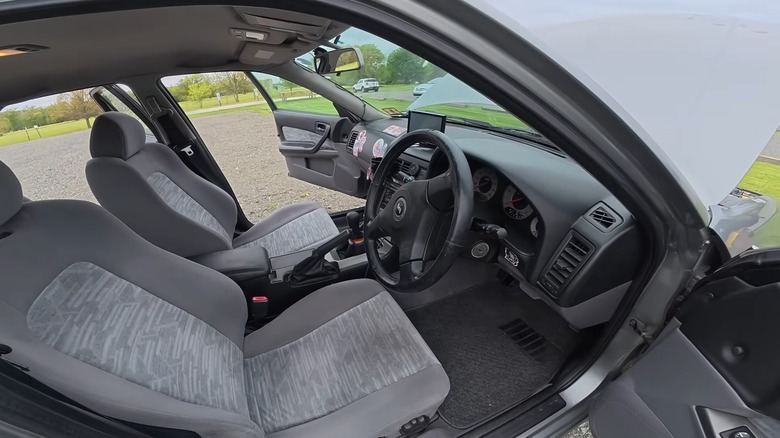
JDM cars are weird, to put it bluntly. Many of us know about the blinker/wiper thing, but if you're unfamiliar, the stalks are reversed on JDM cars versus USDM cars, similar as they sometimes are. That means that the indicator stalk is on the right and the wipers on the left — the opposite of what we're used to here. So it's something of a rite of passage for new JDM owners to "indicate" with their wipers. If you see such a car at an intersection and their wipers suddenly turn on, they want to make a left, but haven't built the muscle memory yet.
Beyond that, sometimes they have weird options as well. For example, my Skyline came with a dealer-installed DVD-based navigation system. It has a three-disc CD changer that integrates with the head unit; each disc contains navigation data, allowing it to operate by dead-reckoning — at least, that's what I figured out on my own. It's Nissan's take on the DVD-based navigation software used in the Cosmo, with pre-programmed routes and a general map. It doesn't actually work outside of Japan because there are no CDs with American road data, obviously. But it can tell me which direction my car's pointing and how economically I'm driving, which is helpful for tracking mileage numbers.
You'll be doing an awful lot of archaeological digging to solve your own mysteries, which can be fun by itself. Some stuff like ETC sensors and AM radios tuned in to pick up highway traffic bands are relatively well-known, but your car will likely have its own odd little quirks; an unexpected joy of ownership is figuring it out for yourself.
Order parts early, and from reputable sources
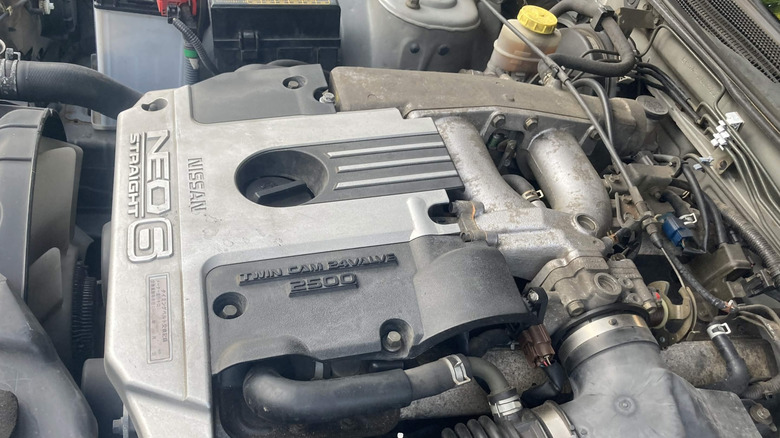
This obviously doesn't apply to everything; a lot of these cars use stuff from the parts bin, meaning you can get plenty of parts stateside, or adapt other parts to fit. Likewise, they're called tuner cars for a reason — aftermarket support is deeply ingrained in their identity. This means I'm spoiled for choice with the basics: Toyota Prius battery, Nissan 240SX suspension bushings, aftermarket Project Mu pads on EBC rotors, 300ZX fuel pump, and so on.
As a manufacturer, you're not going to build bespoke parts for one singular model only, as opposed to sharing parts with as many models as you can to streamline logistics. Except that logic gets thrown out the window when you have, let's say, a car with the legendary RB26 – an engine only sold in Japan. What happens when you need an engine part?
It took me two months and $410 to purchase an OEM water pump, and that's for the regular RB25. Moreover, the parts warehouse listed three different part numbers for my car. These varied right down to the month of production, with some parts easily found and others virtually unobtainable. I ended up having to order my water pump directly from the warehouse itself. I could've gotten an aftermarket one for like $78, but frankly I don't trust anything that comparatively cheap in a daily driver.
That's why preventative purchasing is so important. Even if you don't need it now, jump on deals when you can. Parts vanish quickly for these cars. Moreover, find a mechanic that knows these cars and their unique quirks. In my experience, not everyone is comfortable working on them.
If you want one, save up enough to buy two

Probably the biggest lesson I learned when I first bought my car was how expensive everything actually was. Yes, JDM cars can be reasonably priced, but the tariffs were 15 percent, so that's likely several thousand right there. You have to do the timing belt, water pump, the bushings might've gone, some electrics might not work properly; the list goes on. You'll quickly learn what needs doing for yourself. I've never once heard of anyone who imported one of these cars without it needing any maintenance whatsoever.
Take my car for instance. I had to replace the tires, do a multi-point inspection for myself and confirm with another tech, get all the service manuals, change the battery, all the fluids, the brakes, fix some wiring in the horn relay and fuel pump, among other things. In total, I spent a cool six or seven stacks on everything that came after I got my license plates. Moreover, I went through a total of six insurance companies before I finally found one that insured my car, and the rates are frankly obscene. My car is a money pit, but I accept that because I love the smiles driving my car brings me. It's a smile-tax.
Of course, the romanticism of driving such a car is powerful. They have many high-points, but cost often isn't one of them. Unless you're going for a cheap and surprisingly capable kei truck, expect to pay a premium for the privilege of driving these cars, both in parts and everyday expenses.