

10 Audio Brands That Are Owned By Samsung
We may receive a commission on purchases made from links.
When you think of Samsung, you probably think of excellent Android smartphones like its Galaxy S devices or its many high-quality TVs. That's perfectly justifiable, too, as Samsung is one of the best brands in both market segments, with customer satisfaction ratings to prove it. But these products are only the tip of the iceberg as far as the Korean giant's efforts are concerned. Samsung has its fingers in many pies, including medicine, hospitality, shipping, and even insurance.
One industry you might not necessarily associate Samsung with is audio — more specifically, audiophile-approved, Hi-Fi audio. Sure, the Galaxy Buds 3 Pro are excellent earphones, but there's a huge gap between a good pair of wireless earphones and massive, room-filling Hi-Fi speakers and audio amplifiers. Or is there? As it turns out, not quite — at least, as far as corporate ownership is concerned.
Samsung owns a good chunk of prominent audio brands, many of which have serious heritage and cachet. Think JBL, Denon, Marantz, and AKG, for example. This impressive portfolio comes courtesy of two big acquisitions. The first was the 2017 acquisition of Harman International for $8 billion, which gave Samsung ownership of Mark Levinson, Lexicon, and Harman Kardon, plus the aforementioned JBL and AKG. The second purchase was in 2025, when Samsung's Harman bought Masimo Corporation's Sound United subsidiary for $350 million. Sound United owned brands like Bowers & Wilkins, Denon, Marantz, and Polk Audio, which became subsidiaries of Samsung once the deal was done.
Denon
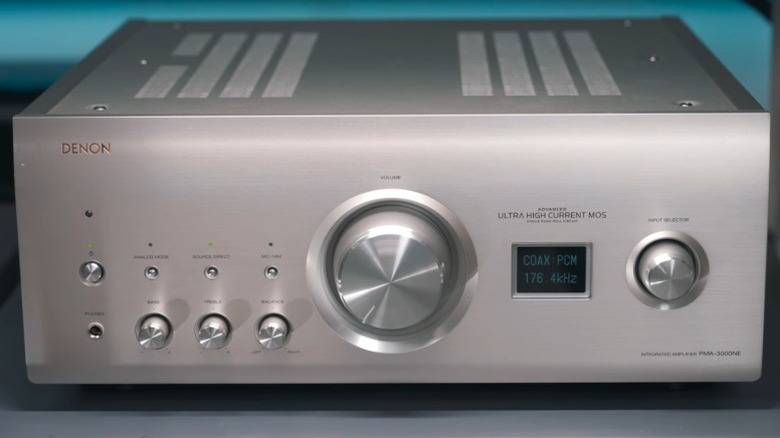
Denon is one of, if not the, oldest audio brand under Samsung's ownership, thanks to a heritage it can trace back all the way to 1910, when American entrepreneur Frederick Whitney Horn founded a company known as Nippon Chikuonki Shoukai. The company focused on gramophones and took on the Denon name after merging with Japan-U.S. Recorders Manufacturing and Japan Denki Onkyo — the latter of which gave the company its new name.
The brand is well-known among audiophile circles for its Hi-Fi components thanks to classic products like the DL-103 moving coil turtnable cartridge and DCD-1800 CD player, to name a couple, as well as more modern fare like the high-end AVR-A1H multi-channel receiver. Aside from its traditional product categories, such as turntables and CD players, the brand also has a presence in more mainstream territories like audiophile-approved wireless speakers and soundbars.
Denon's route to Samsung ownership involves a link-up with another Samsung brand, Marantz, that took place well before even Harman became part of Samsung. In 2002, Denon and Marantz Japan merged to create D&M Holdings. The company acquired a handful of brands in the following years, including legendary amplifier manufacturer McIntosh before it itself was bought by Sound United in 2017. Masimo purchased Sound United in 2022, leading to the current state of affairs.
Marantz
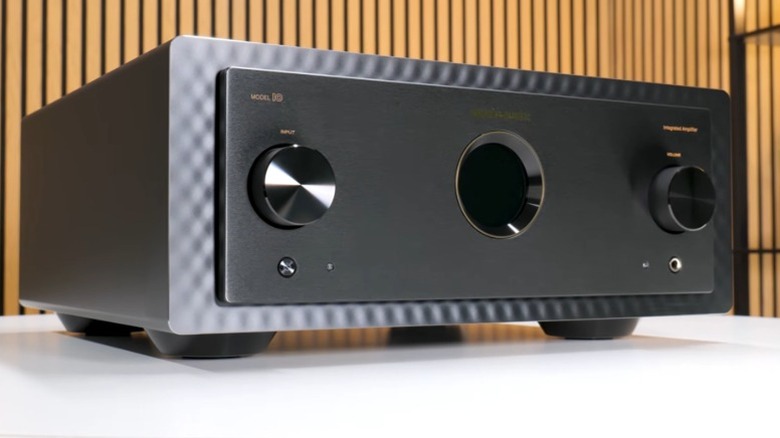
Beside Denon, Samsung's D&M Holdings contains what used to be Marantz, an American audio brand started by Saul Marantz in 1950s New York — albeit with a strong Japanese presence and heritage. The Marantz Audio Company's first product was the Audio Consolette preamplifier.
Saul Marantz did not stay at the helm of his eponymous company for long, as he sold it to Superscope in 1964. Superscope, the importer of Sony tape machines to the U.S., used its Japanese links to start overseas manufacturing of some Marantz products. This led to the creation of Marantz Japan, a long line of classic Hi-Fi hardware, and a curious business move when, in 2001, Marantz Japan had to buy the Marantz name from Philips. It was also around that time when Marantz and Denon combined to form D&M Holdings.
In the years since Marantz Japan reunited the brand under the original Marantz name, it has released a range of highly-regarded Hi-Fi components, from the SC-7S1 and MA-9S1 pre- and power amplifier combo to the flagship Model 10 integrated amp. Of course, it also has more everyday fare in its lineup, including the great Marantz Model M1 streaming amplifier, as well as home theater-oriented gear through its Cinema range of products.
Bowers & Wilkins
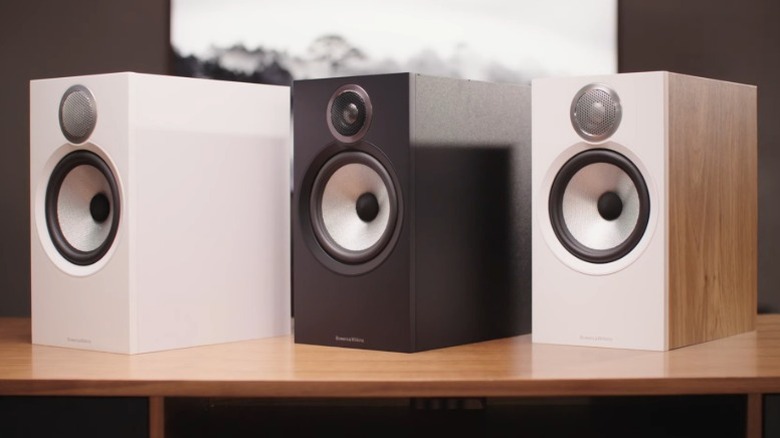
Ask a few audiophiles to list their top loudspeaker brands, and you'll hear British company Bowers & Wilkins (B&W) mentioned often. B&W made plenty of great speakers over the years, with offerings like the 606 standmounts being bona-fide classics alongside their more attainable younger siblings, the 607s. The well-heeled audiophile crowd has also been well served by offerings like the instantly recognizable Nautlius and B&W's 800-series speakers, which have been the monitoring speaker of choice for Abbey Road Studios since 1979.
Bowers & Wilkins has its roots in a business founded by WWII vets John Bowers and Roy Wilkins, who had opened up a business catering to amateur radio enthusiasts in the immediate aftermath of the conflict. B&W as a speaker brand, however, was only founded in 1966, after a wealthy local resident left Bowers a then-enormous £10,000 in her will. This allowed him to step back from the store he was running with Wilkins and focus solely on speaker design. The rest, as they say, is history.
Out of Samsung's many audio brands, B&W was probably subject to the strangest acquisition. Sure, the idea of a storied speaker company being owned by a what is often considered just a phone brand is a bit strange, but not nearly as odd as Gideon Yu's EVA Automation buying B&W in 2016. You don't remember EVA, the company that promised to "reimagine the home entertainment experience?" That's no surprise: EVA went down in flames in 2020, allowing Sound United to scoop up B&W.
JBL
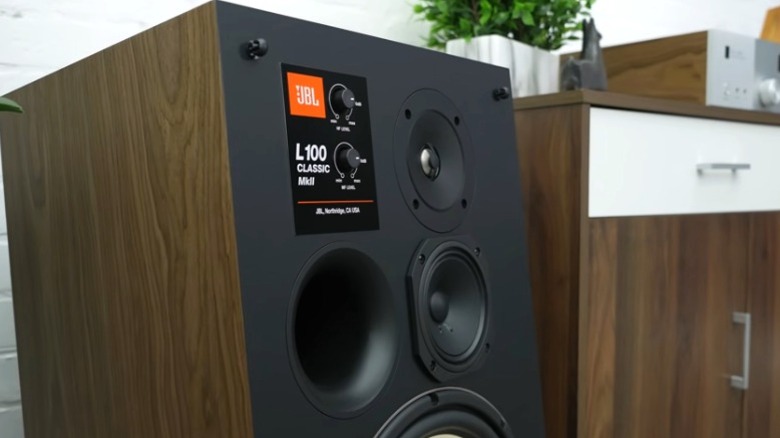
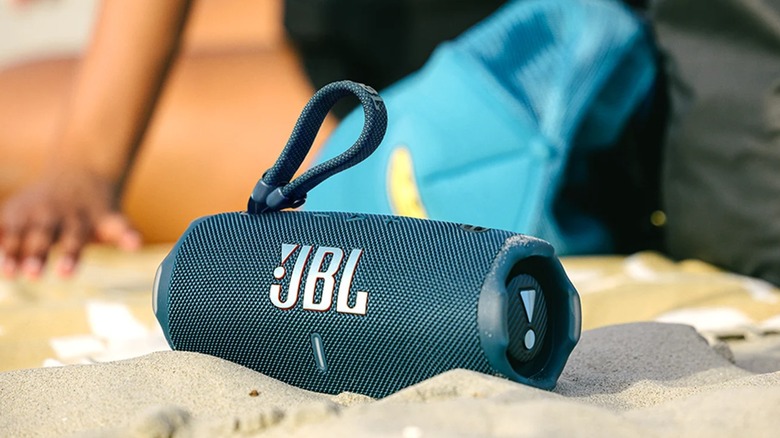
In the pantheon of Samsung-owned audio brands, few have quite the level of popular awareness that JBL has. Founded by James B. Lansing as Lansing Sound in 1946, JBL survived a rough first few years — and the early death of its founder — to become a modern-day market leader in portable speakers, thanks to great-sounding Bluetooth speakers like the JBL Xtreme 4 and Charge 6. Hi-Fi enthusiasts, however, will also recognize JBL for its iconic passive speakers, ranging from the legendary JBL 4344s to more "real-world," but no less enjoyable, offerings like the L100s (and their modern recreations).
JBL, then, is in the enviable position of having a strong presence among more casual listeners and audiophiles alike, not something that all brands can claim. The company's efforts don't stop there, though, as it also makes audio components for cars and boats. This includes a collaboration with Toyota that puts JBL speakers in most of the automaker's cars. Aside from in-vehicle entertainment, JBL has also built on its wireless speaker successes by branching out into personal audio, including gaming headsets.
Harman Kardon, which itself has a curious history that we won't get into here, purchased JBL in 1969, long before most of the other brands under the Harman-Samsung umbrella. Harman Kardon renamed itself Harman International around the same time and, after a period of significant growth, went public in 1986. It would scoop up a range of other brands in the following decades, before Samsung came calling in 2017.
Roon
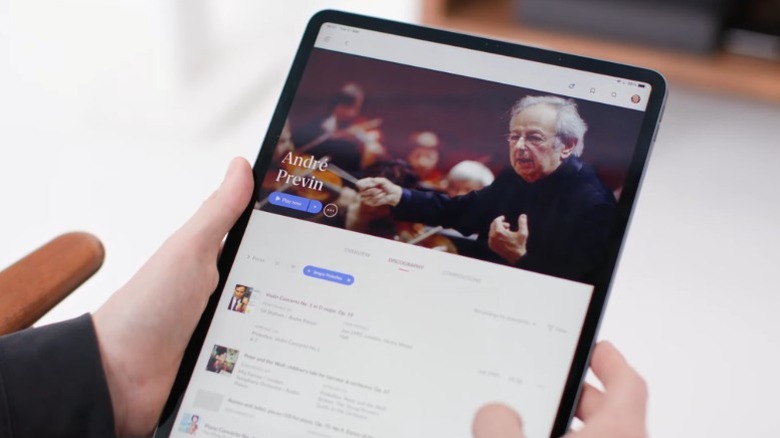
Many of the audio brands that Samsung owns are legacy brands: JBL, Marantz, and AKG were all founded in the early and middle 20th century and built their reputations well before the turn of the millennium. But that isn't the case for all the Korean giant's audio subsidiaries. Case in point: Roon, which traces its roots back to 2004.
Well, technically Roon as a company has only existed since 2015, when it was spun off from then-owners Meridian Labs. But the team's efforts to rethink the way consumers interact with digital music had been going for more than a decade by that point, most notably with 2006's Sooloos, a standalone, touchscreen-based system for managing digital audio libraries. Sooloos' success — especially considering its $10,000+ price — eventually caught the attention of Meridian Labs, which bought the brand in 2008.
After Roon Labs was spun off in 2015, it debuted the software for which it's now known, Roon, which took Sooloos' concept one step further. While it manages and organizes your digital music like its predecessor, Roon is not limited to Sooloos hardware; Instead, it works with an ecosystem of Roon Ready devices that can play music from a central Roon server over Ethernet or Wi-Fi. It's a very full-featured system, and easily one of the best ways to play local music across multiple devices (or rooms) at home. Harman acquired Roon in 2023, bringing it into the Samsung fold.
AKG
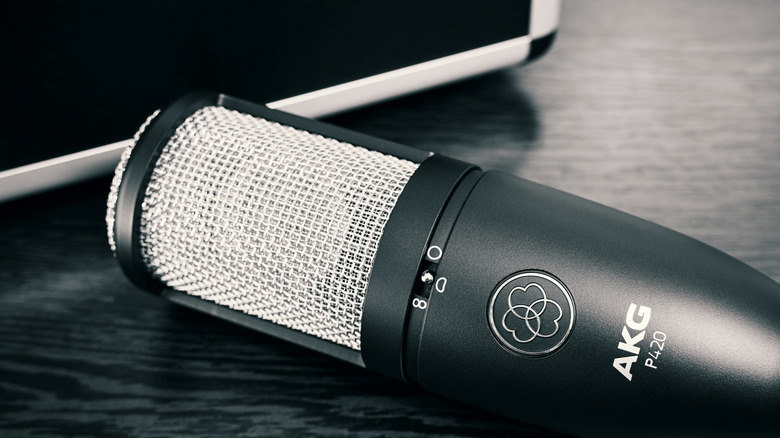
Samsung's audio subsidiaries don't just make products for music listeners, even if most of its brands operate primarily (or solely) in the consumer-facing market. One such exception is AKG, a European company originally founded in 1947 by Dr. Rudolf Görike and Ernst Pless, a physicist and an engineer, in Vienna, Austria. The company's original name, Akustische und Kino-Geräte Gesellschaft, translates to "Acoustic and Cinema Audio Company," clearly outlining the duo's intentions for their new endeavor.
By the time the name was shortened to AKG in 1965, however, the company had expanded beyond its original market significantly, with a range of products that encompassed everything between phone headsets and door intercoms. Among these products was the AKG D12 dynamic microphone from 1953, whose wide frequency response made it a hit and, eventually, the de-facto standard mic for recording bass drums in the coming decades. It followed the D12 up with other highly-regarded microphones, including the C414 and P120, the latter of which is an excellent budget-friendly home studio vocal mic.
Harman purchased AKG in 1993. While the company continues to specialize in high-quality mics, the change of ownership has led to a broadening of AKG's horizons. Most notably, AKG partnered with Cadillac to develop a 36-speaker sound system for the 2021 Escalade. Cadillac's entire lineup of Escalades, as of 2026, features AKG sound systems, with speaker counts ranging from a lowly 19 on the Escalade IQ's Luxury trim to a massive 42 speakers on models specced with an Executive Second Row.
Polk Audio
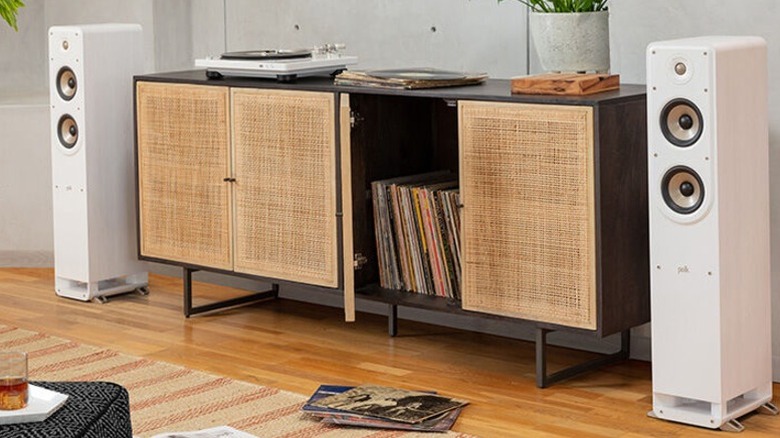
Like many Hi-Fi brands (including quite a few under Samsung's ownership), Polk Audio bears the name of one of its founders, Matthew Polk. Polk founded the brand alongside Sandy Gross and George Klopfer in 1972. The brand very soon became known for speakers like the Monitor 7 and Model 10 and, in the mid-1980s, for its Stereo Dimensional Array products. SDA speakers had extra drivers that took advantage of acoustic phenomena to offer clearer stereo imaging and a wider "sweet spot" for listening, and were quite impressive for the time.
Polk has mostly moved on from SDA these days, but the company remains a speaker manufacturer first and foremost, with a wide range of wired home speakers — including some highly-rated bookshelf speakers — and wireless units available. The brand also branched out of the home market with a line of reasonably priced sound bars and vehicle audio components. Polk's first foray into car audio was in 1999, via a collaboration with Italian firm Momo, while its sound bar efforts started in 2007 when it released the SurroundBar SDA.
Polk remained independent for more than three decades, before Directed Electronics purchased it for $136 million (about $225 million in 2026 money) in 2006. In 2013, Directed Electronics united its home audio brands — namely Polk, Definitive Technology, and Boom Movement — into a new division called Sound United. This is, of course, the same Sound United that Masimo bought in 2022 and Harman acquired in 2025.
Mark Levinson
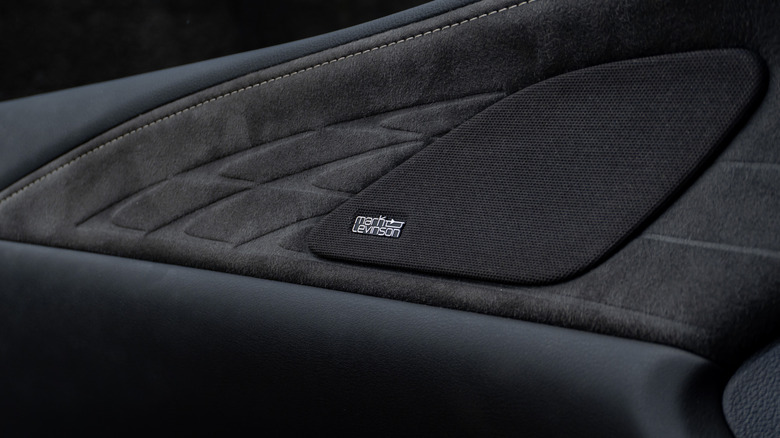
Samsung has quite a presence in car audio across its brands, not least thanks to names like JBL and AKG, which make vehicle audio components and design whole sound systems for specific vehicles. Another of its subsidiaries with a foothold in the in-car entertainment world is Mark Levinson, which exclusively designs sound systems available in the higher-end trims of Lexus vehicles, including the pricey but impressive Lexus GX SUV.
Mark Levinson (also referred to as Mark Levinson Audio Systems) was founded in 1972 by the eponymous Mark Levinson. The company quickly developed a reputation for making high-quality audio gear, debuting with the LNP-2 preamplifier and later solidifying that standing with offerings like the ML-2 power amplifier, which is commonly considered a classic by audiophiles lucky enough to have owned it.
While one might rightly expect its close association with Lexus — which started with the 2001 Lexus SC430, a decade after Harman purchased the brand in 1990 — to have somewhat diluted the brand's audiophile focus, that's far from the case. Mark Levinson still offers high-quality (and very expensive) products like the No. 536 monoblock power amp and No. 526 preamplifier. A pair of No. 536s alone will set you back over $35,000, and you'll need two, since they're mono amplifiers. The $1,000 or so you'll have to pay for Mark Levinson audio in your Lexus doesn't seem that much of a premium in comparison, does it?
Lexicon
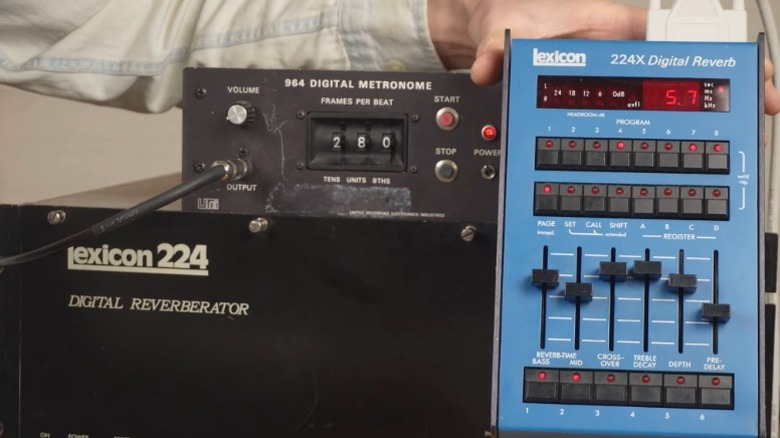
If you're only familiar with mainstream consumer audio products, then you may not know about Lexicon. But if you're a musician (or a home theater enthusiast), then you'll know that the Lexicon name is one that carries a lot of weight and heritage.
Founded in 1971, Lexicon spent its first decade exclusively in the business of time-based digital rack effects (i.e., reverb and delay) for musicians and recording engineers. It released a range of classic effects units during this time, most notably the legendary Lexicon PCM 70 that was a mainstay of high-end recording studios the world over. In the late '80s, the company branched out into consumer home theater products with the CP-1, a surround sound processor. Harman bought Lexicon in 1993, leading to the brand moving into car audio over the next few decades. It designed the multi-speaker setup for the Rolls-Royce Phantom and provided Logic 7, a stereo upmixing algorithm, for early-2000s BMW and Mercedes-Benz models. It also provided a full car audio system for the 2009 Hyundai Genesis.
Lexicon seems to have taken a bit of a step back from public-facing hardware at the time of writing. While the site still lists a handful of products, the only physical product available seems to be the PCM96 Surround; the rest are plug-in bundles for digital audio workstations.
Arcam
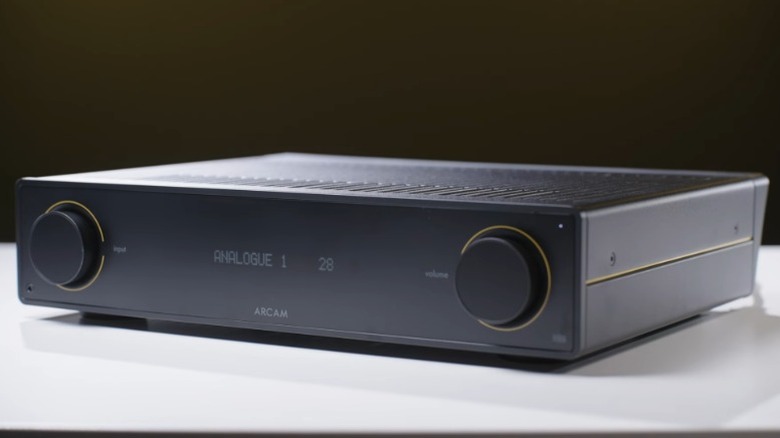
A good chunk of the audio brands Samsung owns are American or have American roots, but that isn't the case for all. Arcam, like fellow Samsung brand Bowers & Wilkins, has origins that are as British as they come. Arcam was founded as Amplification & Recording Cambridge in 1976 by two Cambridge University students, Chris Evans and John Dawson, the latter of whom was still involved with the company as late as 2025.
The company eventually shortened its name to A&R Cambridge before settling on the even shorter (and much snappier) Arcam. Its first hit was also its debut product, the A60 amplifier, and that product's success set the stage for a number of other excellent value-for-money offerings over the next few decades. These include the P77 turntable cartridge, the Arcam Two speakers, and CD players like the Alpha 7. The brand is not just trading on its past glories, however, and more recent fare like the A5 and A5+ amplifiers show that it still offers good sounding and, crucially, attainable products — at least, by audiophile standards.
Arcam was one of Harman's earliest acquisitions after the Samsung takeover. The newly-minted subsidiary purchased Arcam from its then-owners, Montreal-based Jam Industries, in 2017. Under Harman's auspices, Arcam launched the Radia series of products (including the aforementioned A5) in 2023, alongside a revamped brand image that leaned fully into its heritage of affordable Britsh-designed Hi-Fi gear.