

5 Car Parts You Need To Check At 50,000 Miles (That May Need To Be Replaced)
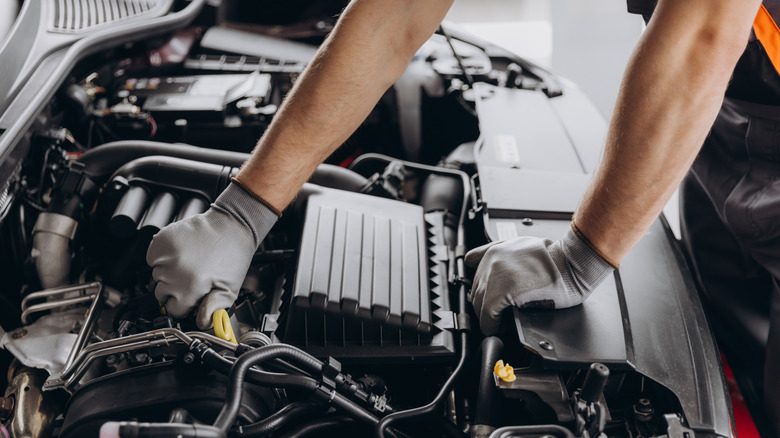
Your car is a perishable item, as anyone who's had to contend with issues like rust knows all too well. That isn't helped by the fact that automotive maintenance isn't an exact science — service intervals can be all over the place. One manufacturer recommends oil changes every 5,000 miles, another every 10,000, so which is it? All that confusion aside, there are some general guidelines that every owner should follow — change your fluids, don't skimp out on brakes or tires, and take your mileage seriously. 50,000 miles is a long distance, and a lot can break down in that measurement.
As a general guideline, a 50,000-mile service necessarily covers anything that wears out over time — rubber can degrade, metal can rust, and so on. You'll want to bring your car in for a detailed inspection to make sure there's nothing defective as well. Your vehicle should still drive perfectly fine at 50,000 miles, assuming you did the maintenance. Likewise, many cars aren't exactly phased by 100,000 or even much larger mileage counts, such as the classic Jeep Cherokee.
That said, because it's not exact, there's no one set recommendation for all cars that says something like, "Check all of these and you're good." It doesn't work like that — driving is more than just the mechanical degradation of parts. Take transmission fluid, for example. If you're towing heavy loads, you can basically halve your service interval. If you live in a humid region, you better check those suspension components like control arms for corrosion. We'll address all these and more.
Tires
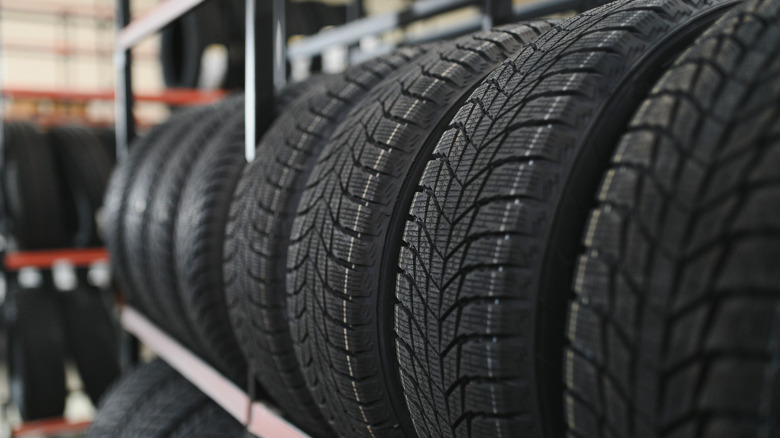
There are two golden rules when it comes to taking care of a car, the first of which is to never go cheap with tires. That doesn't necessarily mean you have to buy expensive tires; rather, it means buying quality ones and checking their tread depth every now and then. Another consideration is a tire's age — tires are, funnily enough, made of rubber. And rubber degrades over time; this degradation leads to cracks and fissures, which can lead to all manner of issues ranging from leaking air up to full-blown tread separation; there are actually many warning signs of a failing tire, if you know what to look for.
All this relates to how tires are made. Tires aren't one single piece, but rather multiple complex layers composing the carcass (the inner part) with the tread baked on the outside. Tire technology has advanced leaps and bounds since the days of solid rubber; today, your tire is effectively part of your suspension system. Tires mesh with the porous pavement, molding to it like a rock climber gripping a cliff face. They help absorb bumps in the road with air pressure. They even displace water when it rains, thanks to the tread pattern. All this is common sense, granted, but it won't work right if the tire is old or badly worn.
Some tire lives extend well beyond 50,000 miles, granted, with long-lived examples like the Michelin Defender2 sporting an 80,000-mile treadwear warranty. But checking tread depth takes mere seconds, as does refilling the air if it's running low, both of which should be done at 50,000 miles regardless. It's easy, painless, and saves you a mountain of expense due to a blowout.
Brakes
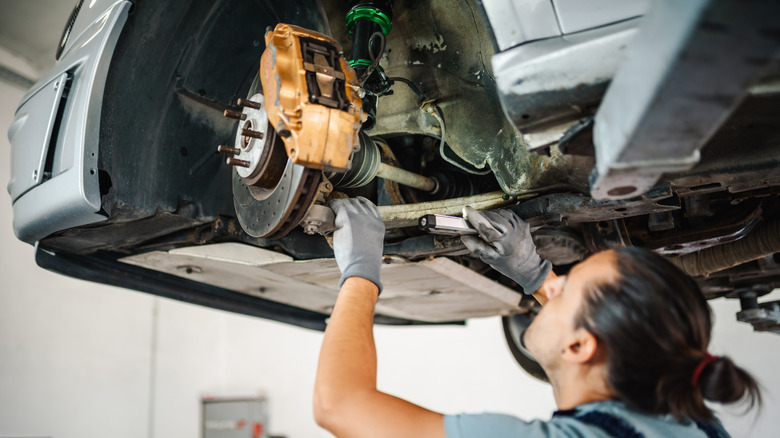
If tires are the first golden rule, then surely brakes are the second. Without brakes, your car doesn't just become unsafe, it becomes a death trap. Everything can fail — engine, suspension, and so on — but if you can't stop, then you're the pilot of a missile, not an automobile. That's why you absolutely never mess around with getting poor-quality brakes or shoddy installations, and why it's so imperative to check on them every 50,000 miles or so.
Checking your brakes isn't actually too involved. Because everything is mechanical, it's relatively straightforward to diagnose any issues. First off, it's generally a good rule of thumb, if not outright recommended by your manufacturer, to change your brake pads every 50,000 miles. The brakes themselves likely won't need changing after the first 50k, but beyond 100 or 150,000, it's probably a good idea to check your rotors as well. Rotors can rust up, especially if left standing for long periods, which is one reason why keeping a car in storage for long intervals means driving it every week or so.
Bear in mind that your brake system starts at the master cylinder before going down the brake lines and into the calipers or drums. Again, you don't exactly need to check everything at 50,000 miles, but precaution doesn't hurt. These components can get corroded or damaged, leading to telltale signs like your brake pedal behaving strangely when you press on it, or your car shuddering when slowing down. A quick inspection of the whole system can prevent these complications before they ever occur.
Timing belt
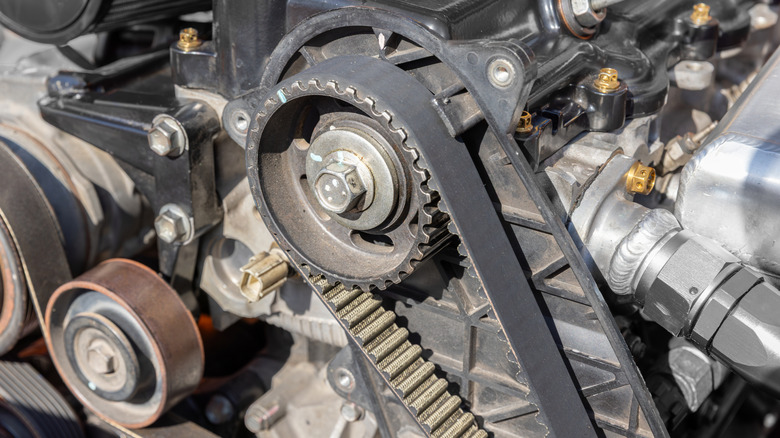
This is one item that is incredibly unforgiving if you're late with the maintenance, but it'll never punish you for being a bit early. If your ECU is your car's brain and the crankshaft is its heart, then the timing belt is the aorta. It's a relatively unassuming name at first glance — we're all used to a failing serpentine belt merrily squealing away on a humid morning. The difference is, while a serpentine belt failure is an inconvenience, a timing belt failure will absolutely brick your engine if it's an interference-pattern design.
Put simply, a timing belt's job is to synchronize the crankshaft and camshaft(s). It's often difficult, if not downright impossible, to check your timing belt on your own; they're typically buried within the bowels of your engine. There are some telltale signs it's about to fail, though — ticking from your engine, difficulty starting, a check engine light, and so on. Generally these last around 60,000 miles, though some belts can last longer, up to 100,000 depending on the model. It'll be listed in your owner's manual or sometimes on a sticker in the engine bay somewhere.
If your timing belt breaks, one of two things will happen. Either your car will simply stop working once, or it'll stop working forever. The latter occurs with interference engines; an interference engine is when the piston moves up into the same space as the valves. So if the valves are extended when the piston comes up, it'll smash into the valves and that's all she wrote. Therefore, you always want to change your timing belt ahead of time — 50,000 miles is a safe bet, especially if you don't know your car's service history.
Transmission fluid
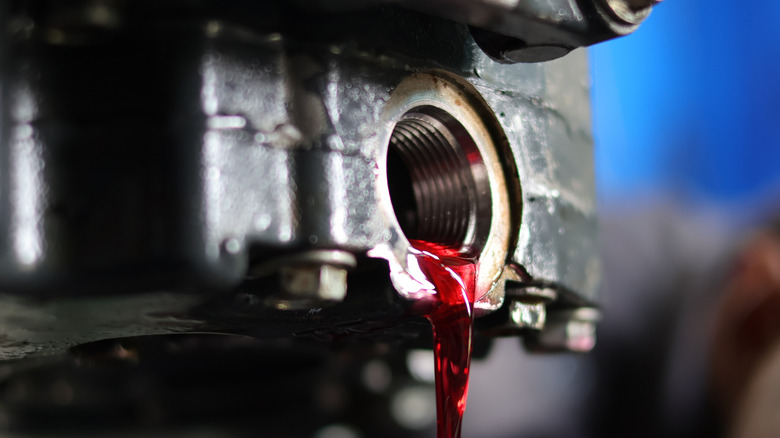
Like your tires, this is one that may very well be purely preventative maintenance, but it's also equally painless — provided your car has a fluid dipstick, which sadly isn't a guarantee these days.
On vehicles equipped with automatic transmissions, the transmission fluid acts as the medium by which power is delivered from the engine to the transmission. Many automatic transmissions have torque converters, which contain and circulate this fluid around, acting in place of a traditional clutch on a manual. This puts transmission fluid under immense strain, both through pressure and workload, and that fluid will wear out over time.
Automatic transmissions typically require fluid changes around 60,000 to 100,000 miles, much like timing belts; this varies by manufacturer, of course. Moreover, as mentioned before, driving hard or hauling heavy loads will strain your transmission, so it's generally good practice to change it in advance in these circumstances.
Of course, it's not just automatics we're talking about here. CVTs are a whole different ballgame; some manufacturers recommend changing your CVT fluid in as little as 30,000 miles. Dual-clutch transmissions (DCTs) vary widely in their maintenance intervals, ranging anywhere from 40,000 to 80,000 miles for a fluid change. Manual transmissions have fluid as well, though manual transmission fluid lasts longer than its automatic transmission counterpart.
Regardless, it's prudent to check on your fluids and make sure nothing's leaking or discolored. Bad transmission fluid can result in a whole host of problems, ranging from gears slipping to your transmission overheating. Moreover, less fluid means more metal-on-metal contact, which by extension means money.
Rubber hoses, gaskets, and seals
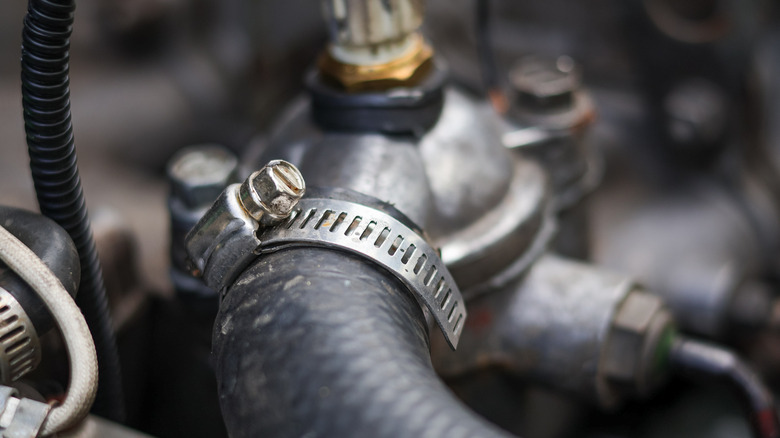
Imagine what you see if you open up your hood and remove all that plastic hiding the actual mechanical parts of your car. It'll be a mess of different materials — hoses running into and out of the radiator, wires and sensors connected to the engine, and all manner of parts joined together. You don't need to know what everything does, but it helps to have a look anyway because you can quite readily spot if something's wrong.
Let's say you think your radiator springs a leak. You look down on the ground and notice some colored fluid towards the front of your car, so you open up your hood and lo and behold, one of the hoses looks a little slick — time to replace your radiator hose.
Bear in mind that, like tires and timing belts, many of these components are also made of rubber. Components like radiator hoses and your head and oil gaskets are flexible, pressure-bearing members. Moreover, they're constantly subjected to extremes of temperature, going from outdoor ambient temp to scorching-hot in a matter of minutes. If you drive your car every day, they could be cycling temperatures twice or three times daily.
There's no set interval for parts like these; it's usually taken care of as part of an inspection. You visually identify any leaks, cracked hoses, or frayed wires, and replace them as-needed. But 50,000 miles or around 4 or 5 years is a pretty good estimate for when you should get eyes on everything and replace easy-to-reach stuff. Even if nothing needs changing, it's better to be safe than sorry.
Our methodology

Given that every manufacturer and shop has its own service intervals, there's no universally agreed-upon definition of what constitutes a 50,000 mile service. Moreover, independent driving habits greatly affect these intervals; one person driving on flat highways will have extremely different requirements than someone living in mountainous Colorado and using that same vehicle for towing. We took this into consideration with our estimates, going with a weighted average where we could, and otherwise mentioning such circumstances and their effects on these intervals.
Our selection process involved parts common to most cars and trucks for a fairly universal exercise. Elements like suspension and chassis members vary dramatically from one car to the next, so we kept it simple and selected items that could apply across the board. These items are either easy to inspect or time-critical, in the case of the timing belt; meaning they can be performed at any 50,000 mile service regardless of the car's actual mileage — 100,000, 150,000, etc.
Finally, we only used sources from reputable shops or the manufacturers themselves, which publish service manuals and general recommendations on the public domain for download.