

What Is A Torque Converter & What Does It Do In An Automatic Transmission?
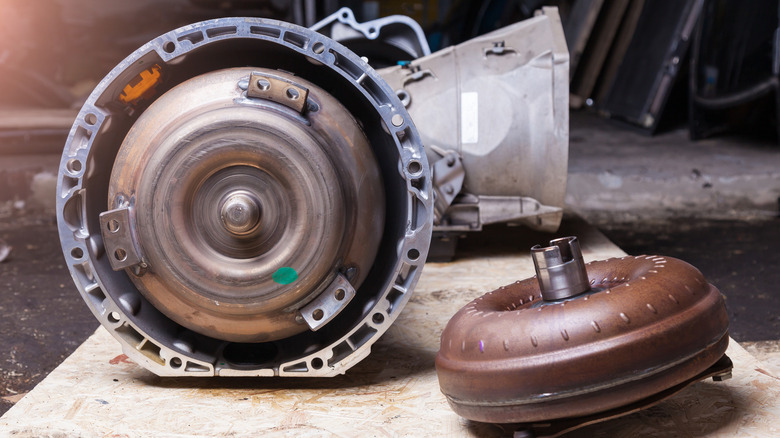
The nice thing about automatic transmissions is that you don't have to think about shifting gears. They appear simple as anything from the driver's seat, but as anyone who knows how automatic transmissions work will tell you, they're anything but. Automatic transmissions have several key elements, including the flex plate, torque converter, and gearbox itself. That second part, the torque converter, is also one of the most enigmatic.
A torque converter serves multiple functions in your drivetrain, but the most crucial is the role of a clutch. It's a middleman, taking the engine's torque and transferring it to the gearbox. However, rather than using a clutch disc, it uses automatic transmission fluid — which is not the same as gear oil, or manual transmission fluid — to rotate a set of components. There are several parts inside a torque converter, each one serving to spin this fluid like a washing machine.
To keep it simple, let's divide the torque converter into three parts: the impeller, turbine, and stator. These components allow the transmission fluid to work as a clutch of sorts. And because it's liquid — and not a stationary piece of metal like a manual transmission's clutch — the engine won't stall when the car is stopped. But why is fluid the answer to that problem, exactly? And how is it that a relatively small amount of fluid can push a car from a standstill, even on a steep incline? Let's discuss the parts and how they work to find out.
The components that make up a torque converter
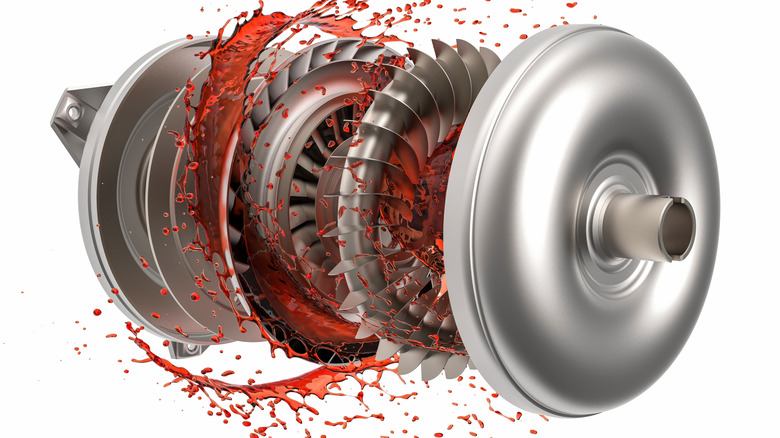
As mentioned before, there are three major parts to a torque converter: the impeller, stator, and turbine. We'll start at the beginning and work our way back. The impeller rotates with the engine, powering the whole assembly. It comprises half of the outer housing and a large fan-like assembly within. It's basically a little jet engine turbine that the engine spins around. This moves the transmission fluid housed in the converter, circulating the fluid and driving the transmission's pump.
All that fluid then transfers through what's known as a stator, which operates not unlike a bicycle's freewheel — it can freely rotate in one direction, but locks in the other direction. It, too, looks like a turbine blade, albeit with blades moving in the opposite orientation. This reverses the direction of the transmission fluid, multiplying the torque the system produces. It puts the "torque" into "torque converter."
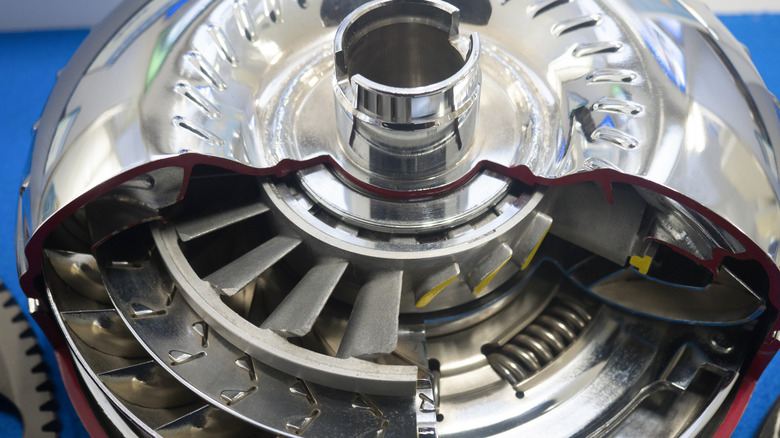
All that then runs back to the turbine, which is splined to the transmission. When the turbine rotates, so too does the transmission. The faster the transmission's shaft rotates in relation to the wheels, the easier it is for the turbine to transfer the power — that's why automatic transmissions typically have multiple gears. Another component present in more modern automatics is a clutch that locks the turbine and impeller. This improves fuel efficiency by eliminating the deleterious effects of power loss in the fluid — more on that shortly.
How everything interacts to drive the car
First things first: Why not just have a clutch? Well, one type of automatic transmission does. These are DCTs, which differ significantly from other automatics. The main problem with a clutch, however, is that it mechanically links the engine and transmission.
When you're at a standstill with your engine on, the engine's output shaft rotates — obvious enough. The problem is that the transmission isn't doing anything; it's engaged, but the car isn't moving. If there were a physical link between the two, then the engine would stall whenever the wheels stopped spinning. That's why manuals have clutch pedals: to disengage the clutch when there's a speed difference between the engine's output shaft and the transmission's input shaft. But fluid is, well, fluid. It's not a mechanical link and will keep spinning even with the brakes on.
Next, imagine that the engine is a hand stirring a pot. The fluid acts in a similar way: it's a bit slower at the bottom and edges due to power loss. This affects the torque converter as well; no matter how fast it spins, there will always be a small amount of power loss. That's where the turbine's clutch comes in handy — it mechanically locks the two halves, eliminating that problem.
Lastly, there's the stator. Its torque multiplication helps a car get going, working at extremely low speeds to give your car a bit of extra grunt to launch. After that, it's no different than a bicycle freewheeling, keeping the torque down to manageable levels.