

5 Reasons Why Someone Might Not Want To Wear A Smartwatch
If ever there was a good time to buy a smartwatch, it's now. Great budget-friendly options are easy to find, and they offer a treasure trove of health metrics for your general well-being and workouts; wearing one could help you improve your sleep, get you moving more, and make you more conscious of other negative impacts on your health, like exposure to loud sounds. They further prove their worth when they save people's lives with their fall and crash detection. As awesome as they might sound, though, they're definitely not for everyone.
I've been wearing an Apple Watch daily for years now. While it's one of the best tech purchases I've made, I think I have a pretty good idea of why you wouldn't want to wear one. I'll be using the Apple Watch as the baseline, although these arguments apply broadly to any smartwatch brand. Read this if you're a person who is intrigued by the idea of a smartwatch — enough to maybe buy one — but isn't fully convinced you truly need or want one. If any of the reasons below are dealbreakers, then a smartwatch might not be for you.
Increased digital distractions

One of my favorite studies continues to be the one that suggested merely having a smartphone nearby will ruin your focus. Proximity — not usage, just being close — is all it takes. That study was about smartphones. Some studies find smartwatches more distracting than phones, and I think it's pretty obvious why: they are quite literally within arm's reach at all times. And they have to stay there if you want your watch to provide long-term analyses of health metrics, such as hypertension. Meanwhile, it's serving you notifications from your phone, vibrating on your wrist constantly unless you change the settings.
Even with a stringent focus mode that only lets your smartwatch vibrate for the most important things, you develop a reflexive habit of checking it a lot more frequently than a smartphone. Even in cases where you just want to check the time and date, your eyes will inevitably drift to that unread notification dot. There are also plenty of instances where it's visible in your field of view (such as when you're typing or reading a book), and all the while it's goading you, silently, saying, "C'mon, look at me."
There are ways to mitigate this. Theater Mode on the Apple Watch blanks the screen and creates some friction when viewing notifications. And of course, it doesn't hurt to take it off during the hour or two when you want no distractions. Nonetheless, wearing a smartwatch presents a perpetual potential distraction, so if you can't afford to have yet another device hogging your precious cognitive bandwidth, steer clear.
Superfluous biometric hardware
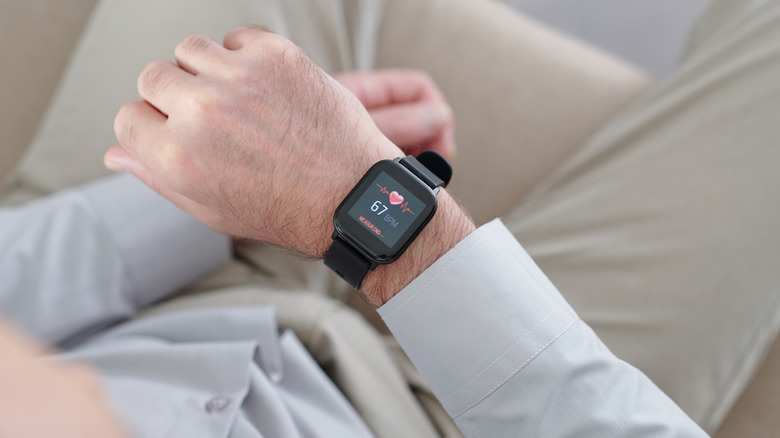
Modern smartwatches gather an impressive list of health metrics. Take the Apple Watch Series 11. It has heart rate monitoring, hypertension tracking, blood oxygen levels, ECG, accurate sleep tracking, sleep apnea warnings, respiratory rate, and temperature sensing. More are coming. There are whispers of blood glucose monitoring. Point is, the list of health-tracking capabilities is huge. That's great, but there's an unexpected issue: These metrics (I think) may be nice to have, but not essential.
Think about it. When you go to the gym, does it really matter what your heart rate is? As long as you get a sweat in and feel the endorphins afterwards, probably not. Even for an everyday gym rat like myself, I wouldn't lose a wink of sleep if I never saw that data again. The same argument extends to a lot of other areas. Does it really matter knowing how many times you woke up at night as long as you feel rested? Does it really, really matter knowing how many flights of stairs you climbed? Some of the health metrics gathered by smartwatches can be hard to find any use for, even if you tried, like blood oxygen levels.
I'm not talking about people who have health concerns that a smartwatch could keep tabs on, by the way, just those who don't have a strict need for most (or all) of the health-tracking features. Humans have lived without smartwatches quite contently for thousands of years, and today companies seem to gish gallop consumers with a list of health-tracking features because they recognize this is a completely optional, auxiliary device. Think real hard if you need that health information. Chances are, you don't.
Battery anxiety
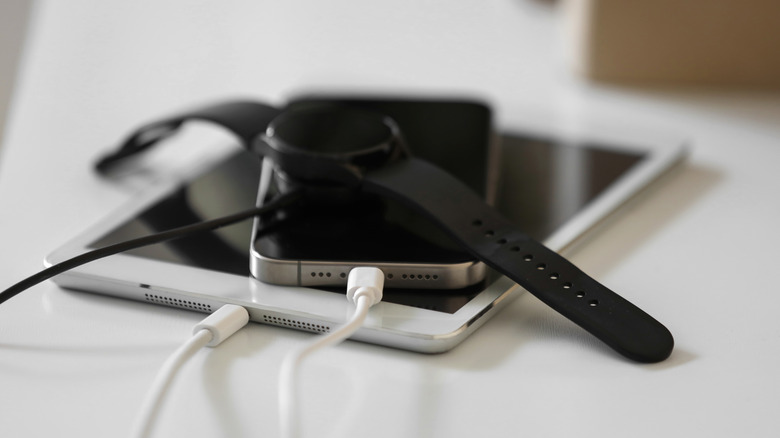
Battery anxiety is no joke. Some studies have estimated that as many as 90% of people get anxious when their smartphone battery is low. It's a problem that seems to get compounded the more devices you add to the equation, like laptops, tablets, e-readers, and wireless earbuds, all of which take a little sliver of your cognitive pie as you mentally track what battery level they're at and when they need a charge. Adding a smartwatch only exacerbates that problem.
Granted, smartwatches tend to have pretty long battery life. The Apple Watch Series 11 can squeeze out up to 38 hours on low power mode, and more expensive ones like the Apple Watch Ultra boast up to 72 hours. Other brands go even longer, lasting as long as months in some cases. Still, one day you're going to have to charge it, and as we've explained, it's in your best interest to keep a smartwatch topped up to see those long-term health metrics. If you were on the fence already, this might be reason enough to reconsider.
Privacy concerns
Privacy is perhaps the number one concern users have about the tech industry, and it's a moving target that constantly forces you to evaluate what information you give to whom, what apps you use, and how you prepare for the fallout if a company breaks its promises or gets hacked. Smartphones already contain a ton of personal information that can be abused and exploited, but smartwatches take that to the next level.
Again, if it wasn't already obvious, a smartwatch is a device that could have access to your most sensitive health information. It knows whether you have hypertension and when your period is, knows everywhere you go, and then at night it quite literally watches you while you sleep. No other consumer device gets that intimate. All you have protecting you is a company's paper-thin privacy policy that — as the tech industry has demonstrated again and again and again — it might see only as a guideline. Considering your smartwatch will likely be running closed-source software, you simply cannot verify it's doing only what it says it will, and even if it does behave, it could be hacked.
It's probably impossible for us to completely eliminate privacy risks in the modern age without living off the grid. But if you're trying to limit the reach tech companies have into your life, yeah, avoid a smartwatch.
Physical discomfort

As we've said, a smartwatch is a device that benefits from being worn for long periods of time, which makes it the ideal way to give yourself a rash. Sometimes it's the watch's fault. Remember when Fitbit's fitness bands were giving people allergic reactions? Sometimes it's not. Skin irritation may be something you're more prone to than others, and you'd be miserable wearing one without some adjustments — and even then, it still might chafe and itch.
I personally haven't had any skin irritation issues from the Apple Watch, but I have noticed that at times it can get extremely uncomfortable to wear. Throughout the day, I'll find myself constantly adjusting it, occasionally getting so bothered by it that I just take it off for an hour or two so my wrist can breathe. It has to be at the perfect tightness setting, too, or it becomes too tight — even more uncomfortable — or too loose. Smartwatch sensors have to "maximize skin contact," in Apple's words, to work effectively.
This is coming from a person who likes having a smartwatch, mind. If you're the sort of person who can't sit still for long or gets annoyed wearing necklaces and wristbands, then a smartwatch could be torture to wear. These things are heavy, too. The Apple Watch Series 11 (the 42mm version) weighs 29.7 grams at its lightest, which could be a lot more than that cheap plastic Casio you're replacing it with.