

If You Grew Up In The '80s, You Definitely Remember These Cars
For many, the 1980s are viewed as a time of unrepentant overindulgence driven by greed and materialistic consumerism. But if you look at the '80s with the proverbial rose-colored glasses, it was a decade marked by nothing but good times rife with punchy pop hits, classic movies, iconic cartoons, and world-altering advances in technology.
Yes, it was also a time that delivered its fair share of unforgettable automobiles. The decade actually opened with manufacturers largely pivoting away from the gas-guzzling monsters and souped-up muscle cars that had become so popular with drivers throughout the 1970s. While that pivot helped open the floodgates to smaller, fuel-efficient models from automakers from the U.S., Asia, and beyond, the '80s also saw the release of a few cherry rides that many auto enthusiasts might rightfully have deemed "totally rad" in their heyday.
Even as time may have forgotten many of the decade's automotive ventures, car lovers who lived through the '80s likely have a running list of radical rides whose attributes they can still conjure at will. We'd wager that these are some of the more common rides that the car-loving children of the '80s might remember with no shortage of nostalgic adoration.
Chevrolet Camaro IROC-Z
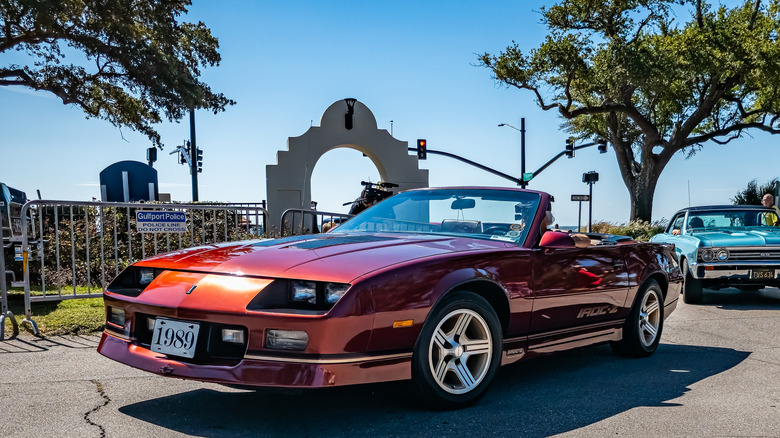
We noted that the 1980s saw a distinct move away from the muscle car mania of the 1970s, but that doesn't mean automakers actually abandoned the muscle car mentality. Quite the opposite is true, with Chevrolet keeping that hard-charging torch aflame with the release of the Camaro IROC-Z. The vehicle stands as a testament to both '80s indulgence and automotive muscle, and if you're an auto enthusiast who lived through the decade, it's a vehicle that likely raised your heart rate a tick or two whenever you saw one cruising down the road.
Chevrolet debuted the street-ready but race-inspired IROC-Z — its name is even an acronym for the International Race of Champions — in 1985, and the vehicle quickly became a hit with consumers who categorically refused to acknowledge the end of the American muscle car movement. Indeed, Chevy rewarded that fidelity with a Camaro that captured the spirit of its predecessors, but was decidedly of the era that spawned it.
Indeed, the IROC-Z looked like an automotive bullet, boasting an aggressive, low-slung design and a 5.0-liter V8 engine under the hood that delivered 215 horsepower, 279 lb-ft of torque, and a max speed of about 140 mph. It was also available with its distinctive T-Top roof and was eventually sold as a convertible. Whichever style you chose, Chevy's Camaro IROC-Z was as impossible to look away from on the road as it was not to hear when it was speeding your way. They also continue to appreciate decades after debuting.
Ferrari Testarossa
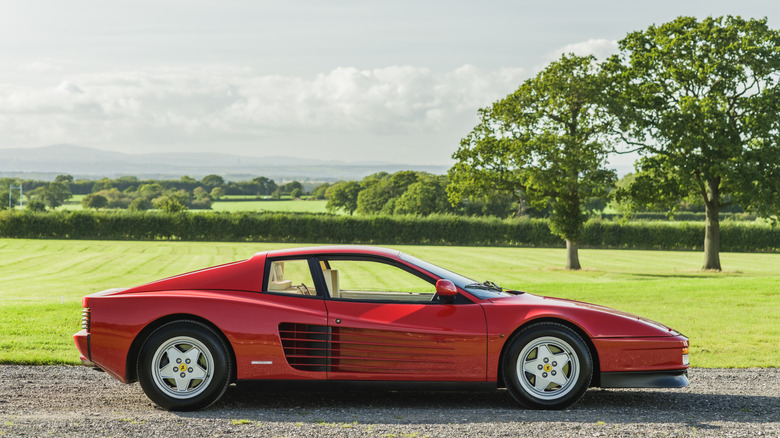
By the time Italian automaker Ferrari released the iconic Testarossa supercar, it had already long established itself as one of the world's preeminent designers of high-octane cars that looked as beautiful as they ran. While some might argue that the F40 is more deserving of a spot on Ferrari's all-time best list, a case could be made that the Testarossa was far more iconic, at least in terms of pop-culture impact.
After all, during the 1980s, few supercars appeared on posters as often as the Testarossa. Posters are likely the only place most common folks ever got to see one, save, of course, for the vehicle's many appearances on the neon-drenched '80s cop series "Miami Vice." Still, Testarossas were rare sights on American roads, and they weren't exactly a regular presence in Europe, either, as the sleek Ferrari was priced well out of range for most Average Joes when it debuted at the Paris Motor Show in 1984.
The vehicle stunned upon debut, with its slim, wedged body and its side-door air intakes giving it a distinctive look even among the sexy Ferrari range. The Testarossa was also packing some serious punch by way of a V12 engine delivering a claimed 380 horsepower and 354 lb-ft of torque. The vehicle was popular enough that Ferrari kept the Testarossa in production for seven years before the build gave way to the highly touted 512 TR.
Honda CRX
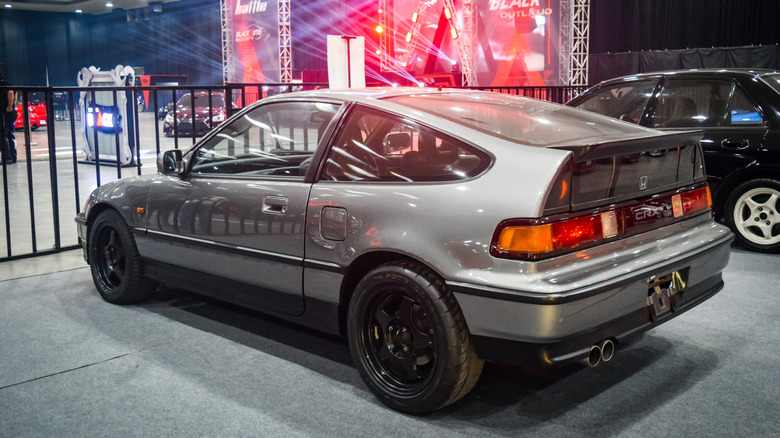
The 1980s were not all about speed and sex appeal in the automotive arena. As noted, it was also the decade when the Asian auto market really came of age in the States. That charge was led in no small part by Honda, and one could argue that, upon its 1983 debut, the CRX was one of the brand's first builds to really claim some proper "rad" status among younger U.S. drivers.
That is because the quirky but sporty little compact was also pretty affordable when it hit the streets. CRXs were seen cruising cityscapes and suburban streets in surprising numbers throughout much of the decade and into the early 1990s. By the dawn of that decade, it was hard to drive around town without seeing at least one CRX, and most drivers of that age almost certainly had a friend or two among the CRX-driving masses.
Though the CRX wasn't particularly fast and lacked any discernible sex appeal, the compact boasted some pretty cool features during its 8-year production run, with its distinctively off-beat rear hatch design helping it earn some legit cult icon cred over the years. Though Honda killed the CRX as '80s kids knew it in 1991, it's not entirely uncommon to still see one on the road every now and then. In fact, the CRX's unique power-to-weight ratio has made it a fun restomod project for some of the more adventurous garage gurus.
DeLorean DMC-12
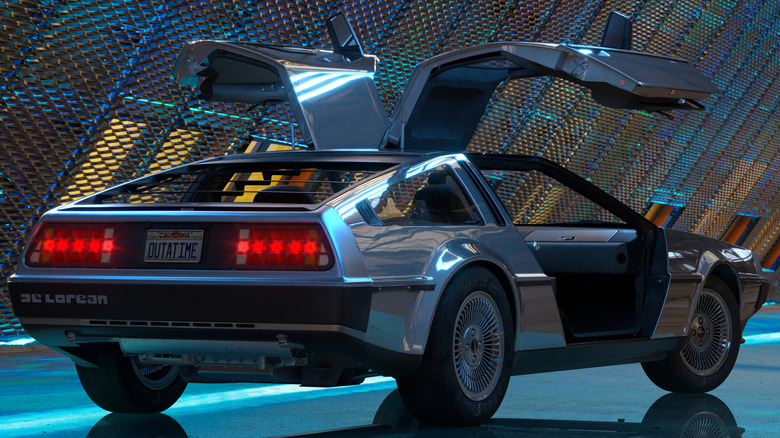
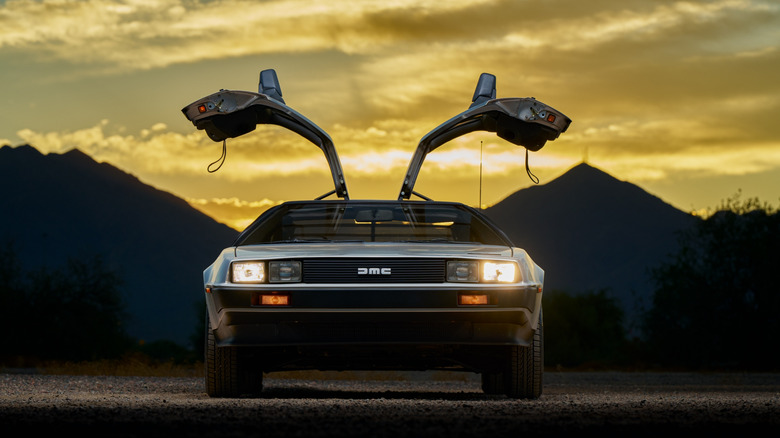
A wise soul once said that there's a fine line between being famous or becoming infamous. In the annals of automotive history, no vehicle has more singularly summed up that sentiment than the DeLorean DMC-12. Interestingly enough, now more than 40 years after John DeLorean debuted his ill-fated dream car, the DMC-12 still exists on both sides of the famous/infamous line.
As for the fame, that came with Flux-Capacitor-fueled fury on July 3, 1985, when "Back to the Future" stormed into movie theaters to become one of the biggest hits of the decade. The DeLorean DMC-12 is the vehicle that Christopher Lloyd's mad scientist, Dr. Emmett Brown, transformed into his time-traveling mode of transportation. The producers couldn't have picked a more suitable vehicle, as the DMC-12's design and its unique open-up doors make it look and feel like the car of the future.
Of course, by the time "Back to the Future" was released, the DMC-12 was already a vehicle of the past, with DeLorean Motor Company ceasing production in 1983 due to poor sales and even poorer road performance. Only around 9,000 were ever made. That market failure made the DMC-12 sort of a winking in-joke in the film. Still, for '80s kids around the world, there may not be a more of-the-decade ride in existence.
Lamborghini Countach
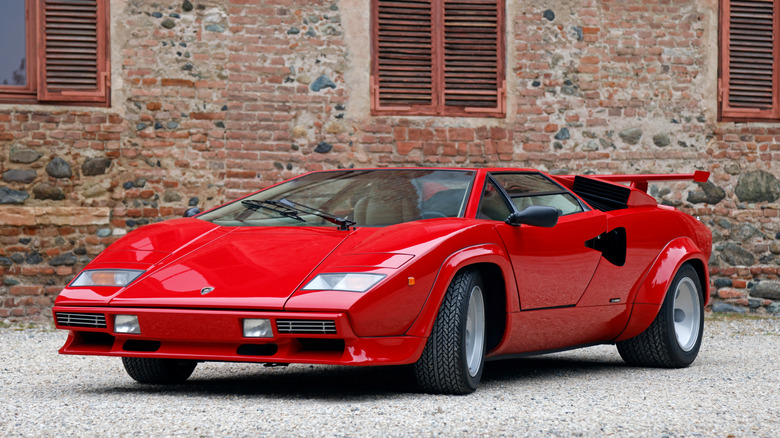
We already covered the Italian-made Ferrari Testarossa, but we'd be remiss if we didn't note that they weren't the only Italian carmaker that flexed 1980s decadence. Enter the Lamborghini Countach, the Testarossa's equally poster-boy counterpart.
By the '80s, the Italian marques had been locked in a decades-long battle for road and track supremacy in Europe. While it was seen as a competitor for the Testarossa, it's worth noting that Lamborghini had made the Countach since the 1970s. The supercar and its iconic pancake flat body style was not, however, available in the U.S. until 1982. The Countach became a bit of an overnight sensation when it hit U.S. markets and garnered the bulk of its icon status in the '80s.
That status was well-earned, too, as few vehicles on the road looked anything like it. Fewer still could match its power credentials, with the Countach fronting a 4.8-liter V12 that could make 385 horsepower and go 0-60 mph in 5 seconds. To that end, it instantly became the dream vehicle for any car enthusiast who was over the age of 5 in the 1980s, and likely retains that status for many today. During its '80s heyday, the vehicle would feature prominently in major motion pictures like "The Cannonball Run" and "Rain Man," and even appear on "Miami Vice." Lamborghini discontinued the Countach in 1990.