

5 Inline-6 Engines That Pump Out More Power Than Most V8s
When people think about serious engine power, the V8 is usually the first thing that comes to mind. Eight cylinders, large displacement, and a firing order that keeps the combustion events coming in rapid, even succession. It's a formula that generates abundant power and torque while staying smooth and tractable. V10s and V12s sit even higher on the totem pole, but in the modern car market those have become about as rare as an interior without a massive touchscreen dominating the dashboard.
When you add forced induction or hybridization on top of a V8's already generous displacement, the numbers can get truly absurd — the most powerful V8 engines now crack 1,000 horsepower straight from the factory. Still, those are the outliers. The vast majority of V8s on the road today sit in a much more ordinary power band, and that's where things get interesting.
Modern engineering has reached a point where a well-developed inline-six — six cylinders in a single row — can match or beat them outright. De-throning every V8 on the planet is a different conversation, but here are five inline-six engines that pump out more power than most V8s you'll actually see out and about.
BMW S58 - 550hp
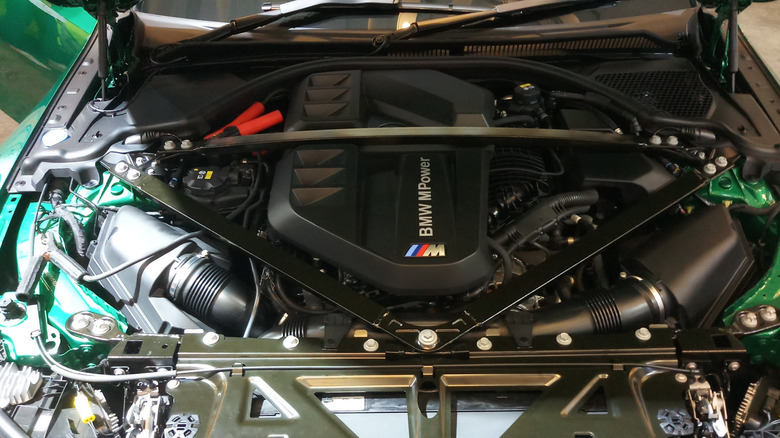
BMW's S58 is the inline six that effectively showed the world that an inline six can not only compete with a V8, but actually beat it. It has been the backbone of BMW's entire compact M performance lineup since 2019, and many cars have the BMW S58 under the hood. When CarWow lined up every current BMW M model for a standing quarter-mile drag race, the S58 didn't just hold its own against the V8s — it actually won. Displacing 3.0 liters, the S58 uses twin mono-scroll turbochargers, a closed-deck block, and forged internals as its foundation.
What separates it from most engines at this power level, however, is its 3D-printed cylinder head. Such a manufacturing approach allows cooling channels to be placed exactly where thermal management demands them, all while keeping the weight extremely low. The result is an engine that makes 550 hp in its highest street-legal form in the G80 BMW M3 CS, and it pulls hard from low in the rev range.
Perhaps most impressively, the tuning community has repeatedly demonstrated that the factory has left a lot of horsepower headroom. In other words, the S58 handles power increases above 1,000 horsepower. It is, by any honest measure, one of the greatest performance engines currently in production, especially in an era where the new Mercedes C63 uses a four-cylinder hybrid that does not offer the same level of involvement, excitement, or emotion.
Stellantis Hurricane HO - 540 hp
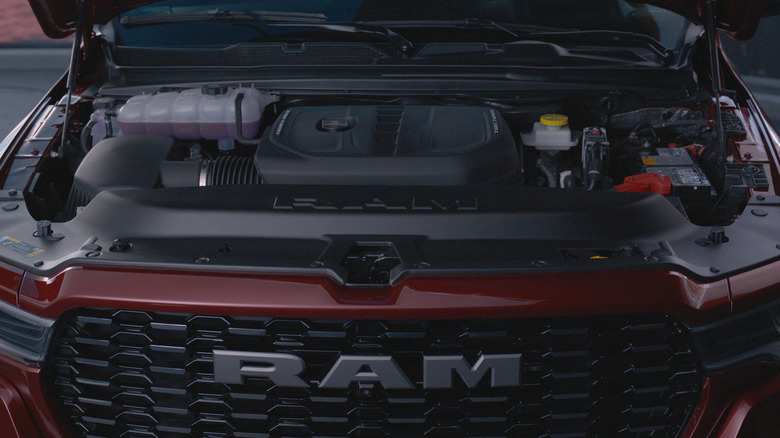
The Hurricane is Stellantis' definitive statement that the V8 era in American performance is not all that. The Hurricane engine is a 3.0-liter twin-turbo inline six designed from scratch to replace the legendary Hemi V8 across Dodge, Jeep, and Ram product lines. Without any hybrid assistance to speak of, relying purely on two high-flow turbochargers, a direct injection system, and forged internals, it produces up to a maximum of 540 hp and 521 lb-ft of torque. Stellantis still brought back the V8 as an option, but the Hurricane's performance is nothing to scoff at.
The 5.7-liter Hemi V8 it was supposed to replace makes 395 hp and 410 lb-ft. The Hurricane doesn't just match that, it makes the old V8 look way too big and thirsty for the power it actually offers. Along with the Ram 1500, it's available in the Dodge Charger Daytona Sixpack in a slightly different tune, and that's one of a few cars powered by the 3.0-liter Hurricane engine.
With the Dodge Charger nameplate — historically always associated with V8 power American automotive culture — now carrying this engine as its performance option, the Hurricane represents a genuine shift in how Stellantis thinks about power. Still, power is not everything, and for many people, the feel and sound of a burbly V8 can't be replaced, regardless of how big the power output might be.
Mercedes-AMG M256 - 435 hp
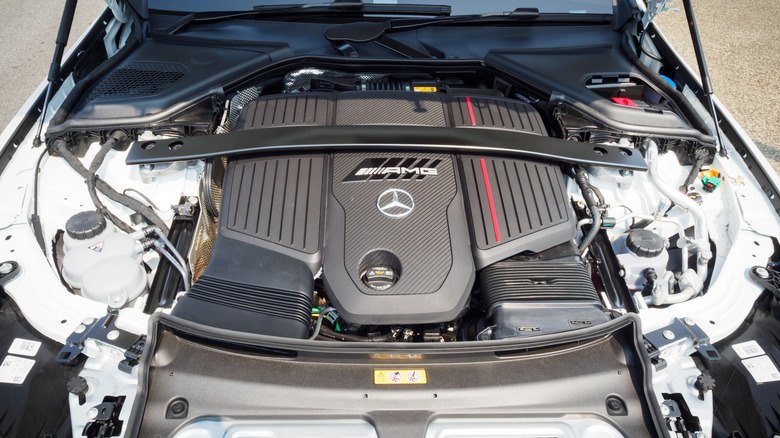
Mercedes knows a thing or two about building powerful engines, and it spent decades building V6 engines after retiring the inline-six in the late 1990s. Thankfully, the three-pointed star finally returned to the straight-six layout in 2017, and it made the wait worthwhile. The M256 is one of the most technically layered engines on this list, combining a single twin-scroll turbocharger with an electric auxiliary compressor integrated into a 48-volt mild-hybrid architecture.
That electric supercharger spins up to 70,000 rpm in under 300 milliseconds. This effectively fills the boost pressure before the turbocharger gets a chance to build boost, and turbo lag is largely eliminated. Additionally, it makes the throttle response feel instantaneous regardless of engine speed. In AMG-tuned form, the M256 produces 435 hp and 384 lb-ft of torque – one of the most powerful inline-six engines ever put in a car. The best part is that it does so with a refinement and composure that its power output doesn't obviously suggest.
It powers the AMG GT53, E53, and CLS53, and in each of those vehicles it provides the kind of effortless, always-available thrust that makes everyday driving a lot nicer. As a piece of engineering, it represents Mercedes at its most inventive. Mercedes is currently working on the next iteration of this engine — the M256 Evo – and although horsepower figures haven't yet been disclosed, we know that the Evo gets 472 lb-ft of torque, almost a 100 lb-ft increase over the current powerplant.
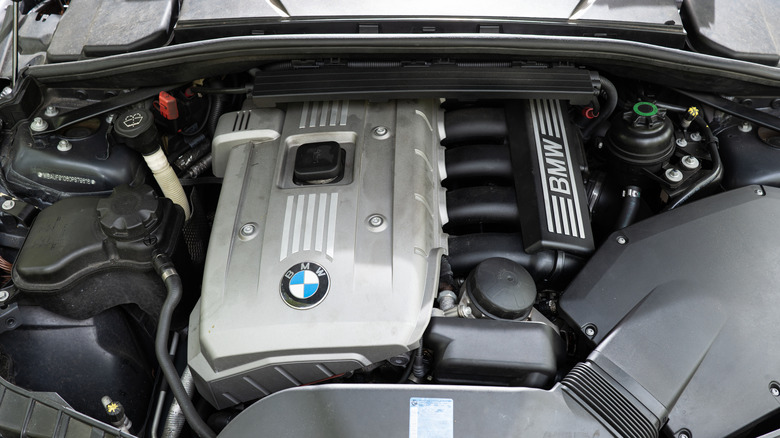
BMW B58 - 393 hp
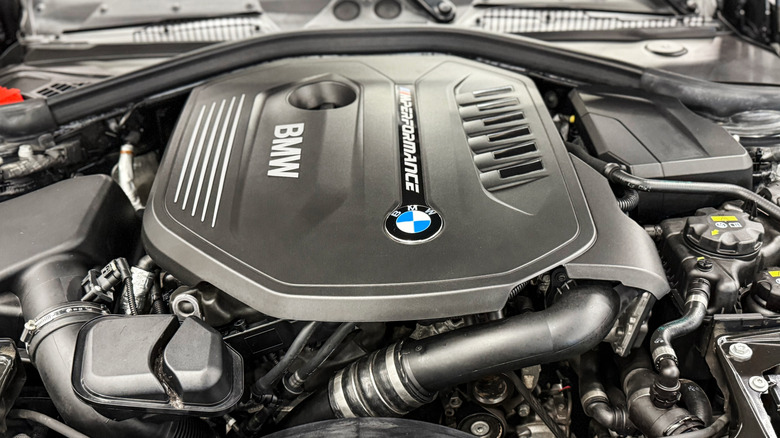
According to BMWBlog, the B58 and the S58 represent the "same displacement, same family — but the S58 borrowed its connecting rods from a V8 and runs three radiators." In other words, the M-car specific S58 has largely been developed on the underpinnings of the B58. Although the S58 does beat it in terms of sheer output, the B58 is no slouch. There are many cars that use the BMW B58 under the hood, many of which aren't even BMWs.
The B58 is a 3.0-liter in-line six engine paired with a single twin-scroll turbo. Power outputs range from 322 horsepower to 393 horsepower in BMW's 40i models, while torque goes up to 398 lb-ft. It shares the closed-deck block architecture and Vanos variable valve timing of its more extreme S58 sibling, and while the internals are not as aggressively specified, the fundamental engineering quality is identical. What the B58 has become most famous for, beyond its factory output, is its relationship with the world of tuning.
It is widely regarded as one of the most modification-friendly engines ever placed in a production car, regularly supporting substantial power increases on nothing more than a software tune. The good news is that the B58 isn't going anywhere — BMW is reportedly updating the B58 for the next generation of BMW's M Performance models, with current reports stating that it is going to offer 417 hp.
Land Rover Ingenium P400 - 395 hp
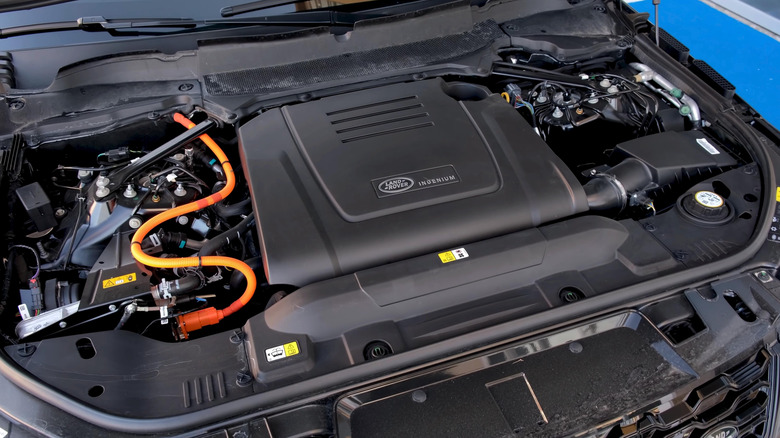
Due to the context of where it ought to be used, Land Rover's P400 inline-six is potentially the most quietly impressive engine on this list. The Ingenium P400 engine makes 395 hp and 406 lb-ft of torque from a 3.0-liter displacement. It does so while installed in vehicles that weigh over 5,000 lbs, are expected to tow, wade through water, and traverse serious off-road terrain. However, it is also offered with the Range Rover where refinement and sophistication are essential.
To achieve this, the P400 pairs a twin-scroll turbocharger with an integrated electric supercharger and a mild-hybrid assist system. The electric supercharger handles low-end response while the turbocharger takes over at higher engine speeds, with the mild-hybrid system filling any remaining gaps in the power delivery. In a lineup of engines that includes some genuinely focused performance units, the P400 stands out not for being the most extreme, but for being extremely versatile.
When we reviewed the 2023 Land Rover Defender, it clocked a 0-60 mph speed of 5.8 seconds, the same time as the 1990s halo sports car, the Acura NSX. However, the Defender weighs more than 5,000 pounds, while the NSX weighs almost 2,000 pounds less. Sure, it may not be as exciting as the supercharged 5.0-liter V8 you find in the Range Rover SVR, but it is one of the most impressive JLR engines of late.
How we made the list
A V8 is a V8, and no matter how impressive a six-cylinder engine can be, it will never have the same theoretical power ceiling as one. The premise of this article was never to claim that inline-sixes are categorically more powerful than V8s — it was to find inline-six engines that can match horsepower numbers typically associated with eight cylinders.
To make this list as grounded as possible, we went through engineering briefs, product press releases, first-drive impressions, and reporting from reputable automotive publications, primary manufacturer sources, as well as our own in-house SlashGear reviews. Where numbers are cited, they come directly from those sources or from the manufacturers themselves. If an engine didn't have the receipts to back up its inclusion, it didn't make the cut. What's left are five inline-six engines that comfortably live in the same power territory as a V8.