

5 Cheaper Alternatives To The Pontiac GTO
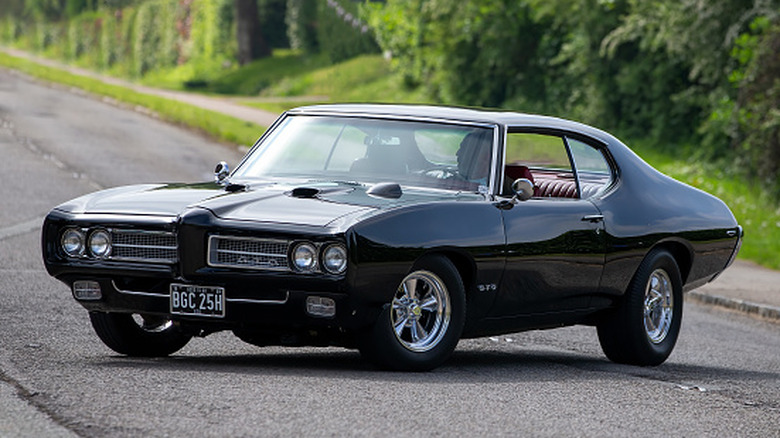
The Pontiac GTO is inarguably one of the most influential American cars of all time, almost single-handedly launching the muscle era into full swing. Its design was simple but elegant, riffing on what hot rodders had been doing for years prior — shove a huge engine into a cheap midsize car and see what happens. It was actually quite straightforward in Pontiac's case, given that the Pontiac V8 has identical external dimensions regardless of displacement, so a 287 could become a 389 with modifications to the bore, stroke, and main journal diameter. Suddenly, you could have big power in a small car for an affordable price.
This legacy lives on to this day, and it's reflected in the price point — good luck finding a clean Ram Air III GTO for less than $50,000, with high-quality examples routinely breaking $80,000 or more. Judges and other high-end GTOs with all the right options easily command low six-figure prices, extending all the way to the stratosphere. The most expensive GTO ever sold was an eye-watering $1.1 million when the hammer fell — statistical outliers aside, though, these are unquestionably expensive cars.
But let's suppose that you're after the experience a GTO provides: Its menacing presence, fast acceleration, and Hot Wheels-like character. We're taking historical provenance out of the equation here, focusing solely on cars that fulfill that purpose on a tighter budget. Granted, none of these cars are "cheap" as such, but they're all a fair bit lower than the GTO while still providing the same practical value. These are cars to own and drive rather than collect as investments. Let's take a look.
Pontiac Tempest / LeMans
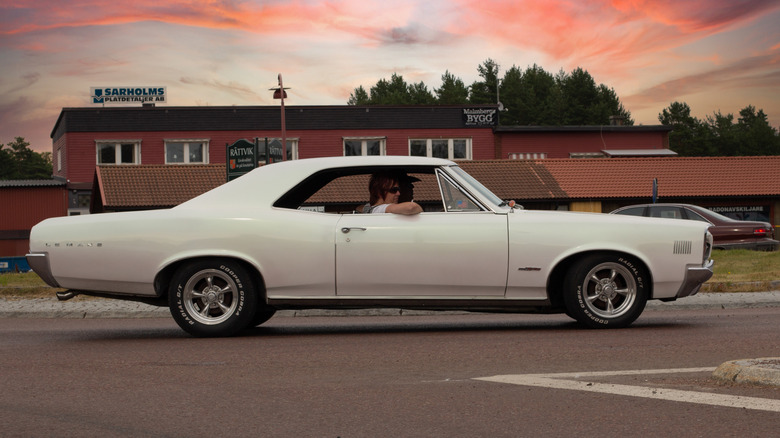
This one should be a fairly obvious inclusion, since a well-equipped Tempest or LeMans is fundamentally almost identical to the GTO, apart from the engine selection, with the GTO holding a monopoly on the larger-displacement Pontiac V8s. The Tempest and LeMans got straight sixes and more "basic" configurations of V8. But by 1970, you could order a Tempest or LeMans with a 400 V8 boasting 330 hp, an engine known as one of Pontiac's best.
That's still shy of the GTO's top engine options, of course, but they're certainly no slouches. And thanks to the Pontiac V8 being so interchangeable due to its unique dimensions, it's not uncommon to find Tempests and LeMans models as GTO clones. Let's suppose that you're not after the car being correct; you just want a rebadge or an upgrade. In that case, smart money would buy one of these and throw parts at it, since that's what men like Pete Estes and John DeLorean did to create the GTO in the first place.
Of course, therein lies the problem: Even if it's exceptionally well done, let's be honest — a clone is a clone. It's not a real GTO, and will never be priced as such. But if you're not interested in selling and only want the experience, then there's no better way to do that than taking a page out of Pontiac's playbook and modifying a Tempest. They pass the rearview mirror smell test, resemble a GTO in traffic, sound like one, and behave like one. They just don't need a second mortgage to afford.
Buick Gran Sport
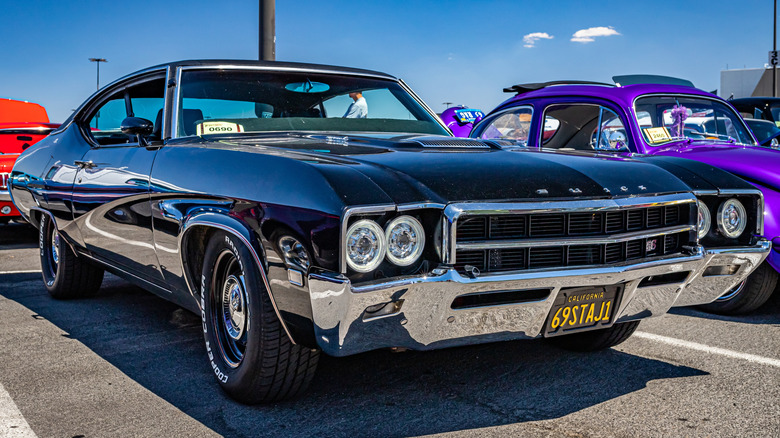
This one also seems fairly obvious at a glance — it's another A-body GM, so of course it offers a similar experience. And yes, that's certainly the case, right up until you open up the hood. Pontiac V8s, as their name implies, were exclusive to Pontiac models, not shared with other GM vehicles. In the case of the Skylark-based Buick Gran Sport, that means foregoing the Pontiac 400 or 455 for the Buick 400 or 455 (depending on year), which again, sounds like it should be the same thing. In fact, these are different engines entirely, with the 455 boasting a healthy 360 hp and 510 lb-ft torque.
Let's put this into perspective: this Buick, of all things, has more factory-rated torque than a 426 Hemi. The 455 Stage One Gran Sport is one of the most powerful Buicks to leave the showroom, placing it among the pantheon of cars that make the GTO look slow. The shared body type also exudes that same intimidating energy as the GTO, with that massive grille and svelte pillar shape being instantly recognizable.
Moreover, yes, it's cheaper than a GTO. According to Classic.com, the A-body GTO in all its variants averages out to $71,180 as of April 2026. The Gran Sports from those same years, by contrast, come in at $59,364. Sure, a GS 455 will run north of $70k, easy. But then again, so too will the Judge — comparing fire with fire, the GS 455 is still the smarter buy and a faster car in a straight line.
Ford Torino
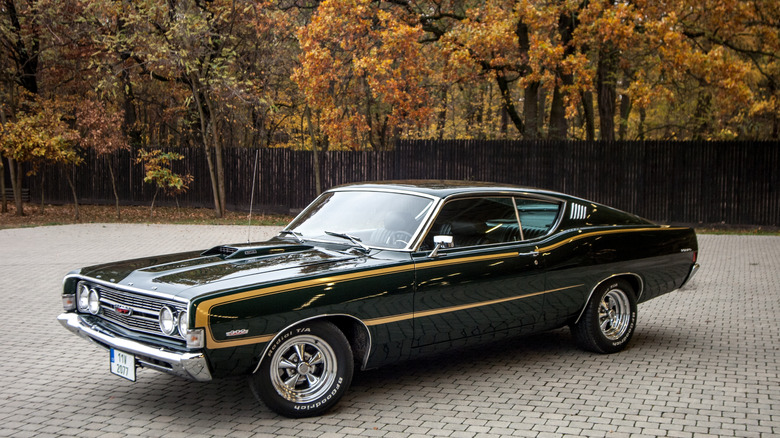
We're taking a break from GM to bring you one of the most understated midsize muscle cars of the era. The Ford Torino came in three generations, with the first starting life not too dissimilar to the GTO — it was originally a package option for the 1968 Fairlane. As such, the opening year of the Torino was somewhat all over the place, available with everything from a column-shifted 200 cu in straight six to a big block 427 FE. Sadly, no cars were produced with this engine, leaving us with the 428 FE Cobra Jet — yes, all these big block Fords are different engines.
The most powerful Torino came in 1970: the 429 Super Cobra Jet, officially the 429 Cobra Jet Ram-Air. Characterized by the shaker hood scoop, this engine produced a cool 370 hp, the same figure as a '70 Pontiac GTO Judge with the 400 Ram Air IV. So — according to the factory ratings, at least — the cars are just as powerful as one another, are a similar size, and have a plethora of options. Except the Fairlane is far cheaper.
Taking another look at Classic.com, the average price of all Fairlanes is just shy of $45,000, with the second-gen representing the most expensive option at $54,817 average. Moreover, even the highest listings around don't touch the Pontiac's numbers, with Judges routinely going over six figures. Fairlane examples reaching that sum are the outliers, not the norm.
Dodge Coronet
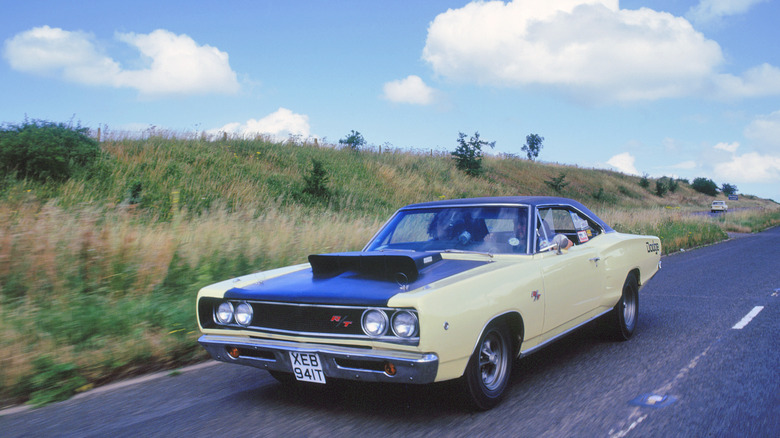
Mopar is weird when it comes to cars. On the one hand, you have the Dodge Charger R/T, which is astronomically priced no matter how you slice it. Then you have its (somewhat) more reasonably priced sister cars, the Coronet, which features largely the same options. And guess what? It's nowhere near as popular, and therefore nowhere near as expensive. Even a street Hemi 4-speed likely won't run you beyond $100,000, and that's for a 425-horsepower monstrosity powered by an engine originally built exclusively for NASCAR. The same goes for its Plymouth counterpart, the Belvedere (outside its drag specials).
The Dodge Coronet is basically what the Fairlane was to the Torino. The Charger and Coronet share the same platform, but the Coronet was billed as a more universal car. It came in a variety of flavors, ranging from convertibles to station wagons, with the R/T or Super Bee being the models with that glorious Hemi. Of course, that's optional — you get the 440 as standard with the R/T. That's the 4-barrel 440, not the Six Pack. Granted, it still produced a hefty 375 hp and 480 lb-ft torque, easily winning the numbers-match against the GTO.
As far as midsize muscle cars in general go, it's tough to beat a Mopar thanks to those engines. Most people associate Hemi power with the big names: Hemi 'Cuda, Challenger, Charger, and Roadrunner, among others. But the Coronet doesn't command nearly as much reverence despite being just as powerful. It represents one of the most cost-effective ways to get a Mopar big block, with average costs at just $43,608 — even less than the Torino, surprisingly.
AMC Rebel
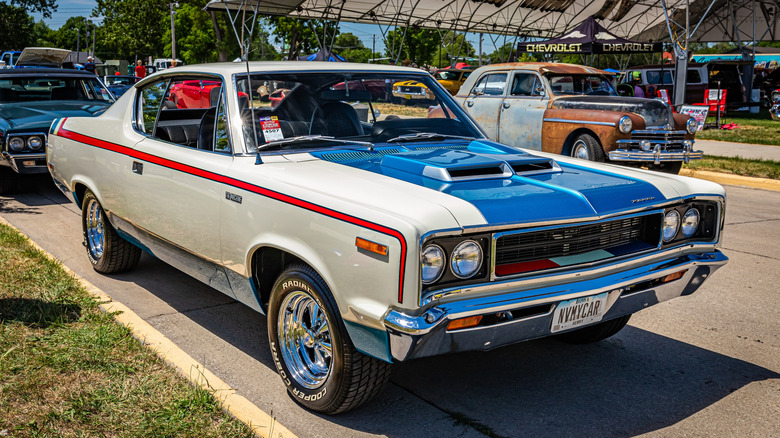
This is likely one of the most obscure muscle cars you can mention to someone who isn't an enthusiast, especially if you get "The Machine" package — which is correctly called AMC Rebel The Machine, and sadly discontinued after a very brief tenure. AMC didn't sell a lot of these cars, with just 2,326 examples of The Machine leaving the production line. And on paper, it wasn't quite as fast as the GTO, either, with The Machine only featuring a 390 c.i. V8 with 340 hp and 430 lb-ft torque. That is, unless you opt for a dealer-added performance package called the Group 19 Service Package that features, among other add-ons: a larger carburetor, aggressive camshaft, and Doug Thorley exhaust headers.
The Rebel, in general, is a fairly typical muscle car — it's a midsize, two-door coupe with a V8 about as large as the GTO's 400, albeit not as powerful without the secret performance package. Nevertheless, even The Machine will run you less than your average GTO of similar trim level (The Judge, for comparison's sake).
AMC, in general, is relatively overlooked, yet the company's lineup is stacked with famous racers — the Javelin and AMX, to name a couple more from this era. Is the defunct company slept on? Probably more than many, certainly more than the GTO in terms of midsize. But it offers the whole package regardless: Big block power, the boxy aesthetics, Hot Wheels looks with the characteristic livery, quad headlights on a deep grille, fastback body, and more. They don't come up often for auction, but you'd rarely find one for over $100 grand, even an SST or The Machine.
How we selected the cars
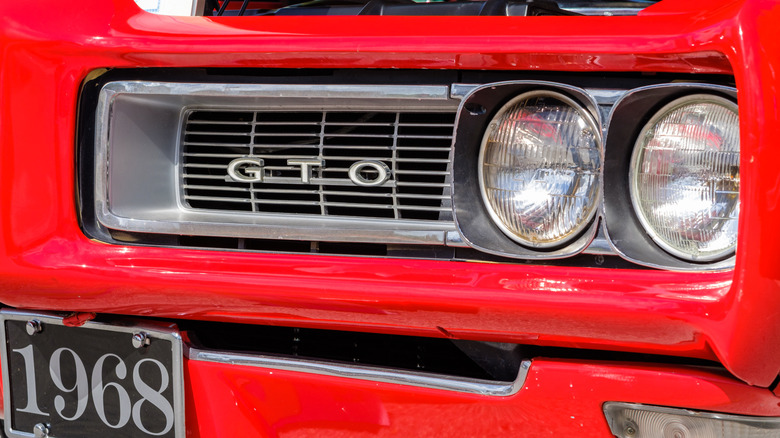
First and foremost, we removed the GTO name and took a candid look at what the car brings to the table in all its formats. The most famous (and expensive) GTOs are the first and second generations, respectively, so we narrowed our focus here, targeting other similarly-equipped midsize muscle cars from the same years. These vehicles represent close (though not identical) matches in terms of performance, looks, and general character, while costing noticeably less over the course of several years.
Our sample size includes auctions from multiple sites, including Mecum and Bring a Trailer, as aggregated on the company sites as well as Classic.com. Trim levels, years, and options are assumed to be relatively identical; we compared the top trims of each car with the top trims of Judge, the mid-tier with similarly-equipped GTOs, and so on. This gives a broader representation of pricing across the model range, rather than just the top or bottom of each vehicle's hammer prices.