

5 V8 Engines Less Powerful Than The Ford 3.5L EcoBoost V6
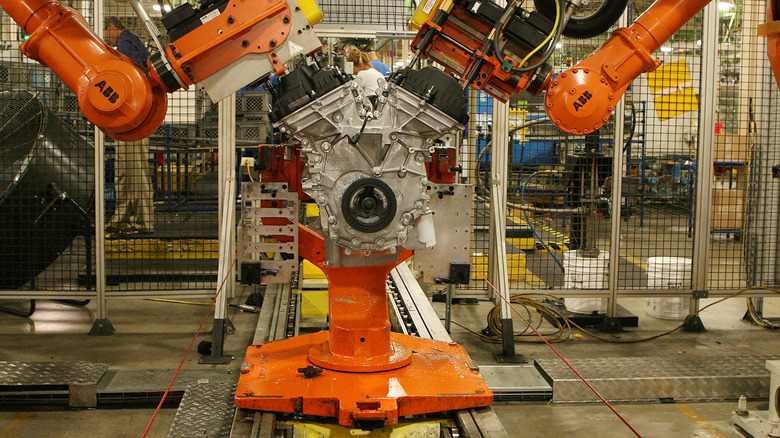
Power has grown to absurd numbers in modern automobiles. It comes from the whirring batteries of the 1,020-horsepower Tesla Model S Plaid and the scream of the 1,064-hp Corvette ZR1's flat-plane crank. Numbers scarcely believed possible a half century ago show up regularly under the hoods of sedate sedans and SUVs.
That doesn't just go for the revolutionary high-performance powertrains. The power standard has risen significantly, and Ford's 3.5-liter EcoBoost V6 is one representative. In 2005, about the time Ford invigorated the retro muscle market with the fifth-generation S197 Mustang, the Blue Oval was also investing in turbo technology. Turbochargers deliver efficient power. Once upon a time, that was a byword for boring, but times have changed, and Ford's EcoBoost lineup is respected and tested.
For 2026, the 3.5-liter High-Output EcoBoost V6 is rated at 450 horsepower. Even given the usual fluctuation between factory claims and power to the ground, that leaves it in respectable power territory. So respectable, in fact, that it tidily outperforms some of the most legendary V8 engines in history. Here are five of them that the 3.5-liter EcoBoost leaves in the dust.
1932 Ford Flathead
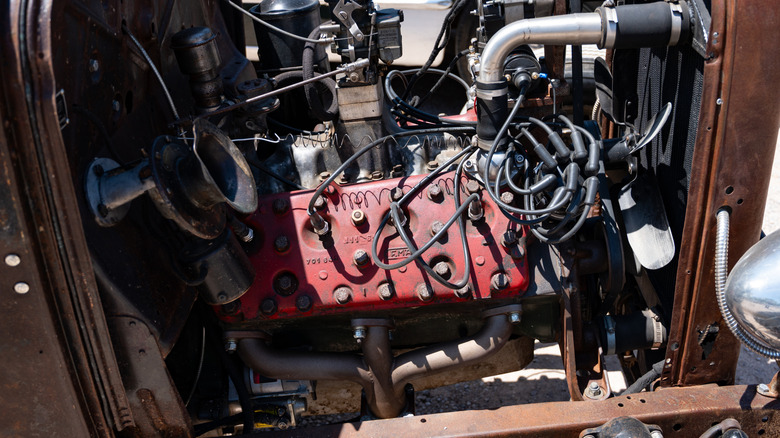
It's an understatement to say the 1932 Ford Flathead V8 engine was special. It launched (and fueled) an American car movement from its inception on March 9, 1932. It was a sturdy 90-degree V8 designed to endure a pounding on still-developing American roadways. It displaced 221 cubic inches and used a 5.5:1 compression ratio, producing 65 horsepower at 3,400 RPM. It was only up from there. Oil and gas were plentiful at the time of the engine's inception, making its approximate 20 MPG rating not bad at all.
Within half a decade, the Model 78 Flathead was making 94 horsepower, and Ford's V8s had embarked on a long and storied journey. The Flathead would be an official part of that until the last one rolled off the production line in 1953.
That was hardly the end for the Flathead, though. It became the centerpiece of the rise of hot rodding culture in the decades that followed. While the original 1932 edition Flathead made a mere 65 horsepower, that number has ballooned to as much as 700 horsepower in special-purpose salt-track racing builds. It would undoubtedly surprise the Flathead's original engineers to learn that a turbocharged V6 was outperforming its power by such a margin.
1949 Oldsmobile 303
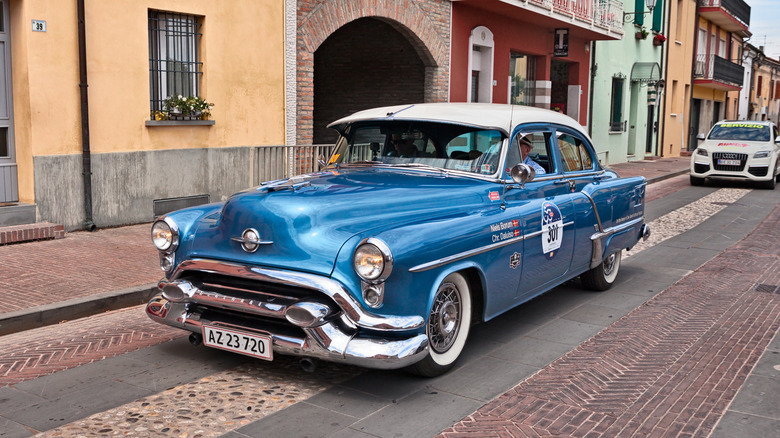
The Oldsmobile Rocket 88 and its V8 engine are candidates for being the progenitor of the muscle car. The arrival of the 1964 Pontiac Tempest/GTO is often considered the kickoff of the era, but the 303 cubic-inch V8 in the Oldsmobile paved the way from its introduction in 1949. The first-generation engine ran from 1949 to 1953, including in the emerging Oldsmobile 88 models, which earned the nickname "Rocket" 88s.
For 1949, Oldsmobile wanted to offer something a cut above the 78 model, so it introduced the 88, which combined the lighter chassis of the 76 with the new Rocket V8 engine. The 1949 303 V8 used a two-barrel carburetor, producing 135 horsepower and 263 lb-ft of torque. The 1952 edition used a four-barrel carburetor to boost output to 160 horsepower and 273 lb-ft of torque. Looking back, the 303-powered Oldsmobile 88 looks like the beginning of modern muscle, with its classic pairing of lighter weight and more power.
As the years went by, Oldsmobile's engine displacement and complexity increased. By 1963, the dawn of the golden muscle era, the Rocket 88 was a 394 cubic-inch engine producing 330 horsepower and 430 lb-ft of torque with the optional four-barrel carb. No edition of the legendary engine series comes close in power production to Ford's current 3.5-liter EcoBoost.
1967 Chevrolet 350
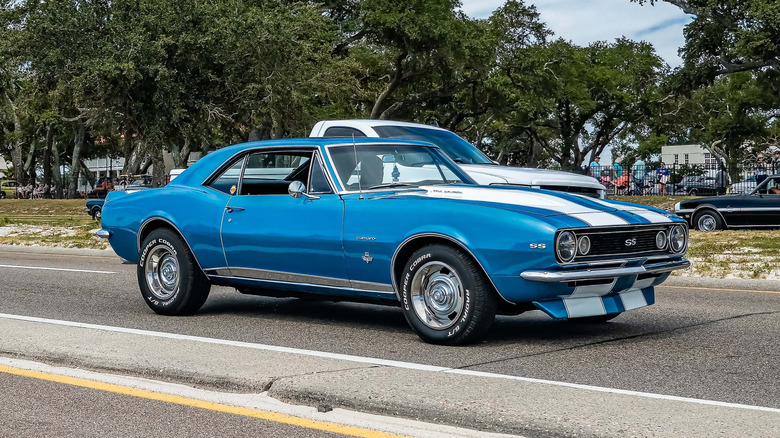
It's a little unfair to poor Chevrolet to malign its classic 350 V8 engine; horsepower isn't what it used to be, and we're afraid Ford's modern turbo tech outperforms the best of muscle mania (as it should, 50 years later). The Ford Mustang lit the fuse on a keg of dynamite packed by cars like the Oldsmobile Rocket 88 and Pontiac Tempest; by 1967, GM scrambled to catch up by introducing the Chevrolet Camaro and Pontiac Firebird.
The 1967 high-performance option for the first-generation Camaro was a 350 cubic inch V8 with everything to prove. The 283 and 327 had done their work, but Chevrolet needed a base platform for future high-powered muscle cars and Corvettes, not to mention a wide range of trucks and vans. In its ultimate SS form, Chevy's high-output 350 made about 295 horsepower in 1967.
When it was all said and done, Chevy's 350 V8 made outrageous power as part of any number of professional and amateur builds. But the entire thing started with an engine that makes significantly less power than Ford's EcoBoost.
1972 Chrysler 440
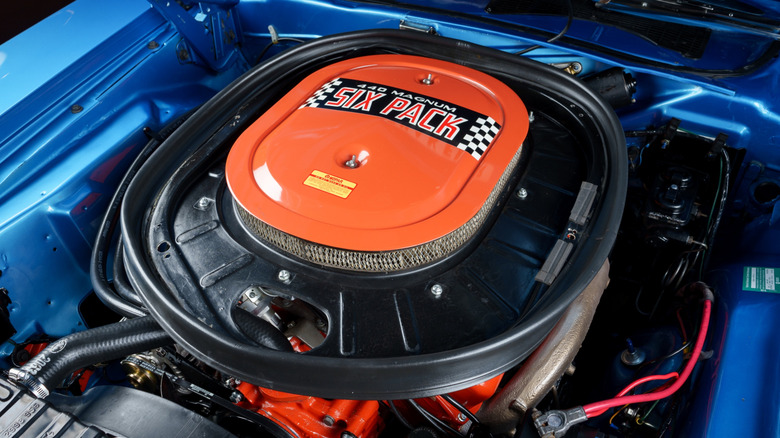
Chrysler's enormous 440 cubic inch V8 engine debuted in 1966, just in time to power some of the most absurd MOPAR muscle cars through the '60s and into the '70s. The original iteration made 350 horsepower — a competitive figure for the era.
The later Magnum 440 engine powered some of the most legendary big-displacement muscle cars on the market, including pulling duty in the Dodge Coronet R/T and Plymouth GTX. Yet, at 375 horsepower, it still doesn't broach the power of the 3.5-liter EcoBoost. Which, for the record, uses less than half the displacement of the 440. That's not to say that the march of years was good for the Chrysler 440. Emissions regulations and gasoline crises closed the big-displacement party down, ultimately leading to innovations to find power elsewhere. Maybe there's a replacement for displacement, after all.
The lineage of the 440 ultimately played a part in the retro-muscle revival of the mid-aughts. Cars like the Hellcat and Hellephant can trace their lineage to the success Dodge and Chrysler achieved with this engine. We imagine the engineers of those days would be impressed with the output of a turbo V6.
1996 Chevrolet LT4
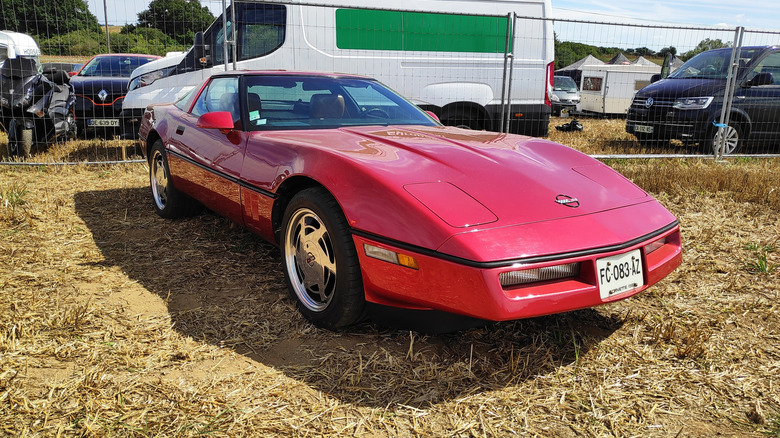
The Malaise Era forced manufacturers to find new ways to produce power more efficiently. For years, it looked like vehicles would never regain the raw oomph that V8s delivered during the unrestricted glory days of the muscle car. It took a long time for V8s to reach mid-'60s levels. Even America's premier sports car, the venerable C4 Corvette, couldn't make EcoBoost power.
Chevrolet came into 1996 hot with a new V8 engine that spiced up the 'Vette. It included an option for a 5.7-liter (350 ci) V8 dubbed the LT4. In a Car & Driver review of a 1996 Corvette Grand Sport with the LT4 V8 engine, the publication reported a horsepower rating of 330, a 30-horsepower boost over the previous year. That was no small claim for any era, and it's no surprise that C4 Corvettes remain fairly collectible even decades later. The 1996 iteration of the 330 hp LT4 was the only year that engine was produced at that power rating, and it powered the final and ultimate model year of the fourth-generation Corvette.