

Sonos Play Goes Back To Basics, And I Think It's About Time
We may receive a commission on purchases made from links.
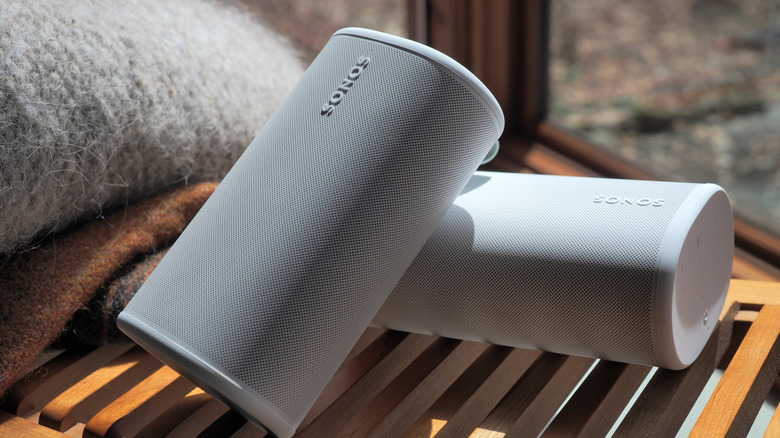
If you had to quantify the Sonos Play, you might say the new portable speaker takes us back to basics with a sprinkle of the old Sonos sparkle. On the one hand it's a (relatively) affordable entry point to multi-room home music; on the other, a Bluetooth speaker that punches above the crowd for sound quality. In fact, the Play arguably straddles Sonos' home and portable speaker ranges in the most convincing way to-date.
Sonos' embrace of battery power felt like an obvious step, when it launched the first Move in late 2019. The Roam — smaller and more affordable — brought some of that convenience (if not all the volume) to a far lower price point. Since then, though, while Sonos has replaced both speakers with second-generation versions, there's been a yawning gap between the $179 Roam 2 and the $499 Move 2.
On price alone, then, the new Sonos Play makes a lot of sense. I won't argue $299 is cheap for a portable speaker, but it's more within the realm of premium-brand options than the Move 2. It took less than one track, meanwhile, to demonstrate that the Play is far more serious as a musical speaker than the Roam 2 is.
Real buttons are welcome
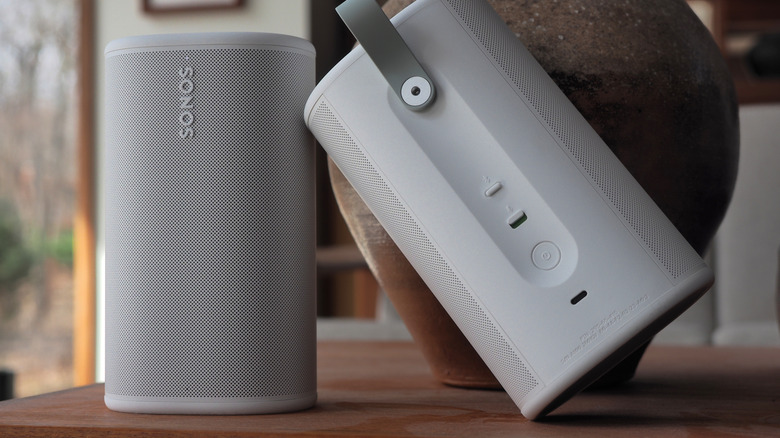
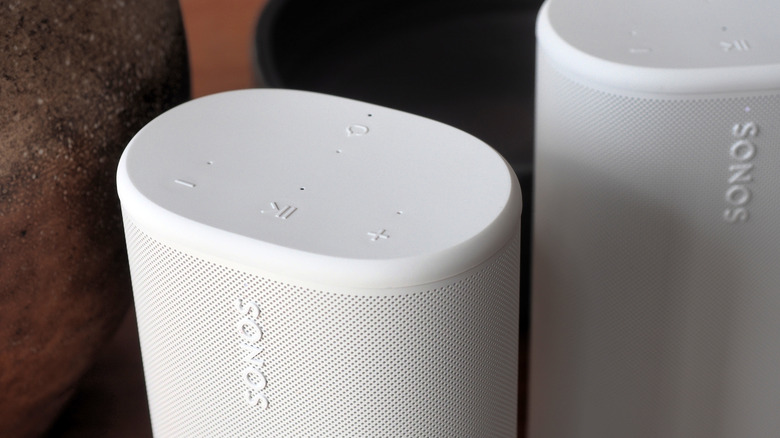
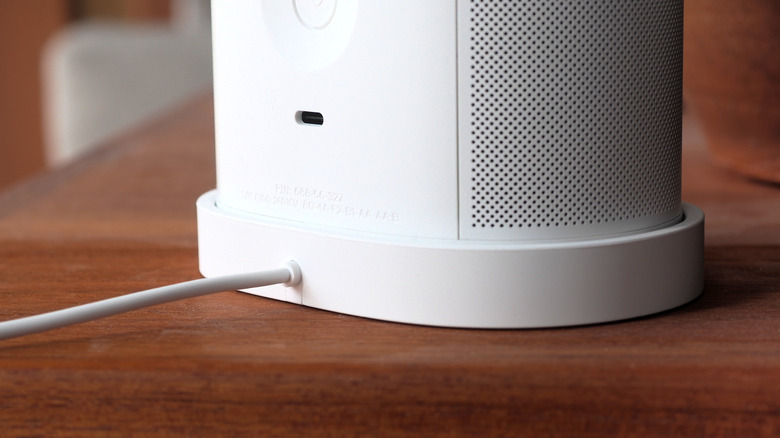
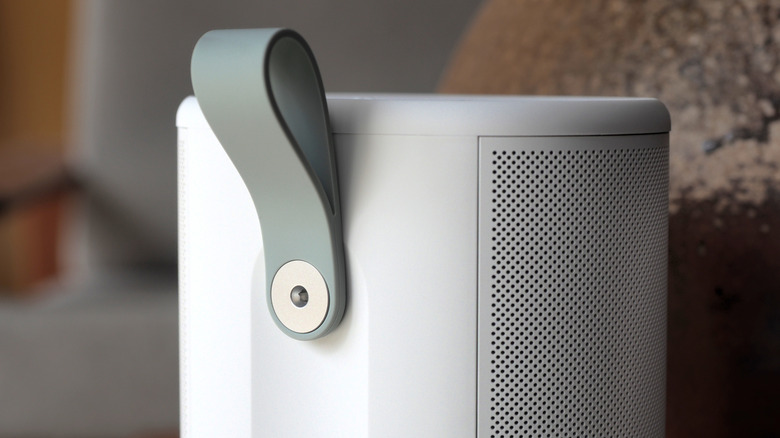
Sonos' design is familiar but refined. The new Play's squashed-cylinder shape can be gripped one-handed; there's a neat little carrying loop on the back, drop-resistance, and IP67 dust and waterproofing should you fumble it nonetheless. You get a charging dock in the box, color-matched to the black or white speaker, but not the USB-C power adapter you'll also require. Physical buttons on the top panel make using play/pause and volume control straightforward, even if you're not looking.
I'm also pleased to see Sonos continuing with a privacy-centric stance. While there's support for Amazon Alexa and the company's own Sonos Voice Control — as well as Siri control over Apple Music alone, alongside AirPlay 2 support — you get both a physical microphone switch on the back, and a voice assistant-specific mute button on the top. With the former turned off, both voice control and auto Trueplay are disabled; the latter allows you to disable the assistants but still keep the automatic EQ working.
While it had a somewhat shaky start, Sonos Voice Control has improved between then and the Sonos Play's arrival. It'll also work when the speaker is connected via Bluetooth rather than WiFi, though only for rudimentary things like playback and volume control. Still, that's probably more than enough for a picnic or backyard party.
Familiar hardware from the Era 100
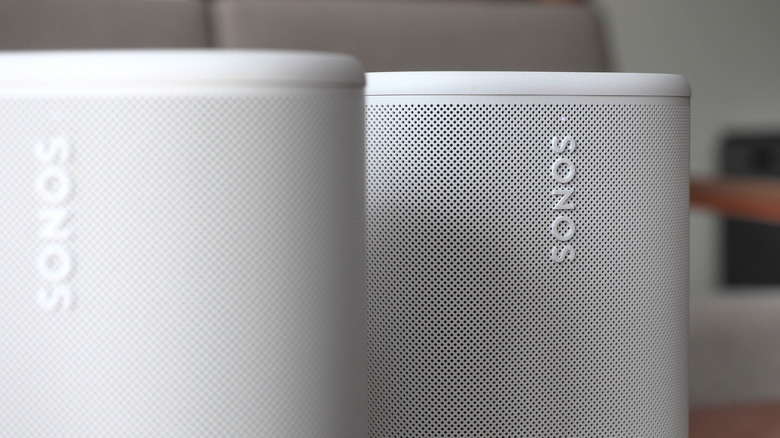
Like the Era 100 launched in 2023, the Sonos Play delivers stereo sound courtesy of two angled tweeters, combined with a midwoofer for mid-range and bass. There's no fancy spatial audio — for sounds that seem to drop down from overhead — as in the larger Era 300. In fact, poised on its charging dock, the Play seems intent on supplanting the Era 100.
As an individual speaker, the Sonos Play is certainly loud enough. It's similar in performance to the Era 100, unsurprisingly, well-balanced with an impressive amount of bass given there's no dedicated woofer (Sonos' portable speakers can't be paired with one of the company's subwoofers). I found I needed to be positioned fairly centrally in order to really hear the promised stereo separation; no great surprise, given the limits of a single unit.
Honestly, I appreciated it more for the overall width of the soundstage, which generally avoided an obvious sweet-spot in the room. It all feels very "Sonos": transparent, without leaning too much on an exaggerated high-end or cranking up the bass in the hope of hiding an absence of midrange clarity.
Bluetooth now gains grouping support
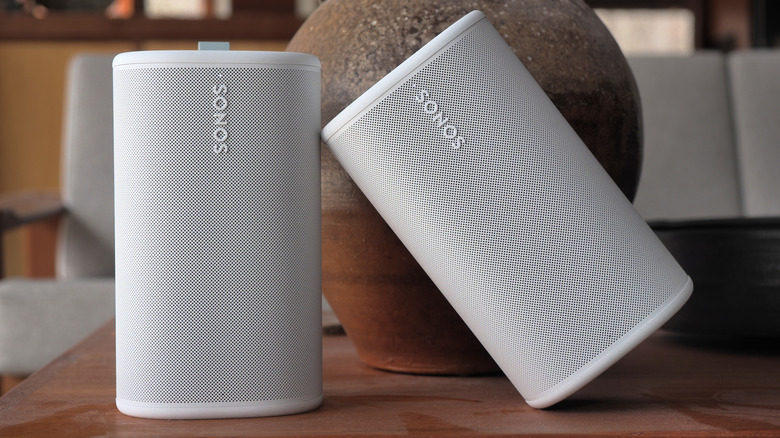
You can add the Play to a group with other Sonos speakers — multiple models all playing the same thing — or you can link two Play speakers together for a proper stereo pair. That obviously improves the stereo separation, the duo putting out more volume on my desk than I'd expected from their relatively compact footprint. Again, expect performance akin to a pair of Era 100's similarly linked.
Thumb the Bluetooth button on the back, and you can link a smartphone (or laptop, or any other Bluetooth source) instead; it'll automatically connect once the Play is out of WiFi range, or if you do so manually. Bluetooth playback doesn't support stereo pairing, but it does now support up to four Play (or Move 2) speakers grouped, and it's really easy to use. When one speaker is connected and playing via Bluetooth, bringing another close and holding down play/pause will link (or subsequently unlink) them.
Software is as important as hardware
Though by default the Play will switch off after 10 minutes idle, when off its charging dock, it woke in a few seconds, reappeared in the app, and a previous stereo pairing was restored a couple of seconds later. Table stakes, certainly, but the sort that — for a while, at least — Sonos products haven't always delivering on. That's with WiFi Power Save and Battery Saver both turned on; disabling them trades some battery life for a persistent connection.
Other niceties — like the 35 Wh battery being replaceable for $69, and the USB-C port being capable of charging other devices such as a smartphone — promise a little more longevity than the average Bluetooth speaker. There's line-in support with Sonos's $19 adapter, too.
Some mention must be made, of course, about Sonos' recent software woes. I've been using the company's speakers for many years, now; like a lot of users, I've found stability taking a downward turn as new features were added. Most frustrating has been stumbling with the basics, like choosing a track from a streaming service in the app, picking a speaker or group of speakers to play it through, and then managing that playlist. Sonos itself had conceded it'd strayed from its original promise.
The good news is that, so far, Sonos' latest version (I've been using Sonos OS S2 build 83.00.36, and each Play speaker is on v18.2 build 94.1-75110) has done exactly what I expected. That's with less than two weeks of testing, mind; not only can I understand skepticism from the so-far Sonos faithful, I share some of it. I want to believe that the company has turned a corner, but only time will tell.
In the speaker sweet-spot
When Sonos announced the Play, my big question was whether it justified the $80 premium over the Era 100. Having listened to them side-by-side, I'm pretty convinced that — unless you really do never intend to take your speakers to the beach, or even just onto a balcony or into the garden — that eighty bucks is a worthwhile price to pay for the Play's 24 hour battery.
Meanwhile, given you can only pair two identical Sonos speakers together for stereo use, the Play makes far more financial sense doubled-up than two Move 2. Though individually less powerful compared to a Move 2, two Play speakers proved plenty for even a decent-sized room. Sonos will sell you such a set for $568, a far cry from even the currently-discounted $798 that two Move 2 costs.
The downside is that Sonos Play can't be used as home theater surround speakers with a soundbar like the Arc Ultra or Beam 2 (a pair of the new microphone-free Era 100 SL speakers, at $189 apiece, would arguably make much more sense for that anyway). And while Play will easily group with Move 2 in Bluetooth mode, it won't with any other of Sonos' Bluetooth-capable models. That's going to annoy the early adopters.
Preaching to the choir
Those loyal early adopters are undoubtedly Sonos' biggest strength along with the source of its most vocal criticism. The latter has certainly had more volume lately, something Sonos' regrouping to focus once again on audio — rather than set-top boxes and other avenues — seems intended to tackle head-on. While it's early days for that reset, the Sonos Play has a lot to recommend it.
It's priced aggressively — in Sonos terms, at least — and, while full-featured, doesn't lose sight of the fact that a great speaker needs to sound, well, great. Easy transition between WiFi and Bluetooth modes, along with genuinely useful features like grouping during Bluetooth playback, help blur the lines between a home speaker and a portable one, but without the sticker shock of a Move 2.
If there's a lingering question, then it's how well Sonos' software delivers its side of the bargain. That's a matter of usability within the Sonos app, yes, but also stability more broadly. As a line in the sand to mark a reboot, the Sonos Play certainly has the hardware chops. Now to see if the broader package holds up too.