

12 Tire Tips That Can Actually Make A Difference
There is a saying that recommends investing in high-quality items that stand between you and the ground — shoes, mattresses, and, yes, tires. However, what many people don't realize is that there are several things people get wrong (or don't know about) when it comes to tire management and care. You see, tires are the only parts of your car that make contact with the ground, yet they are often the most neglected components. Many drivers tend to treat their tires like permanent fixtures of the car, instead of as a perishable, consumable product with a fixed lifespan and maintenance requirements.
They are ignored until a catastrophic failure occurs, such as highway blowouts, hydroplaning in the rain, or discovering during emergency braking that worn tread has erased your stopping ability. All of these things are important because tire wear and failure creep up on you like engine failure or brake failure — it happens suddenly, and usually at the worst possible moment.
The irony is that proper maintenance and care require little effort. A few basic practices and tips can extend your tire life by thousands of miles. These tips are not revolutionary, but many drivers don't know them.
Check the tire pressure only when cold

By this, we don't mean to only look at tire pressure when it's cold outside – we mean before the car is driven, after it's been standing a while. This is because as the car is driven along the road, the friction between the rubber and the asphalt creates heat — and a lot of it. Over sustained periods of driving, the heat transfers through the tire, warming it up considerably.
Air expands when heated, but it has nowhere to go inside the tire because there are no leaks. As such, the pressure inside the tire, measured in PSI, or pounds per square inch, can increase drastically. Some studies have found that this temperature delta can be as much as 5 PSI, which is a lot. Assume that a vehicle's optimum PSI is 60, and it's driving with tires at 50 PSI.
If the driver only measures it when tires are hot, the pressure might show up as 55 or 56, but return to 50 when cold. Driving with underinflated tires can increase fuel consumption, impair handling, and even shorten tire life. So, if you're one of those drivers who only check the tire pressure at the gas station (which is usually after driving for a while), then you could be driving with underinflated tires. Next time, check the pressure first thing in the morning.
Account for the climate you are in
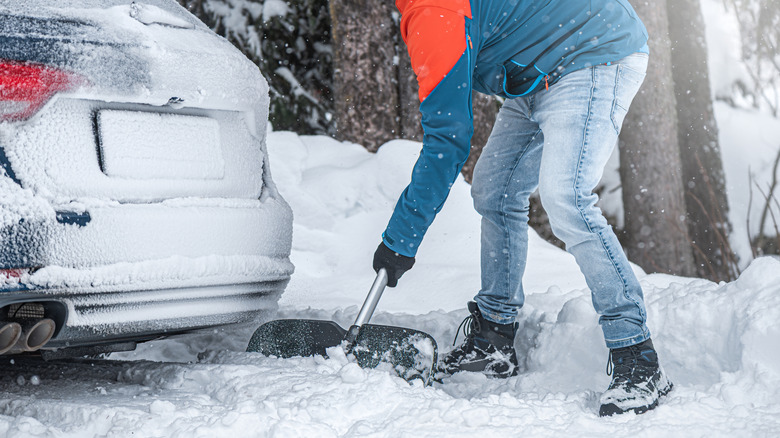
Above, we guided you on when to measure tire pressure, but the climate and environment can also affect tire pressure. For example, the scientific consensus is that for every 10-degree (Fahrenheit) drop in the thermometer, your tire PSI will drop by one point. This is especially important to note in states with sharp seasonal temperatures. Some states plummet over 50 degrees Fahrenheit during the winter, which could reduce tire pressure by up to 5 PSI.
That's another reason that monitoring tire pressure frequently is crucial, especially during seasonal changes. Remember that as the winter turns to summer, the reverse also needs to be accounted for to avoid overinflated tires. Also, if you see your TPMS warning light (usually in the shape of a tire with a flat bottom) come on during a cold snap, this could be the case. As we'll discuss, relying on TPMS data isn't ideal when gauging your tire pressure.
Don't rely only on the TPMS
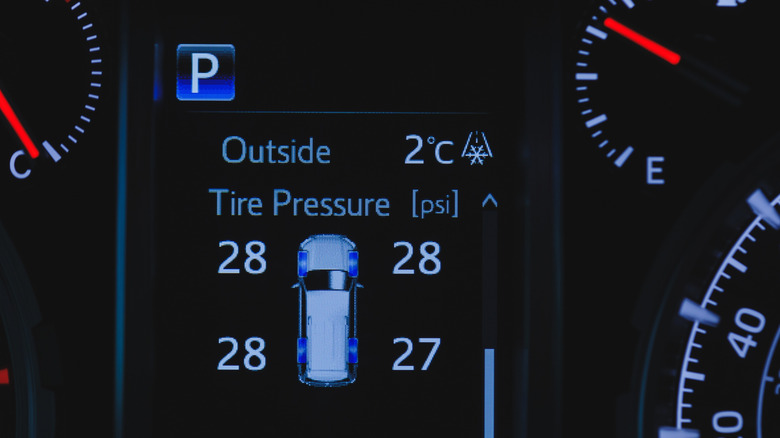
Readers are advised to check their tire pressure at least once a month, though doing it more frequently won't harm anyone. "TPMS" is an acronym for Tire Pressure Monitoring System, and it is included on many vehicles these days. The system alerts the driver if one or more tires are underinflated.
If you've ever noticed that TPMS gear has become surprisingly common in recent years, that's no coincidence. After a slew of accidents caused by underinflated tires in the early aughts, the U.S. Congress updated something called the TREAD Act in 2005. Consequently, many vehicles now ship with TPMS as standard. There are two main types of TPM systems: direct, which measures actual pressure, and indirect, which measures wheel diameter.
TPMS sensors cannot warn the driver when a tire is overinflated (though some direct systems can), and generally only detect underinflation. Especially with indirect versions, TPM systems can have errors and glitches, so it's best not to rely on them completely and do a manual check once a month or so.
The PSI printed on the sidewall is the maximum
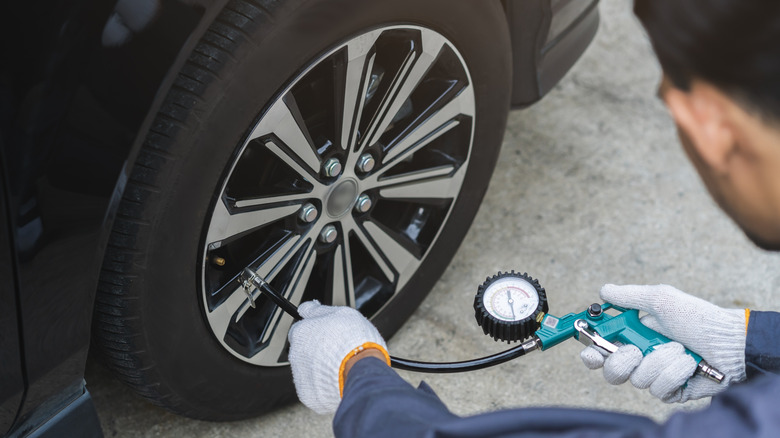
If you ever see a certain PSI stamped on a tire, that's the absolute safe limit that the tire can be inflated to – it's a limit, not a target. The vehicle manual will state the optimum PSI for your tires. Note that a tire's maximum load rating may be lower than the maximum PSI, so be careful. And for those who'd like to know, reading the information on a tire sidewall is actually pretty straightforward.
For instance, it'll usually be printed in a layout like "290/50 R18 95V" — this means the tire is 290 mm wide, and the tire "walls" are 50% of the width, i.e., 145 mm. The R refers to the construction type — radial, in this case — while the 18 means the tire is mounted to an 18-inch rim.
The 95 is what's called a load index, which means that each of the axles shouldn't exceed about 1500 pounds of load, or the tires would be stressed. The V is the speed rating, meaning the tires are rated for about 149 mph operation. Here is a handy guide on how to find your tires' speed rating. The date of manufacture and the pressure rating will also be found somewhere on the sidewall, and the latter is sometimes clearly marked with "Max Press" before the PSI number.
Having properly inflated tires improves fuel economy
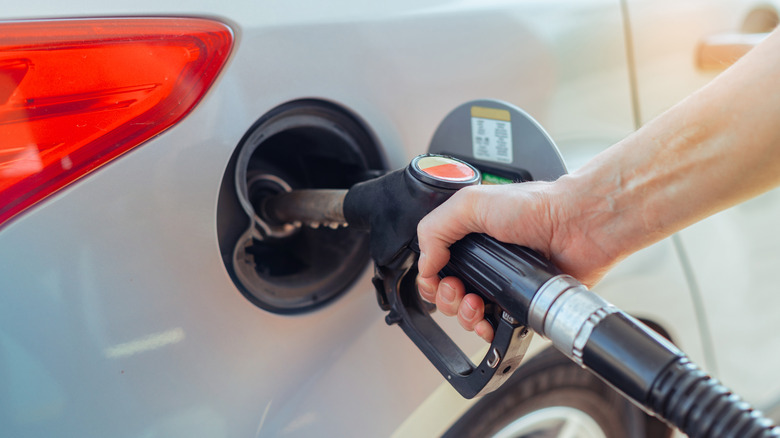
Correct inflation is too important to ignore, beginning with safety. Studies show that for every PSI point that your tires are underinflated, you would lose 0.3% in fuel economy. For every 5 PSI that your tire falls (below the manufacturer-suggested PSI for your particular vehicle), you will lose approximately 2% in fuel economy.
Some may think that too much air is better than not enough, but overinflation is almost as damaging as underinflated tires. Also, filling your tires with nitrogen has exactly zero benefits on real-world mpg, so don't fall for that upsell at your next garage visit.
Use a penny to test how much tread is left
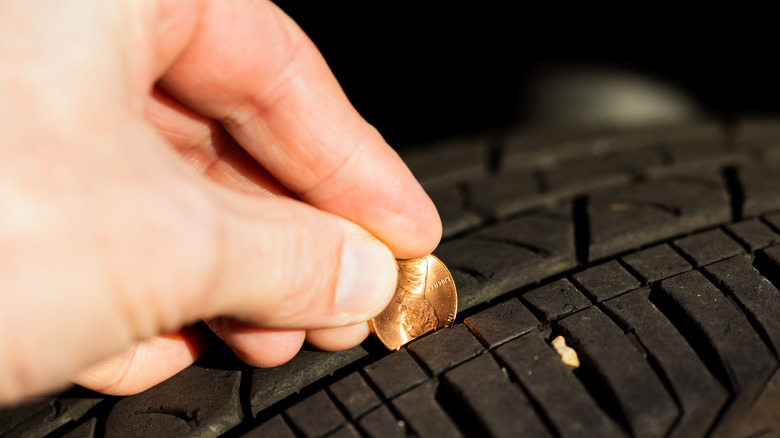
The "tread" is the depth of the grooves on the tire. These grooves help channel moisture away from the surface of the tire, and they help the rubber "columns" in between the grooves flex to increase the contact patch with the road, giving better traction.
As the tire is used, friction will eat away the rubber, making these channels shallower. Eventually, the grooves will become shallow, affecting grip and performance. Now, some tires have "tread indicators" built into the grooves. When the little tread indicator marker is level with the groove, it's time to change.
However, you can also use a standard U.S. penny to check your tread depth. Simply stick the penny into the groove of the tire, with Lincoln's head pointing downwards into the channel. If you can see the top of Abraham's head, then it's time to change your tires. As a final note, there are different types of tire tread patterns, such as symmetrical, directional, and asymmetrical, and experts recommend not mixing and matching between them when getting new tires.
Change your tires at 4/32ths of an inch
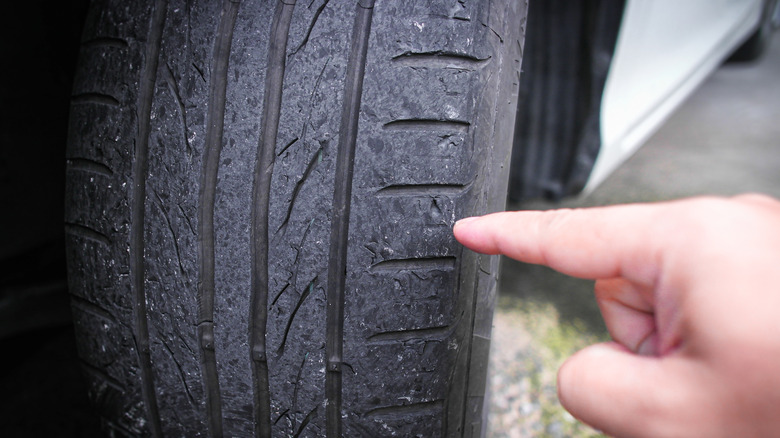
To be clear, the legal limit in most states is 2/32nds of an inch, and the Lincoln penny test only accounts for this limit — but there's plenty of evidence to suggest that an earlier change is the better choice. For one, experts and automakers agree that performance and traction in wet or moist conditions significantly deteriorate beyond the 4/32nds of an inch limit.
What this means for buyers is that if they live in an area that gets a lot of rain or melting snow, then their tires could lose a lot of performance if their tread is below 4/32nds of an inch. The biggest concern is the effect on braking, which is the last function you want to fail.
That's why, especially for people who live in wet areas, changing tires before the legal limit kicks in is highly recommended. Your local store may have good deals, and they will likely do a free PSI check. That said, many buy their tires online, so it's worth doing your research to see if there's a local garage near you, as these rotations are usually free for tires purchased at a garage.
Rotate your tires every 5,000 to 8,000 miles
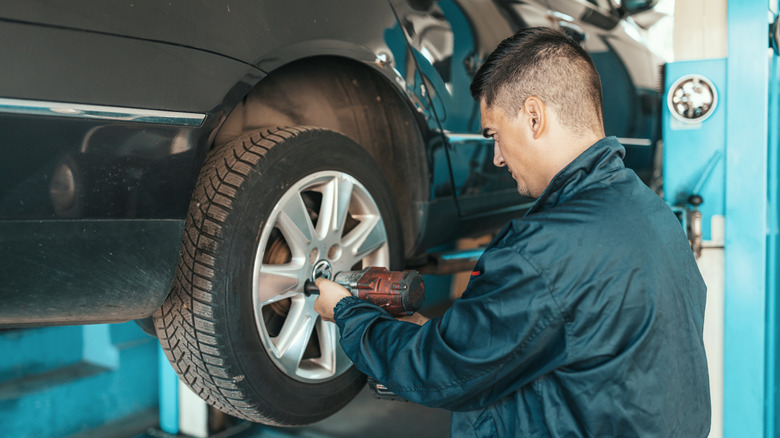
A surprising number of drivers do not realize that tires should be rotated semi-frequently. To be clear, "rotating" your tires means changing the position of each tire. For example, on AWD vehicles, the front-right tire would go to the back-left position after rotation, with the same being true for the other side.
On RWD and 4WD vehicles, the process is slightly different. The back-left tire moves to the front-left, the back-right moves to the front-right, but the front-left goes to the back-right (i.e., opposite), with the same true for the front-right tire.
Lastly, on FWD vehicles, it's the exact inverse. The front-left and front-right tires go to the back-left and back-right, while the back-right and back-left tires go to the front-left and back-right. These change patterns are known as an X-cross pattern on AWD vehicles, a rearward cross pattern on 4WD/RWD vehicles, and a forward cross on FWD vehicles.
There are several key benefits to rotating your tires, including maintaining tread depth, evening tire wear, minimizing traction loss, and improving fuel efficiency. Lastly, studded tires should always be rotated by simply exchanging the front and back tires, with no crossing over from left to right at all.
Your tires age, even if the tread looks okay
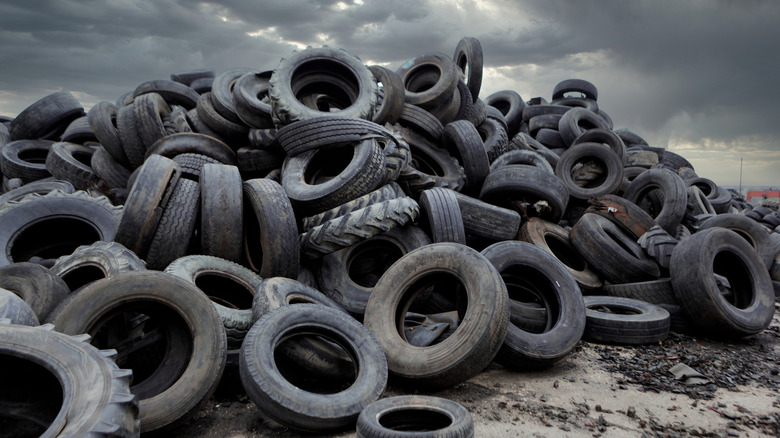
Most, if not all, of the major tire brands say to replace tires every six to 10 years, regardless of tread. The manufacture year for your tires is found on the sidewall. While durable, rubber is a perishable material that withstands a lot of abuse from weather, moisture, and varying road surfaces.
Even if a car is not driven, rubber degradation remains inevitable. Oxygen, ozone, and temperature fluctuations slowly crack and harden rubber, severely compromising performance and safety without visible wear and tear. Even the longest-lasting car tires will need to be swapped out in time.
Try to match your tires
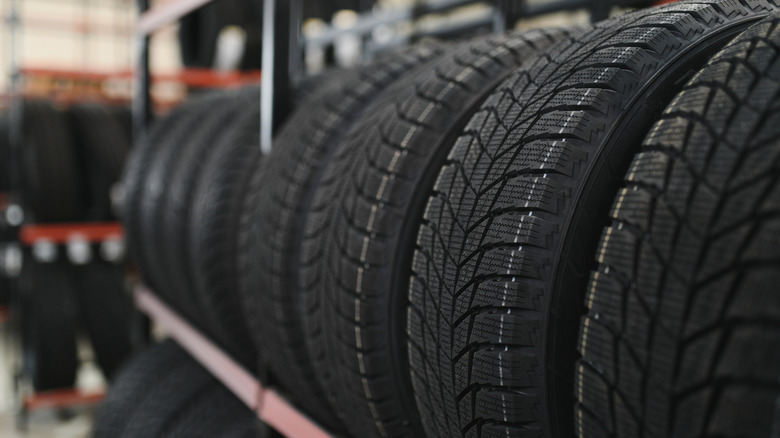
It's best to avoid mixing and matching the types of tread on the tires of your vehicle. If your tires have symmetrical treads, don't buy tires with asymmetrical or directional treads when you go to buy new ones. There's also the situation where people don't change all four tires at the same time. Sometimes, that's an acceptable cost-saving measure. However, not all vehicle types can get away with this.
On FWD and RWD vehicles, change tires in pairs — both front, or both back. However, on AWD vehicles, it's recommended to change all four tires at once. This is because having uneven wear on even a single tire can put insane amounts of stress on the AWD system, leading to expensive and hazardous breakdowns in the future.
That said, we should point out that this can be prohibitively expensive: what does one do when just a single tire gets damaged on an AWD vehicle? Instead of replacing all four tires, you can buy a "shaved" tire, where a shop fits a new tire to your car, then grinds down the treads to exactly match the other three, removing the stress from the AWD system. It's a neat trick if you're looking to save a few hundred dollars.
Don't ignore small vibrations while driving

We've all noticed an odd squeak or rattle while driving. While mostly innocuous, drivers should pay attention if these noises persist. When tires, wheels, or the brake systems develop imperfections, these usually first show up through odd squeals, rattles, and sometimes vibrations. It could be anything from uneven tread wear to internal damage or misalignment as a root cause, but it's always worth looking into.
For instance, steering that shakes, wobbles, or "gives" is most likely caused by a problem with the front tires on your car. You don't need to rush to a garage every time you hear something out of the ordinary, but it's worth noting at your next service. An experienced mechanic will figure this out in no time. If new tires are recommended, don't skimp on quality. There are plenty of cheap tires that are really high quality, while others are cheap tires to be avoided at all costs — so it's best to do your research.
Tire repairs aren't always safe
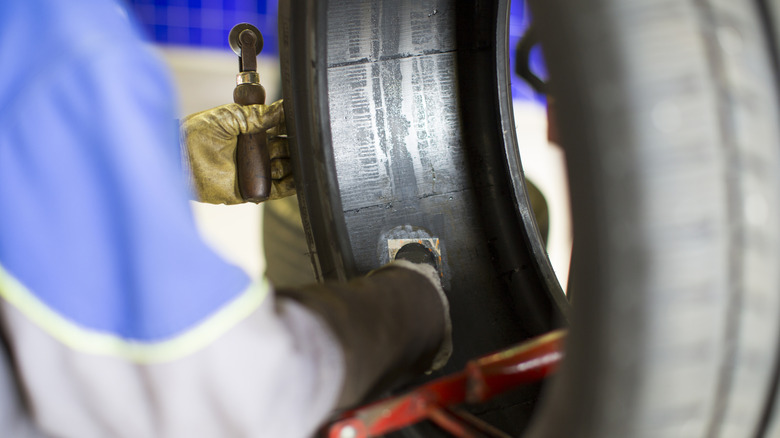
Sometimes, you'll be offered repairs rather than replacement. Here, you should exercise caution, as not every type of tire damage can be fixed or mitigated through repair. For small punctures that are in the so-called "tread zone" of the tire, getting a patch put on it with proper sealant (applied to the inside) can be fine.
This is certainly the more cost-effective option. Again, it's typically unwise to replace only one tire, so a patch could save several hundred dollars. Additionally, because of the low profile (read: thickness) of patches on tires these days, the wearing of the tread on all your tires will remain unaffected, which means less stress on all associated systems on the car. However, the downside is that it will be less durable than a new set of tires.