

4 VPN Services To Avoid, According To Customer Reviews
Virtual private networks, commonly known as VPNs, have been a big part of the internet-browsing landscape since the start of the 2020s. Data from Security.org suggests that 75 million Americans use some sort of VPN. There are plenty of reasons to use one, from bypassing region locks on streaming content to supposed security and privacy benefits, though it's worth noting that VPNs can't really provide anonymity on the internet.
No matter what you want to use a VPN for, though, there's probably a service out there for you. The best VPN services out there, such as Nord VPN, Surfshark, and Private Internet Access (PIA), offer all the basics and generally provide extra features such as ad blocking, threat protection, and split tunneling. They also have audited no-logs policies to reassure users that their browsing data is, allegedly, not stored on the VPN's servers.
There's generally no need to hunt far and wide for a VPN; the popular ones are, for better or worse, generally the best ones. That said, not every VPN out there is good; some come across particularly poorly based on user reviews due to issues including scammy behavior, poor performance, and fake server locations. Here are four that are best avoided.
A quick note before we start: VPN pricing is notoriously hard to compare. Most VPN providers entice you with steep discounts on your first billing cycle, and even the best providers require you to commit to two- or three-year subscriptions to get the lowest prices. Thus, while we'll touch on price here, you should do your own research.
VirMach

VirMach is not your typical VPN provider. We mean that literally: It's not a service like PIA or Proton VPN, which gives you a browser plugin or desktop app that does all the fancy VPN work for you. Instead, VirMach is in the business of virtual private servers (VPS).
This essentially gives you a virtualized server instance that lets you do almost anything you could want to use a server for — including hosting your own private VPN. This isn't as straightforward as a typical VPN service, but it does offer several benefits, including a dedicated IP (which reduces the likelihood of being blacklisted, for example), scalability, and the fact that you're not beholden to a VPN provider's whims and any Terms of Service changes. This is a feature set that's hard to replicate with a ready-to-go VPN, although you can at least get a dedicated IP as an extra-cost add-on from most major VPN companies including PIA and Nord VPN.
If the other benefits of a private VPS-based VPN appeal to you, then you'll want to turn more trusted names in the space, such as Kamatera, Ionos, or KnownHost. VirMach, for its part, has a terrible reputation with customers, with many claiming poor uptime and that it's an outright scam. Those of you tech-savvy enough to consider a VPS will want a reliable provider, and VirMach looks far from that. Given that the website itself is barely functional as of March 2026, we think this is very much a case where judging a book by its cover is entirely fair.
PrivadoVPN
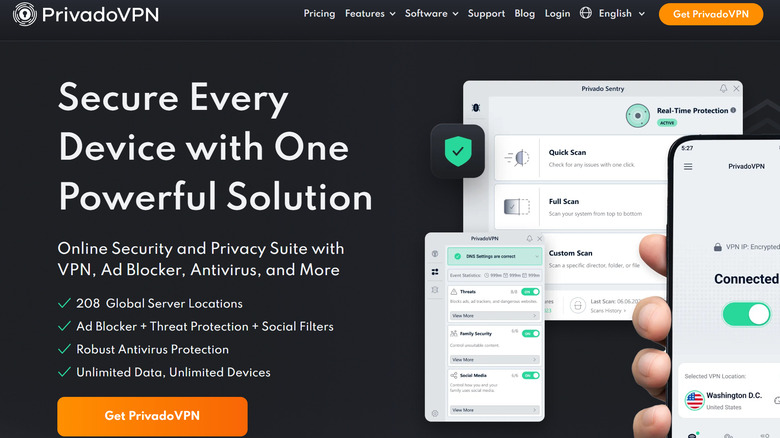
One of the notable characteristics of the VPN landscape of the mid-2020s is the ownership consolidation behind the scenes. Ostensible competitors like Nord VPN and Surfshark, for example, are actually under the same corporate umbrella. While that isn't necessarily a problem, those of you seeking something different may come across PrivadoVPN. However, customer reviews indicate that it's not a great choice — even if we'd we'd categorize the user opinions as "mixed" instead of "abysmal."
The main reason to consider this VPN over others is its free plan. Privado gives free users 10 GB monthly and claims to offer 12 server locations worldwide. It's compelling, but Proton VPN's free tier offers unlimited bandwidth across one device and servers in 10 countries, albeit with no way to choose which server you connect to. Privado's paid plans are nothing out of the ordinary, with users able to get pretty much the same features from Surfshark, for example. Privado does have a cost advantage, though, with even the one-month plan coming in at $12.99 versus the $15.99 Surfshark asks for one month of its most basic plan.
While the price might be tempting, customer reviews indicate that the VPN's services don't live up to the promises. Users often claim that the servers are problematic, either being blacklisted by common websites or turning out to be so-called fakes in different locations than advertised. Customers also allege that the company isn't that great at honoring its 30-day money-back guarantee. You could do worse, but we'd argue there's little reason to try Privado unless you really need a free VPN. Even then, you're probably better off trying Proton first.
HMA
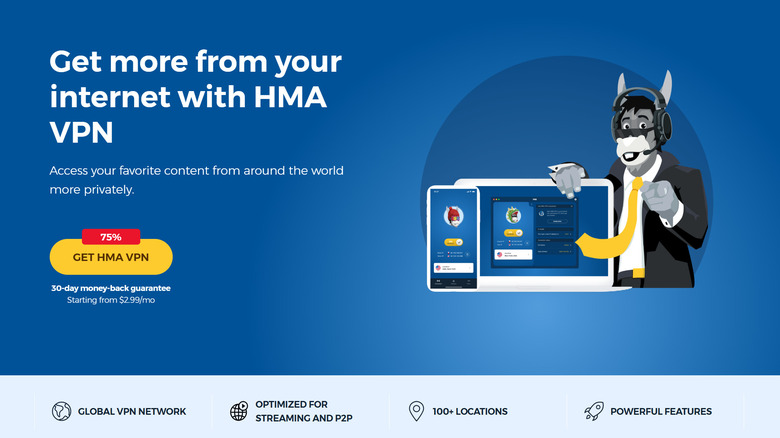
As far as VPN services go, HMA is one of the originals. Founded in 2005 by a 16-year-old schoolkid from the U.K. under a longer, and definitely more vulgar, name, HMA in its original incarnation was likely the first free VPN many users tried, by virtue of it having gone viral more than two decades ago. HMA is now far removed from its humble origins, having been acquired by AVG in 2015. AVG was, in turn, acquired by Avast! in 2016 — yes, that same Avast! that got into trouble for selling anonymized user data. Not a good start, then.
HMA's feature set is pretty standard for VPNs but lags behind some other prominent services when it comes to extra features. The VPN claims to have a no-log policy, a kill switch feature, split tunneling, AES-256 encryption, and servers in more than 100 locations worldwide. That's not bad, but a service like ExpressVPN has all of that and more. For example, it has 105 locations, split tunneling, and AES-256 encryption, and adds nice-to-haves like an ad blocker, gaming-capable servers, and a threat manager. HMA also only maxes out at 10 devices per account, whereas ExpressVPN lets you connect up to 14.
HMA isn't cheap, either. A 12-month plan for 10 devices will run you around $95, which is close to identical to ExpressVPN's non-discounted rate of around $100 for 12 months. To top it all off, users really dislike HMA, with many complaints of scammy behavior, poor performance, and fake servers that aren't where HMA says they are. The latter is especially troublesome, as finding a server close to you is ideal for maximum performance.
UltraVPN
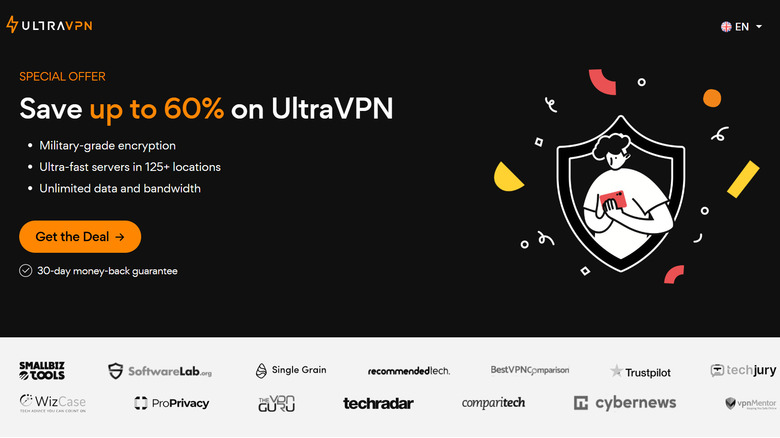
On the face of it, there's not much that sticks out about UltraVPN. Sure, it relies on the same iffy discounted-then-not subscription model of most VPNs, which give you a steep discount on the first year (or more) then hits you with the full fee after that, but it's hardly alone in doing so. Its advertised capabilities all seem decent, too, with must-have features like a kill switch, a no-logs policy, streaming support, and AES-256 encryption. It even offers some value-adds in the form of a dark web scanner and a password manager — both included for free even on the cheaper tier.
Unfortunately, customers claim that UltraVPN's business practices aren't great. Complaints abound from subscribers who claim that they were charged renewal fees out of the blue, even after canceling their subscriptions. Now, some of these may simply be out of ignorance of how auto-renewing subscriptions work, but it's not a good look — especially when there's nothing here that you can't get elsewhere.
Most major VPNs will provide the same core functions, although not all will have the dark web monitoring. Two that do are, thankfully, quite highly-rated: both Nord VPN and Proton VPN offer the functionality with their paid plans. Integrated password managers perhaps aren't as common, but you don't really need one: There are plenty of great free solutions like Proton Pass and Bitwarden available. Sure, the idea of bundling a password manager into your VPN may seem appealing, but there's genuinely little reason to do so. UltraVPN isn't even that cheap, either, with its basic $99/year plan costing more than Proton VPN's $84 yearly plan (both prices after the discount period ends).