

Sorry, The 2026 Jeep Grand Cherokee Really Doesn't Need A HEMI
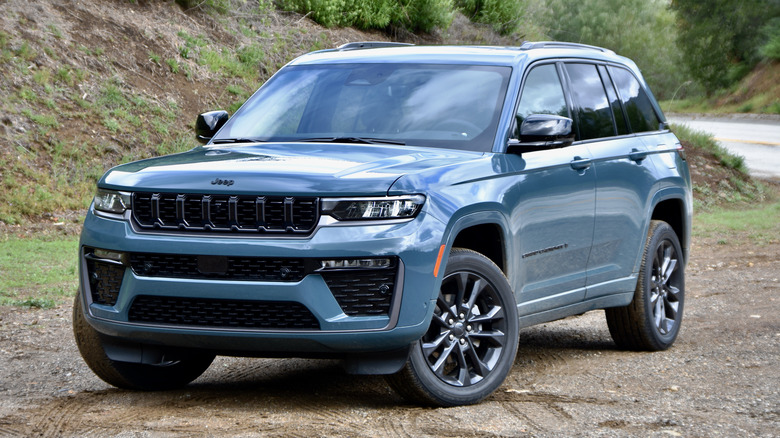
No American suburban scene is complete without a Jeep Grand Cherokee, and there's a reason for that. The Grand Cherokee made a strong first impression not only because it was driven through a window (search "1993 Jeep Grand Cherokee reveal" on YouTube) but because it marked an important stage in the evolution of the SUV. It took the concept of the Range Rover and Jeep's own Wagoneer—combining off-road capability with car-like amenities—to a wider audience.
Three decades later, the Grand Cherokee is still many new-car shopper's go-to option for a rugged vehicle that can also serve as an everyday family hauler. But its evolution has slowed. The current-generation Grand Cherokee—known as the WL—dates back to the 2021 model year and receives only a few changes for 2026. The biggest news is under the hood, where a new four-cylinder engine debuts as the 4xe plug-in hybrid powertrain bows out.
This year's Grand Cherokee may not shift paradigms like the original, but all Jeep needs to do is hold the line against other aging models like the Ford Explorer, Nissan Pathfinder, and Honda Pilot, with the newer Chevrolet Traverse, Honda Passport, and Toyota Grand Highlander offering fresher competition. And luckily for Jeep, there wasn't too much about the WL Grand Cherokee that needed fixing in the first place.
It's what a modern Jeep should look like
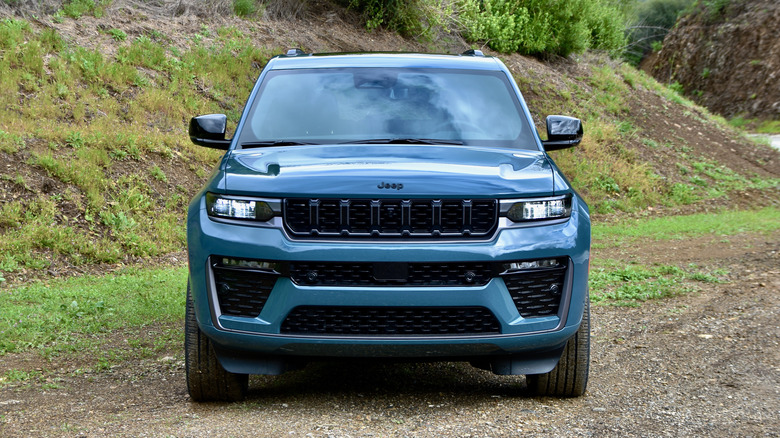
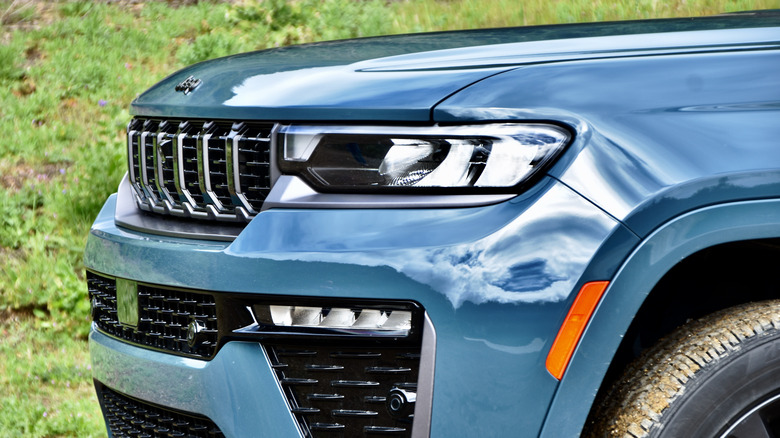
The Grand Cherokee is a great example of channeling a brand's history without descending into retro pastiche. There are some references to past Jeep models, but this design still stands on its own and is aging gracefully.
With a long hood, relatively flat sides, and a greenhouse scooted all the way to the back, the shape is a lot more angular than previous Grand Cherokees, but channels a bit of the classic SJ Cherokee and Wagoneer. Trapezoidal wheel arches, along with the forward-leaning front fascia, add to the effect. Yet the lack of extraneous detailing and reasonably-sized grille make the WL Grand Cherokee look clean and modern. And while it's still a large, imposing SUV, it also avoids the visual bloat of today's Grand Wagoneer.
Jeep also has no need to update the styling because rivals haven't quite caught up. The Toyota Grand Highlander looks like an enlarged version of the last-generation RAV4, while Ford, Honda, and Nissan are still trying to telegraph the car-like crossover underpinnings of their midsize SUVs like it's 2016, not 2026. The Grand Cherokee does look a bit plain compared to the latest Hyundai Palisade and Santa Fe, as well as the Honda Passport, however.
The new engine is great
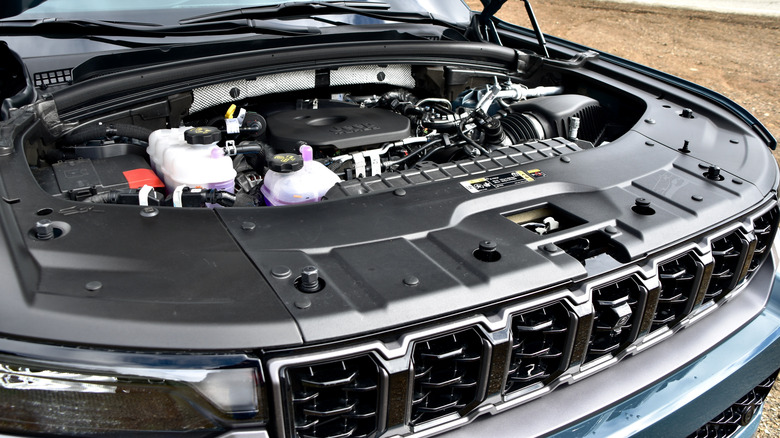
The most noteworthy change for the 2026 model year is a new turbocharged 2.0-liter four-cylinder engine dubbed the Hurricane 4 Turbo. It's completely unrelated to the 2.0-liter turbo-four used in the Wrangler, and while it shares a name, bore, and stroke with the Hurricane inline-six used in the Grand Wagoneer and other Stellantis products, that's where the similarities end. Jeep actually intended the name as a reference to four-cylinder engines produced by predecessor Willys.
Engineers threw everything they had at the Hurricane 4. It has a variable-geometry turbocharger for maximum effectiveness at all engine speeds (with an intercooler), runs on the Miller cycle for increased efficiency, and features passive pre-chamber ignition, in which a tiny bit of fuel is ignited with a second spark plug, creating a mini blowtorch that shoots down into the main combustion chamber to burn the fuel-air mixture more evenly. It's a simplified version of what Jeep cousin Maserati uses in V6 engines for its MC20, Grecale, and GranTurismo.
The result is 324 horsepower and 332 pound-feet of torque. That's 54 hp and 37 lb-ft more than the Wrangler's 2.0-liter turbo-four—achieved without premium fuel. This engine is standard in most Grand Cherokee trim levels for 2026, but the base Laredo and Laredo X continue with the Pentastar 3.6-liter V6, producing 293 hp and 260 lb-ft of torque.
But powertrain choices are still limited
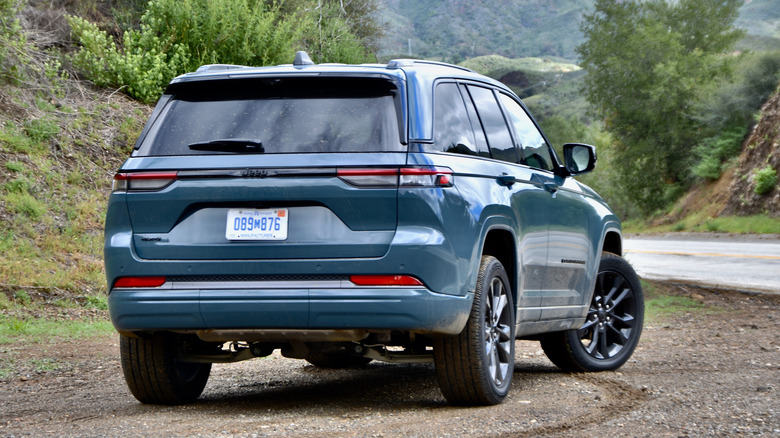
Adding a turbo-four to the lineup definitely makes sense, and Jeep deserves credit for putting so much effort into this one. Rivals like Ford and Chevy are also offering four-cylinder engines, but the driving dynamics of the Hurricane 4 stand out. On some of California's best driving roads, it was the only part of the Grand Cherokee that felt situationally-appropriate, dolling out power effortlessly and playing well with the eight-speed automatic transmission that's standard on all Grand Cherokee models regardless of powertrain.
Four-cylinder models also have the same impressive 6,200-pound towing capacity as those equipped with the V6, but we suspect we'd have an easier time towing close to that limit with the 5.7-liter Hemi V8 that was last offered on the three-row Grand Cherokee L for the 2024 model year (it was discontinued for the two-row version after 2023). That engine, which made 357 hp and 390 lb-ft of torque, recently made a comeback in the Ram 1500 pickup, so we wouldn't be surprised to see it back under the Grand Cherokee's hood in the future.
And while Jeep's estimated 27 mpg combined is not bad (it's 5 mpg higher than the V6), the just-discontinued Grand Cherokee 4xe plug-in hybrid could be driven up to 25 miles on electric power alone (with 23 mpg combined fuel economy after that), and was available in Trailhawk spec with all-terrain tires and sway-bar disconnect for off-roading.
It's refined, but not sporty
The original ZJ Grand Cherokee impressed reviewers with its combination of SUV brawn and car-like driving dynamics, and today's WL is true to that lineage. It's impressively comfortable and refined for a mainstream SUV. The low levels of cabin noise and the smooth ride quality of the standard steel-spring suspension (air suspension is also available) will keep luxury brands honest.
That being said, the Grand Cherokee drives like the hefty SUV it is. The twisty drive route didn't flatter its slow steering, and while the suspension is great at cushioning bumps and keeping wheels on the ground off-road, it's out of its comfort zone dealing with weight transfer in corners. The Hurricane engine has plenty of power, but a Ford Explorer Tremor equipped with the optional 400-hp twin-turbo V6 is even fleeter.
On a Jeep's home turf, the two-row Grand Cherokee's 8.4 inches of ground clearance (8.5 inches for L models) is a few tenths less than a Tremor's, but more than most other midsize SUVs. The optional air suspension also bumps that up to 10.9 inches, and is packaged with a two-speed transfer case in the top Summit trim level. However we didn't get to test any of that out due to rain-soaked ground at the planned off-roading site.
The interior looks very familiar
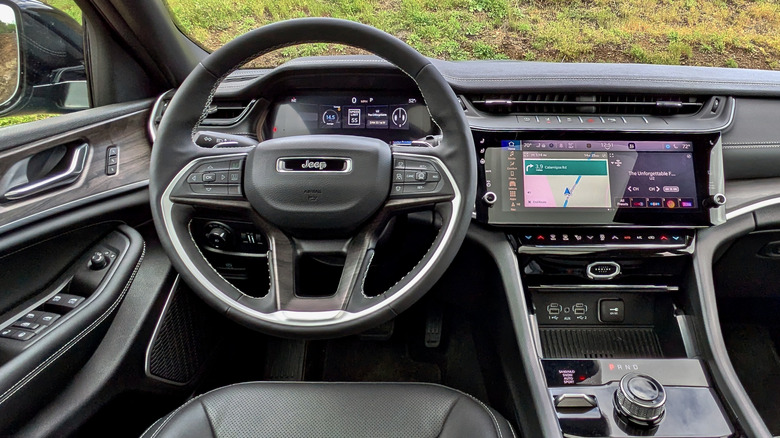
Perhaps because it has nothing to prove, Jeep eschews rugged interior design elements like the Nissan Pathfinder's chunky touchscreen surround, instead aiming for Land Rover-like sophistication. The Grand Cherokee's dashboard is a bit more cluttered than a Land Rover's, however, and looks very similar to that of the cheaper Jeep Cherokee, which is redesigned for 2026.
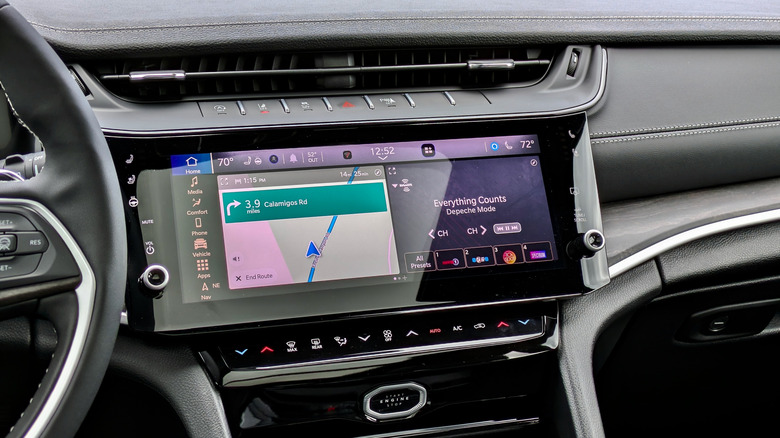
The screen setup—a standard 10.25-inch digital instrument cluster and 10.25-inch touchscreen, with a 12.3-inch touchscreen available on higher trim levels—is also nearly identical to that of its non-Grand sibling. The only difference is an optional 10.25-inch front-passenger screen that makes us wonder what kind of deal Stellantis got from its supplier for these displays.
The Uconnect 5 infotainment system is also unchanged, but there's nothing to complain about other than an unimaginative instrument-cluster layout and the questionable utility of the front-passenger screen. You still get wireless Apple CarPlay and Android Auto, and if you actually go off-road the dedicated Off-Road Pages menu includes cool readouts like an inclinometer.
The Grand Cherokee elevates things with available features like a 19-speaker McIntosh audio system, leather upholstery on the high-end Limited Reserve and Summit models (others have cloth or leatherette upholstery), and Active Drive Assist for highway driving, with hands-off capability similar to General Motors' Super Cruise and Ford's BlueCruise. But it can't shake the rental-car feel baked into base models, especially when it comes to interior trim.
Interior space is still competitive, but there's one functionality misstep
While some newer competitors have come along since the current-generation Grand Cherokee's introduction, the Jeep still offers comparable interior space. Whether you choose the two-row model or the three-row Grand Cherokee L, you'll find similar headroom to rival SUVs across all three rows, albeit with less legroom than most competitors. It's another plus for Jeep, and a welcome indicator that vehicular size creep is finally slowing down.
Both versions of the Grand Cherokee have less cargo space than most rivals but, at 37.7 cubic feet behind the second row and 70.8 cubic feet behind the first row for the two-row version, and 17.2 cubic feet/46.9 cubic feet/84.6 cubic feet behind rows three/two/one for the Grand Cherokee L, it's still a lot. With the seats in place, the available Fam Cam also lets parents keep an eye on children. That's a feature normally seen on minivans which, incidentally, make it easier to load and unload kids or cargo thanks to their sliding doors and a lower step-in height.
A minivan is theoretically inadequate for those with active lifestyles, of course, but the haptic touch points for the Grand Cherokee's climate controls don't exactly scream "rugged" either. Designers might love the way they declutter the dashboard, but customers won't like using them.
2026 Jeep Grand Cherokee verdict
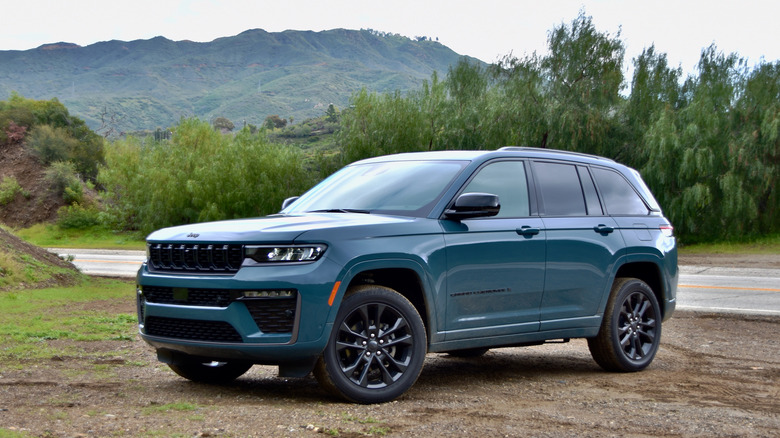
For 2026, Jeep dropped the Overland and Summit Reserve trim levels, as well as the aforementioned Trailhawk, leaving the Laredo, Limited and Summit. But Laredo X, Laredo Altitude, Limited Altitude, and Limited Reserve packages serve as half-steps between them.
At $40,410 for the base Laredo with rear-wheel drive, the Grand Cherokee is more expensive than before but still competitive with other midsize SUVs. The Grand Cherokee L is an extra $2,000, as is four-wheel drive on all but the $53,405 Limited Reserve and $62,190 Summit, where it's standard. These two high-end trim levels are arguably the best value, as Jeep claims the Limited Reserve offers similar equipment to the Overland for $6,000 less, while the Summit is similarly-equipped to last year's Summit Reserve but $5,000 cheaper. The Jeep's stately design and driving experience are also better-matched by those well-equipped trim levels. Some V8 rumble would also be a perfect match, but the new Hurricane 4 engine is a more logical option.
The Grand Cherokee is probably still the best in its segment off-road, but the off-road variants of competitors have gotten good enough that it may not matter. A Ford Explorer Tremor can already get much further off-road than most people will take a vehicle like this, for example. It's as a cheaper alternative to luxury SUVs that the Grand Cherokee really stands out, even if its interior and tech aren't quite there and powertrain options are limited.