

5 Honda Models Likely To Last 250,000 Miles – According To iSeeCars
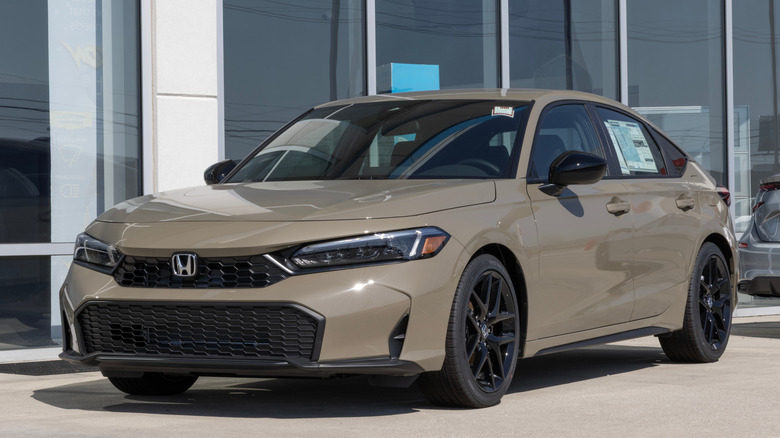
Some drivers never stick with any one car for long, while others are absolutely in it for the long haul. That vehicle could be your pride and joy, or your legacy to the next generation, even. In both cases, starting with as low a mileage as practically possible is probably the goal. For the latter type of driver, the mileage that a vehicle is practically and realistically able to reach is more of a priority. 250,000 miles, to put the number in perspective, is very close to the furthest distance between the Moon and the Earth (252,088 miles precisely, according to Royal Museums Greenwich). Sadly, a road trip to the Moon isn't in the cards, but if it were, perhaps a trusty Honda would be the model to take you there. After all, in 2025, Honda made SlashGear's list of the most reliable car brands you can buy.
In October 2025, iSeeCars published a study of various vehicle models. The angle was this: Which models are most likely to make it to 250,000 miles on the clock? It is, undoubtedly, a very tall order indeed. In fact, Karl Brauer, iSeeCars Executive Analyst, reported that "the average car [has] a 4.8% chance of reaching 250,000 miles." Brauer went on to note that the model in 25th place out of the 25 studied, the Acura MDX, almost doubles that, at 9.1%, while at the very top is Toyota's Sequoia: "With a 39.1% predicted chance to reach 250,000 miles, the Sequoia is more than eight times as likely to hit that milestone as the average vehicle." In between those two models on the list, though, are five hardy Hondas. Let's take a look at each of the five Honda models in turn and the score they received in the study.
Honda CR-V

The lowest-placed Honda model to feature in the rankings scored 20th place out of 25. iSeeCars awarded the model a 10.6% chance to reach 250,000 miles. It's unsurprising that the CR-V was declared to be a long-lived vehicle in the study, as it has considerable past form in this area. Warrantywise, a warranty provider in the United Kingdom, concluded that it was the most reliable SUV of all, with an 85/100 on the outlet's Reliability Index. This resource takes into account critical factors like the vehicle's age and the average cost of repairs needed (as well as how often, on average, a driver can expect to need to have them repaired).
In the United States, the CR-V was introduced for the '97 model year, at a base price of $19,300. In its native Japan, it debuted in 1995, with Honda boasting of more than 15 million global sales of the vehicle family on the occasion of its 30th anniversary in 2025. Needless to say, it has developed significantly over three decades, with a total of six different generations being introduced in that time. 2006's generation three model, for instance, added a more sophisticated suspension and the 2.4L i-VTEC powertrain, which helped to underline efficiency, safety, and performance. With generation five, which was introduced a decade later, Japanese models included the Honda SENSING features as standard for the first time. These tools, which now include the likes of Adaptive Cruise Control, Traffic Sign Recognition, and Road Departure Mitigation System, help to keep the driver safe and, by so doing, help increase the vehicle's lifespan by reducing the need for costly repairs. In a review of the 2025 Honda CR-V Hybrid, SlashGear noted, "Decades into its run as one of the top compact SUVs, the CR-V still has a lot going for it."
Honda Civic
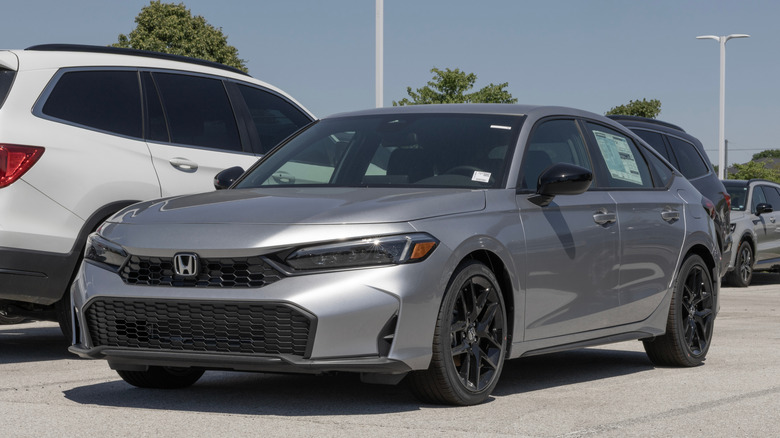
The second model from the Japanese auto giant's repertoire to appear on iSeeCars' list is one of its most iconic: the Honda Civic. It takes 17th place, with the outlet concluding that the Civic has a slightly higher chance of reaching 250,000 miles on the odometer than the CR-V: 10.9%, topping Lexus's RX (10.7%) and the GMC Sierra 1500 (10.8%) in comparison.
The Civic has a reputation for reliability among Japanese compacts, with J.D. Power declaring it to be overall more dependable than the Toyota Corolla in a reliability showdown between the two in 2025. This is a true icon of Honda's lineup and the auto world as a whole, as the numbers demonstrate. In 2022, Honda marked a half-century since the Civic's 1972 introduction, noting that, in that time, 27 million of them had been bought. According to the brand, "the name 'Civic' summed up Honda's ambition to create 'a car created for citizens and cities,'" a relatively humble and understated model built around the concept of fuel economy and reliability. Given the fuel crisis of 1973, it was the right time to introduce such a model, and 1972's U.S. debut of the Compound Vortex Controlled Combustion engine demonstrated that Honda was serious about efficient and more eco-friendly operation.
As of the beginning of 2026, there have been almost a dozen generations of the Civic. Some made rather dramatic changes (the rather larger 6th generation model for instance), while others focused more on the details that underscore the Civic's reliability: The 9th generation, introduced in 2011, boasted reduced weight and Eco Assist technology for even more efficiency, and Honda also boasts that, with this generation, "a renewed focus on safety helped the Civic earn a five-star Euro NCAP safety rating — the highest rating possible."
Honda Odyssey

The next Honda model to appear on iSeeCars' list makes another considerable leap upwards in the rankings. It's the 12th most long-lasting model to appear in the study, with the outlet giving it a 13% chance to reach the lofty goal of 250,000 miles driven. The Odyssey is a minivan, an appropriate name for a vehicle designed for longer adventures. This was Honda's very first model in that milieu, and it isn't as big as some models in its class. Instead, MotorTrend reported in March 1995, "the Odyssey is smaller than all other minivans except for the familiar Mazda MPV and the short-wheelbase Chrysler and Ford Aerostar minivans." This is important because those accustomed to driving smaller models of car, for instance, often won't find anything very mini about a minivan. They can even be a little intimidating as a result.
In 2025, iSeeCars gave the Odyssey a reliability ranking of 8/10. The outlet noted that a new model is typically driven for 13,069 miles per year during its first decade in use, and that it can quite often hit 200,000 miles on the clock when well cared for (25.5% of models reportedly reach this number). On average, they can be expected to hit 159,500 miles. Since its debut in 1995, the Odyssey has advanced through five separate generations, implementing features to bolster performance and reliability as it has done so. The 2026 Odyssey boasts Snow Mode to help with traction in the trickiest conditions, as well as the Honda Sensing range of safety features that are included in models such as the Honda CR-V. In our review, we note that the 2026 Honda Odyssey "will make you rethink minivans," reflecting the idea that the family still serves well as a sort of transitional piece.
Honda Pilot
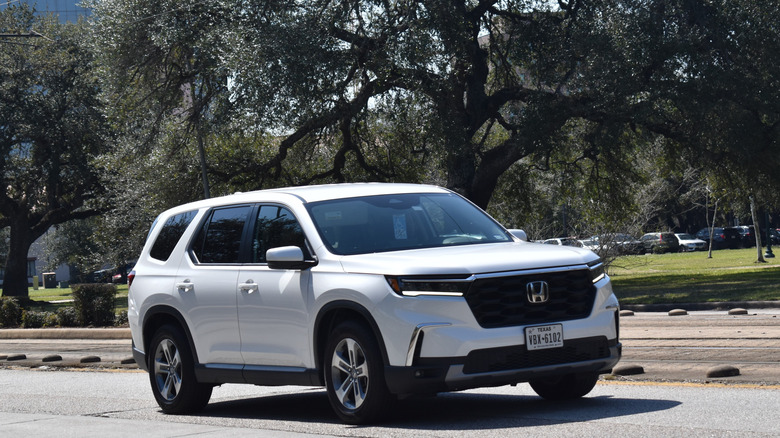
In 11th place on iSeeCars' list, topping the Odyssey by just 0.1%, it's the Honda Pilot. This model has been offered since 2003 and has defined itself as a powerhouse in its category. When it arrived for 2023, Honda declared it to be "the industry's first three-row, mainstream SUV developed on a car-like unibody platform," which speaks volumes about the versatility of the model. The same year, Honda celebrated 2.3 million Pilot sales. The model, from the very first generation, was built to emphasize reliability and safety. It was to this end that the first-generation Pilot was equipped with the brand's Variable Torque Management 4WD system and a powerful 3.5-liter V6 that could deliver up to 240 horsepower.
At the time of writing, the most recent generation of the Pilot is the fourth, which was added to the family in 2023. This model sports a 3.5-liter DOHC offering 262 lb-ft of torque and horsepower of 285. The i-VTM4 system ensures the Pilot is capable regardless of driving conditions, and Honda explains it was designed to manage off-road terrain well as "the largest and most powerful SUV in Honda history," with the TrailSport model designed for heavy off-road use with its specialized suspension. It can be a difficult choice between the Honda Pilot and the Honda Pilot Trailsport, in fact, but the differences are notable. iSeeCars gave the Pilot an 8/10 Reliability Score, tying it with the Odyssey. With the former, the outlet reports that a typical mileage per year is slightly higher than the Odyssey, at 13,262 miles, but that it was also more likely to reach 200,000 miles, with a 31.8% chance of doing so. Achieving the 250,000 miles goal is even more remarkable, with the chance of that dropping, in the Pilot's case, to 13.1%.
Honda Ridgeline
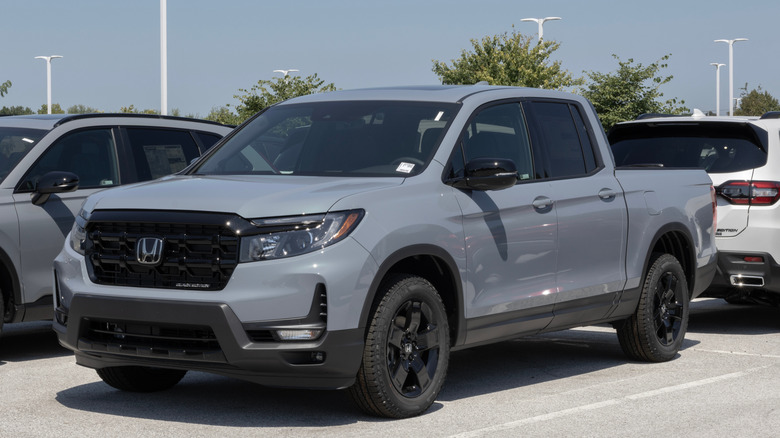
The highest-placed Honda model on iSeeCars' study is the Ridgeline. This is another unibody, but this time a rugged and reliable pickup. These qualities are evident from its 2025 Reliability Report from iSeeCars, which states that a Ridgeline will last for approximately 185,524 miles. The number of them that can push this to 200,000 is a very impressive 40.8%. Meanwhile, approximately 14.7% of these vehicles will last for a quarter of a million miles, slightly over three times the chance that the average vehicle has of reaching that number.
Honda proudly reported in June 2025 that the Ridgeline scored seventh place in Cars.com's American Made Index, which considers factors including a U.S. manufacturing workforce, the location where the vehicle was ultimately put together, and the percentage of domestic parts used in construction. From the driver's perspective, though, the most important factor may simply be that it was built to last, which the Ridgeline absolutely was. Though it's the highest-ranked Honda model, it's quite far from the top of their list of long-lasting vehicles overall. That honor goes to the formidable Toyota Sequoia, which reportedly has a 39.1% chance to make it to 250,000 miles on the odometer.
The Ridgeline isn't as old as some of its fellow hardy Hondas. It was first introduced in 2005 at the North American International Auto Show. In a press release from the time, executive vice president of American Honda Motor Co., Inc, Dick Colliver reported that the model "delivers all the capabilities of a truck with none of the traditional truck trade-offs. It combines Honda innovation, Honda engineering, and Honda's commitment to environmental and safety leadership in a next-generation truck package." It may have been a mistake on Honda's part not to really change the Ridgeline at all for '26, though.