

5 Factory Supercharged Cars Time Has Sadly Forgotten
The mass-produced automobile as we know it has been around for over 100 years. Whether you want to go back all the way to Carl Benz's Patent-Motorwagen of 1886, which was the first car ever invented, or stick to more recognizable early mass-production vehicles like the Ford Model T from 1908, there's no way around it: Cars have been around for ages.
We've seen all manner of four-wheeled vehicles come and go over those years. Some, such as the iconic Lamborghini Miura, ended up becoming all-time classics that even the most casual gearhead will know and love. Others quickly faded into obscurity, sometimes unjustly so: A quick look at the many forgotten two-seater sports cars of past decades shows that even fun drivers' cars can end up by the wayside for some reason or another, their charms forgotten by all but the most dedicated fans (or automotive historians).
Sportiness doesn't guarantee a car's place in history, unfortunately, and neither does the presence of a power enhancement like a supercharger. Despite the supercharger's popularity as a hot rodder-approved way to add power — and its association with big-boy engines like the Hellcat HEMI — there have been many supercharged vehicles over the years that, for better or worse, have been lost to the mists of time. Here are five such cars from major manufacturers like Mazda, Toyota, and Ford.
1994-1997 Toyota Previa
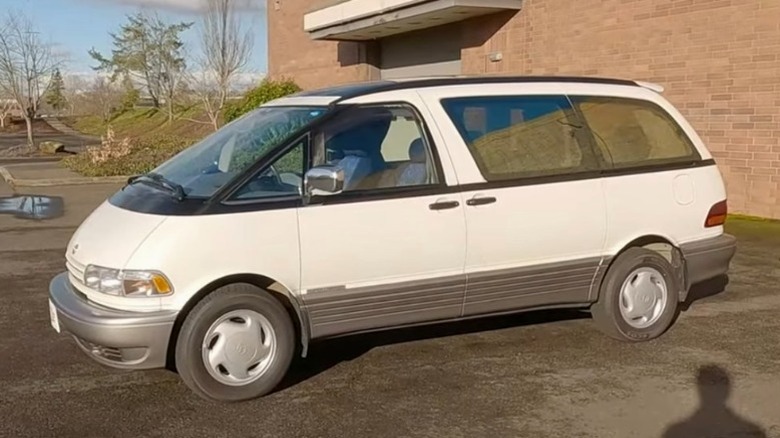
There are a lot of adjectives that probably come to mind when one thinks of minivans, but "supercharged" likely isn't one of them. For a couple of years in the mid-'90s, though, that was exactly how buyers and the automotive press could describe the first-generation Toyota Previa.
The Previa debuted in 1991 and caused quite a stir, with reviewers of the time praising its aerodynamic, egg-shaped design, mid-engine layout, and great interior. It was a well-thought-out and practical minivan, and it has a pretty vibrant fanbase to this day. What it wasn't, however, was fast: The inline-4 made a paltry 138 hp, which wasn't enough for a full-sized minivan. The weak engine, plus a tendency to be unreliable, means that the first-gen Previa has a terrible reputation compared to its Toyota siblings.
Toyota probably knew that it needed to do something about the engine, and it came up with a simple solution: forced induction. Company engineers took the Toyota MR2's supercharger, modified it, and mounted it to the front of the minivan, which pushed power and torque up to 161 hp and 201 lb-ft. Toyota first offered the supercharged engine in the 1994 Previa LE S/C before making it available on the DX as well in 1995. Toyota dropped the naturally aspirated inline-4 in 1996, and the Previa was only available with the supercharged engine for its final two years. Supercharged engine or not, though, the Previa wasn't a hit with buyers; Toyota replaced it with the Sienna starting in the 1998 model year.
1989-1995 Ford Thunderbird Super Coupe
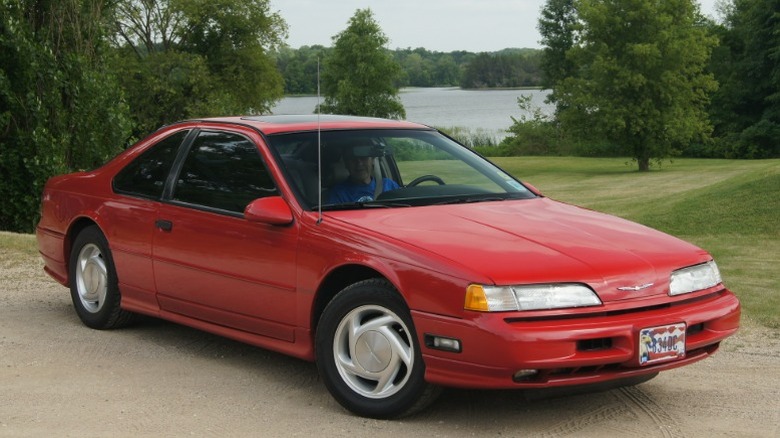
The Ford Thunderbird is likely best remembered for being an icon of 1950s American cruising culture, but the nameplate lasted for many decades after its heyday in the '50s and '60s. It survived into the early 2000s, but this short-lived 11th-gen model isn't the one that we're concerned with. Instead, let's look at its 10th-gen predecessor, which Ford built between 1989 and 1997.
This 10th-generation Thunderbird, while not a classic by any stretch of the imagination, had quite a few things going for it: It had a V8 (eventually, at least; 1989 and 1990 models only came with a V6), an independent rear suspension, and, in Super Coupe form, a supercharger. The Thunderbird Super Coupe, available starting in 1989, was the most powerful 10th-gen Thunderbird that Ford built. Its supercharged V6 made a solid 210 hp and 315 lb-ft of torque, 10 hp and 40 lb-ft more than the Windsor V8 that Ford would introduce to the T-bird in 1991. The company managed to squeeze a bit more power starting in 1995 to the tune of 230 hp and 330 lb-ft, further cementing its status as the 10th-gen Thunderbird's top-dog engine — especially since the V8 had shrunk to 4.6 liters by the time 1995 rolled around.
This iteration of the Thunderbird was broadly a sales success overall, with Ford selling more than 780,000 units over its eight-year run. Not much of this was down to the Thunderbird Super Coupe, though. Despite earning praise from automotive journalists for its great acceleration and solid handling, sales barely topped 5,000 units a year for most of its run; only the 1990 model managed to crack the 20,000-unit mark.
1993-2003 Eunos 800/Mazda Millenia S
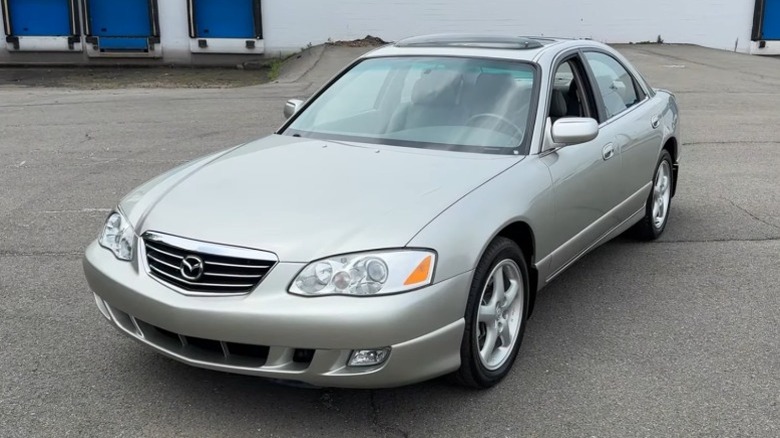
In the early '90s, Mazda tried to muscle into the luxury market with a Lexus and Infiniti-style sub-brand for the U.S. This marque was to be named Amati, with the automaker planning to start selling luxury cars under this nameplate in the U.S. starting in 1994. The collapse of the Japanese economic bubble and an attendant downturn in car sales scuppered these plans, but that didn't stop Mazda from releasing one of the cars earmarked for Amati under its own name.
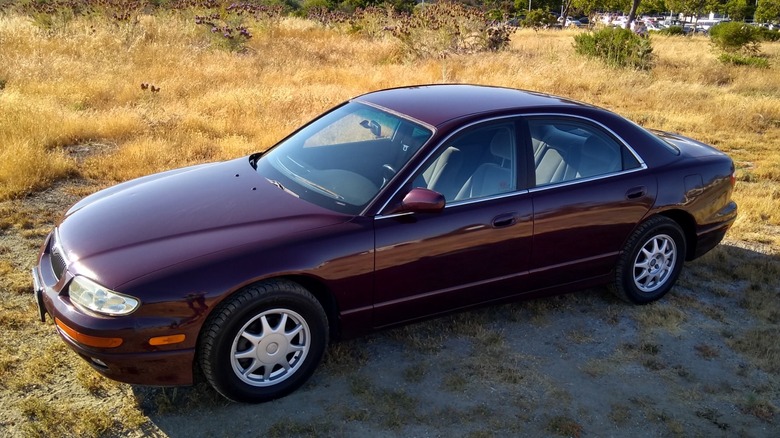
Sold as the Eunos 800 in Japanese and Australian markets and as the Mazda Xedos 9 in Europe, the sedan debuted in 1993 and was notable for its multi-link suspension, luxury aspirations, and the unique Miller-cycle 2.3-liter V6 available on certain trims. This supercharged V6 was the world's first-ever Miller-cycle engine and made around 213 horsepower.
The Eunos 800 eventually came to the U.S. as the Mazda Millenia, with the 2.3-liter supercharged engine in tow in the Millenia S. The Millennia S was quite warmly received by the motoring press, with the V6's smooth power delivery and good fuel economy, plus the car's overall great ride quality, allowing it to compete well against contemporaries such as the Mercedes-Benz C-Class and BMW 530i. The Millenia S continued into the 2000s with the same supercharged V6 before Mazda ended production at the end of 2003 and exited the luxury market the following year.
1995-1999 Buick Riviera
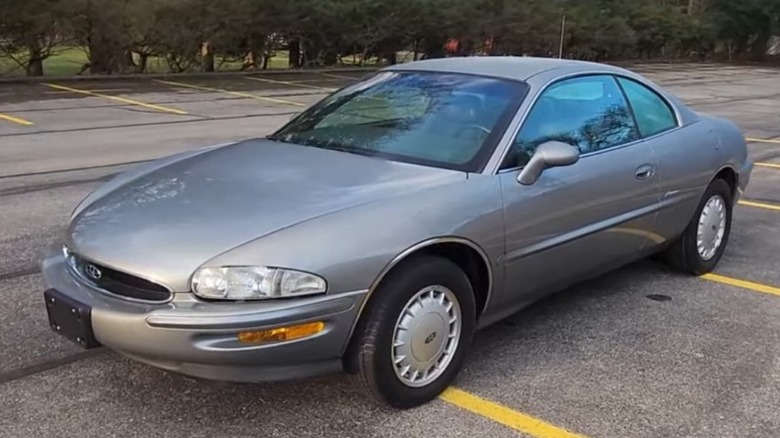
The Buick Riviera was a shadow of its former self by the time the mid-'90s rolled around. The 1993 model year proving a particularly low point with a production run of fewer than 5,000 — quite a precipitous fall from the nameplate's glory days. GM wisely took a break after that, skipping 1994 and using the time to refit the Riviera.
Buick's revived Riviera debuted for the 1995 model year with a daring new look and a new powerplant under the hood — in a sense. The Riviera stuck with the ever-reliable GM 3800 V6 that had powered the previous model, but this time in an updated and supercharged guise that made a healthy 225 hp at its debut (and 240 hp by its final year in 1999). Nothing outstanding in the cold light of today, but its 231-cubic-inch engine was not terribly far off from the most powerful American engines back in '95.
While we're not fans of the final Riviera's styling and think it's one of the ugliest cars of the 1990s, there's no way to deny that the supercharged V6 was a stout performer: Car and Driver managed a 0-60 mph time of 7.2 seconds, competitive against pricier V8-powered rivals, and considered it a solid buy overall provided one was keen on its looks. GM's gamble paid off for 1995, with nearly 41,500 units sold, but the success was short-lived. Sales dipped below 20,000 the next year and kept dropping, reaching a nadir of just 1,956 Rivieras sold in 1999; a sad end for a storied nameplate.
2004-2007 Saturn Ion Red Line
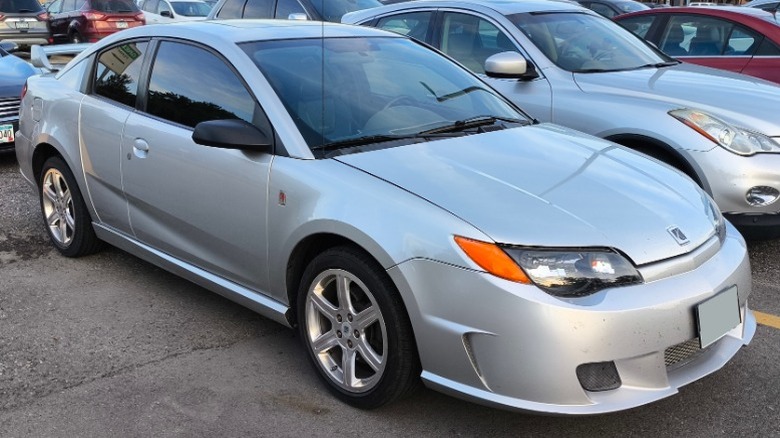
The Saturn Ion Red Line was part of GM's mid-2000s attempt to add some excitement to the Saturn lineup, alongside other questionable examples like the Saturn Vue Red Line. The Vue Red Line was a sporty take on the SUV, featuring large wheels, a reduced ride height, and a 250-hp V6 under the hood — which, admittedly, was an option on non-Red Line Vues as well, making it a primarily cosmetic makeover. The Ion Red Line, which debuted for the 2004 model year, took things a lot further, though.
While reviewers found that the original Ion offered decent value, the car was a broadly dull and uninspiring offering with little going for it in the grand scheme of things. The Ion Red Line was an attempt to inject some much-needed sportiness, with many major aspects of the car receiving welcome changes. The most notable upgrade was to the engine: GM engineers reworked the Ion's 140-hp 2.2-liter inline-4 for the Red Line, dropping it to 2.0 liters and adding a supercharger to bring power up to a much more exciting 205 hp. The Ion Red Line paired this beefier engine with steering, chassis, and suspension adjustments that helped it offer decent, if unspectacular, handling.
Somewhat predictably, these changes couldn't completely transform the Ion's fortunes. The Red Line couldn't make up for the base Ion's shortcomings, including its excessively long wheelbase, awkward interior layout, and poor build quality. Saturn didn't make many Ion Red Lines, with reportedly fewer than 6,000 units sold over its short production run. GM replaced the Ion with a rebadged Opel Astra for 2008 before shutting the Saturn brand down entirely in 2009.