

5 Of The Coolest JDM Luxury Cars You Can't Buy In The U.S.
What do you think of when you see the letters "JDM?" For most, it will probably be one or more of the many classic Japanese-market performance cars that came out over the past decades and never made their way to American shores. These would, of course, include iconic '90s JDM cars like the Nissan Skyline GT-R, the Subaru Impreza WRX STI, and Mitsubishi's Lancer Evolution cars.
While these high-performance cars are indeed the standard-bearers for JDM in the eyes of many, there has always been more to the world of Japanese domestic-market automaking than out-and-out sportiness. The subset of bosozoku car-modifying culture known as VIP style, for example, has long been based on slamming JDM luxury cars such as the Toyota Crown and Nissan Cedric.
The JDM luxury market that defined that car modding scene is still going strong to this day. There are a handful of genuinely plush vehicles available to Japanese (and, occasionally, global) buyers that would shame some of the most premium vehicles you can get in the U.S. It's not quite as vibrant a market as it used to be, with Toyota having somewhat of a stranglehold as of 2025, but it's still one well worth checking out. Here are five of the coolest.
Century SUV
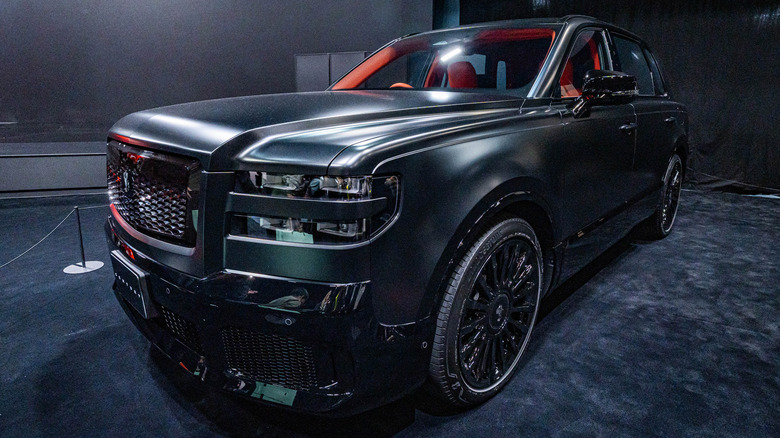
Formerly known as the Toyota Century SUV before Toyota spun the brand off in October 2025, the Century SUV is arguably the epitome of four-wheeled, high-riding luxury. Coming in at a cool $173,000 or so, it's, for our money, one of the best of the many luxury SUVs not available in America. Well, if you're sitting in the rear seats, that is — although, with a price like that, why wouldn't you have a driver, anyway?
Unlike, say, a Range Rover, which marries luxury with genuine driver-focused utility (and off-road ability), the Century SUV is all about chauffeur-driven opulence. The key selling point is its rear seating, which is more reminiscent of a private jet than anything you'd find in a typical SUV, even a pricey one. The core tenet here is spaciousness: the Century SUV is 17 feet long but only seats four, meaning there's a ton of room in the back. What does the Century SUV do with this space, you may ask? Well, quite a lot — as you'd expect for the money.
The two rear seats recline fully, with an ottoman, massage function, heating, and ventilation. Each passenger gets their own 11.6-inch screen, with 10 of the 18 speakers situated in the rear passenger compartment. There's a GPS-adjusted analog clock, a ton of storage, a swiveling and folding table, and even an optional fridge. Passengers also get a multi-purpose control panel that can be used to adjust the lighting, sunshades, and seating positions. Toyota even offered sliding doors on the Century SUV GR, although we're not sure whether the spun-off Century will keep that version in the lineup.
Toyota Alphard/Vellfire
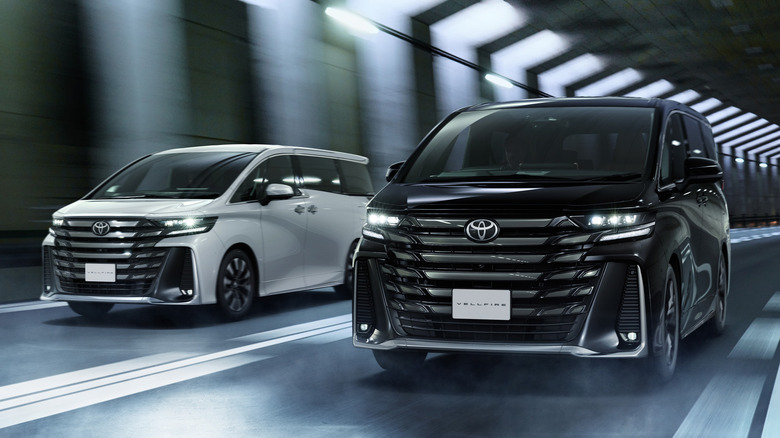
In the U.S., minivans aren't really anything to get excited about, perhaps with the exception of the excellent VW ID. Buzz. In Japan, however, those with thick wallets can opt to ride in the lap of people-carrying luxury by choosing one of the handful of luxury minivans available to domestic customers. Arguably, the leading name in this market is Toyota, with its closely-related Alphard and Vellfire minivans.
The Toyota Alphard first debuted in 2002 and was aimed squarely at luxury-minded buyers. It replaced four of the automaker's SUVs outright, establishing itself as the top dog as far as Toyota's minivan efforts were concerned. The seven-seater was joined by the Vellfire when Toyota refreshed the model in 2008, with the new variant offering an edgier exterior but retaining the same engines and interior layout. Both minivans are still available in Toyota's Japanese lineup, with the automaker also making one or both available in select global markets such as Malaysia, India, and Singapore.
But what are you, the U.S.-based reader, missing out on? Well, quite a lot, at least if you like the idea of a luxury minivan. Features on the Executive Lounge trim for both models include a 15-speaker setup, power sliding and reclining middle-row seats (with heated ottoman and arm rests, naturally), Nappa leather throughout, power sunshades, independent left- and right-sided moonroofs, and a 14-inch display for rear seat entertainment. Rear passengers even get voice control of some of these features, too, with a remote console for those who consider voice operation a bit passė.
Lexus LM
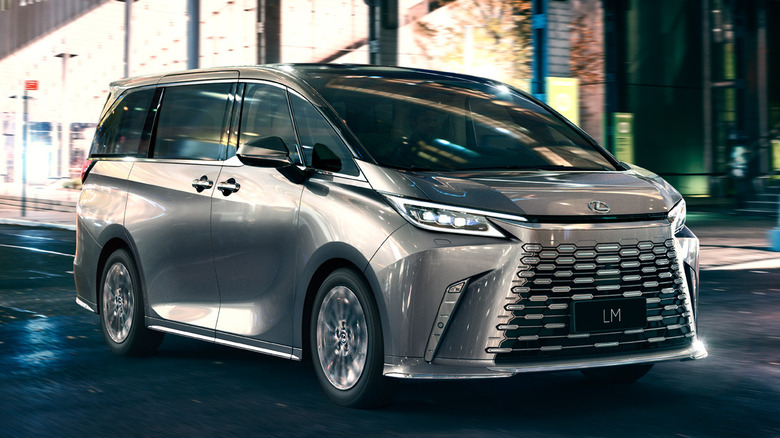
What would you do if you were an automaker — Toyota Motor Corporation — with a luxury brand — Lexus — that didn't have an equally luxurious minivan to offer to exceedingly wealthy clients? Well, rebrand and spruce up an already pretty plush product from your mainstream brand, of course. That's exactly what Toyota Motor Corp did when it unveiled the Lexus LM in 2019.
The LM is fundamentally a rebadged Vellfire with more Lexus-like visual details on the outside and an even more extravagant interior setup for buyers to choose from. To wit: the LM cribs a page from the Century SUV's book, offering a four-seater, limo-style layout that takes advantage of its 16.8-foot length and 6.2-foot width, complete with a dimmable (and retractable) glass partition that splits the front and rear compartments for privacy. But the LM's four-seater configuration isn't just about giving passengers a luxurious private space on the road: the partition also houses a TV, with the current LM sporting a 48-inch display here, complete with a built-in fridge underneath for storing refreshments. Perfect for high-powered business meetings, then: seal the deal through a video call, then pop a bottle of champagne to celebrate.
Another notable feature on the limo LM is what Lexus calls a "Warmth-Sensing IR Matrix Sensor." This sensor scans the rear passenger compartment, detecting the temperature of occupants and select surfaces, before intelligently adjusting the air-conditioning and seat heating (and ventilation) to cool users down based on these temperatures. Buyers also, as you might expect, get leather all around. This much luxury doesn't come cheap, though, with the four-seater LM's roughly $130,000 MSRP being double that of the most expensive Alphard.
Nissan Elgrand
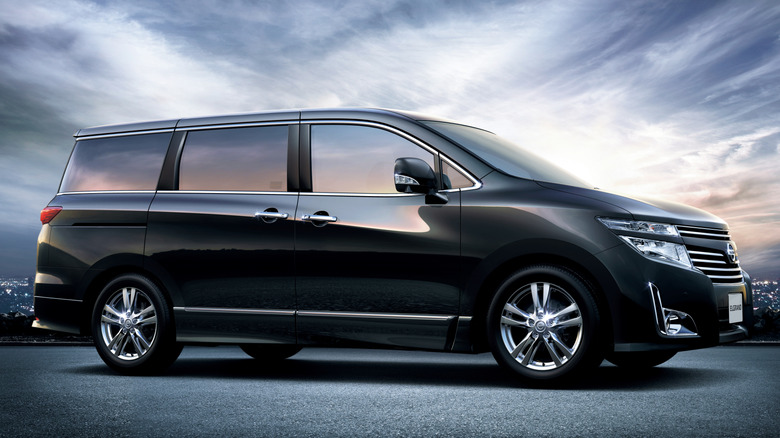
Toyota Motor Corp has a couple of truly upscale minivans in its lineup, sure, but it's not the only Japanese automaker competing for buyers' money. Nissan has a rival of its own, called the Elgrand — the latest generation of which looks, on paper at least, to be every bit the equal of the Toyota Alphard and Vellfire. The Elgrand actually predates the Alphard, having debuted in 1997, and is currently in its third generation, although a new fourth generation is set to enter production in 2026.
Let's start with the third-gen Elgrand before we look to the future. As is the case with Toyota's luxe minivans, the third-gen Elgrand is a people carrier available in seven- and eight-seater configurations, the former of which sports the slightly fancier dual captain chair setup available on the equivalent Toyota offerings. The seven-seater version has three ottoman-equipped seats (middle row and front passenger seat), with enough room to use all three simultaneously. You can also expect leather all around on certain grades, two TV screens to keep passengers entertained, and a healthy selection of safety equipment and driver aids, including sign detection.
The fourth-gen Elgrand, which Nissan unveiled at the Japan Mobility Show 2025, looks to keep this ethos of space and comfort going, albeit with a much-needed exterior revamp that brings it bang in line with offerings like the Lexus LM. The new look is razor-sharp and futuristic, and brings with it interior updates such as so-called zero gravity captain's chairs, TailorFit leather, and dual 14.3-inch displays (which Nissan claims are a first in the segment). Optional features include a 22-speaker sound system and 64-color ambient lighting.
Century Sedan
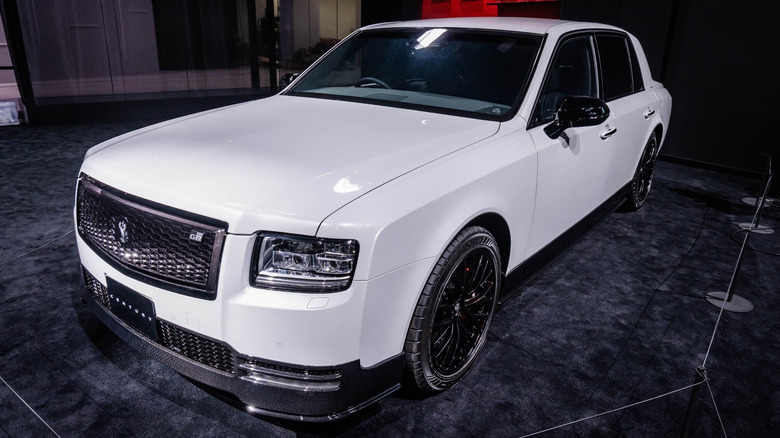
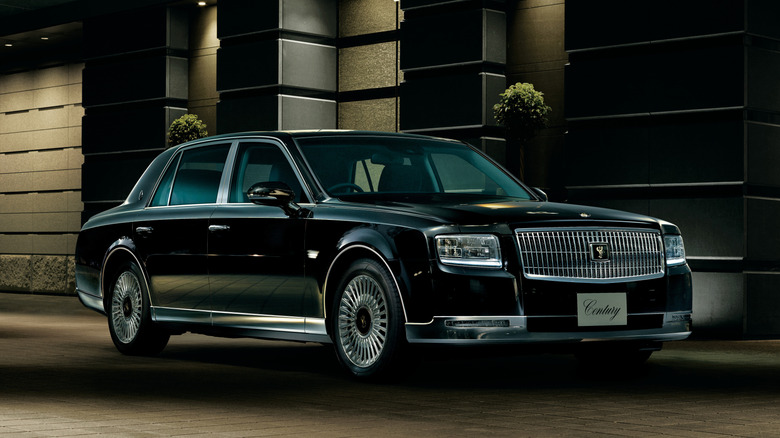
The Toyota Century has sat at the top of Toyota Motor Corporation's luxury offerings for decades, and continues to do so after its decision to spin off the Century brand into its own marque. Toyota first unveiled the Century sedan in 1967, with this new offering having designed from the ground up to offer the utmost in luxury to discerning Japanese clientele — partly by offering the first use of air suspension in a Japanese passenger car.
Toyota's first-gen Century stayed in production for a staggering 30 years, a sign of how perfectly Toyota nailed it — or, admittedly, of wealthy Japanese buyers' conservative tastes. The second-gen Century, Japan's only V12-engined car, also survived for a long time, although its 21 years weren't quite as impressive. The current generation Century, which debuted as the Toyota Century in 2018, carries on the luxury legacy, albeit with a slightly more mundane hybrid 5.0-liter V8 under the hood.
You don't buy a Century Sedan for an exciting powertrain, though. Instead, anyone buying into this heritage — and willing to fork over around $146,000 for the privilege — will probably be more enthused by appointments such as its coil-sprung, jacquard wool-clad seats (leather is also available, of course) with independent air conditioning and the full complement of heating, ventilation, and powered reclining features. It also sports an 11.6-inch display complete with a Blu-ray player and a multi-function control panel built into the rear seat rest. In December 2025, Toyota updated the current Century Sedan with the latest version of Toyota Safety Sense, so the Century should be as safe as it is luxurious.