

Inside Toyota's Test Track: Sideways Camrys, Hydrogen Trucks, And One Big Surprise
It's an understatement to say that Toyota is a huge company. It sold over 2.2 million cars last year, just in the United States, with over 10.1 million cars leaving the line in 2024 across the world. Any large automaker needs somewhere to test and develop vehicles for different markets. For BMW, it has its development center in South Carolina (where I drove the new M5). Stellantis (formerly Chrysler) has a tech center in Michigan with simulated highways over a 4,000 acre facility.
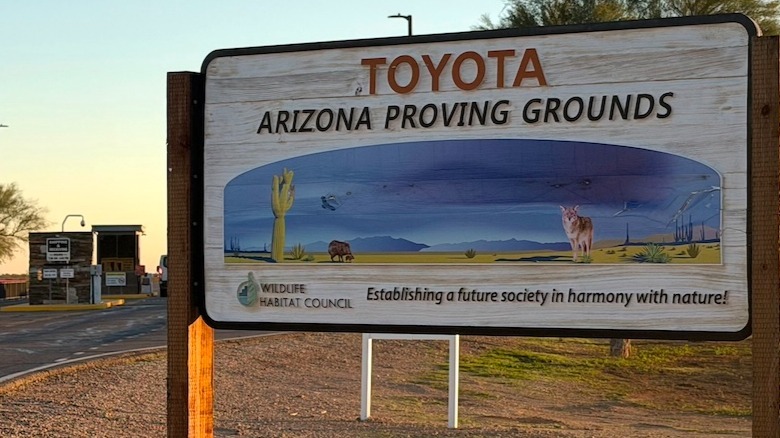
Toyota is no different, though the scale gets an upgrade. It has the Arizona Proving Ground right in the middle of the Sonoran Desert in the general vicinity of Wittman, Arizona. It covers 11,650 acres and was originally unveiled in 1993. In 2021, the testing ground was given a new coat of paint with an updated 5.5-mile oval track, and other automakers (including Rivian and Lucid) and suppliers were given the chance to test their products' mettle on the track.
Thrashing around the desert
Last week, I was given the chance to not only tour the grounds and see where cars like the Camry, Tacoma, and RAV4 are refined and tweaked before hitting the market, I got to try out a few of those tests myself. Toyota's proving ground is huge and varied with dozens of miles of trails and sections of track for which to test the different performance envelopes of whatever is being evaluated, and there are people who have full time jobs finding every idiosyncrasy of ever car that wears a Toyota or Lexus badge. So, I wasn't going to get the full experience in just a couple of days. But I can attest that I was given a good taste — and a better appreciation — of what a big automaker like Toyota does before bringing a car to market.
Upon arriving at Toyota's facility in the desert, you will be immediately confronted by how massive it is. Nearly 12,000 acres puts the proving ground above entire towns when it comes to size. The vastness is surely helped by the fact that it sits in the Sonoran Desert with mountains and cacti stretching for quite literally tens of thousands of square miles. The isolation is, of course, intentional to keep prying eyes away from what Toyota or Lexus may be working on.
 Alex Hevesy/SlashGear
The majority of the vehicles I saw were already in production (or very close to production) and I actually drove the 2026 model years of the Camry, Tacoma, and RAV4. However, it wouldn't be a self-respecting test center and proving ground if there wasn't anything a little wacky and futuristic.
Toyota's hydrogen fuel cell plans
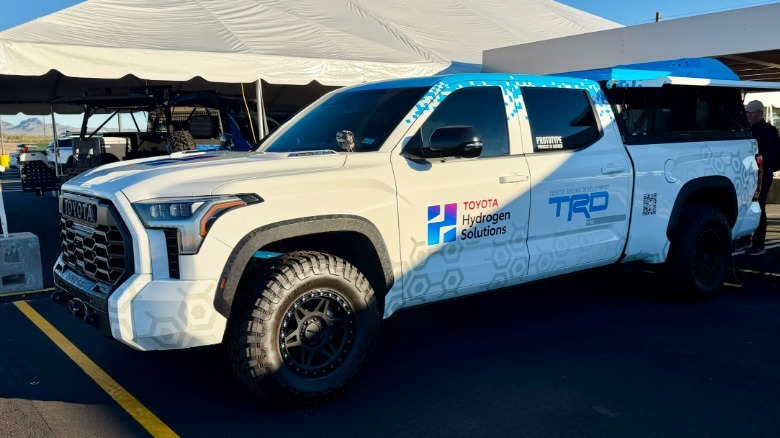
Toyota is doing a lot of work in the field of hydrogen fuel cells and it's trying very hard to get the technology in more hands (and by extension more cars). On the consumer end, two concepts were shown off: a Tundra-based hydrogen fuel cell generator and a fuel cell-powered overlanding Tacoma.
The Tundra was being used as a stationary generator that powered all of the audio and video equipment we used at the facility, as well as charging two Toyota BZ electric vehicles. The Tacoma was transformed into an overlanding rig with the powerplant of the hydrogen-powered Toyota Mirai. Given that the only by-product of a hydrogen fuel cell is water, it was fitted with a water tank for cooking and cleaning when you're out on the trail.
 Alex Hevesy/SlashGear
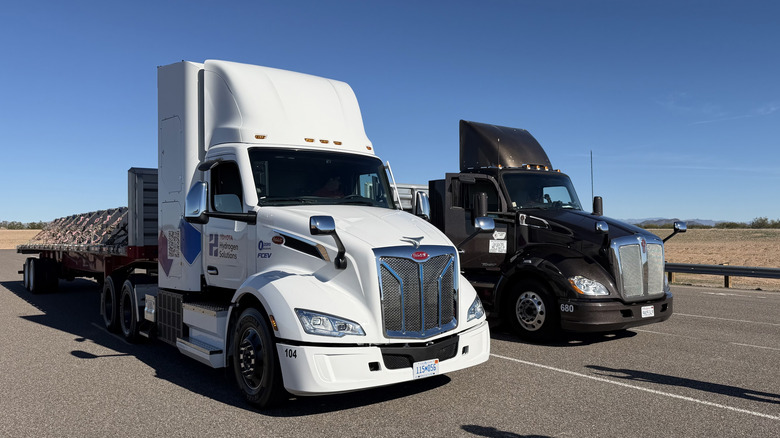
On the commercial end, Toyota showed me the strides it's making in powering semi trucks. It demonstrated this by allowing me to sit in the passenger seat of both a hydrogen fuel cell powered semi truck and a conventional diesel-powered rig and hosting a drag race between the two. Given the fuel cell truck's electric motors, it won handily. Toyota reported that its fuel cell can give semi trucks a range of around 450 miles, theoretically ideal for short trucking and delivery routes. Given that there are currently very few places to even fill up on hydrogen in the United States, this technology is firmly in the future category.
Taking the Camry to the track
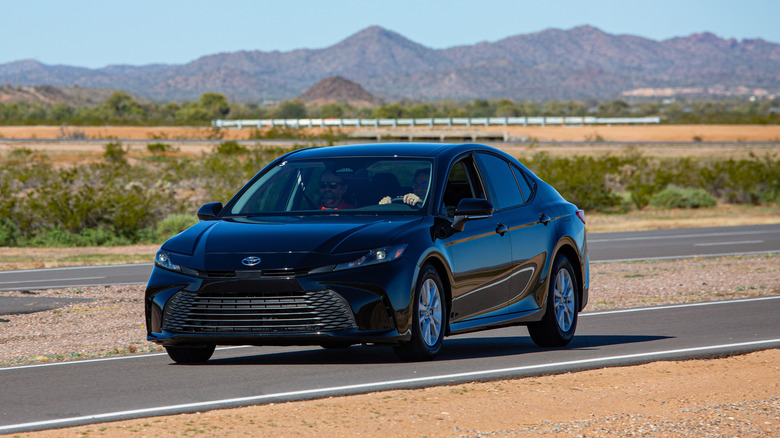
On the more immediate production-focused side of things, I spent the most time behind the wheel of Toyota's bread and butter of normcore sedans, the Camry. My second ever car was a 1996 Toyota Camry V6 in the LE trim and I absolutely adored it (to this day, it's the only car I've owned that I actually miss driving), so it's fitting that I was given the ability to test a 2026 Toyota Camry LE on part of the 5.5 mile track.
The route had sections of simulated highway surface pristine roads for high-speed runs, and sections where the surface is not so immaculate. I have spent most of my life living in and around Baltimore City, a city that I love dearly but where the roads can only be described as "present." Toyota's simulated poorly maintained surfaces did an excellent impression of Charm City's roadways.
With a vehicle as widely used as the Camry, it behooves Toyota to test it on every road surface it can think of. The United States alone has some of the most varied topography on the planet and there are millions of Camrys on the road so it makes sense that Toyota would test it where the road surface is less than ideal. Although I never eclipsed speeds of over 70 or so miles per hour, I can attest that the Camry performed admirably, regardless of the road surface. It's the king of commuter cars, so you want it performing its best whether you're going down the roads of Silicon Valley or out in the sticks in West Virginia.
Sliding around Arizona
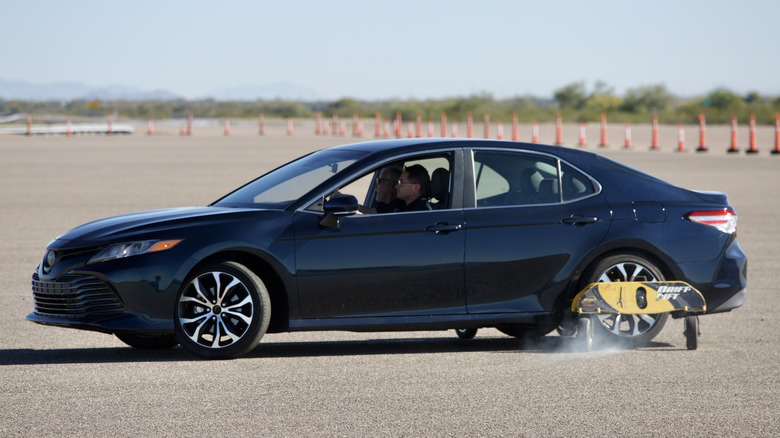
We were also treated with a stint behind the wheel of a previous generation Camry (and a now-discontinued Avalon) fitted for skid plate driving. A set of casters on the rear wheels lift up the back of the car ever so slightly, to simulate inclement weather conditions and poor traction. Given the fact it almost never rains in the middle of the desert, Toyota has to make road hazards when it can.
Given my vast "experience" of driving in the Northeast (namely getting my car stuck in snow and sliding around on ice intentionally and unintentionally), I can say that Toyota provided a pretty good facsimile of what happens when traction goes out the window and you have to wrestle control of the car. Toyota uses this to train drivers for its test courses and other avenues of the company. Putting aside my journalist hat for a moment, I can also say that it was really fun whipping a Camry around a big parking lot. I'm very proud to say that only one traffic cone valiantly gave its life when I was behind the wheel.
Trail hunting with the Tacoma
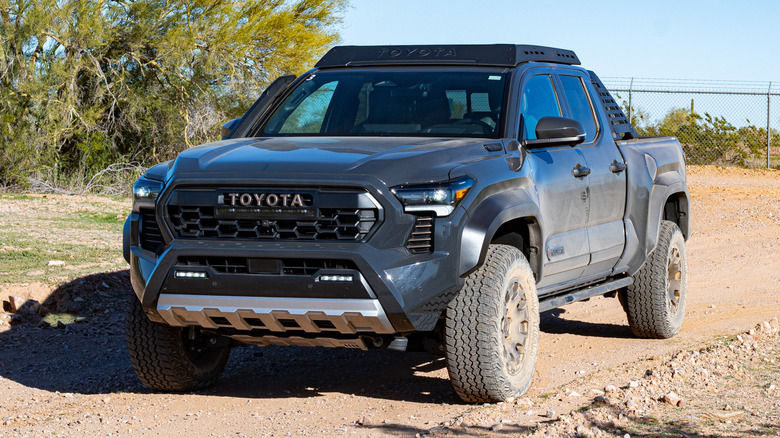
Next, we were shuttled off to test the off-road capabilities of both the 2026 RAV4 and various flavors of the 2026 Tacoma. At the helm of the RAV4, we crawled down a rocky trail using the crossover's hill descent control feature, which is essentially cruise control for going down a hill. We also tested the anti-lock braking system on a simulated wet road. From my short time with the RAV4, it did what it said on the box: the RAV4 was confident when the road surface was not.
 Alex Hevesy/SlashGear
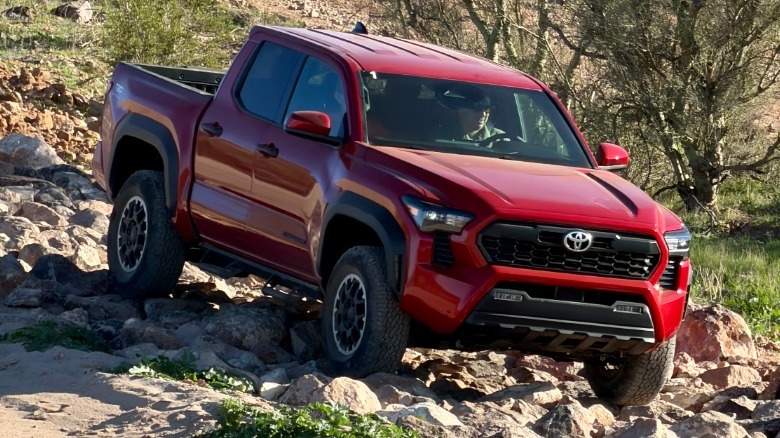
It was a little more exciting with the Tacoma. Three different Tacoma's were presented to us. The decked-out Trailhunter, the off-roadified TRD Pro, and a regular ol' quad-cab Tacoma TRD Off-road with a few optional extras. The Trailhunter performed incredibly well blasting down one of Toyota's many dirt roads at well over highway speed. It didn't think twice about charging up and down inclines at speeds you would typically reserve for when you're late to work.
With the TRD Pro and the other Tacoma, we tested the "CRAWL" control feature. Like the RAV4, this is essentially cruise control, except in this case it was cranked up a considerable degree as we crawled down the side of a mountain. The TRD Pro, interestingly, was fitted with a "IsoDynamic Performance" front seat as Toyota calls it. The seat is fitted with its own suspension of sorts that seeks to isolate the hard bumps you might feel while crawling up and around different terrain.
Scion is back?
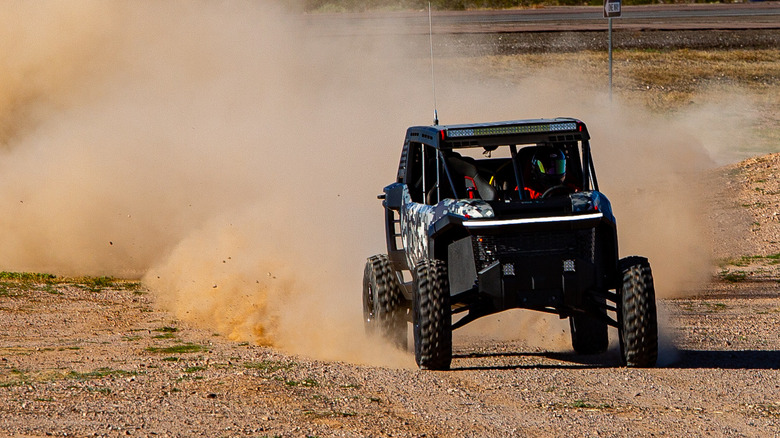
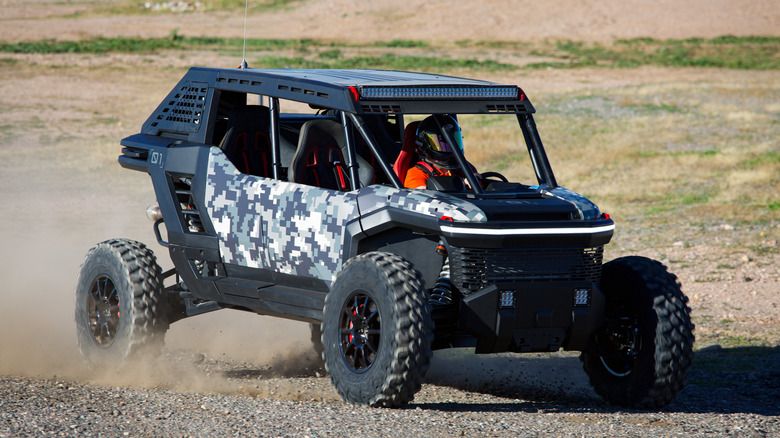
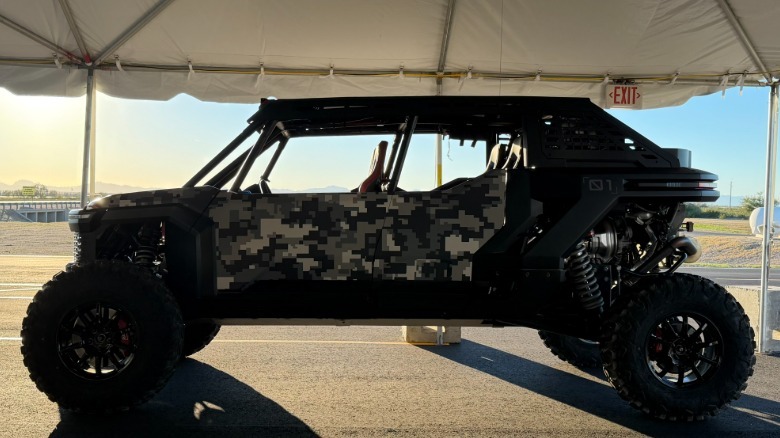
Lastly, Toyota gave us a peek at another concept vehicle that carried a familiar name. Toyota's beloved old brand Scion is back, sorta. The Scion 01 concept is a wild off-road side by side in the same general vein as the Polaris RZR. Toyota didn't announce any production goals or prices or much of anything apart from some basic numbers. The Scion is powered by the same 2.4-liter hybrid powertrain you would find in a Tacoma (complete with 326 horsepower and 465 pound-feet of torque) and is built out of a lot of Toyota parts from other cars.
 Alex Hevesy/SlashGear
The gear lever is right from a Tacoma, the brakes are from Toyota GR sports cars, and so on. I didn't get to sit behind the wheel unfortunately, but I did see it rip around a dirt track ever so briefly. The Scion 01 Concept is similar to the aforementioned Polaris RZR in shape and overall purpose — that is jumping and racing around dunes as fast as possible — but the execution couldn't be more different. The Scion's hybrid powertrain gives it an EV mode that allows riders to use electric power. The extra torque imparted by electric motors is also a plus.
Additionally, Polaris is a powersports company using powersports parts to make the RZR. Toyota is an automotive company using car parts to make a side by side. It's certainly an innovative way going about what is essentially a new division of vehicles, if, of course, the concept ever sees mass production. I have a lot of thoughts on what this might turn into for Toyota and what the Scion name may deserve if it was ever brought back from the dead, but I'll save those thoughts for another time. I can safely say that Toyota has a good facility on its hands to test out whatever idea it thinks up, no matter how outlandish.