

15 Of The Fastest Motorcycles Of The 1960s

Speed is king. Seldom does a new vehicle model year debut without magazines trumpeting its zero-to-60 mph times. Heck, automakers even race to see how fast a car (or bike) can stop. If there is a measure of speed that impresses, you can bet that the engineers (and marketers) of the world overwork overtime to get that information to the consumer. Everyone wants to be the fastest, and nowhere is that as true as in the motorcycle market.
There are no minivans in the motorcycle world. They are, almost by nature, impractical and appealing to thrill-seekers. Manufacturers have spent millions on research, from engineering superchargers from the ground up to shaving every fraction of an ounce from a design. The thing is, not everyone can be the fastest, but almost everyone can be fast.
The 1960s were a slow burn in motorcycling. Some manufacturers, such as Harley-Davidson, lost ground in the top-speed competition. Meanwhile, others, like Honda, gave birth to the very concept of the superbike. While the performance numbers of these machines seem quaint compared to some of the fastest motorcycles ever built, each one was a heavyweight contender for the speed crown in its time. The Ninja H2R soared because the H1 Mach III sputtered. So strap in as we take a trip down memory lane to revisit 15 of the fastest motorcycles from the 1960s.
1960 BSA Gold Star Clubman
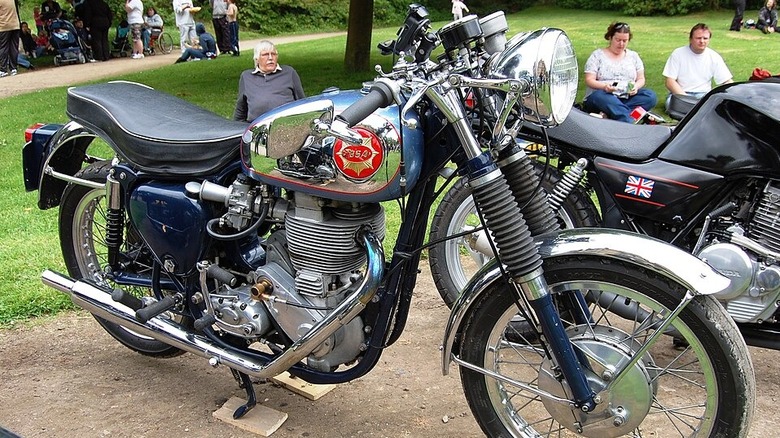
At the outset of the 1960s, the British were building some of the fastest production motorcycles on the planet. The BSA Gold Star Clubman had already enjoyed an illustrious career by the time the swinging sixties began. First conceived of in 1938, it started out as a hand-built roadster designed for racers and hardcore riders. The Second World War interrupted production, but it was revived afterward, due in part to the popularity accrued in local road races and time trials. By 1960, the BSA offered it in off-road scrambles and road-oriented Clubman trims.
The 1960 Gold Star employed a single-cylinder, 499 cc engine that made 42 horsepower, channeled through a four-speed transmission with a wet clutch. Weighing just 380 pounds, even BSA acknowledged that the high-strung machines weren't exactly coast-to-coast road trip material. However, with a top speed of 110 mph and a string of racing accolades, the aging bike retained a certain panache. BSA would build the Gold Star until 1963. It remained competitive to its last year of production — a testament to the durability of its original design.
1960 Harley-Davidson Sportster XLCH
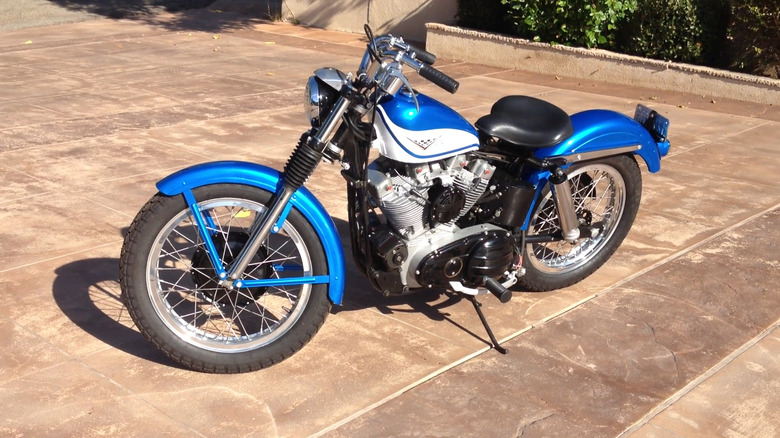
It has been a long time since Harley-Davidson was a serious contender in the sport bike game. Known today for luxury cruising and torquey twins, things were different in the '60s. The Sportster debuted in 1957 with an eye toward taking a leading role in the performance game. Lighter and faster than any other Harleys of the era, it ultimately proved to be one of the bar and shield's most popular and enduring models.
With a few years of development under its belt, Harley was ready to evolve its new baby. The 1960 Sportster XLCH was a competition-oriented bike with a torquey 883 cc 45-degree V-twin making approximately 55 horsepower at 6,300 rpm. That's an enormous amount of horsepower for the time, but it was wrapped up in a relatively hefty 480-pound package.
Those numbers are respectable even today, but you won't find anything remotely close in modern sport bikes. Nevertheless, the Sportster had what it took to run with the big dogs. It could achieve a top speed in the 115 mph range — more than enough to put it among the fastest motorcycles of the 1960s and set it on its path to become one of Harley's longest-running badges.
1961 Velocette Venom
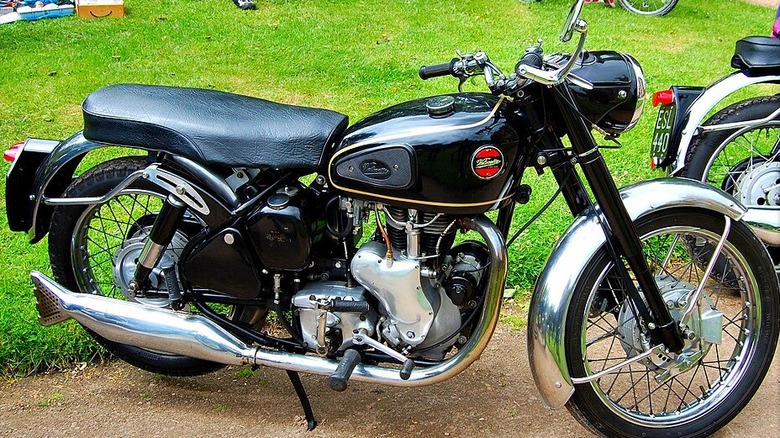
The name isn't bandied about much today, but Velocette has its roots in the earliest days of motorcycling. Founded as Veloce Limited in 1905, the company initially planned on building motorcars before switching to bikes. In 1913, the daintily named Velocette debuted as a 206 cc two-stroke single-cylinder. Velocette earned a strong reputation on the track throughout the 1940s in the 350 cc and 450 cc racing classes. By 1961, the company was poised to make history.
While other manufacturers doubled the number of cylinders, the Velocette Venom retained a single-cylinder design. The 500 cc machine for the 1961 model year produced 36 horsepower and had all the lean, mean appeal of the burgeoning café racer movement. The company boasted to potential buyers that "Europe's greatest" motorcycle could hit up to 130 mph (if you removed the muffler). While that number may be open to dispute, the Venom's record-breaking run at Montlhery is not. The thumper achieved 100 mph, which was respectable enough by itself, but even more so when you consider that it averaged that speed over 24 hours of non-stop running, a record that has stood ever since.
1962 Norton 650SS
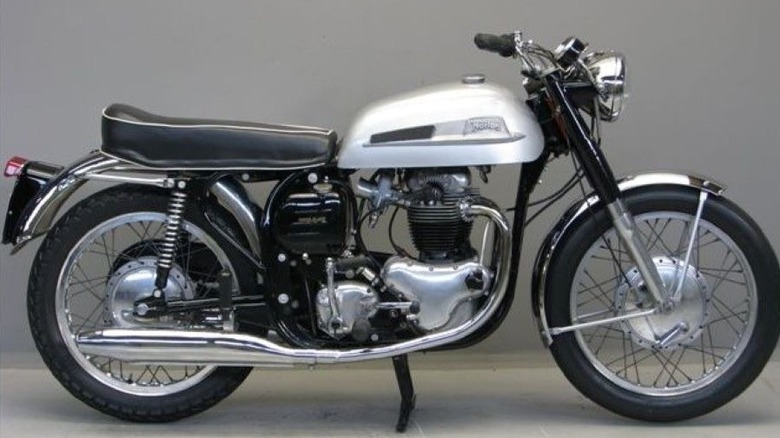
The British bike-building scene during the 1960s was wild — as evidenced by much of the content of this list — and Norton was front and center. The 1962 Norton 650SS (the SS stood for Sports Special) was about as big and beefy a bike as you could get in England at the time. Powered by a 650cc air-cooled parallel twin breathing through a pair of Amal carburetors, it made 49 horsepower at 6,800 rpm and weighed a hair over 400 pounds.
Like any good motorcycle, the Norton wasn't just fast; it was consistent. It achieved top spot at the 500-mile Thruxton Endurance Race three years running. It was lightweight, a solid handler, and had drag-bike potential with powerful acceleration that topped out around 115 mph. Unfortunately, the 650 SS's time at the top was short. Norton was ready to outdo itself, introducing the public to the 745 cc Atlas at around the same time. The higher-displacement bike immediately eclipsed the 650, particularly in the American market.
1963 Honda CB77 Super Hawk
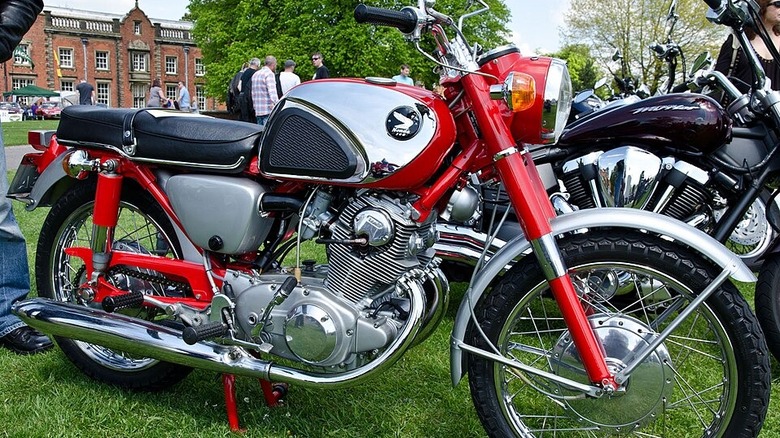
Honda hit the American market by attacking it from both ends. Reliable commuters were its bread and butter, but it wanted to improve its reputation as a purveyor of performance motorcycles. The 1963 Honda CB77 Super Hawk represents one of the earliest examples of Honda catching the right kind of attention on the track.
With a 305 cc air-cooled vertical twin-cylinder with a pair of 26 mm Keihin carbs, it produced 28 horsepower at 7,500 rpm and 17 lb-ft of torque at 6,000 rpm. Honda lifted the frame from earlier experiences in racing. The rear of the engine and transmission unit served as a load-bearing strut that reduced twisting and fortified the frame.
Contemporary testing achieved a top speed of 105 mph, which was a little under the factory claim of 110 mph, but was still pretty darn impressive. The CB77 isn't thought about much today, but it helped set Honda on the path to revolutionize performance by the end of the decade.
1964 Triumph T120 Bonneville
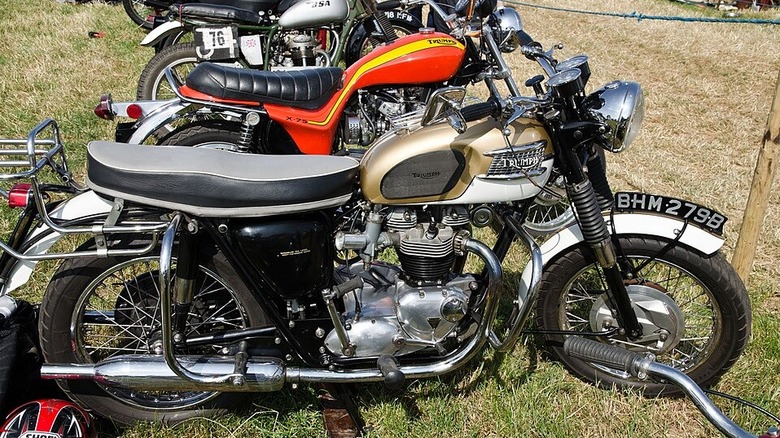
Triumph introduced the Bonneville in 1959 with an eye toward the future, and that future proved glorious. The British bike builder named its new model after recent triumphs at the Bonneville Salt Flats, where it set world land speed records, powering highly customized machines to speeds north of 200 mph. The Triumph team endeavored to take what it had learned and apply it to its street bikes.
The road-going Bonneville wouldn't get anywhere near 200 mph (though today's fastest bikes certainly do), but if you're going to name a bike after your speed record, that bike really can't be a dog. The T120 lived up to its name. At its heart was a 649 cc parallel-twin with dual carbs that pushed 46 horsepower to the rear wheel through a four-speed transmission. While that engine configuration might sound pretty commonplace, it was the Bonnie's featherlight 363-pound weight that gave it a sporting edge. The 1964 T120 R Roadster could reach speeds near 115 mph.
1965 BSA A65 Lightning
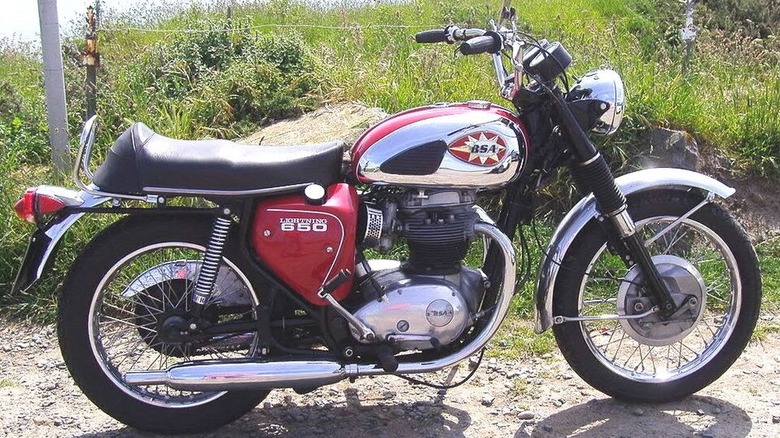
BSA struck in 1965 with the Lightning. Much like actual lightning, the little bike was a wonder to behold but tended to be dangerous in close proximity. It used an air-cooled 654 cc parallel-twin to produce 52 to 56 horsepower. Propelling an airy 395 pounds, it was enough to hit 112 mph and average somewhere near 58 miles per gallon.
The problem with the Lightning was that you did not want to go anywhere near that fast on it. It achieved max horsepower at about 7,000 rpm on the tachometer, but anything over 5,000 rpm introduced serious vibrations. Those vibrations went hand in hand with an uncomfortable tendency to death wobble over 80 mph. The Lightning had other flaws, including a low oil pressure light that malfunctioned so frequently that riders learned not to pay attention to it, and, ironically, given its name, electrical issues. Today, the Lightning is little-remembered except by enthusiasts, though it has an undeniable aesthetic flair that makes us want to look at it for hours. Plus, it gets extra cool points for being ridden by Spectre assassin Fiona Volpe in the 1965 Bond film "Thunderball."
1966 Ducati Mach 1
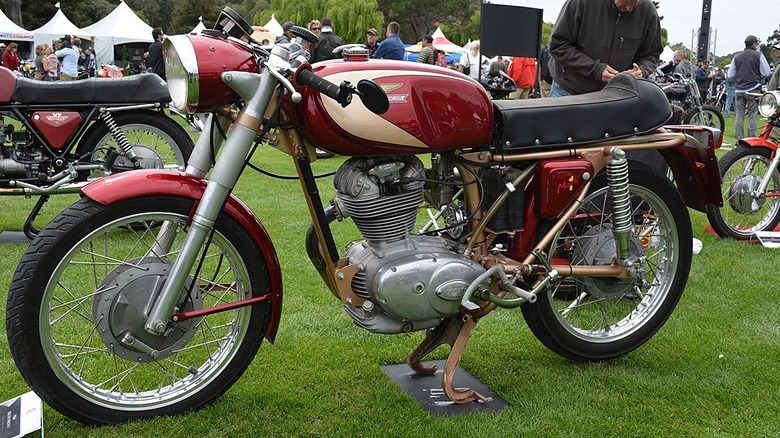
England wasn't the only game in Europe. Among all the BSAs and Triumphs, Italian firm Ducati put its own spin on high performance. With a verified pedigree earned on the racetrack and a revolutionary desmodromic valve train that made it famous, Ducati took a refined approach to performance. The Ducati Mach 1 might not have achieved supersonic speed, but it sure aspired to it. Launched in 1964, the single-cylinder, air-cooled 248.6 cc engine revved to a screaming 8,500 rpm.
The engine produced only 28 horsepower, but weighing only 255 pounds, the right rider could hit speeds of up to 110 mph. Ducati put that performance to good use at the legendary Isle of Man TT in 1969. Rider Alistair Mike Rogers secured the company's first victory at the Irish event in the saddle of a Mach 1. This bike is growing increasingly rare to collectors, as Ducati only built around 2,000 Mach 1s before new machines took its place.
1966 BSA Spitfire Mark III
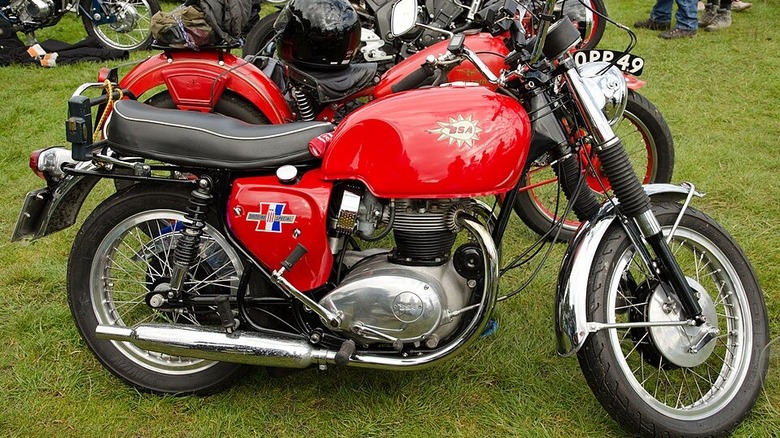
Hitting high speeds on a salt flat or paved track is one thing. Off-road riding is something else entirely. Founded in the 1860s as the British Small Arms Company, by 1966, BSA had shifted gears, so to speak. In the days when enduro and motocross riding were still growing in popularity, the British builder introduced the Spitfire Mark III.
When Cycle World took out the Spitfire in the spring of 1967, it found it to be the fastest motorcycle under 750 cc that it had ever tested to date. The 654 cc two-cylinder street bike was designed with the horsepower-hungry American market in mind but proved a competent competitor to the likes of the Triumph Bonneville and Royal Enfield Interceptor. The Spitfire motorcycle lived up to its namesake. While it may not have achieved the top speeds of the Spitfire aircraft, its 55 horsepower was enough to propel it to a top speed of 120 mph — though you likely would not want to try it on the enduro trails. Between 1966 and 1968, the Mark III was the speediest member of BSA's stable.
1967 Honda CB450 Black Bomber
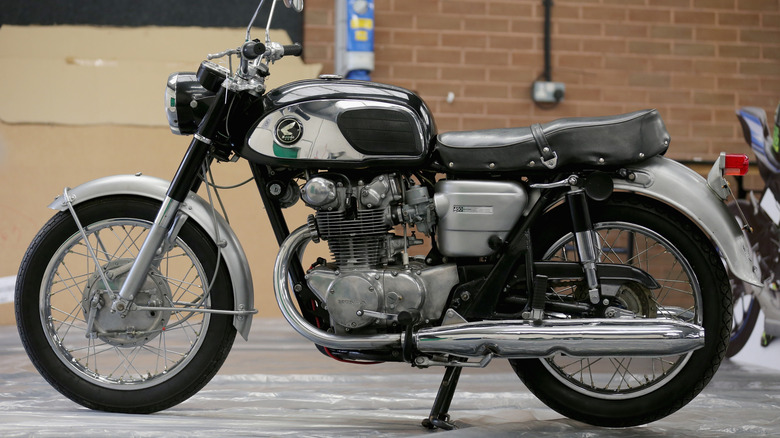
While the British blithely went about their business in the 1960s, the Japanese manufacturer was gearing up to change the world. Honda hit American shores in 1959. Within a few years, its motorcycles were gaining traction. While Harley-Davidson struggled with its association with outlaw biker gangs, the Japanese brand claimed you could 'meet the nicest people on a Honda' – provided you could catch them.
In America, bigger tends to be better, and though the CB450 is laughably small by modern standards, its displacement of 445 cc made it the first of Honda's big bikes, and the air-cooled, state-of-the-art double-overhead cam twin cylinder packed a punch. It delivered 45 horsepower at 9,000 rpm – a relatively high rev limit that foreshadowed the screaming superbikes of the future — and could break the 100 mph mark under the proper circumstances. The CB450 may not have been at the top of the speed heap, but it put the British on notice that Japanese bikes were ready to compete. The CB450 remained in production until 1974, but by then the dam had broken, and builders were in an all-out power war.
1968 Suzuki T500
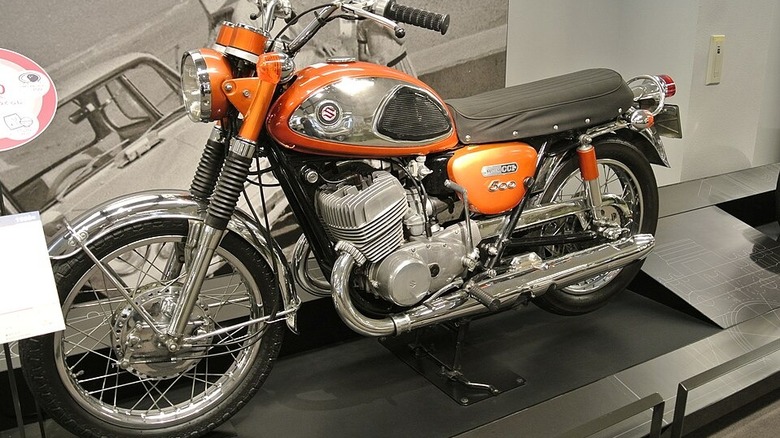
The difference in performance and tech between the early '60s and late '60s was like night and day. By the time Suzuki put forth the T500 Titan in 1968, an arms race was heating up in the performance motorcycle arena. Two-stroke engines are a thing of the past now, but once upon a time, they powered some of the fastest motorcycles on the road.
Based on Suzuki's earlier T20, the T500 was the marque's biggest bike when it debuted in 1968, and it was aimed directly at the growing fracas between British twins and Japanese imports in the American market. The T500 employed a 492 cc smoker that made 44 horsepower at a respectable 7,000 rpm and 37 lb-ft of torque at 6,000 rpm. All that amounted to an observed top speed of around 105 mph, though considering it was a two-stroke, it probably sounded like it was going even faster.
Where the T500 really shone was in value. Honda's CB750 was poised to change everything, but lovers of cheap speed could snag a T500 for half of what the CB750 demanded in 1970. Suzuki built the T500 between 1968 and 1974, after which it went the way of the dodo. However, it enjoys some cache as a collector's bike among some vintage enthusiasts.
1968 BSA Rocket 3
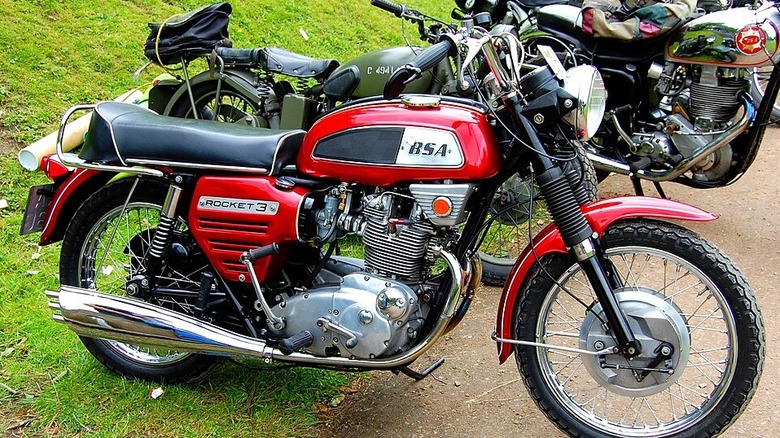
If it weren't for the revolution sparked by the Honda CB750, the BSA Rocket 3 may have gone down in history as the height of '60s performance. Executives at BSA caught wind that Japanese machines with inline four-cylinders were on the horizon, and turned to engineer Doug Hele to design an engine that could compete. The resulting 740 cc inline triple breathed through a trio of Amal carburetors to the tune of 60 horsepower at 7,250 rpm and 45 lb-ft of torque at 6,900 rpm. However, the finished motorcycle weighed in at a hefty 520 pounds.
The engine was put through its paces on a T120 Bonneville test chassis, securing leadership's nod to put the bike into production. Unfortunately, design firm Ogle delivered its take on the platform 18 months late, meaning that by the time the BSA Rocket 3 was ready to rock, the CB750 had already pilfered its thunder. Still, with an estimated top speed of 115 mph, it was one of the fastest bikes of the '60s.
1969 Honda CB750
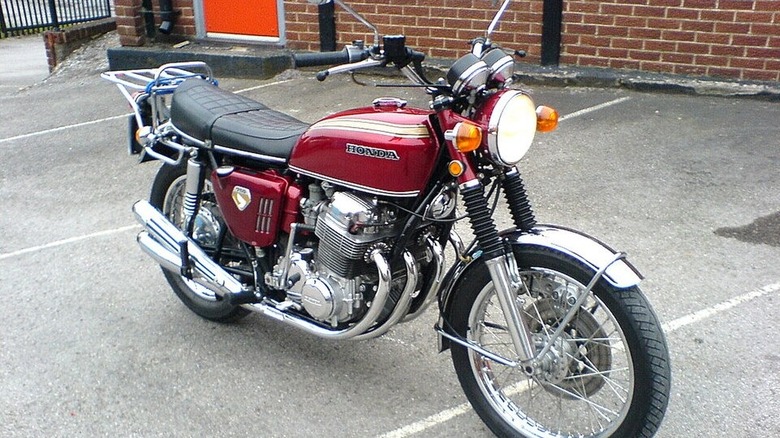
If the British had a stranglehold on fast motorcycles entering the 1960s, it had transferred to Japan by the end of the decade. Honda's CB line had been making performance strides since its inception in 1959, with the Black Bomber marking a major step, but it was the 1969 CB750 that would be the first vehicle to be dubbed "superbike".
The CB750's secret lay in its engine configuration. While parallel and V-twins were the order of the day, Honda built its new bike around a transversely mounted 737 cc air-cooled inline-four-cylinder engine breathing through a quartet of Keihin carburetors. It made 67 horsepower at 8,000 rpm and 44 lb-ft of torque at 7,000 rpm. Honda also threw in a front disc brake and electric starter to sweeten the package. All this led to a 12.6-second quarter-mile time, with a top speed of about 125 mph. And it was no slouch in the twisties, either.
The upshot of the CB750 was nothing less than a revolution in motorcycling. Half a century and more later, the fastest motorcycles on the planet use the same inline-four configuration (Honda didn't invent it, but the CB750s' impact is undeniable).
1969 Kawasaki H1 Mach III
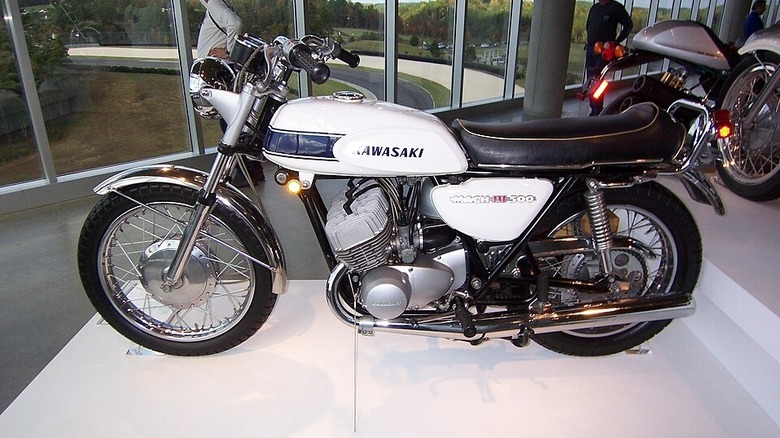
If you've ever wondered why the Ninja H2R wasn't called the H1R, look no further. In 1969, Kawa unleashed the H1 Mach III, a 499 cc, three-cylinder two-stroke that earned the nickname Widowmaker for its twitchy power and tendency to punish unwary riders.
The H1 Mach III made 60 horsepower against a dry weight of 383 pounds. This helped it outpace the heavier CB750 in the quarter mile with a 12.2-second run, though the difference in displacement became evident at the top end, with the Mach III hitting as high as 118 miles per hour compared with the CB750's 125 mph.
Though impressive for the time, those numbers aren't particularly eyebrow-raising by modern standards. The Mach III earned its bad reputation (fairly or otherwise) due to a tendency for frame flex in early models and inadequate drum brakes. Coupled with peaky two-stroke power, it went down in history as a dangerous bike. Kawasaki currently builds the world's fastest production motorcycle, and it's clear that its roots run deep in the form of the Mach III.
1965 Gyronaut X-1
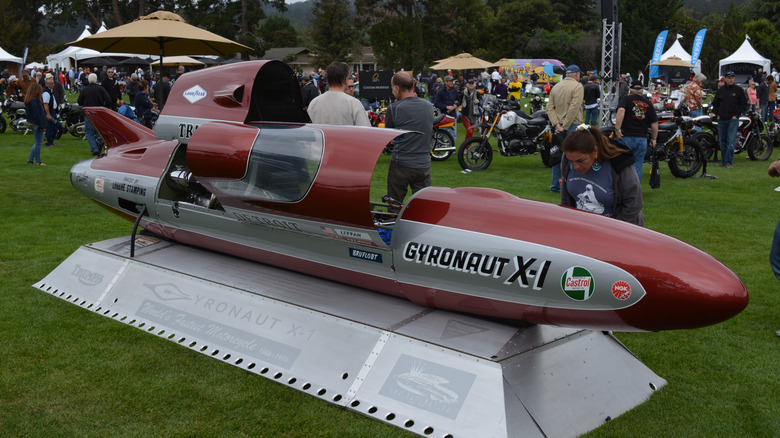
This one is a little outside the wheelhouse for this list, considering it's the only entry that wasn't a mass-produced motorcycle. But we all measure ourselves against something, and in the 1960s, the Gyronaut X-1 was the benchmark for motorcycles chasing high top speeds. The machine looks like a cross between a toy rocket and a speedboat, but it has two wheels, and it doesn't fly or float, so we're counting it. The curious little bike was born when a pair of Triumph dealership owners, Bill Martin and Bob Leppan, joined up with mechanic Jim Bruflodt and set out to build not just a fast bike, but the fastest motorcycle in the world.
With a tubular chromoly chassis, a pair of specially prepared Bonneville engines bored out to 820 cc, and a streamlined hull designed by Auburn-Cord-Duesenberg stylist Alex Tremulis, the Gyronaut set a new record of 212.689 mph average speed at the Bonneville Salt Flats in 1965. The following year, it eclipsed itself with a 245.667 mph run — a record that it held for the next four years.