

5 Drag Racing Icons That Owned The Quarter Mile In The 1980s
The 1980s was a transformative decade for the automotive industry, especially as it was recovering from the Malaise Era of the '70s. With engine power rising back to reasonable levels and car design moving away from the trends that gave us some of the worst-looking cars from the 1970s, car manufacturers started releasing models that were once again capable of owning the quarter mile.
And while there were quite a few options from that decade that were relatively quick, there were only a handful that achieved truly iconic status. These cars combined power, performance, and looks — a refreshing change from the anemic engines and dreadful aesthetics of the previous decade — and that still hold up to this day. This was also the time when turbocharged engines started gaining popularity, allowing cars like the Buick GNX and Ford Mustang SVO to beat larger V8 engines with their smaller V6 and I4 motors.
We won't be able to list all the vehicles that every teenager from the 1980s swooned over, so you might be disappointed to find that your favorite isn't listed below. Nevertheless, these are some of the most legendary muscle cars to grace the drag strips of the 1980s that remain mythical more than 40 years later.
Buick GNX
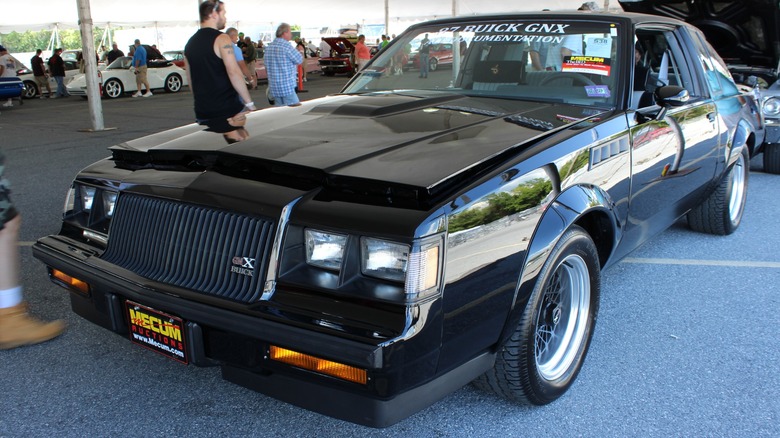
The Buick GNX was the car maker's parting gift for the Regal Grand National. The GNX, which stands for Grand National eXperimental, was the top trim for the 1987 model year. This vehicle was initially intended to be limited to just 500 units (all painted black), but a total of 547 were ultimately produced, making it one of the rarest muscle cars to enter serial production. It's based on the Buick Grand National (itself a higher-performance version of the Buick Regal), which featured an already powerful 245 hp turbo V6 that helped it beat Lamborghini in certain tests.
Instead of working on it directly, Buick sent the Grand National to the Automobile Specialty Company and McLaren Engines in Michigan, which upped the power output to 300 hp. They did this by replacing the stock turbo with a larger one that had a ceramic turbine wheel, using ported and polished heads for better airflow, and adding a recalibrated chip to the car's ECU. They also modified the automatic transmission to make it more aggressive and used a short torque arm and a Panhard rod to deliver power from the engine to the rear axle.
All this power and performance meant that the GNX could go from zero to 60 in 4.7 seconds and run the quarter mile in 13.5 seconds with a trap speed of 102 mph. This made it a legend in straight-line performance, with Car and Driver saying that the only other vehicle available in the U.S. that could beat its zero-to-60 time was the Porsche 911 Turbo's 4.6 seconds. But more than its speed and acceleration, the other thing that makes the GNX so iconic is its mysterious all-black color scheme and squared-off body lines, which gave it the Darth Vader nickname.
Chevrolet Camaro IROC-Z
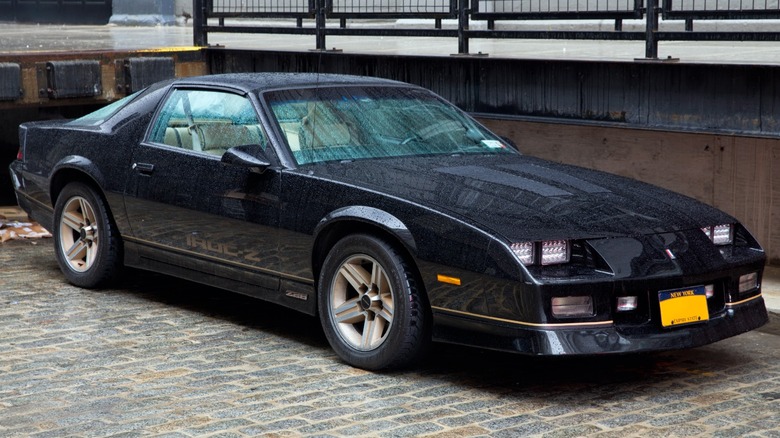
The third-generation Chevrolet Camaro came out in 1982 and spent ten years on the showroom floor before it was replaced by the catfish generation. And although it was released a few years after the worst of the '70s fuel crises, this generation Camaro still had some of the weakest engine options available (starting at 90 hp). But it was also in this generation that Chevrolet introduced the IROC-Z — the model's top trim that was inspired by the International Race of Champions.
The IROC-Z fixed the low horsepower issue in 1985 by giving it a fuel-injected 305-cubic-inch V8 that put out 215 hp and 275 pound-feet of torque, allowing the car to go from zero to 60 in 6.9 seconds (versus the almost 10 seconds it needed before the IROC-Z arrived). This was then increased to a 350-cubic-inch small-block V8, increasing its output to 245 hp and 345 pound-feet. The new engine allowed it to hit 60 mph in 5.8 seconds and run a 14.4-second quarter-mile trap speed of 97.8 mph.
The Camaro was nothing but a pretty face when GM launched it for the first time in 1982. But the arrival of the IROC-Z transformed it from a beauty queen into a real thoroughbred, allowing it to compete with other muscle cars of its time. And by the latter part of the decade, you'd no longer be ashamed to drive a Chevrolet Camaro — as long as it had the IROC-Z badge, that is.
Dodge Shelby Charger GLHS
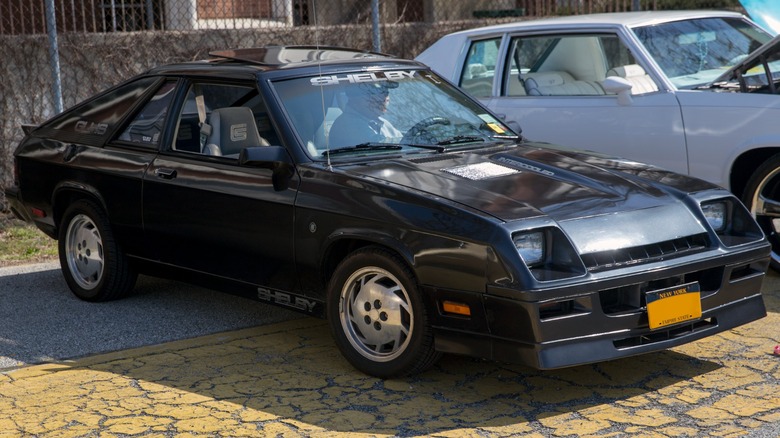
Many car enthusiasts overlook the fifth-generation Dodge Charger, which some consider an underwhelming comeback from the Malaise-ridden fourth-generation model. This car is based on Dodge's Omni, which was Chrysler's economy-car answer to the influx of affordable Japanese cars. But what made it worse was that it was wrong-wheel drive, with power going from the engine to the road via the front axle. That is until the legendary Carroll Shelby got his hands on it.
The Dodge Shelby Charger arrived in 1983, where he squeezed 107 hp from its 2.2-liter four-banger — some 13 hp more than the standard configuration. This allowed drivers to go from zero to 60 in 9 seconds and finish the quarter mile in 16.8 seconds at 82 mph. Not much, but that's already a lot of fun for a car that cost under $8,300 at that time. However, this car reached true muscle car status when Shelby gave it the GLHS treatment in 1987.
The Dodge Shelby Charger GLHS — which means "Goes Like Hell S'more" — retained the same 2.2-liter displacement of the Shelby Charger but gained a turbo. This pushed its output to 175 hp, allowing it to go from zero to 60 in 6.7 seconds and beat the quarter mile in 14.9 seconds at 95 mph. This beat the Ford Mustang SVO's zero-to-60 time and even put it within spitting distance of the IROC-Z's quarter-mile time, all with a $12,995 starting price, making it an affordable car you can bring to the drag strip. That's why it's on our list of the best Dodge Chargers ever made.
Ford Mustang SVO
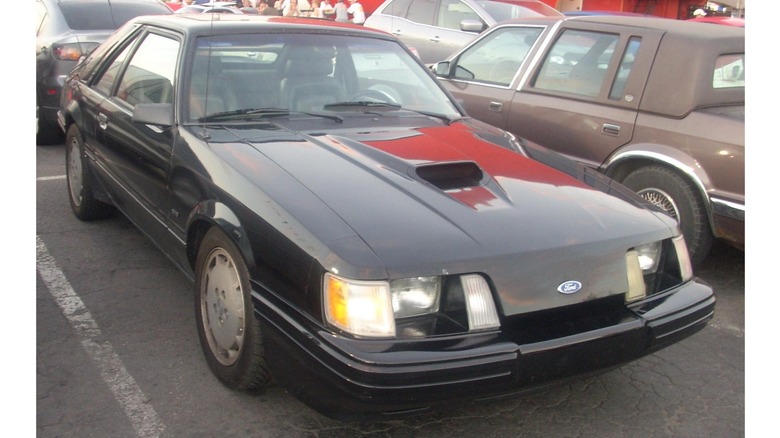
The Mustang has always been one of Ford's most iconic models, even with its "missteps" with the Ford Mustang II. The Fox Body Mustang is the third-generation Ford pony car, built from 1979 to 1993, and it's also the first model that went under the microscope of Ford's Special Vehicle Operations group, or SVO. Many purists would consider the Ford Mustang SVO a scandalous choice, especially given the fact that it didn't even have a V6 under the hood. Instead, the Ford SVO team put a turbocharged 2.3-liter four-cylinder engine that put out 176 hp mated to a five-speed manual. This might seem minuscule today, but that is almost the same power output as the 4.9-liter V8 found in the 1983 Mustang GT.
Aside from extracting so much more power from a smaller engine, the engineering team also worked on the suspension. This resulted in new suspension bits, including forged lower control arms from the Lincoln Continental mated to adjustable Koni low-pressure shock absorbers, and tuned springs, bushings, and an anti-roll bar. They also gave it ventilated disc brakes to match the increase in engine performance with better stopping power.
The Ford Mustang SVO has a zero-to-60 time of 7.5 seconds, and it finishes the quarter mile in 15.5 seconds with a trap speed of 90 mph. It's not quite the same raw performance as the Buick GNX, but it does offer comparatively good handling and excellent ride quality, making it ideal as a daily driver. More importantly, even with its limited 10,000-unit run, it had a much lower price tag that kept it within reach of most drivers in the 1980s.
Pontiac Firebird 20th Anniversary Turbo Trans Am
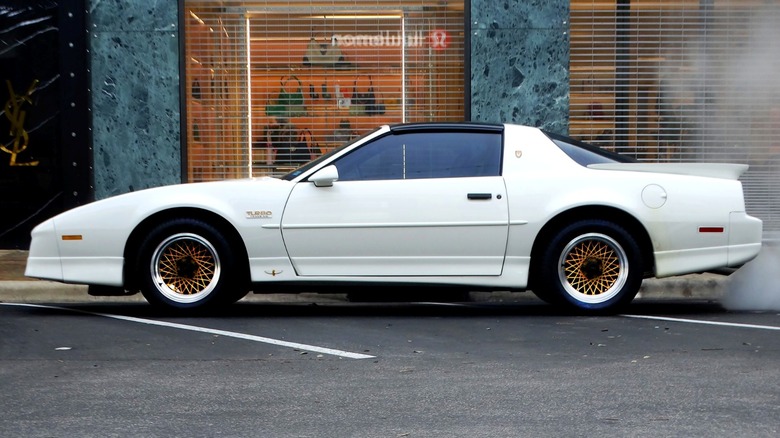
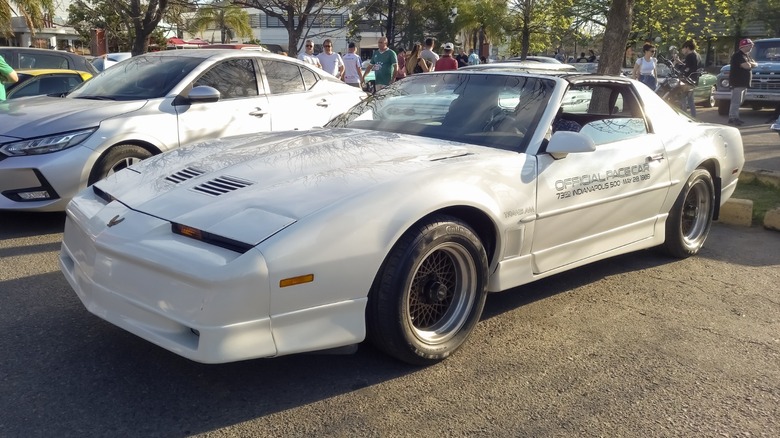
The Firebird and the Camaro were often mistaken for being the same car, especially during the '80s. And while both models had more similarities than ever back then, the 1989 Pontiac Firebird 20th Anniversary Trans Am Turbo was a unique model in that it was the only one that had an engine that the Camaro didn't get — the 3.8-liter turbo V6 also used on the legendary Buick GNX. Pontiac claimed that this engine put out 250 hp at 4,400 rpm and 340 pound-feet of torque at 2,800 rpm, but some argue that it delivered far more than that.
One would expect similar performance between the GNX and Trans Am, given that they use the same engine, but the Trans Am's more aerodynamic body and modern design meant that GM's engineers could push the car to its limits. This made it the fastest drag racing icon on our list, capable of hitting 60 mph in 4.6 seconds and finishing the quarter-mile run in just 13.4 seconds, with a trap speed of 101 mph, even with an automatic transmission. In fact, if you keep your heel planted on the floor, the Trans Am can break 130 mph in a little over half a minute — something impossible with the GNX's electronically limited 124 mph top speed.
This performance, alongside its limited run of 1,500 units, made it one of the most sought-after muscle cars of its time. You might expect this car's price to have gone down over the decades, but because of its heritage, it's quite expensive for its age. If you want to get one in your garage, you should be ready to spend somewhere between $35,000 to $48,000, making it one of the pricier classic Pontiac cars from the 1980s.