

5 Car Brands Headquartered In Michigan

If there's one place on Earth that's universally known as "that one region where American cars are made," it's Michigan. The Great Lakes State served as the headquarters of dozens of automakers throughout the years, ranging from early pioneers in the 1890s to the Big Three today. Bluntly, almost every major American automotive company has called Michigan home at some point in its life, hence why Detroit is nicknamed "Motor City." So formulating an exhaustive list of every single one of these manufacturers and their histories would easily fill a book.
Plenty of defunct companies like AMC, Packard, Hudson, Checker, and the dozens of smaller startups throughout the early 20th century, all called Michigan home. A lot of it is centered around Detroit, naturally, but other places like Grand Rapids and, most famously, Dearborn also appear in company address logs, past and present. Then you have all the subsidiary manufacturers, both defunct and present — everyone under Ford like Lincoln and Mercury; GM has Chevrolet, Buick, GMC, and so on; and Chrysler Corporation boasts Dodge, Ram Trucks, and all the rest of its roster.
Rather than addressing each of these marques individually, we'll instead incorporate them into the broader umbrella of each of the Big Three. Moreover, there's a couple of extras — much like the early 20th century, the 21st century has brought a number of startups to the region, capitalizing on the skilled labor, rich history, and available corporate and raw resources in the area. EVs and alternative fuel vehicles, along with countercultural movements against the bloating of new cars, both center (at least in-part) in Michigan. Let's explore this automotive giant and see what it's producing today.
Ford Motor Company
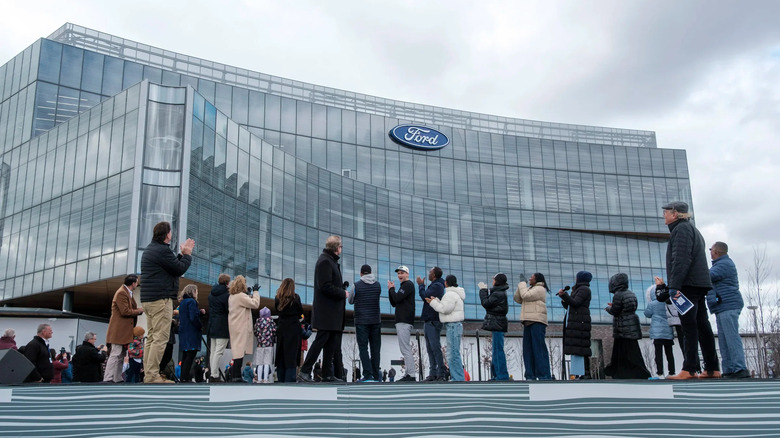
Obviously there's no list of Michigan-based automakers without the company that legitimized the automobile as a means of travel for anyone, not just the wealthy and eccentric. Of course, Ford didn't invent the automobile; that title belongs to Benz with the 1886 Patent Motorwagen, though even that's disputable. Cars have been around for a while at this point, even in Michigan itself, with early innovators such as Ransom E. Olds calling Michigan home. Nevertheless, it was Ford's establishment in Dearborn which solidified Michigan's industry and fueled automotive development in the coming years.
Ford's headquarters is located in Dearborn, with its most famous building being the Glass House that served as its administrative house from 1956 to 2025. Prior to this, Ford served a number of key roles in automotive and industrial development as a whole, especially in the military industrial complex; for instance, Ford built some 280,000 Jeeps during World War II, along with producing one Consolidated B-24 Liberator bomber every 63 minutes. The Willow Plant housing bomber production was also among the most ethnically and gender-diverse workplaces in the country at the time, owing to the demands of the military draft.
Obviously Ford has expanded quite a bit since these early days. Ford of Europe and Ford Australia, in particular, have made waves in their own respective countries, and Ford operates plants across the nation. But its headquarters, as always, remains in Dearborn, though Ford demolished the Glass House, replacing it with a brand new headquarters in 2025. Likewise, its multiple subsidiaries, most prominently Lincoln and Mercury, also report to the main headquarters in Dearborn, named the New Ford World Headquarters.
Chrysler Corporation
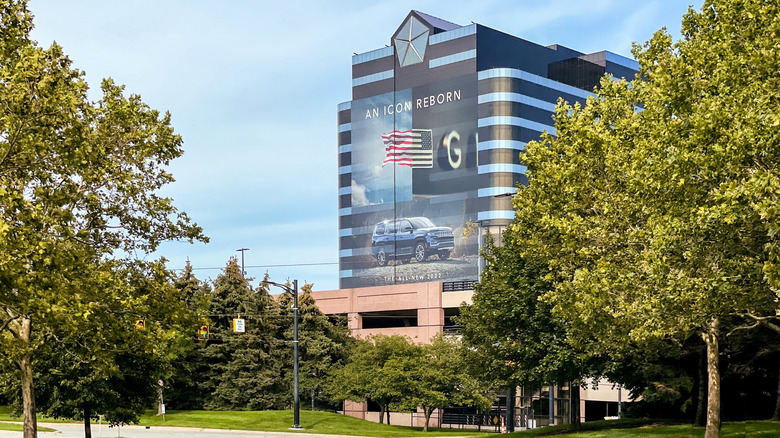
This one is a bit weird, because Chrysler is under the Stellantis umbrella, and Stellantis isn't actually headquartered in the United States at all; it's actually based in the Netherlands. No, it's also not Italian; it just serves as the merger between FCA and the PSA Group, the latter consisting of Peugeot, Opel, and Citroën. It's complicated; imagine you have a company. Your company goes bankrupt and gets bought out by an Italian firm. Then that Italian firm merges with a French firm, becoming a bigger conglomerate with all these companies under its belt. That's Chrysler's current situation in a nutshell.
Nevertheless, Chrysler boasts one of the richest portfolios in automotive history. It got its start in 1925, producing the original Chrysler Six that bore the name of entrepreneur and engineer Walter P. Chrysler, who actually worked for Buick prior to going independent. Chrysler soon purchased Dodge Brothers, Inc. and founded Plymouth in 1928, creating its first of many subsidiary marques. Much like Ford, it too was involved in World War II production, principally building Sherman and Pershing tanks.
Much like every other big American automaker, however, Chrysler was hit hard during the 1973 Oil Crisis. A series of financial struggles saw the company change hands numerous times, becoming Daimler Chrysler, Chrysler Corporation, Fiat Chrysler, and finally Stellantis. But throughout that time, Chrysler remained a true innovator, effectively inventing the minivan as we know it today and popularizing the idea of modular design, both attributed to the famous Chrysler K-Car designed by Lee Iacocca.
Despite its tumultuous history, Chrysler is still headquartered in Michigan, with its offices, completed in 1996, located in Auburn Hills.
General Motors
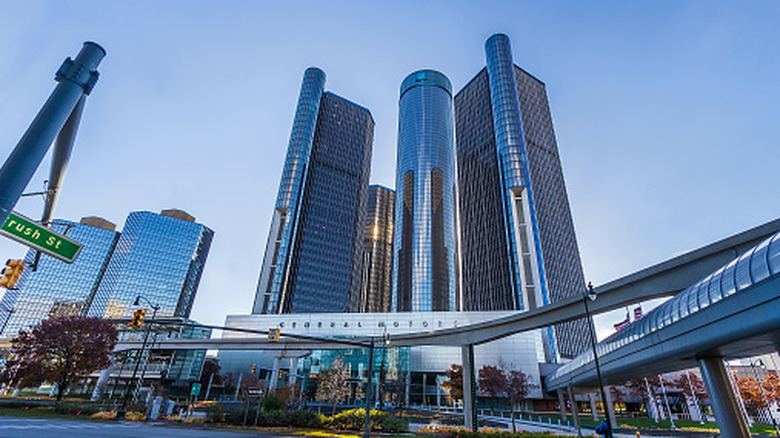
General Motors rounds out the final, and eldest, of the Big Three. Like Ford and Chrysler, General Motors also traces its heritage to Michigan from the very beginning, beginning in 1886. William Durant and Josiah Dort founded the company's progenitor, named the Durant-Dort Carriage Company, that subsequently acquired a budding Buick in 1904. This led to the official creation of General Motors on September 16, 1908, headquartered in Flint, Michigan. Chevrolet joined the roster in 1921, and by the beginning of the Second World War, GM was as well-established as the other two American giants.
The early history of General Motors was marked by a huge variety of iconic innovations and gorgeous automobiles. From the top-tier luxury Cadillac that rivaled Duesenberg in its heyday, to the 1936 Parade of Progress mobile exhibitions. The interwar period was particularly lucrative and set up GM as a major driver of future technology. For example, Oldsmobile introduced the industry's first mass-produced automatic transmission in 1940, the Hydra-Matic, which was adopted by Cadillac the following year. That marked GM's final major innovation before the War, which saw the company hire some 750,000 new employees, about a third of which were women, for military production.
General Motors continued expanding well into the 21st century, surviving multiple financial crises and making its name as a genuine pioneer. Pontiac ushered the Muscle Era with the GTO, the Corvette was the first fiberglass body and America's first sports car, the EV1 pushed vital development talent into electric vehicles, and so on. Today, General Motors' corporate headquarters, the Renaissance Center, is located at the Hudson's Detroit landmark in eponymous Detroit.
Scout Motors
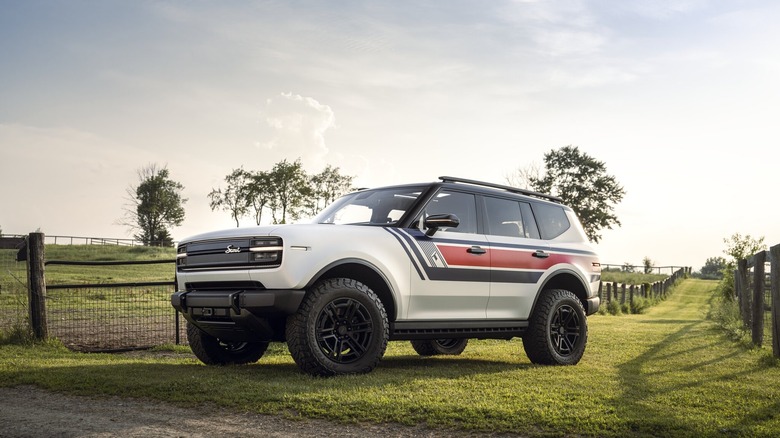
Scout Motors is one of the newest additions to the Motor City family. No, it's not the International Scout from the 1960s, at least not directly; it's an EV startup, based out of Novi, Michigan. Of course, there's a million random startups popping up as alternative fuels gain more and more traction, so what makes Scout Motors distinct?
The company derives much of its business model from what the original International Scout brought to the table — a simple, practical off-roader meant more for recreation and exploration than everyday usability. A tall order in today's economy, though the sting is softened somewhat by Volkswagen officially backing the project. It's basically Detroit's take on the Ineos Grenadier, at least on-paper; you're taking an older car design and modernizing it with. However, that's an interesting proposition for an SUV not manufactured since 1980.
Scout Motors' take on it was to create two distinct models: the Traveler SUV and Terra pickup truck. Both models are said to come in either full-electric or with a range-extending gasoline engine, meaning the engine will act like a generator to keep the batteries charged to a quoted 500+ miles. Granted, both trucks will still be packed with tech and are estimated to cost "below $60,000," according to Scout's website, so the concept of a purist SUV like the original Scout is dubious at best.
Whether or not the new Scouts will be any good is, of course, for time to tell. But a budding company like this remains its own sign that the Detroit economy still retains a sizeable, talented body willing to work on cars.
Slate Auto
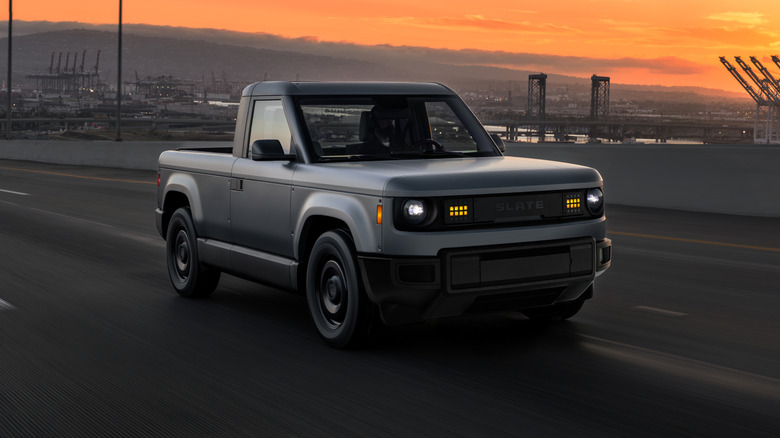
Here comes Slate Auto with the haymaker against big truck companies. Yes, that Slate, the most basic American truck on the market, bringing something with arguably a more unique take than Scout in contemporary regression. It's definitely a Hail Mary shot, if ever there was one, considering the overwhelming popularity of pickup trucks as status symbols. But in the sea of those trucks, we Americans have debatably lost the plot; where, then, have all the little single-cab workhorses gone?
The answer, thanks to Slate Auto, is apparently Michigan. Troy, Michigan, to be specific, where it began inside the walls of Re:Build Manufacturing in 2022. Later on, the project gained enough momentum to attract Jeff Bezos, acting as the principle investor and allowing the startup to branch out and do its own thing. That thing is the Slate Truck, the infamously basic EV pickup priced at under $30,000.
In a phrase, it's a complete enigma of modern American truck design. Most trucks have grown proportionately larger and denser, with more cab and less bed, more features for more cost. Slate Auto's vision harkens back to the days when a pickup truck was considered an agricultural tool. City-based fleets could potentially buy two of these plus equipment for one F-150 Lightning, a welcome alternative if ever there was one.
Like Scout Motors, Slate Auto proves that Michigan's automotive industry isn't just alive and well, but experiencing its own renaissance with startups dishing out hot takes on modern automotive design. Ambitious, certainly, but Slate has plans for its funky little truck. Moreover, it crucially provides prospective pickup buyers with an inexpensive, practical alternative, no dealership needed. What a concept.