

'An Ambitious Goal': How Slate Hopes To Make Its $25K Pickup Profitable
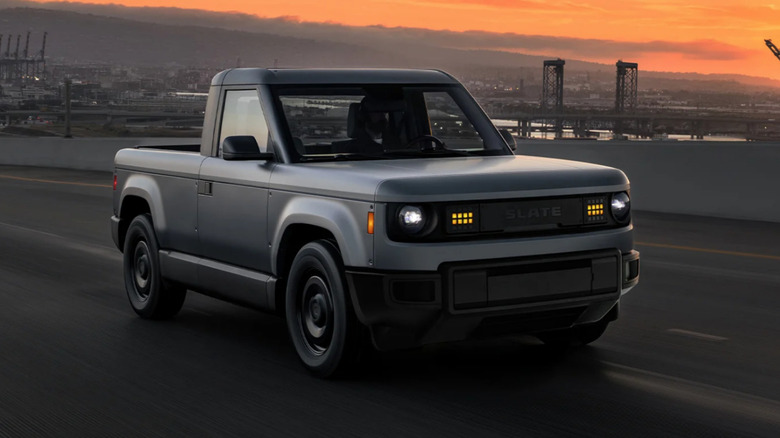
If you see an electric truck on the road, it's likely going to be a Tesla or a now-discontinued Ford F-150 Lightning. But electric vehicle startup, Slate Auto, is trying to change that. The Michigan-based company thinks it has found a way to make an affordable (and profitable) EV truck. This bold belief comes as numerous other electric vehicle startups have struggled with massive losses and even bankruptcies.
Speaking to CNBC, Slate CEO Peter Faricy sounds well aware of what a challenge the company faces. He acknowledged what "an ambitious goal" it is to think every vehicle sold will remain gross-margin positive. Nevertheless, Faricy said Slate expects to achieve positive free cash flow and EBITDA (Earnings Before Interest, Taxes, Depreciation, and Amortization) as soon as 2027. Unlike rivals that prioritized putting out premium electric vehicles over attempting to lower costs, Slate is betting on profitability from a much more simplified product than the competition.
Rather than loading up on luxury features or cutting-edge technology, Slate is intentionally removing much of what's come standard with the automotive industry in recent years. On the manufacturing side, that gives Slate a production break-even point of roughly 80,000 vehicles annually — just over half of its Indiana plant's planned capacity of 150,000 units. Only time will tell if people end up convinced by Slate Auto's master plan or not.
Slate hopes going back to basics will be the key to success
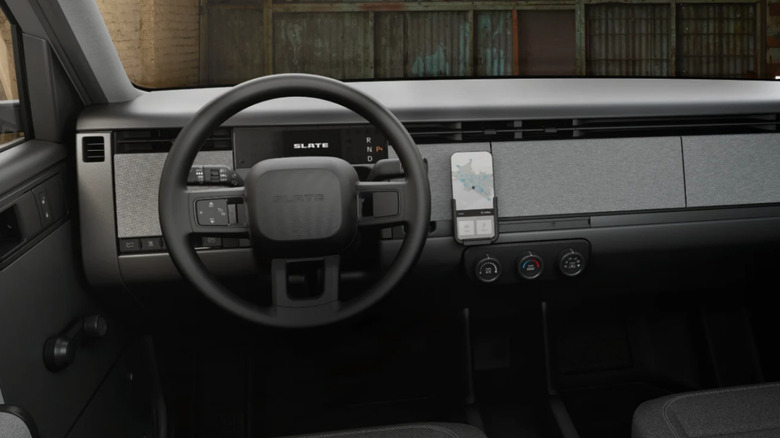
If you can live without an infotainment screen, speakers, paint, or power windows, Slate's base pickup starts at $24,950. Of course, you can add those some of those things yourself. For instance, the truck gives you space to connect your own phone or tablet for navigation and entertainment. The truck also uses molded composite body panels, so you don't even necessarily need paint if you don't want it. The company simply plans to make just one basic version of the vehicle, letting customers personalize it further if they please. But that personalization won't come in a way that will complicate production. For context, traditional manufacturers typically build dozens of different trim levels with included, factory-installed options, all of which increase costs.
More than 175 accessories are expected to be available at launch, including stereos, roof racks, lighting packages, and other cosmetic upgrades. Over 80% of them are priced below $500. Customers can also transform the two-seat pickup into a five-passenger SUV through a modular conversion kit. That's great and all, but for Slate to succeed, it's going to have to bank on meaningful demand for an intentionally minimalist electric vehicle in a market where people have come to expect premium bells and whistles. Then there's also the plummeting EV sales industry-wide to consider.