

10 High-Tech Autonomous Aircraft Made By Boeing (And What They're Used For)
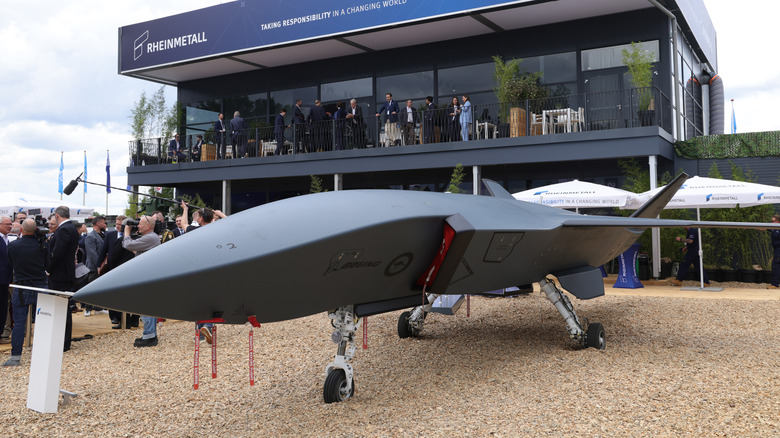
When William Boeing founded the world-famous airplane company in 1916, no one could have predicted what a juggernaut it would become. In fact, no one could foresee that air travel itself would turn into a crucial global industry, but today both people and goods move through the sky using technology the company helped pioneer.
Boeing is mainly known for its passenger airplanes such as the legendary 747, but the company is no stranger to wild designs like the 500-foot-wingspan Pelican Super Transport. Likewise, beyond commercial air travel, Boeing has made several of the most important military aircraft in history.
The world of aviation is changing. Advances in Artificial Intelligence (AI) and the growing use of drones in both civilian and military life have pushed the company to explore new ground, with craft that don't require a pilot onboard or, in some cases, any sort of pilot at all! Some of these unmanned craft are developed by one of the many aviation companies owned by Boeing, and several are prototypes or experimental. But no one can argue that they aren't fascinating and brilliant feats of engineering.
The Boeing MQ-25 Stingray is an unmanned flying gas station
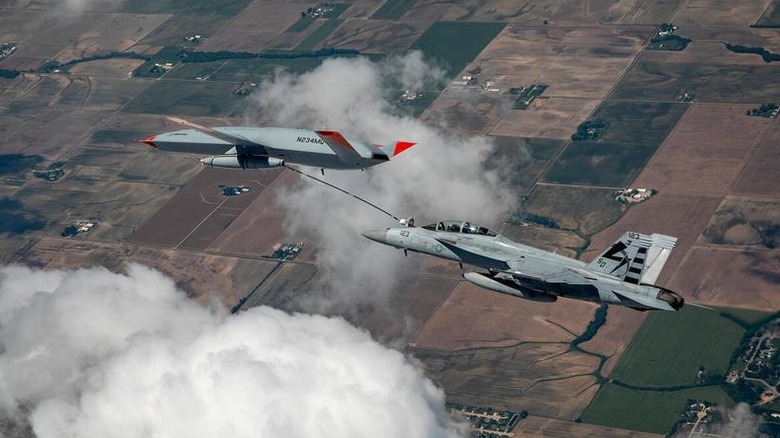
Mid-air refueling is one of the trickiest aerial maneuvers a pilot can be asked to do, but modern missions often require taking off from a point beyond the operational range of the aircraft in question. Aerial refueling duties require crewed aircraft, so this airborne fuel network represents a significant commitment of manpower.
In 2021, Boeing's T1 demonstrator proved that an unmanned aircraft could perform a midair refueling procedure. A world first, and enough evidence to greenlight the MQ-25A Stingray, which first flew in operational form in April 2026.
By September 2026, the Navy had awarded a contract worth $562 million for an initial production run, with expectations of delivery in 2029. Once these autonomous refueling craft are in service, they should free up scarce, highly trained personnel for missions that can't be left to a machine and potentially expand the reach of U.S. air assets. Thanks to aircraft that require less fuel themselves, having ditched all that pesky life-support hardware and crew cabin space, relying on a single Rolls-Royce AE 3007N powerplant, the Stingray is completely integrated with carrier operations and, assuming it's delivered on time and on spec, stands to have a significant impact.
The Boeing MQ-28A Ghost Bat is a loyal wingman and scout
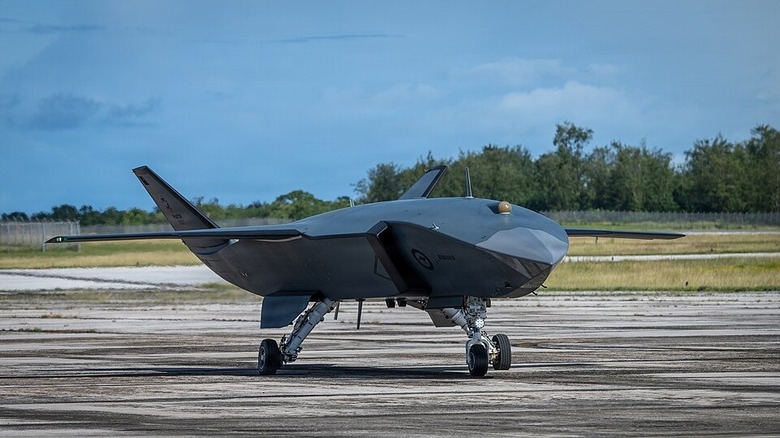
With quite possibly the coolest name of all the entries on this list, the Boeing MQ-28A Ghost Bat is an Unmanned Combat Air Vehicle (UCAV) developed under the "loyal wingman" concept. As such, it's developed to operate alongside human pilots operating combat aircraft like the F-35A or F/A-18F.
With a few Ghost Bats (it is a stealth craft, by the way) flying by your side, your view and control of the airspace are significantly improved. A pilot can direct Ghost Bats to scout, perform strike missions, and act as an electronic warfare aircraft. Loyal wingman drones help human pilots stay out of danger, and in this age of beyond-visual-range attacks, pilots are highly reliant on technology to know what's going on. Combining the judgment of a human pilot with the advanced capabilities of these drones could be a force multiplier in modern air superiority.
The MQ-28A was designed in Australia by Boeing's Australian division (Boeing Defense Australia) in cooperation with the Royal Australian Air Force. While the Ghost Bat first flew in 2021, it wasn't combat-ready until a 2025 test in which it fired an AIM-120 air-to-air missile that destroyed an aerial practice target. This was while flying with an E-7A Wedgetail and an F/A-18F Super Hornet.
Insitu's ScanEagle keeps watch over the seas
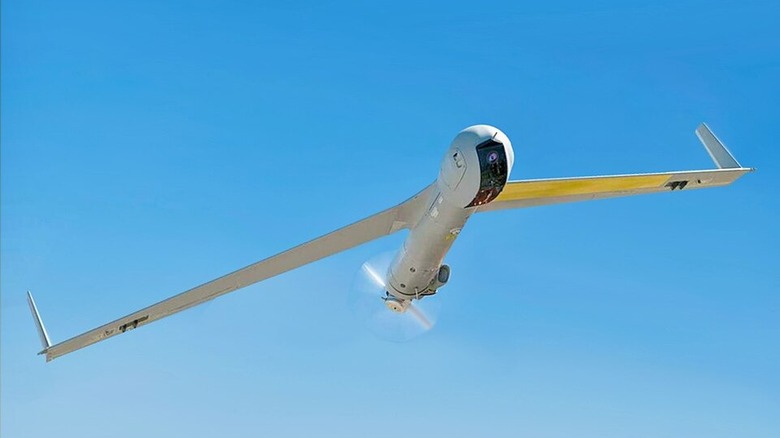
Boeing subsidiary Insitu has come up with quite an interesting system here in the form of the ScanEagle. Typically, the ScanEagle is launched using a catapult system and recovered with a SkyHook Recovery System. However you get the ScanEagle up in the air, once it's there, you can get the ultimate bird's-eye view, depending on your payload. The drone can be equipped with electro-optical cameras, IR sensors, radar, and more.
The ScanEagle has been in operation for quite some time. Officially, ScanEagle reports 1.6 million combat flight hours. It's proven highly effective at that. In February 2025, a ScanEagle operated by the U.S. Coast Guard assisted in stopping four smuggling craft carrying thousands of pounds of narcotics. The ScanEagle can carry 17 pounds for over 18 hours, which really puts the flight time of consumer drones like the Antigravity A1 into perspective.
Boeing's A160T Hummingbird almost became a self-flying cargo drone
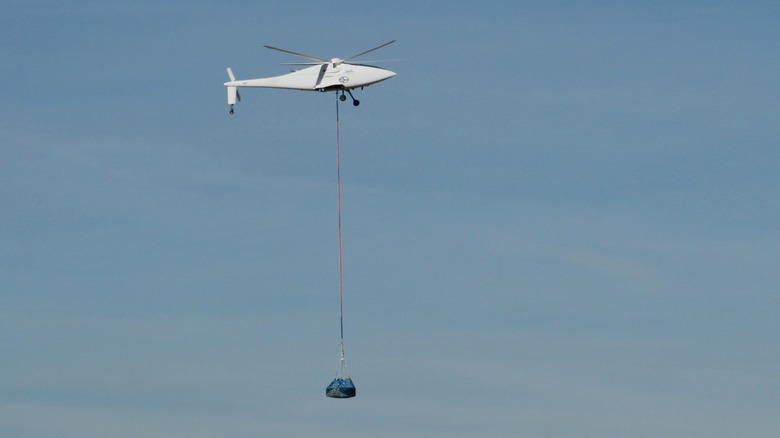
Ever since the first production helicopter entered combat (the Sikorsky R4 in WWII), these aircraft have proven to be infinitely versatile. From attack choppers like the legendary Apache to cargo-carrying behemoths like the Chinook, there's always a niche that seemingly only a helicopter can fill. They're also tricky to pilot, which is why the old joke that helicopters don't fly; they beat the air into submission is repeated so often. In 2010, Boeing's A160T Hummingbird proved that you can remove the pilot from a helicopter and still successfully complete complex missions, such as carrying underslung cargo.
This type of use case is common for forward-position resupply missions, and with a 2,500-pound payload capacity and maximum flight endurance of 18.7 hours, the Hummingbird was set to become a mainstay for the U.S. military. More than 20 test flights carrying the FORESTER foliage-penetrating radar system were completed in 2009.
Overall, things were looking up for the Hummingbird, but sadly it did not win contracts with the U.S. Navy or Army. So development ceased, and Boeing moved on to other unmanned flight projects.
The Phantom Eye watches from far above
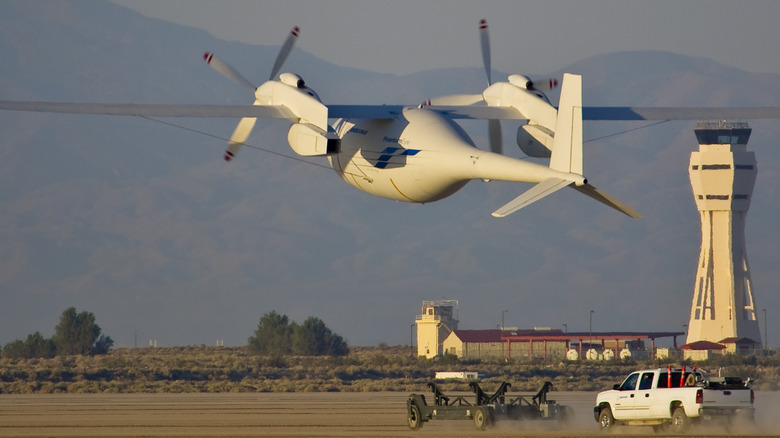
The history of high-altitude surveillance aircraft is storied and includes legendary planes like the SR-71 Blackbird. Spy satellite advancement played some part in the demise of these high-speed surveillance craft, but today there's still a need for slower, loitering surveillance systems. Especially as militaries worldwide chase the ever-elusive unified digital battlefield, where the fog of war is lifted, and one asset can use data from another to complete missions or adapt to changing situations.
Boeing's Phantom Eye drone was an experimental craft that completed its first autonomous flight in 2012, lasting just 28 minutes. An early example of persistent Intelligence, Surveillance and Reconnaissance (ISR). The Phantom's goal was far more ambitious than just half an hour in the air, however. The mission spec called for 4 days of unrefueled, autonomous flight.
Phantom Eye used hydrogen-powered engines as part of the solution, but in the end the craft completed just nine flights before ending in 2014. In 2016, the prototype was sent to live out its days as an exhibit at a test flight museum.
The Boeing H-6U Unmanned Little Bird was the little helper that could
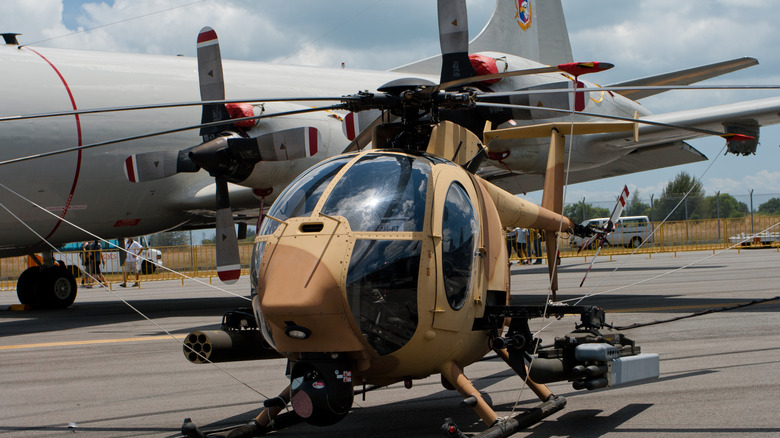
When you think of famous military helicopters, names like Huey or Black Hawk spring to mind alongside the Apaches and Chinooks, but the Boeing MH-6M Little Bird (aka the Killer Egg) deserves to be mentioned in the same breath. You've no doubt seen them in movies, video games, or in file footage where a tiny helicopter pulls off seemingly impossible moves to neatly drop four special-forces operatives on a rooftop. Then promptly flying off to provide close air support with rockets or a minigun.
So perhaps it's not surprising that Boeing would take this proven chopper from the 1960s and attempt to make it an unmanned aircraft. That's where the Boeing H-6U Unmanned Little Bird zooms into the picture. What's immediately interesting about this craft is that a human can still pilot it. This gives it the flexibility to fly itself or stand by as the ultimate autopilot for a human passenger.
While the Killer Egg has seen plenty of combat, the H-6U was not designed with combat roles in mind. Instead, it was meant to demonstrate that UAVs of this size and performance could perform resupply, comms relay, and surveillance roles. The Unmanned Little Bird was first introduced all the way back in 2004, but it was still conducting flight demonstrations in 2012 for shipboard operations. This test platform has not yet entered actual service.
Insitu's RQ-21A Blackjack is a tactical battlefield recon specialist
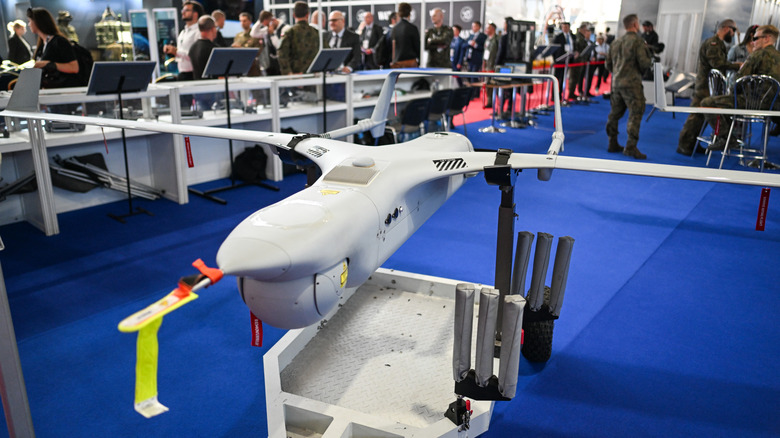
The RQ21A Blackjack was developed for the U.S. Marine Corps, although, as of this writing, the Marine Corps is divesting from the RQ21A in favor of the MQ-9A Reaper. That doesn't mean it's going away immediately, and Insitu still supports the drone, which operated with customers other than the Marines.
The Blackjack has some impressive specifications. Its job as an ISR drone is to provide intelligence day or night, and act as a comms relay to keep everyone informed of what's happening on the ground. In order to do that, it has up to 16 hours of endurance. With a max takeoff weight of 135 pounds, it can reach altitudes of up to 20,000 feet.
Once it's up there, the Blackjack has several wonderful toys to play with. It has an electro-optic imager with 4x digital zoom, an infrared imager, a laser rangefinder, an IR marker, and, of course, the communications hardware to act as a relay between home base and ground forces. With over 17,000 flight hours across 14 deployments, the Blackjack has had a short but busy career with the Marines. Something tells us it still has quite a bit of life left.
Aurora's SKIRON-X is a portable surveillance system
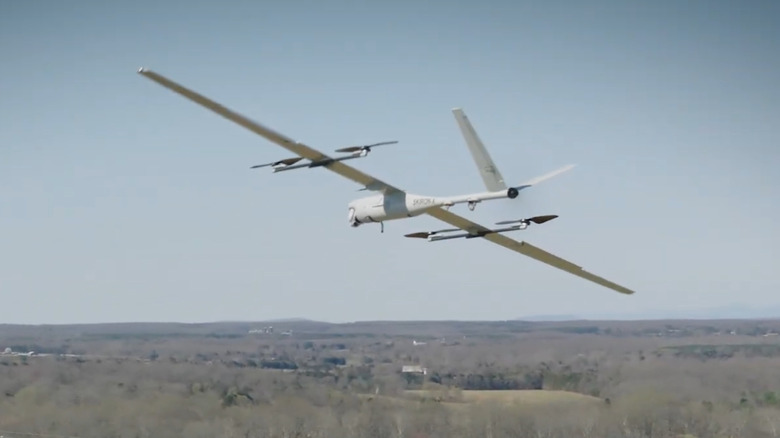
Another Boeing company, Aurora Flight Sciences, calls the SKIRON-X a "small UAS," which is, of course, a relative term. This advanced surveillance drone can fit on the back of a standard pickup truck in its boxed form if you leave the tailgate open!
As you can see by watching this 2025 SKIRON-X video, the main party trick here is combining vertical multirotor takeoff and landing with the endurance, efficiency, and range of a fixed-wing drone. Keep in mind that other similar ISR drones, such as the Blackjack and ScanEagle, have to be launched from a catapult and caught with some sort of net or hook system. The SKIRON-X neatly sidesteps all that drama.
What you'll also see in that video is how quickly the modular payload system can be swapped out. Unlike those other ISR fixed-wing drones we've looked at, the SKIRON-X is fully electric and uses fuel-cell technology. Nonetheless, the SKIRON-X offers up to 3.5 hours of flight time, and with an optional extended radio, it can stay in range up to 47 miles away. The craft can be deployed and operated by just two people, and it can fly autonomously without constant direct control. It's a neat example of how Boeing isn't just building big and bulky drones.
Boeing's Passenger Air Vehicle shows you don't need a pilot to travel by air
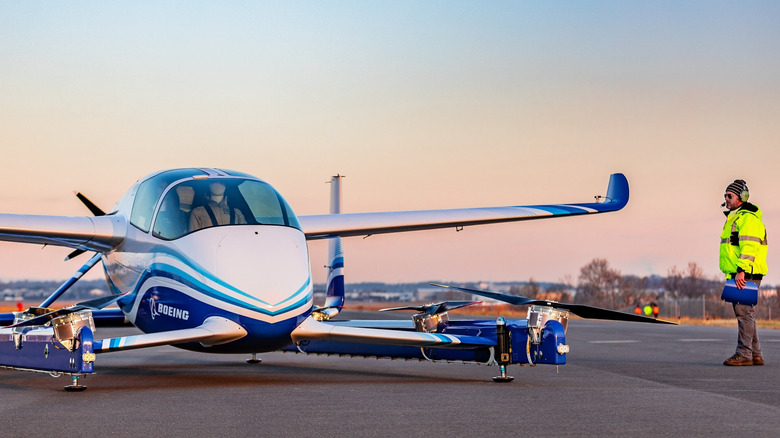
We'll probably never get proper flying cars like in movies such as "Blade Runner" or "Back To The Future: Part II," but the rise of autonomous air taxis like this Boeing Passenger Air Vehicle prototype may be as close as we need to get. True self-driving cars might always be just out of reach, but up in the sky, the problem is easier to solve without those pesky pedestrians and other complex obstacles.
In 2019, the PAV completed its first flight, using an all-electric propulsion system giving it an up-to-50-mile range. It's designed to lift up to 500 pounds, which should cover two ordinary people and a bit of luggage. Several companies are trying to enter the air taxi market besides Boeing, and there are still many safety and regulatory problems to solve. However, making the PAV completely autonomous works around the biggest problem with the idea of a flying car. The fact is that expecting the average person to pilot one of these vehicles in what would presumably be very crowded airspace is unreasonable.
Unfortunately, the PAV crashed in the same year of its first successful flight. The program was put on pause, though we could not find an official cancellation. In the meantime, Boeing has invested $450 million in Wisk Aero to aid in the development of passenger electric unmanned flight. Though Wisk's craft don't look nearly as cool as the PAV.
The Boeing X-37B Orbital Test Vehicle takes you to space
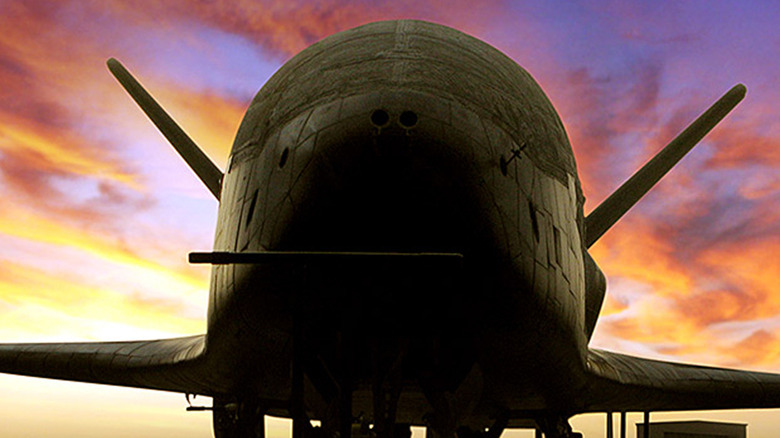
Does the U.S. Space Force actually go to space? It's a fair question considering that the U.S. government often relies on private companies like SpaceX to get into orbit, so logically its military branch dealing with space would need some outside help too. The X-37B might just be key not to how Space Force members will get into orbit (you still need a rocket for that), but to what they can do once they are in orbit.
This experimental orbital vehicle has been sent on missions at least eight times as of this writing, using the SpaceX Falcon Heavy Rocket. You may even have heard of this craft in the news, thanks to the fact that it spent 900 days in orbit, but whatever it did up there is classified.
In total, the two X-37Bs that currently exist have been up there for over 4,000 days, and details of their exact capabilities are hush-hush. As with so many military craft, it may be decades before we find out what they've really been up to, but it is fun to come up with our own ideas.