

5 Of The Best Fighter Jets Flown By The US Air Force
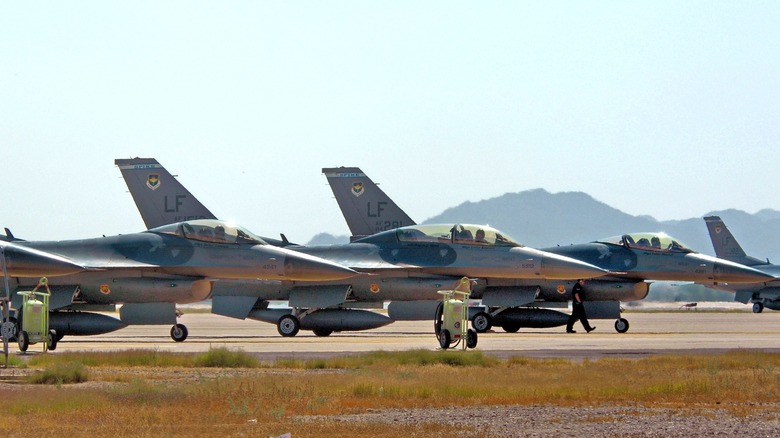
The United States Air Force (USAF) began as a division of the U.S. Army known as the United States Army Air Forces. In 1947, the branch separated to become the USAF. Since that time, the USAF has flown a lot of different types of aircraft, from transport planes like the massive C-5M Super Galaxy to a variety of helicopters, tiltrotor aircraft, fighter jets, bombers, and more. Today, the USAF continues to dominate global air power with a massive fleet of impressive aircraft, many of which are fighter jets.
That said, modern fighter jets are typically multirole aircraft that perform ground-attack and bombing functions. Aircraft like the legendary A-10 Thunderbolt II aren't considered fighter jets and are instead known as attack aircraft. Regardless, there remain a ton of excellent fighter jets that the USAF has operated since its inception, and several stand out among the rest. The fighters that led the way during the Korean War, the Vietnam War, Operation Desert Storm, and the conflicts of the 21st century all played their part, and many were outstanding aircraft.
There are plenty that don't rise to the level of being considered the best, though most of the fighter jets flown by the USAF over the decades have been exceptional military machines that performed well in arduous operations all over the world. Each of these five fighter jets represents the best that the USAF has operated over the decades, and many are representative of the service itself. They remain iconic of the branch and are well known for their maneuverability, speed, and lethality.
North American F-86 Sabre
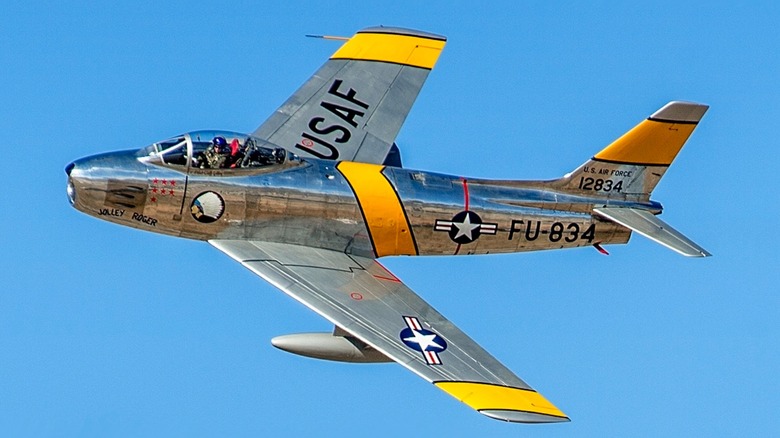
The North American F-86 Sabre began flying for the USAF in 1949, making it the second fighter jet the service piloted after the Lockheed P-80 Shooting Star. The F-86 featured a swept wing, and 9,615 of them were produced before production ended in the 1950s. That made it the most produced Western fighter jet of all time, as no other aircraft has been produced in such heavy numbers. The F-86 is probably best known for how well it ruled the skies during the Korean War, which was its first time seeing combat.
The Korean War kicked off with North Korea operating Soviet-made MiG-15s, and when the two aircraft met in combat, the F-86 proved itself more than capable of handling the enemy fighter. Throughout the conflict, F-86 pilots were credited with downing 792 MiG-15s while losing 78 of their own aircraft. That gives the F-86 an incredibly impressive kill ratio of 8.7:1, though earlier reporting of the fighter jet's performance credited it with a ratio of 10:1. Regardless, both are outstanding for any fighter jet, not to mention the definitive first-generation fighter jet.
The F-86 was powered by a General Electric J47 turbojet engine that produced 5,670 lbs. of thrust, which gave it a top speed of 685 mph. That makes the F-86 subsonic, but not by much, as its top speed converts to Mach 0.89. For arms, it was outfitted with six .50 caliber M3 machine guns, which it used with deadly accuracy against Soviet aircraft. The USAF began phasing out the F-86 in the 1950s. Still, it wasn't finally retired as the Bolivian Air Force flew them until 1994.
McDonnell Douglas F-4 Phantom II
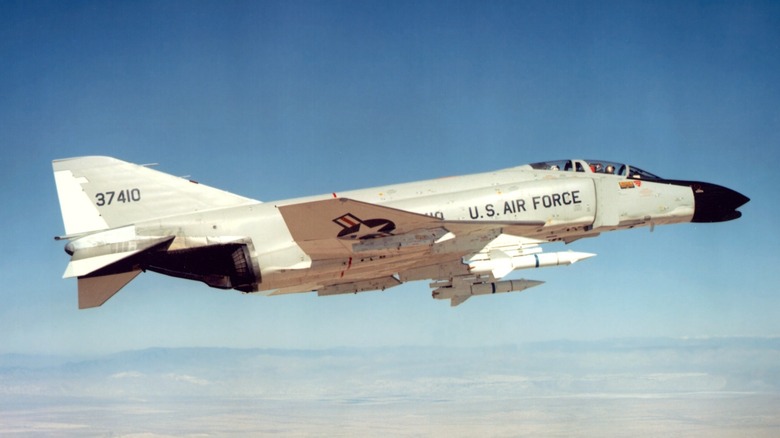
While it was initially intended for the U.S. Navy (USN), the USAF quickly noted the features of the McDonnell Douglas F-4 Phantom II and added it to the inventory in 1963. It also flew for the U.S. Marine Corps (USMC), as it was an ideal fighter jet during the Vietnam War, which is where it saw extensive service. A total of 5,057 F-4 Phantom IIs were produced, and the USAF operated 2,874 of them, making it the service with the most in its inventory, as the USMC and USN collectively had 1,264 while 919 went to allied nations.
It began operating for the U.S. military in 1961, making it the primary fighter-bomber and interceptor when the Vietnam War began. When it took to the unfriendly skies during the Vietnam War, the F-4 Phantom II quickly proved itself an excellent fighter. The USAF primarily used it as an air superiority fighter, but it was also utilized for reconnaissance and ground-attack missions. One noteworthy aspect of the F-4's Vietnam utilization was that all five American aces from the conflict earned their five kills while piloting F-4s.
One of the reasons that the F-4 was such a deadly fighter was how it used air-to-air missiles over guns when it engaged enemy fighters. This included the long-used AIM-9 Sidewinder, which entered the USAF inventory in 1956. The USAF continued flying the F-4 for decades before finally retiring the versatile, deadly multirole aircraft in 1997. While some made it to museums, most were converted into flying drones for target practice up until 2016.
McDonnell Douglas F-15 Eagle
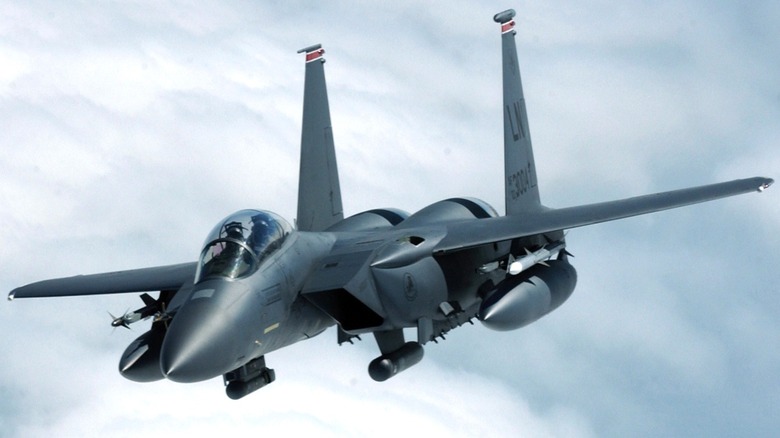
The USAF began flying the McDonnell Douglas F-15 Eagle as its primary air superiority fighter in 1974. It didn't take long for the USAF to see how versatile the aircraft was, and it maintains one of the most impressive records of any frontline fighter jet. The F-15 has never been lost to air-to-air combat, though it's been credited with shooting down 104 enemy aircraft. That gives it an unrivaled kill ratio of 104:0. However, that's not to say that several haven't been shot down by ground-based air defenses.
In fact, three F-16s were mistakenly shot down by Kuwait in a friendly-fire incident in 2026, but the fighter's air-to-air victories still set it apart. During Operation Desert Storm, F-15s flown by the USAF were credited with 34 of the branch's 37 air-to-air victories, proving the aircraft remained relevant long after its introduction. The F-15 initially featured two Pratt & Whitney F100-PW-100 turbofan engines, which gave it incredible speed. It could reach 1,875 mph, and it also boasted a variety of ordnance loadouts, including air-to-air missiles.
As time passed, the F-15 evolved, and the current model, the F-15EX Eagle II, is one of the USAF's best fighter jets. The Eagle II was first revealed in 2021, and it's since been involved in numerous combat operations. None have been lost to air-to-air combat, ensuring the F-15's record remains untouched. The impressive aircraft manufactured by Boeing extends the F-15's service life well into the future as it replaces older F-15s with the newest variant.
General Dynamics F-16 Fighting Falcon
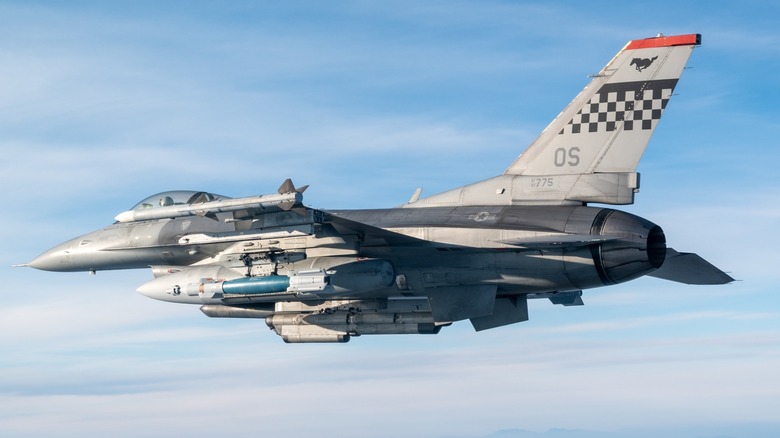
The General Dynamics F-16 Fighting Falcon was also developed in the 1970s, first entering the USAF inventory in 1979. It was initially designed as an air superiority fighter and has operated in that capacity (and others) for decades. Like the F-15, it remains in operation to this day, though, like its predecessor, the F-16 flying these days is significantly more advanced than the one that first arrived in the '70s. The fighter remains relevant, and in 2012, Lockheed Martin delivered the 4,500th F-16, marking an impressive milestone.
While the USAF continues to fly the F-16, it's also operated by dozens of other nations around the world, including Belgium, Greece, Indonesia, Norway, and many others. Despite being over 40 years old, many F-16s are ready to fly at a moment's notice, and they remain deadly and versatile. The F-16 features an M-61A1 20mm multibarrel cannon and 11 hardpoints capable of carrying a wide assortment of ordnance of various types.
The modern variant of the F-16 Fighting Falcon is the F-16V Viper, which is a significantly upgraded version of the original aircraft. It's equipped with all of the modern essentials, including advanced electronic warfare capabilities and radar systems. Lockheed touts it as "the most technologically advanced 4th generation fighter in the world," though it's more akin to a 4.5th-generation fighter with all of its modern capabilities. While it has no set retirement date and will likely continue flying until the 2040s, eventually, the USAF will replace the F-16V with the F-35A Lightning II.
Lockheed Martin F-22 Raptor
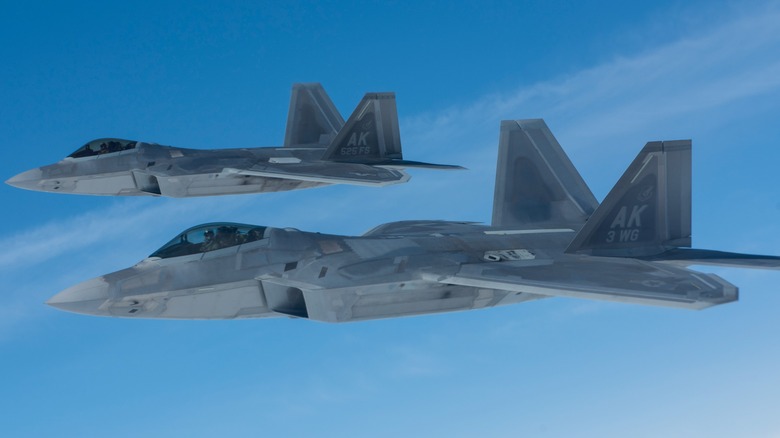
The Lockheed Martin F-22 Raptor is the world's first 5th-generation fighter jet, and it's exclusive to the USAF. Unlike the F-35 Lightning II, which comes in three variants for the USAF, USN, and USMC, the F-22 remains the sole property of the USAF, and that's unlikely to change. The program that developed it cost so much money that the original order of 750 was curtailed to 187 aircraft. Despite this decision, the F-22 remains one of the most advanced stealth aircraft in operation, and the F-22 is slated to continue flying well into the 2040s, thanks to several modernization upgrades.
The F-22 entered the USAF inventory in 2005, and it's been used in numerous combat operations ever since. The aircraft boasts an impressive supercruise ability that enables transonic flight (beyond Mach 1) without having to engage its afterburners. Of course, with them engaged, the F-22 can fly at incredible speed, exceeding Mach 2. It's powered by two bespoke Pratt & Whitney F119-PW-100 turbofan engines that also feature two-dimensional thrust, giving the F-22 excellent maneuverability.
The F-22 can be outfitted with a variety of weapons systems, including various air-to-air missiles for an air-to-air loadout, and it can also carry two 1,000 lb. GBU-32 JDAM bombs, as well as two AIM-120 air-to-air missiles for its air-to-ground loadout. While it's an excellent fighter and multirole aircraft, it's unlikely that the USAF will order additional F-22s, capping the entire inventory at around 100 aircraft, which is how many it has in operation as of this writing.
How we chose these five USAF fighter jets
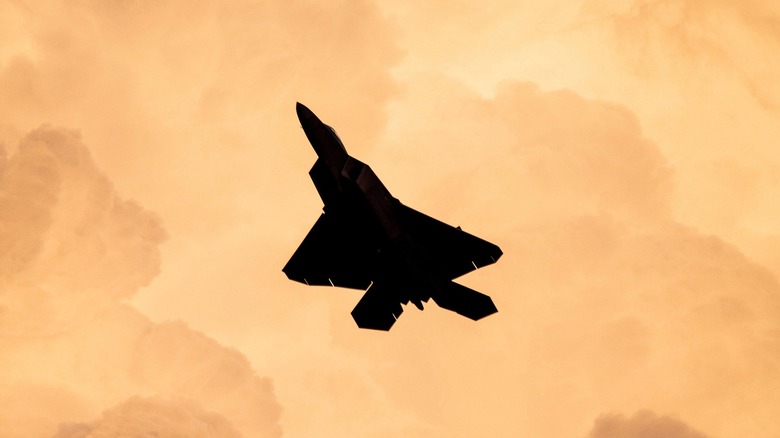
There's no denying that the USAF has flown some of the world's most impressive fighter jets. With dozens of excellent examples, selecting the top five was no easy task. Because picking planes that are considered the best is largely subjective, and objectivity is our goal at SlashGear, we approached this task by looking at overall aircraft usage and quality over other metrics. Some were selected because they're iconic of the branch, which is certainly true of the F-22, as the aircraft is only flown by the USAF.
Other fighters like the F-15 Eagle found their way onto this article because of their impressive combat record. The fact that pilots operating F-15s have shot down over 100 enemy aircraft without losing a single Eagle is an unparalleled metric, so it had to be included. The same can be said of the F-16, and while it's flown by numerous air forces around the world, it's fundamentally an Air Force aircraft that's represented the branch for nearly half of its existence.
Conversely, the F-35 Lightning II wasn't included because the aircraft is still relatively new, and it's flown by the USN, USMC, and numerous allied nations. Because of this, it didn't seem iconic enough to represent the USAF. That said, the F-4 Phantom II, which was also operated by other branches and countries, was primarily flown by the USAF, and its performance in the Vietnam War made it stand out above the competition. Regardless of our choices, one thing remains clear: These aircraft have been flown by some of the most exceptional men and women to wear the uniform.