

Are Subaru Boxer Engines More Durable Than Inline Engines?
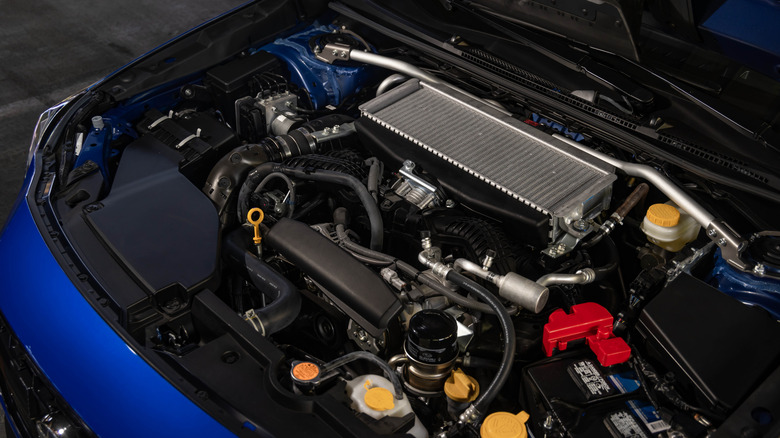
Subaru remains the only manufacturer of regular production cars that uses boxer engines, something the company has practiced for decades at this point. Yes, Porsche also uses the design, but the 911 is hardly a regular car to most of us, so let's focus in on Subaru's design, specifically. And it is a quirky one, at that — boxer engines aren't exactly as intuitive as you might think.
First of all, how do boxer engines work? Put both of your arms sideways-on so you're fistbumping yourself. Keep fistbumping yourself over and over — that's a boxer engine. When the left piston moves out, so does its corresponding right piston. When one moves in, so does the other. That helps cancel out all the horrific vibrations that would otherwise be generated by moving all that mass back and forth at high speed, which is why boxer engines are considered better than other flat engines. But are they more reliable than inline engines?
Let's use a basic flat four versus inline four for this example. Forget displacement, compression, accessories, or anything else. Is the engine itself, at a base level, more reliable? Simple answer: No, because a boxer engine has two heads whereas an inline has one, and an inline has the benefit of gravity to pull oil back down to the pan. But that's a gross oversimplification; both engines are perfectly capable of exceeding six-figure miles with proper maintenance. Similarly, both configurations have better and worse examples in terms of reliability. It truly is a case-by-case thing, in other words. Let's discuss it at a deeper level.
How the differences between boxers and inlines affect reliability
Put simply, boxer engines have numerous disadvantages that tend to shoo away anyone from building them. Subaru, meanwhile, opts to use its boxer instead of something like a V6 because it's so iconic to the brand and the cars are all built around that specific configuration. And yes, it has numerous advantages — all of the weight is sunk down into the car, meaning it has a lower center of gravity than an inline or V engine. The pistons moving in opposite directions also greatly reduces vibrations; inline four engines need balance shafts to deal with that, which means more moving parts (thus, more failure points).
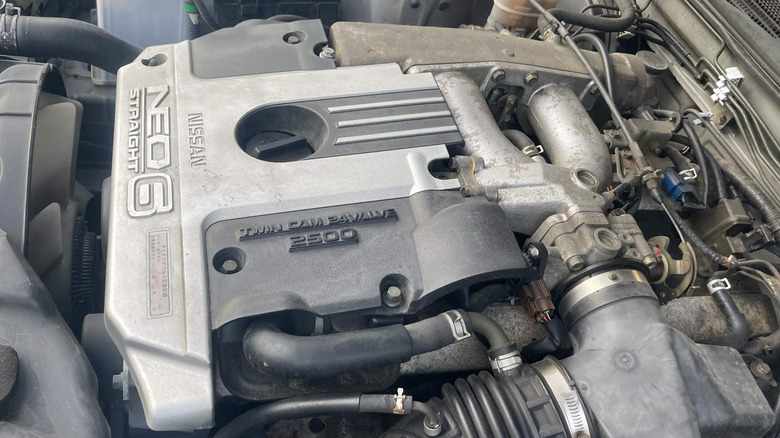
However, a balance shaft ultimately doesn't counter all of the moving parts required for two heads. You have to double the camshaft count, route the timing belt or chain more intricately, deal with all the piping and duct work to keep it well-lubricated and cooled, and seal both sides with their own individual head bolts, gaskets, and covers. Basically, you're building a pair of two-cylinder engines mated to one crankshaft, rather than a single four-cylinder. And that's not even mentioning straight sixes, which eliminate the need for balance shafts entirely because they're inherently perfectly balanced.
Fundamentally, then, all else being equal, an inline four and six are inherently simpler designs than an H4 or H6 boxer engine, respectively. That says nothing about factors like build quality or material science, however — it's simply the logic that the more reliable design is the one with less failure points.
Are boxer engines actually less reliable in the real world?
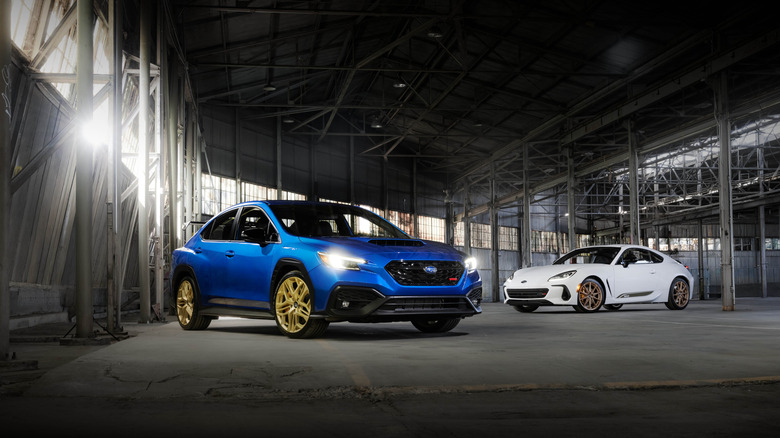
Boxer engines may be more complicated than inline engines and, thus, less reliable in theory, but the real litmus test is whether or not they're actually reliable in practical usage. A quick glance at Facebook marketplace seems to put that to shame, because anywhere you look, you'll find a plethora of old Legacy and Forester models for cheap with hundreds of thousands of miles. One Legacy model even has twin turbos, the only so-equipped factory boxer design. They're not inherently bad engines, likely helped by the fact that Subaru developed boxer technology significantly over the past several decades.
Of course, that doesn't mean that the engines are inherently bulletproof, either, nor are they practically-speaking easier to deal with. Point in fact, a major downside of the boxer is its maintenance complexity. You're having to work in tight confines because of how wide the engine is, and all of the accessories are piled on top of the block. An inline four or six, on the other hand, is far easier for a novice to service because everything is right there when you open the hood. You don't need a lift or ridiculously long and skinny arms to change spark plugs.
In the real world, then, a boxer engine can be more of a pain to service, but as long as it is correctly serviced, it'll last just as long as any inline. Engines in general, unless something is fundamentally wrong, are usually as reliable as the owner is meticulous at doing the maintenance and not abusing them, regardless of how the cylinders are laid out.