

7 Of The Best Fujifilm Cameras You Can Buy In 2026
We may receive a commission on purchases made from links.
Every camera brand caters to a different type of photographer. For example, Sony cameras are the holy grail for vloggers, while Leica cameras have that precise engineering and extraordinary price tags. Likewise, Fujifilm has its own niche. You've probably noticed the resurgence of film photography, as more people try to escape the HDR-heavy look of modern smartphones. The trend was going well, but soaring film prices have pushed many people out. That's exactly where Fujifilm fits in. Its cameras offer exceptional Film Simulations that give photos genuine character, without costing extra. Take the Fujifilm X100VI, for example. It has a cool retro design, takes great photos, and is almost impossible to find at MSRP.
That said, Fujifilm also makes professional medium-format cameras that often don't cost as much as Hasselblads. But which one should you buy? As always, there are plenty of options. So, whether you're a professional photographer in need of a landscape camera or a beginner vlogger who wants to document your journey, don't worry. We've sifted through Fujifilm's current lineup, combined our testing with professional reviews from other outlets, and picked the seven best cameras you should consider in 2026.
Fujifilm X-T5
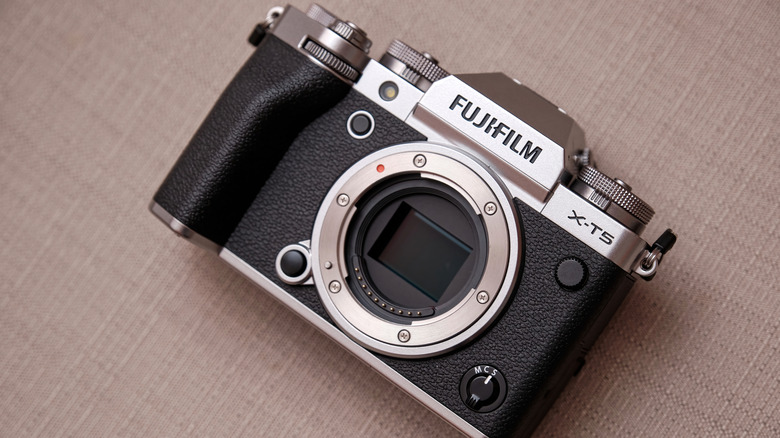
As good as the previous X-T4 was, many didn't like the added bulk and preferred the older X-T3 body. Fortunately, Fujifilm went back to a smaller footprint with the X-T5 ($1,999 on Amazon) while retaining the bigger grip, making it supremely comfortable to use with almost any lens. You still get the traditional camera experience, complete with dials for ISO and shutter speed.
The main reason the X-T5 is our overall pick and one of the most popular mirrorless cameras on the market is its 40.2MP APS-C X-Trans CMOS 5 HR sensor. While some photographers argue against APS-C sensors, the X-T5's images are exceptional. Yes, pixel peepers will notice some extra noise in the harshest scenarios, but that's down to the extra resolution, according to the YouTube channel DPReview TV. You can adjust the colors using the 19 different Film Simulations, each with its own character, and the HDR is spot on.
The new AF-C system can continuously track subjects like bikes, animals, and cars. While we wouldn't call the X-T5 a videographer's camera, its video capabilities are still impressive. You can record up to 6K/30 fps in 10-bit 4:2:2 color. It supports F-Log and F-Log2, which is great news for professionals who use custom LUTs, as well as 12-bit Apple ProRes RAW using an Atomos HDMI recorder. The X-T5 and X-H2 share the same sensor and processor, but they serve different needs. The X-T5 nails the traditional camera formula with its manual controls, while the X-H2 has better video capabilities, including 8K recording. You can't go wrong with either.
Fujifilm X-S20
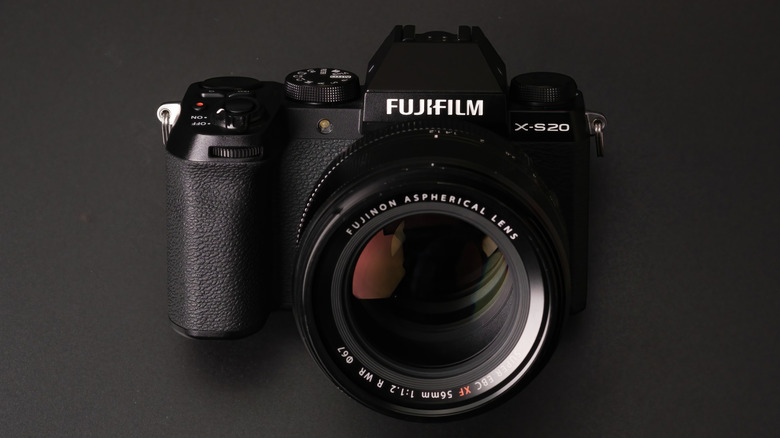
While the X-T5's manual controls are great, there will be a learning curve to using them. And if you're just getting started and need something that works well for both photos and videos, the Fujifilm X-S20 ($1,499.95 for the body) is hard to ignore. It's easier to use, so you won't spend days figuring out the controls, and it includes several useful features. For instance, Product Priority lets you quickly shift focus from a product to a person, while Background Defocus can blur the background when you're shooting yourself. You still get 19 Film Simulations, and Auto Shooting mode adjusts the camera settings based on the scene.
While the X-S20's 26MP X-Trans BSI CMOS sensor has lower resolution than the X-T5's, you won't be disappointed with the videos. In fact, PCMag named it one of the best vlogging cameras. A big reason is its open-gate 6K/30 fps recording, which uses the full 3:2 sensor area. This is great for content creators, who can shoot both landscape and portrait videos without much cropping. The videos themselves are detailed, have consistent colors, and keep both highlights and shadows visible (13 stops of dynamic range). The 5-axis stabilization easily smooths out jitters from a boat or moving car, and you can shoot in both F-Log and F-Log2 for more flexibility. Just remember not to record continuously for more than 30 minutes because overheating is a concern. The lack of any weather sealing is also a bummer, but we aren't taking too many points off.
Fujifilm X100VI
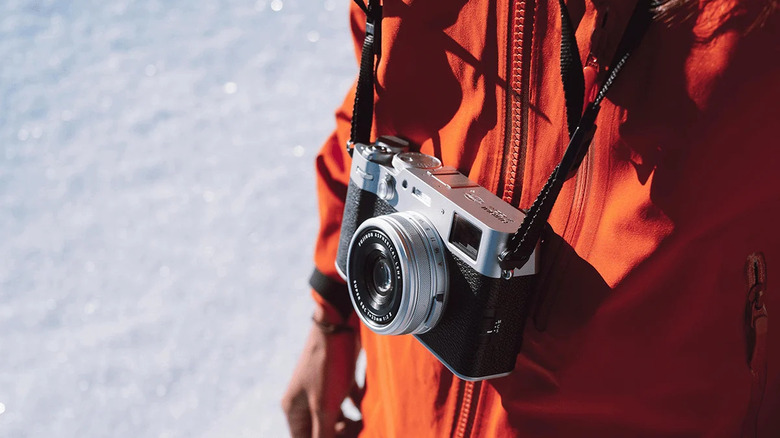
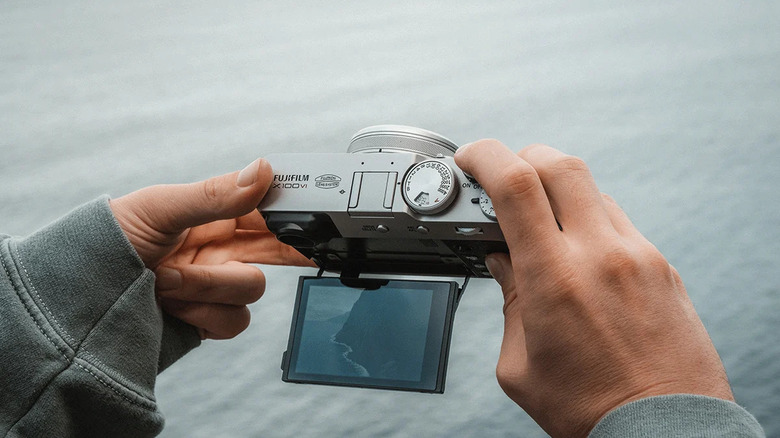
There are two ways to take a photo: RAW for maximum detail and editing flexibility, or JPEG, trusting the brand's color profile. But here's the kicker: most camera makers aim for relatively neutral photos so you can add the final flourish in post. While that's not a problem for professionals, not everyone wants to spend hours editing photos when exploring the Patagonian mountains. That's where the Fujifilm X100VI comes in. The popularity of its predecessor, the X100V, made it clear that regular people also want a camera, but not the editing headache. And the X100VI builds on that. It's compact with a fixed lens and an exceptionally vintage design. It weighs just 521 g (with the battery) and fits inside a jacket pocket. Physical dials let you adjust exposure and shutter speed.
What sets the X100VI apart from the cameras we've mentioned so far is its hybrid viewfinder. We loved it in our X100VI review because it lets you frame shots without staring at another screen. To help avoid framing mistakes, Fujifilm overlays a digital box in the viewfinder that shows exactly what the lens captures. Incredibly clever yet simple. You still have access to a 3-inch LCD display, which will be very useful for previewing Film Simulations. There are 20 such modes in total, including favorites such as Provia, Velvia, and Astia. Images, thanks to the 40.2MP X-Trans CMOS sensor, are detailed, with spot-on contrast and dynamic range. Nighttime photos had minimal noise, and we found the 6.2K/30 fps videos, with 6.0-stop in-body image stabilization (IBIS), very capable. Availability, on the other hand, isn't great. The camera costs $1,799.95 on the official store (stock is limited), but third-party Amazon retailers are selling it for more than $2,000. If you'd rather not overpay, check out some top-rated X100VI alternatives.
Fujifilm X-T30 III
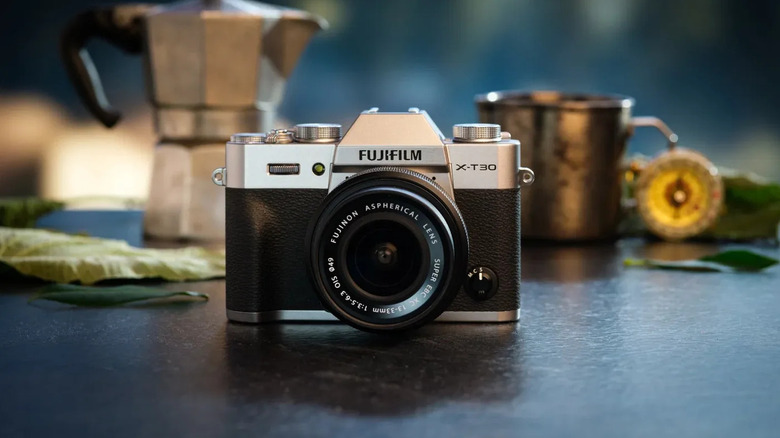
The cameras we've mentioned so far are good, but they're expensive, often costing around $2,000. Not everyone has that kind of money, and if you're on a budget, the $1,000 Fujifilm X-T30 III should be on your radar. It's a bummer that it uses the same 26MP X-Trans BSI CMOS sensor as two of its predecessors, but Fujifilm has paired it with the newer X-Processor 5. This adds support for the more efficient HEIF format. The design is typical Fujifilm, with a retro aesthetic in an SLR-type magnesium alloy chassis. You get plenty of physical dials to change settings and an electronic viewfinder to frame the shot.
The photos? Not bad. In fact, using the same Film Simulations, you can get really good-looking results that preserve details in the shadows and still have bang-on contrast levels. PCMag did note some lost detail when pushing the ISO to around 12,800, but we can't complain much. The autofocus locks onto different subjects like humans and animals without a hitch.
The biggest upgrade, and the reason the X-T30 III made this list, is its 6.2K/30 fps open-gate video. As with the X-S20, this lets creators use the full 3:2 sensor area to capture content, making it easy to get both landscape and portrait videos from the same shot. You can also use the Film Simulations in videos, or record in F-Log to play with colors later. The microphone quality is acceptable, but we don't recommend recording dialogue with it.
Fujifilm X-M5
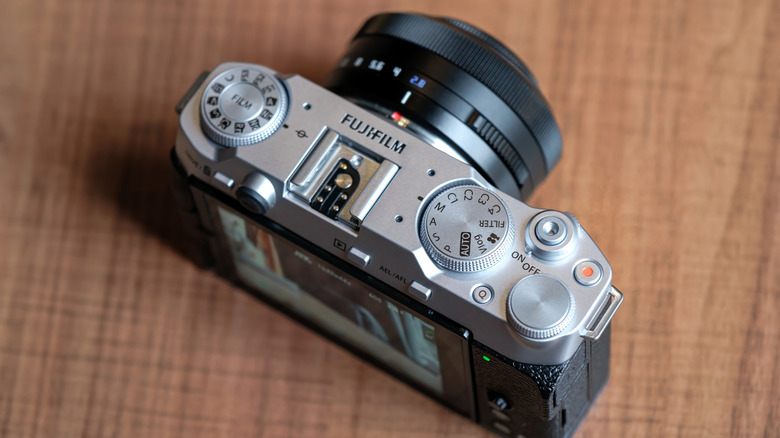
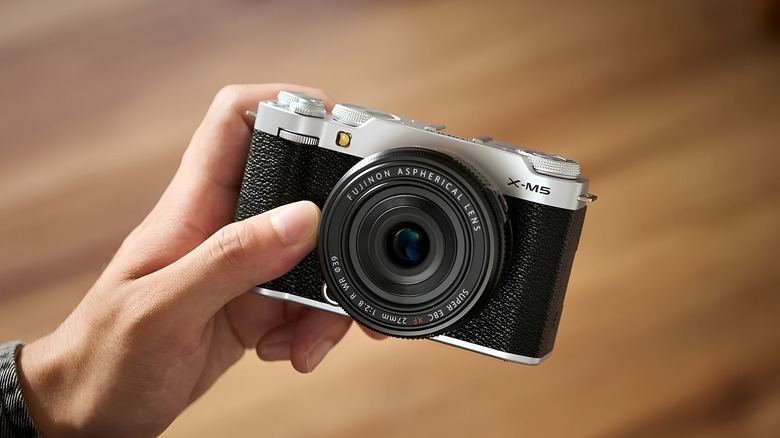
While the X-T30 III has open-gate videos and F-Log support, the lack of a fully articulating touchscreen is a problem. If content creation is where your heart lies, the Fujifilm X-M5 is made for exactly that. It costs $899, $100 less than the X-T30 III, and features a fully articulating touchscreen to help you frame yourself while talking to the camera. You do have to give up the electronic viewfinder, though. Regardless, both cameras use the same 26.1MP X-Trans CMOS 4 sensor, paired with the X-Processor 5. The image quality is stellar, with plenty of detail and Fujifilm's signature colors. Open-gate 6.2K/30 fps videos look sweet. And F-Log2 support will help you capture more dynamic range.
The biggest problem with the X-M5 is the lack of in-body image stabilization. Also, 4K/60 fps videos have a 1.18x crop, which is a slight inconvenience. However, content-creation features like shifting focus from yourself to a product, skin touch-up, and shooting portrait content without rotating the camera help make up for these drawbacks. Microphone quality is another big win for the X-M5. You can choose the direction from which you want to pick up sound. According to Digital Camera World, the quality, while not at the level of a dedicated mic, is much better than its omnidirectional mode on other cameras.
Fujifilm X-H2S
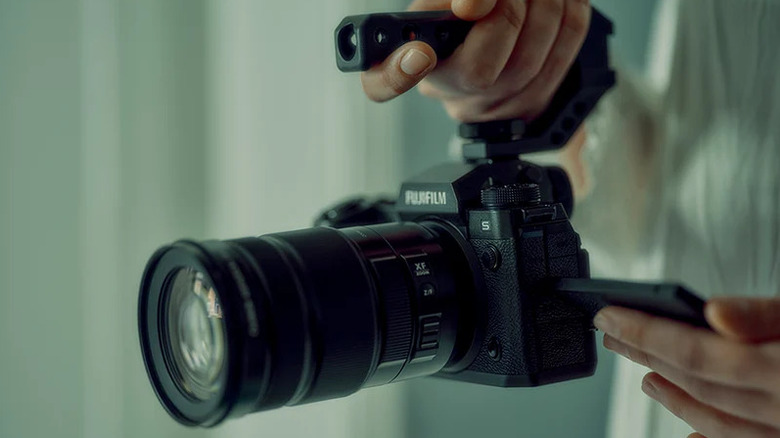
The Fujifilm X-H2S is nothing like the cameras we've mentioned so far. It breaks away from the compact, vintage aesthetic and many physical dials in favor of a larger footprint and a top-plate LCD. It focuses on high-speed photography, with bursts of up to 40 frames per second. That's more than enough to capture F1 cars racing around a track or birds flying. And the images retain exceptional detail thanks to the stacked 26.1MP X-Trans CMOS 5 HS sensor. The camera uses dual memory cards to keep up with that speed, and Fujifilm's prediction-based autofocus system is excellent at locking onto moving subjects, according to RTINGS.
You can record open-gate video at up to 6.2K/30 fps with 10-bit color, or shoot slow motion in 4K/120 fps. Videos stay crisp in different lighting, and Fujifilm's color science works great for skin tones. Thanks to in-body image stabilization, the output is also stable, though panning shots can look jumpy, so keep that in mind. For serious video work, there's support for F-Log2 (14+ stops of dynamic range) and Apple ProRes (ProRes 422 HQ, ProRes 422, and ProRes 422 LT). Despite the lack of a built-in fan, the X-H2S dissipates heat well, letting you record multiple hours in 4K. All this does come at a cost, though, and that number is $2,899 for the body only.
Fujifilm GFX100RF
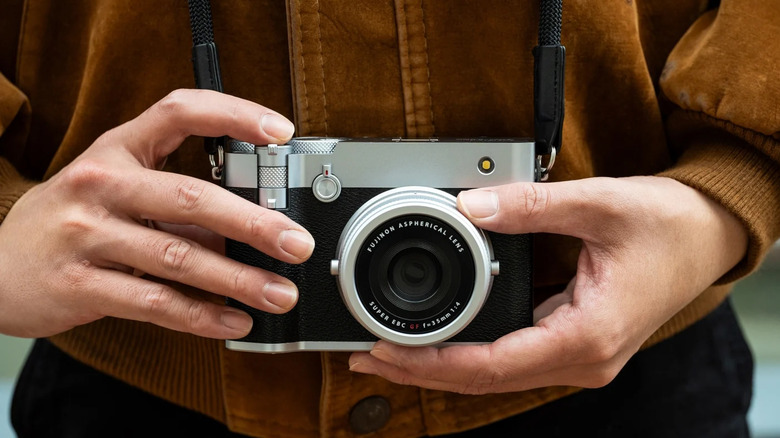
There are two main reasons people buy a medium-format camera. Number one is the sheer detail a big sensor brings, giving you more room to crop into landscapes without losing sharpness. The second is the improved image quality and wider dynamic range. All this sounds great until you hear that these cameras can get big and difficult to carry every day. But there's one exception: the Fujifilm GFX100RF. With the help of clever engineering and maybe some witchcraft, Fujifilm made the GFX100RF measure 90.4 x 133.5 x 76.5mm and weigh 735 grams. That's not much bigger than the X-T5. Despite its small size, the aluminum top plate and leather finish feel extremely premium, in line with more expensive Hasselblad and Leica alternatives. You also get manual ISO and exposure dials, plus a new digital crop slider (45mm, 63mm, and 80mm) and a dial to change aspect ratios.
Imaging is handled by a 102MP GFX (44x33mm) BSI CMOS II sensor. If we had to describe the photos in one word, it'd be "detail." You can capture a forest, spot a beautiful bird on a branch, and crop in to focus on it while retaining plenty of detail. That's the freedom you get with the GFX100RF. In classic Fujifilm fashion, there are 20+ Film Simulations to play around with, or you can shoot RAW and dial in the specifics later. Just remember to get a large SD card because RAW photos can be 100MB each. Battery life is also excellent, lasting roughly 500-600 shots, according to Digital Camera World. There are a few downsides, chief among them the $5,599 price tag. The camera also lacks in-body stabilization (IBIS), and the f/4 aperture isn't class-leading.
Methodology
With over 15 cameras in Fujifilm's portfolio, choosing the best ones wasn't easy. For this list, we combined our hands-on testing with professional reviews from reputable media outlets like Digital Camera World, PCMag, and RTINGS. We evaluated each camera on image quality, dynamic range, battery life, video stabilization, and overall usability. We also considered what each camera is actually good at and who it's meant for, whether that's content creators, landscape photographers, or people who shoot fast cars.