

9 Private Jets That Are Larger Than The Bombardier Global 7500
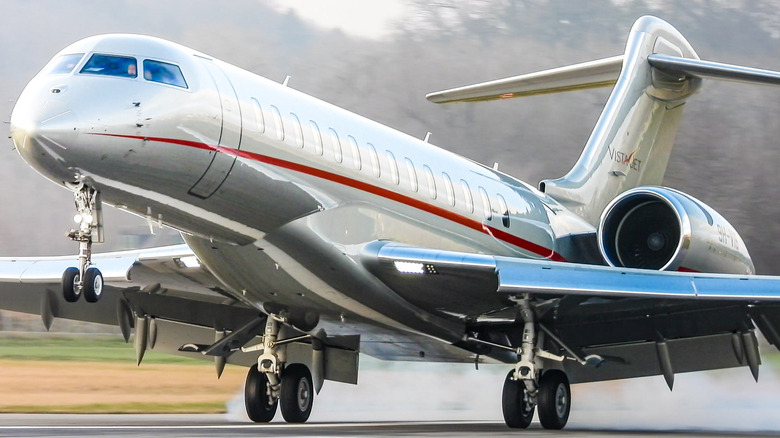
Of all the private jets that have ever existed, the Bombardier Global 7500 definitely is in the upper strata. It is large, luxurious, and ridiculously expensive, reportedly starting at around $78 million. Private jet buyers can often customize their cabin plans, which can quickly add to the cost. We only found one listing with a price in late 2026, and it was asking nearly $60 million for a 2018 model; all others had some variant of "please call for price" in the listing.
Also, while it's a good general idea, planes (along with yachts) are often sold through off-market brokers, or so a fixed-base operator, that's fancy speak for a private jet facility, at Dubai Al Maktoum International Airport in the United Arab Emirates tells me. Thus, take the used valuation with a grain of salt. Anyway, the Global 7500 was Bombardier's flagship private jet for about seven years, from its 2018 release to December 2025, when the Global 8000 was released as its successor.
The 7500 is a fairly large plane, especially for a non-commercial aircraft, with an overall length of 111 feet, a cabin length of 54 feet 5 inches, and a wingspan of 104 feet. However, despite their size, plenty of private jets are larger than the Global 7500; here are nine examples.
Airbus ACJ TwoTwenty
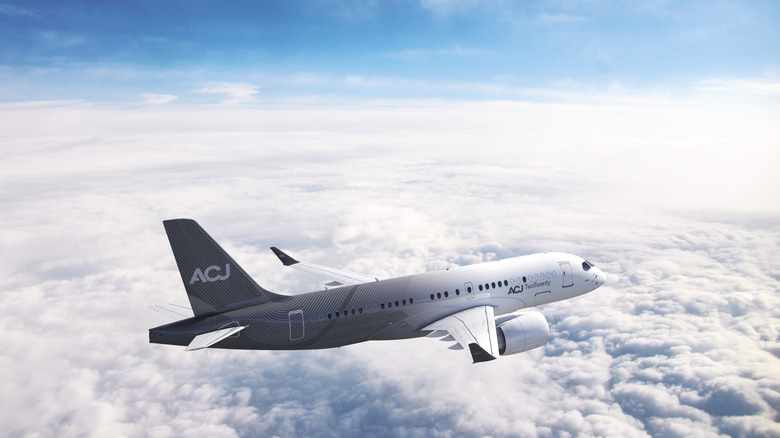
Only real enthusiasts know that Airbus is one of the world's best private jet manufacturers and also builds military jets, though it's best known for its commercial planes. The TwoTwenty gets its name from Airbus's 220 platform. The outer dimensions are only slightly larger than the Bombardier Global 7500: the ACJ TwoTwenty measures 114 feet 8 inches long, with a wingspan of 115.17 feet. However, the ACJ TwoTwenty's interior cabin is significantly larger than the Bombardier's, measuring 78.1 feet in total length, about 40% more space than the Global 7500.
Furthermore, the TwoTwenty can be configured with up to six distinct "zones," each about 130 square feet, that function as living spaces. The ACJ TwoTwenty also beats the 7500 in cabin height, with 6 feet and 11 inches of vertical interior space versus the 7500's 6 feet and 2 inches. Furthermore, the TwoTwenty has a range of 5,650 nautical miles and comes with two Pratt & Whitney PW1500G engines, giving it a maximum cruising speed of 547 knots (Mach 0.82) and a cruising altitude of 41,000 feet.
This impressive configuration gives the ACJ TwoTwenty an MTOW, or maximum takeoff weight, of 140,500 pounds, yet it can easily fly routes like Anchorage to London, Honolulu to Shanghai, and Miami to London non-stop.
Embraer Lineage 1000E
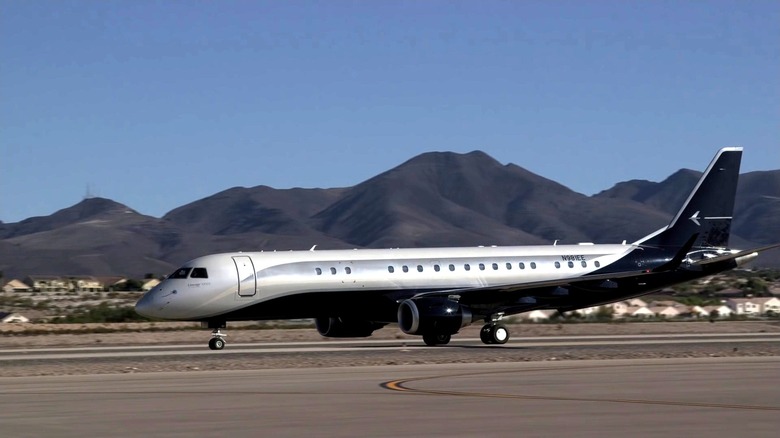
Many people may not have heard of Embraer, a Brazil-based company and one of the world's five largest commercial aircraft manufacturers. Embraer is known for making some of the world's best regional jets, and the Lineage 1000E is based on the Embraer E190 regional jet, with several modifications and upgrades. It's a large plane, measuring 118 feet and 11 inches long, with 84 feet and 3 inches of interior cabin space.
The cabin is spacious, with 6 feet and 6 inches of interior height and 8 feet and 6 inches of interior width. Like the Airbus ACJ TwoTwenty, the Embraer Lineage 1000E has five fully customizable living sections in the cabin, one less than the Airbus. In some configurations, the Lineage 1000E has two Gen 1E750 engines, giving it 4,600 nautical miles of cruising range and a maximum takeoff weight of about 120,000 pounds. The 1000E operates at a maximum altitude of 41,000 feet and can cruise at a top speed of 472 knots (Mach 0.71), putting it in direct competition with the Airbus from above.
Airbus ACJ 321 Neo
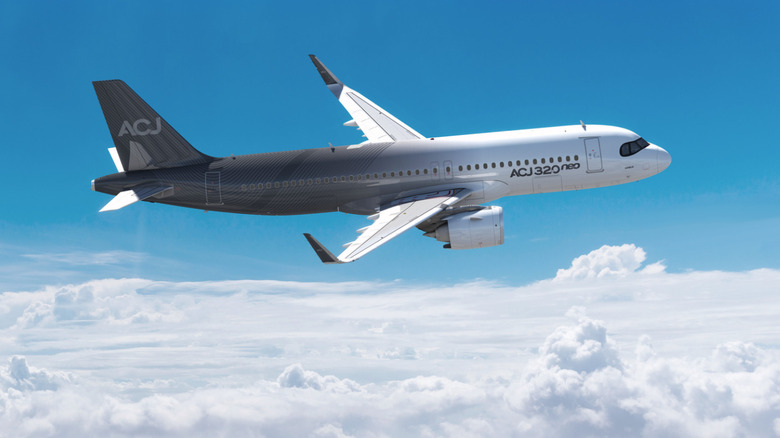
We're back to Airbus' corporate jet line with the ACJ 321 Neo, which steps things up significantly from the Embraer regional jet we just looked at. The ACJ 321 Neo's predecessor, the ACJ319, was widely considered one of the world's most fuel-efficient private jets at the time. Building on that success, the ACJ 321 Neo is about 20% bigger than the planes we've looked at so far, measuring 146 feet nose-to-tail. The cabin is massive, measuring 113 feet — 7 feet 5 inches high and 12 feet 2 inches wide.
As the name suggests, the 321 Neo is based on the 321 platform and can be powered by either CFM International LEAP-1A33 or Pratt & Whitney PW1133G-JM engines. Fun fact, "Neo" on Airbus jets is actually an acronym for "new engine option", which basically had the same bones as the older gen planes, but with newer, more efficient engines. In particular, these new engines give the ACJ 321 a cruising range of about 4,000 nautical miles, which it could cover at its top speed of about 547 knots (Mach 0.82) in about 7 hours and 20 minutes. The ACJ 321 had the same service ceiling as the ACJ TwoTwenty, with a maximum operating height of 41,000 feet.
Boeing BBJ/BBJ1
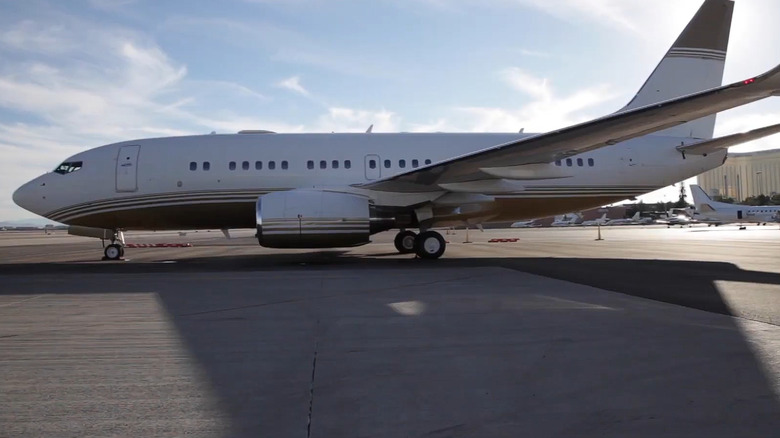
The first homegrown plane on our list comes from industry giant Boeing, headquartered right here in Arlington, Virginia. We're talking, of course, about the Boeing BBJ — or rather, we should say the Boeing BBJ1, since we'll also feature other generations. Introduced in 1998, the BBJ1, where "BBJ" stands for Boeing Business Jet, is based on the 737 platform.
This plane marked Boeing's entry into the private jet world, although the company had been building civilian and military aircraft for decades by then. Because the BBJ1 was based on a platform essentially identical to the commercial airliner 737-700, the BBJ1s were understandably massive. At 129 feet 6 inches long and 117 feet 5 inches wide, the BBJ1 is roughly the same size as the Airbus ACJ 321 Neo, and both are much larger than the Bombardier Global 7500.
Cabin space is massive, as expected, measuring 79 feet 2 inches long, 7 feet 1 inch high, and 11 feet 6 inches wide. Powered by engines from CFM International, another homegrown company based in Cincinnati, Ohio, the BBJ1 could cruise at about 41,000 feet, at 547 knots (Mach 0.82), and had a range of about 6,225 nautical miles in low-passenger configurations.
Boeing BBJ2/BBJ3
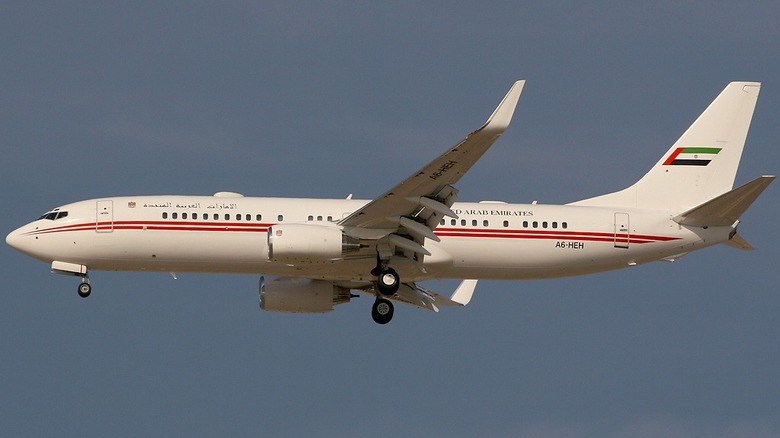
The BBJ2 and BBJ3 nearly doubled the original BBJ's available interior space. The underlying platforms also changed: the BBJ2 used the 737-800, and the BBJ3 was based on the massive 737-900ER. As such, the BBJ2 measured 129 feet and 6 inches long, while the BBJ3 measured a hulking 138 feet and 1 inch tip-to-tail. The cabin cross-section, height and width, was the same on both the BBJ2 and BBJ3: 7 feet and 1 inch high and 11 feet and 6 inches wide.
However, length differed: the BBJ2 cabin was 98 feet and 4 inches long, while the BBJ3 cabin was 107 feet long, about a 9% increase. Both jets used engines from the same family: CFM International's CFM56-7B27, rated to produce up to 27,300 pounds of thrust. While both planes had a service ceiling of about 41,000 feet, the BBJ2 had a range of 5,545 nautical miles (vs. the BBJ3's 5,475 nautical miles) and a top speed of 478 knots (Mach 0.71) (vs. the BBJ3's 473 knots (Mach 0.71). That may seem odd at first, but it makes sense: since the BBJ3 is a larger, heavier plane, using the same engines as the smaller BBJ2 would result in a proportionately lower range and top speed.
Boeing BBJ 737 Max 7 and 737 Max 8
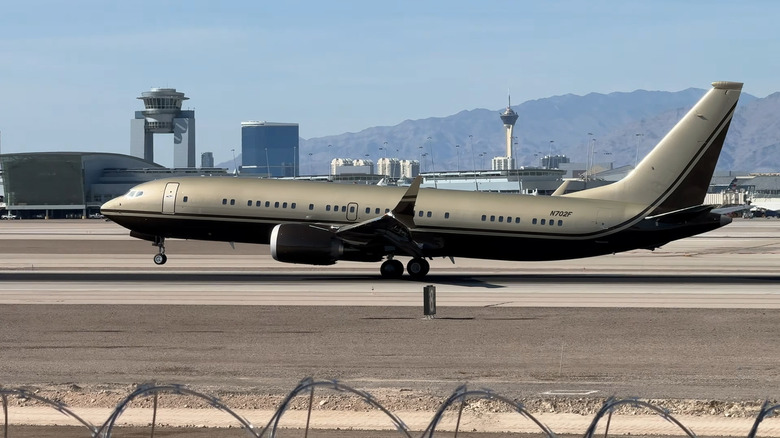
We're long past dwarfing the Bombardier Global 7500 in size now — the larger Boeing BBJ3's cabin length of about 107 feet is almost as long as the entire Bombardier. In a similar size bracket, we have the Boeing 737 Max 7 and the 737 Max 8. As the names suggest, these new BBJs are based on the 737 Max 7 and 737 Max 8 platforms, respectively, and are massive.
The BBJ 737 Max 7 measures 116 feet and 8 inches long, while the BBJ 737 Max 8 is longer, at 129 feet and 8 inches. The cabin lengths are astounding: 85 feet and 7 inches for the 737 Max 7 and 98 feet and 4 inches for the BBJ 737 Max 8. Both are powered by CFM International's LEAP engine family, giving the 737 Max 7 and 737 Max 8 versions of the BBJ ranges of 6,810 and 6,680 nautical miles, respectively.
Top speed is the same too, with both clocking a maximum speed of 470 knots (Mach 0.82). The service ceiling remains unchanged from the rest of the BBJ line, peaking at 41,000 feet. You can also design your own version of a Boeing private jet on a website, customized to your liking.
Airbus ACJ 330-800 Neo
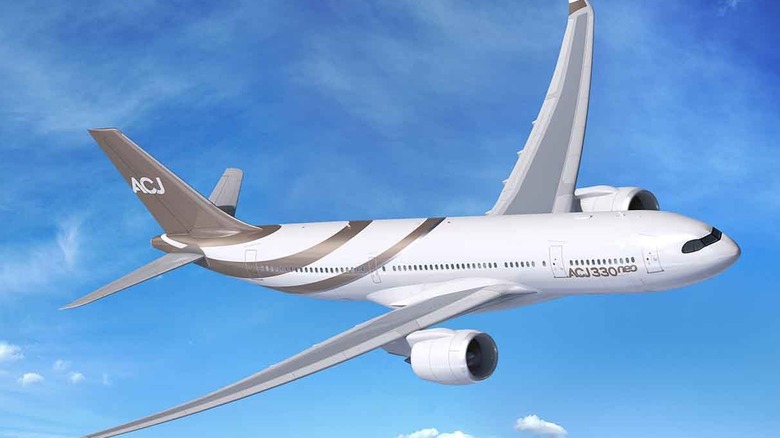
To avoid being left out of the large-size private jet market, Airbus also offers a range of commercial-airliner-based offerings. The first is based on the ACJ 330-800 Neo platform and powered by Rolls-Royce Trent 7000 engines.
The plane is quite large, with a 210-foot wingspan and a length of 191 feet 4 inches — meaning it is wider than it is long. The jet is based on one of the largest commercial planes on the market. The private jet ACJ version is extremely spacious, with 147 feet 7 inches of cabin length, 7 feet 9 inches of interior height, and 17 feet 3 inches of interior width. The cabin's total floor space is 2,325 square feet, larger than many downtown apartments across America.
Yet, the behemoth of a plane can hit a top speed of 568 knots, or Mach 0.86, thanks to those massive Rolls-Royce Trent 7000 engines that make up to 72,000 pounds of thrust — per engine — and have an operational ceiling of 41,000 feet, matching that of all the BBJs we've looked at. The engine family is also quite fuel-efficient, giving the jet a range of about 10,200 nautical miles, based on a 25-passenger layout and load.
Airbus ACJ 350 range
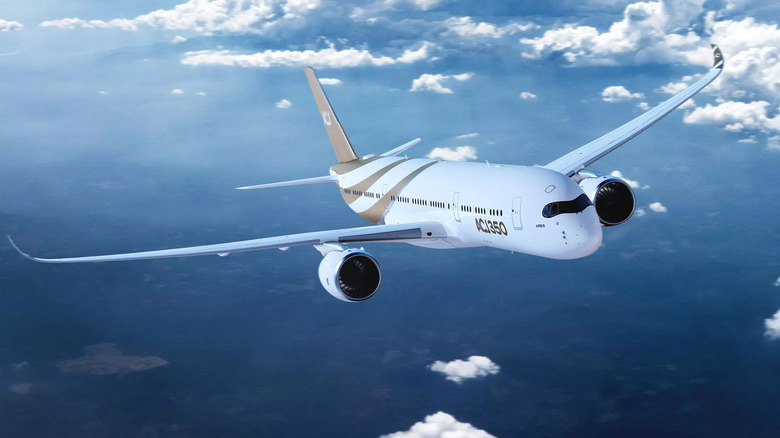
Airbus also makes an even bigger range of private jets than the ACJ330 line, believe it or not. The ACJ350 is based on Airbus's A350 platform, widely regarded as one of the best long-haul jets on the market. It's absolutely massive, with a wingspan of 212 feet 5 inches and a total length of 219 feet 2 inches, including a cabin length of 167 feet 5 inches. So, the cabin length alone is longer than all of the planes we've looked at above, which is quite something.
The cabin height is 8 feet, so even tall people won't have issues moving around the aircraft, and the width is a roomy 18 feet 5 inches. The ACJ350 is powered by Rolls-Royce Trent XWB 84 engines, which give the plane a service ceiling of 43,000 feet, a range of 11,100 nautical miles, and a top speed of 589 knots, or Mach 0.89. Impressively, certain versions of the ACJ350 can fly non-stop for up to 22 hours per mission, meaning almost the entire globe is a single flight from major airports. The plane can fly routes like New York to Sydney, Los Angeles to Dubai, Tokyo to Miami, and more.
Boeing BBJ 777
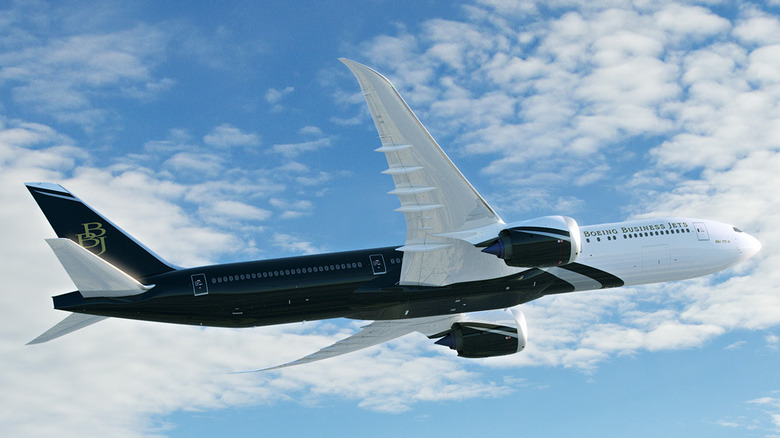
Last up, one of the largest jets ever to take to the skies: the Boeing 777, and yes, the mad folk over at Boeing Business Jets have indeed made a private jet based on this platform. In fact, the company has made two — based on the 777-8 and the 777-9. The BBJ 777-8 measures 232 feet 6 inches long, with a wingspan of 235 feet 6 inches, and stands 64 feet 6 inches tall. Of these massive proportions, the cabin measures 180 feet long.
The cabin cross-section measures 8 feet high and 19 feet 7 inches wide. For its part, the BBJ 777-9 beats those numbers, measuring 251 feet 9 inches long with the same wingspan. The cabin is longer, too, at 202 feet, though the height and width cross-section dimensions remain unchanged compared to the BBJ 777-8.
The BBJ 777-8 comes with GE9X engines that give the plane 11,654 nm of range, a top speed of 516 knots (Mach 0.89), and a service ceiling of 43,100 feet. The 777-9 BBJ version comes with a GE9X-105B1A engine and has a top speed of 516 knots (Mach 0.89), a range of 11,000 nautical miles, and a service ceiling of 43,100 feet. Note that the wingspan figures for both jets are in the wings' "extended" configuration — when folded, it's about 212 feet.