

5 Turbocharged 4-Cylinder Engines That Leave Their V8 Rivals In The Dust
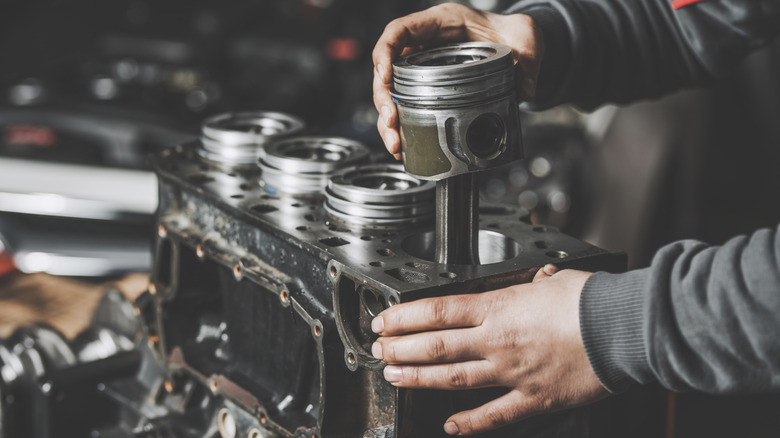
In the old days, strong engines were almost exclusively large-displacement units. This meant that a performance car would most likely use an eight, a ten, a twelve, or even a sixteen-cylinder engine. The logic behind this is sound — the bigger the engine, the bigger the power potential. More cylinders and more displacement meant more air and fuel burning potential.
However, all of this changed when superchargers and turbochargers came into play, allowing engines to become smaller without skimping on the power. By forcing more air into the cylinders, forced induction let a small engine breathe like a much larger one. This changed even more with the dawn of hybrids, and that is when downsizing engines stopped meaning downsizing power.
Stricter emissions regulations and fuel economy targets pushed automakers further in this direction, and engineers responded with advances in direct injection and turbocharging. Nowadays, plenty of performance cars use six-cylinder and four-cylinder engines, many of which can easily outmatch their rivals that relied on displacement and size. This is why modern engines are becoming smaller.
Nowhere is this more obvious than with modern turbocharged four-cylinder engines. Some of these powerplants now produce figures that would have been unthinkable for a four-banger not long ago. With that in mind, here are five turbocharged four-cylinder engines that leave their V8 rivals in the dust.
Mercedes-Benz M139 four-cylinder turbo
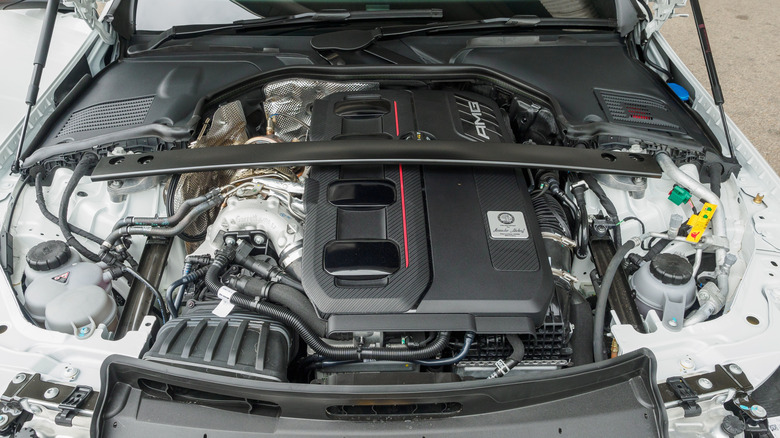
The Mercedes C63 AMG has long been the ultimate expression of a German muscle car, at least until the W206 Mercedes-AMG C63 S E Performance came about and replaced the V8 with a 2.0-liter four-cylinder hybrid turbo. The V8 had already changed once before, as the W205 swapped the glorious 6.2-liter naturally aspirated V8 for a twin-turbo 4.0-liter, but losing four cylinders entirely was a step too far for many AMG enthusiasts.
However, if we set aside the sound, character, and feeling of the legendary 6.2-liter V8 and look at pure power numbers, the four-pot hybrid has it beat to a T. The W204 C63 AMG's most powerful variant was the C63 Black Series — 510 hp and 457 lb-ft of torque. The M139l four-cylinder hybrid turbo in the new C63 S E Performance manages to squeeze out 469 hp and 402 lb-ft of torque from the engine.
With the added hybrid, the total output of the C63 S E Performance is a ridiculous 671 hp and 752 lb-ft of torque. From a horsepower-per-liter perspective, the 6.2-liter V8 gives you around 82 hp per liter, while the four-pot gives you roughly 236 hp per liter from just the combustion engine. Moreover, the 6.2 is a lot bigger, heavier, and a whole lot thirstier as an engine, meaning that it loses on pretty much every performance front compared to the new four-cylinder.
That said, the complete C63 S E Performance is almost 900 pounds (400 kg) heavier than its V8-powered predecessor, so the engine's advantages don't fully carry over to the car as a whole. Ironically, the M139 won't be sticking around either, as AMG is dropping the four-cylinder C63 in favor of an inline-six, citing Euro 7 regulations.
Ford 2.3-liter EcoBoost four-cylinder turbo
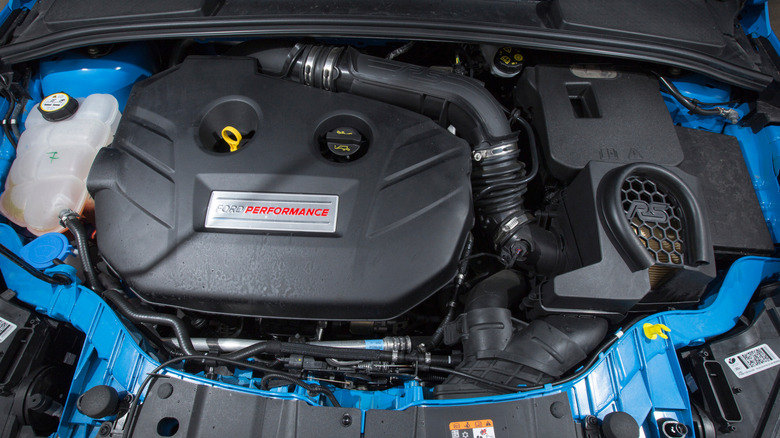
A Mustang, for most people, is a V8 car full stop, but for Ford, it was never just about the V8. For 2020, Ford set out to further change that perception with the 2.3L High Performance Package, which was built around the 2.3-liter EcoBoost from the Focus RS hot hatch. Now, the High Performance Package EcoBoost couldn't beat the V8 Mustang GT it was sold alongside, but put it next to the Mustang GT from a decade earlier, and it does.
The 2010 Mustang GT's 4.6-liter V8 made 315 hp and 325 lb-ft of torque, while the 2.3-liter EcoBoost in High Performance Package guise makes 330 hp and 350 lb-ft of torque. That means the four-pot beats the old V8 with half the cylinders and exactly half the displacement. From a horsepower-per-liter perspective, the EcoBoost gives you roughly 143 hp per liter, while the 4.6-liter V8 gives you roughly 68 hp per liter.
That said, the Coyote 5.0-liter V8 in the Mustang GT of the time still had the four-cylinder handily beaten, so this isn't a case of the EcoBoost dethroning the V8 Mustang outright. Still, the fact that an entry-level four-cylinder Mustang can out-muscle a V8 Mustang GT only ten years its senior speaks volumes about how far turbocharging has come.
It's not just old V8 Mustangs, either, as the base 2.3-liter EcoBoost Mustang can also beat many other sports cars. If that's still not enough for you, the current-generation EcoBoost can go even further, as Ford's dealer-installed Performance Calibration for 2024–2026 Mustangs bumps the 2.3-liter to 350 hp and 400 lb-ft of torque.
Volvo 2.0-liter twin-charged four-cylinder
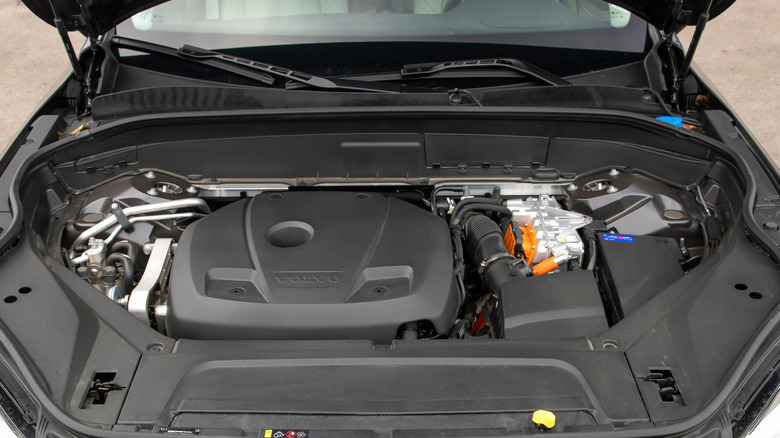
As opposed to the Mustang GT, the Volvo XC90 is not a car typically associated with a V8. However, the XC90 did have one back in 2005, when Yamaha built the 4.4-liter, 311-hp eight-cylinder for Volvo's posh three-row SUV, making it one of only a handful of cars powered by Yamaha-engineered engines. The V8 didn't stick around, and when the second-generation XC90 came out, four cylinders was as many as you could get.
The top dog of the then-new lineup, the XC90 T8, relied on a 2.0-liter four-pot with both a supercharger and a turbocharger, plus an electric motor. Together, they were good for 400 hp and 472 lb-ft of torque, which is 89 hp more than the old V8. Take away the electric motor, and you get the XC90 T6, whose version of the engine is rated at 316 hp, so the four-cylinder out-muscles the V8 on its own.
From a horsepower-per-liter perspective, the old 4.4-liter V8 gives you roughly 71 hp per liter, while the 2.0-liter four-cylinder in T6 guise gives you 158 hp per liter. Opt for the Polestar optimization, and the T8 is rated at 421 hp and 502 lb-ft of torque combined, with 334 hp, or roughly 167 hp per liter, coming from the four-cylinder. Motor1 went as far as calling it "Volvo's most powerful car ever."
That said, a four-cylinder that has been both turbocharged and supercharged has a hard time matching the smoothness and character of a V8. Still, a 2.0-liter four-pot beating a V8 with more than twice its displacement, even before the batteries kick in, is a pretty convincing argument that Volvo made the right call.
Mitsubishi 4B11T four-cylinder turbo
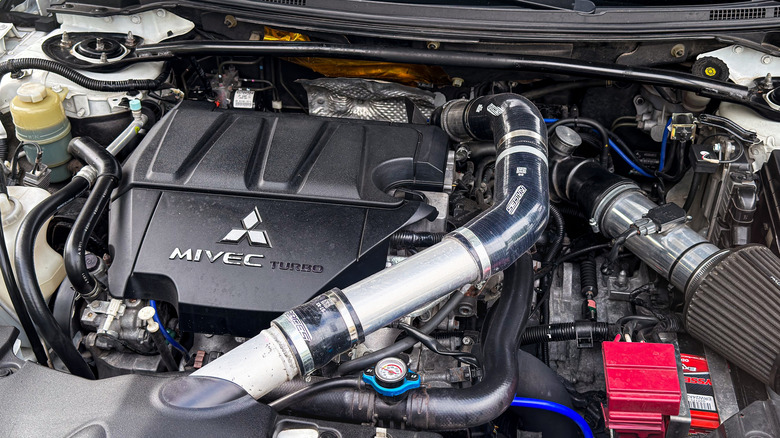
The Mitsubishi Lancer Evolution nameplate is legendary, and its final U.K. special edition proved it with one of the most impressive four-cylinder engines ever. Built by Mitsubishi and Ralliart UK and timed to Mitsubishi's 40th year in Britain, the Lancer Evolution X FQ-440 MR — one of the best looking Japanese cars ever made — arrived in 2014, with production capped at 40 units.
Ralliart UK's upgrade list for the 2.0-liter 4B11T four-cylinder reads like a tuner's dream, with HKS supplying the turbo, Janspeed handling much of the intake and piping, and the ECU getting a remap. The result is 440 hp and 412 lb-ft of torque. Put that next to the E92 BMW M3, whose 4.0-liter V8 made 414 hp and 295 lb-ft of torque, and the four-pot comes out on top by 26 hp and a whopping 117 lb-ft.
From a horsepower-per-liter perspective, the 4B11T gives you roughly 220 hp per liter, a figure that even the Bugatti Chiron's W16 falls short of. The M3's V8, on the other hand, gives you roughly 104 hp per liter. That said, the FQ-440 was a tuned, limited-run special, and a regular Evo X made nowhere near this kind of power.
Be that as it may, the E92 M3 was also out of production by the time the FQ-440 arrived, and Mercedes-AMG's W204 C63 was the more powerful V8 of the two anyway. Regardless, a 2.0-liter four-cylinder humbling an 8,400-rpm BMW V8 is about as Evo as it gets.
Porsche 2.0-liter turbo V4 (919 Hybrid)
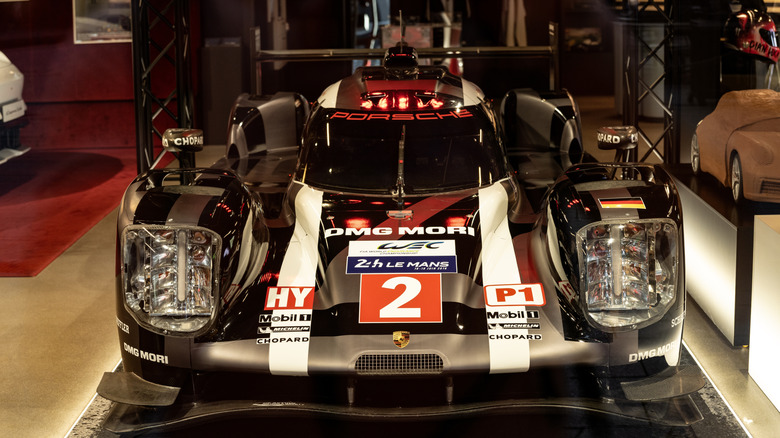
All the engines we mentioned thus far were road car engines, but in the world of endurance racing, a four-cylinder managed to beat a V8 on the biggest stage of all. Porsche's LMP1 weapon of choice, the 919 Hybrid, used a turbocharged 2.0-liter V4 as its combustion engine. In 2015 spec, the V4 was rated at over 500 hp. On top of that, the 919 also relied on a 400-hp electric motor up front, making it the fastest V4-powered car of all time.
Toyota took a very different route with its nearly 1,000-hp TS040 Hybrid. It ran a 3.7-liter V8 with no turbos, backed by electric motors. Toyota came into 2015 as the reigning WEC champion, and on paper, its V8 hybrid had around 100 hp more than the Porsche. Yet it was the four-cylinder that came out on top, as Porsche won Le Mans and both WEC titles that year, then repeated the feat in 2016 and 2017.
The V4 gives you more than 250 hp per liter from combustion alone. Counting the entire hybrid system against engine displacement, the 919 works out to roughly 450 hp per liter, compared to roughly 270 hp per liter for the Toyota, whose V8 needed 85% more displacement.
That said, the 919 was a purpose-built race car with a hybrid system doing much of the heavy lifting, so it's not directly comparable to the road cars on this list. It also came up short in its debut season, as the V8 Toyota took the 2014 WEC title. Still, a four-cylinder beating a more powerful V8 at the world's most famous endurance race is as fitting a finale as this article could ask for.