

The Base Ford Mustang EcoBoost Is Quicker Than These 5 Sports Cars
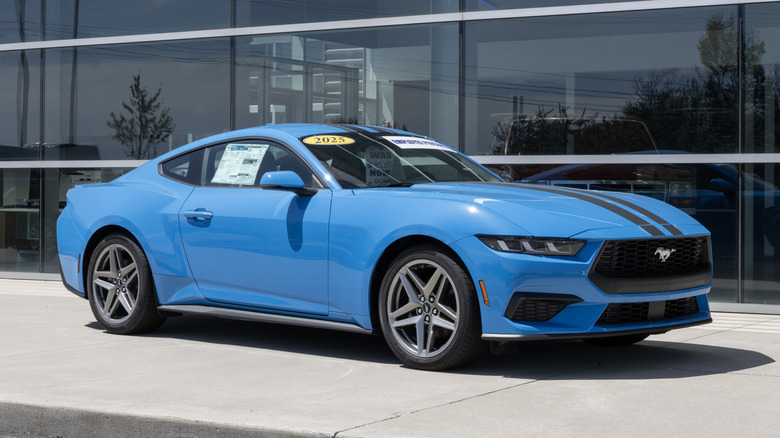
Say "Ford Mustang" and most people picture a V8. It's practically muscle-car law: The Mustang built its legend on eight cylinders and a rumble to match. Still, the GT isn't where the lineup starts. Ford also builds a four-cylinder EcoBoost Mustang and a V6 Mustang, both cheaper and both sitting below the GT on the spec sheet.
At the very start of the range sits the 2.3-liter EcoBoost Mustang, and to many people, four cylinders are not enough for muscle car status. Be that as it may, the EcoBoost earns more credit than it gets. A turbocharged four-cylinder sends power to the rear wheels, and Ford has tuned it to punch well above its "base model" reputation.
On paper, the 2.3-liter turbo-four makes 315 horsepower and 350 lb-ft of torque, and it's paired with a 10-speed automatic. Car and Driver clocked a 2024 EcoBoost model, equipped with the High Performance package, at 4.5 seconds to 60 mph and a 13.2-second quarter mile. Those numbers made it, at the time, the quickest four-cylinder Mustang the outlet had ever tested. That's a genuinely serious pace for a car still wearing the "base" badge.
This isn't just the cheap way into a Mustang. It's a genuinely quick car — quick enough to run down machines that wear a "sports car" badge and cost considerably more. That's not a dig at the sports car crowd; it's just proof that a badge alone doesn't make something fast. Here are a few sports cars the base Ford Mustang EcoBoost leaves behind.
Mazda MX-5 Miata
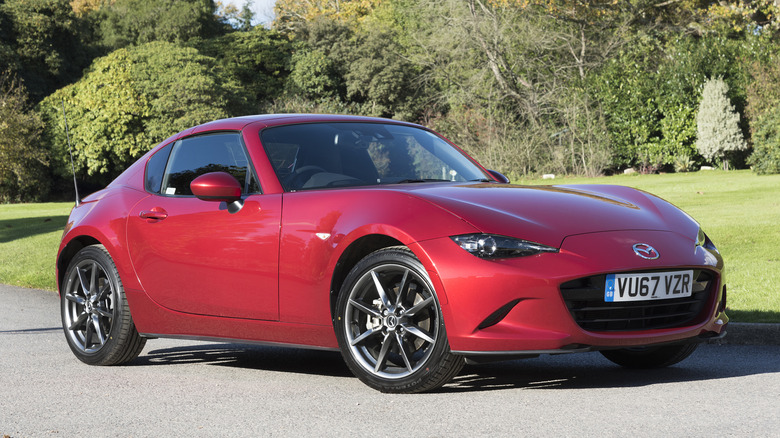
We'll kick off this list with what many people deem the definitive compact sports car, and not because of power or engine size, but rather because of handling, dynamics, and affordability. The Mustang GT's engine power is rarely ever a problem, but cars like the MX-5 show us that you don't need tons of power to have fun behind the wheel.
The MX-5's most potent engine, a 2.0-liter four-cylinder, makes 181 horsepower and, as tested by Car and Driver, pushes the MX-5 from zero to 60 mph in 5.5 seconds and through the quarter mile in 14.3 seconds, an entire second behind the EcoBoost Mustang at 60 mph and just over a second behind by the quarter mile. However, if we compare an entry-level Miata to an entry-level Mustang, the difference grows even larger.
Base MX-5 models in certain markets need more than eight seconds to reach 60 mph. None of this makes the MX-5 a bad car, or even a slow one by the standards of an affordable roadster. It simply illustrates how far Ford's turbocharged four-cylinder has come, and how a "base" Mustang can now comfortably outrun a car built from the ground up to be a lightweight sports car.
It may not have the sound of a V8, but the gap between the V8 and the four-cylinder is not as big as most people think. The Mustang is often viewed as an alternative to the Mazda MX-5, and even in its entry-level form, it outran the MX-5 by quite a lot.
Toyota GR86
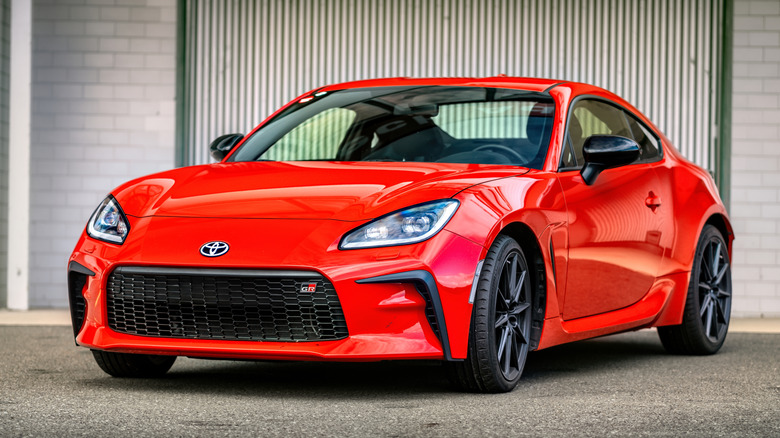
Next up is the Toyota GR86, the closest thing on this list to a spiritual successor to the old Scion FR-S, and again a car whose reputation rests more on chassis balance and driver feedback than outright grunt. Like the MX-5, the GR86 sacrifices raw power for a lighter, more communicative driving experience.
The GR86 uses a naturally aspirated 2.4-liter flat-four shared with Subaru and makes 228 horsepower, a good deal less than the EcoBoost Mustang's turbocharged four-cylinder. MotorTrend clocked the GR86's 0-60mph time at 5.8 seconds, and they even noted how the inline-four Mustang beat it to 60 mph at 4.9 seconds for the Mustang in the publication's testing.
The quarter mile was clocked at 14.3 seconds, which is more than a second after the Mustang's Car and Driver time. Choosing the six-speed automatic over the manual only widens that gap further. Toyota's own claimed figures put the automatic GR86 at 6.6 seconds to 60 mph, half a second slower than the manual, which would stretch the deficit to the Mustang well past two full seconds.
When we reviewed the 2024 Toyota GR 86, we noted how it is the best GR 86 model to get, and that you should skip the Trueno edition. This once again proves that power and speed don't necessarily translate into having a fun experience behind the wheel. In that sense, this is also a genuine plus for the EcoBoost Mustang as well.
Toyota GR Supra 2.0
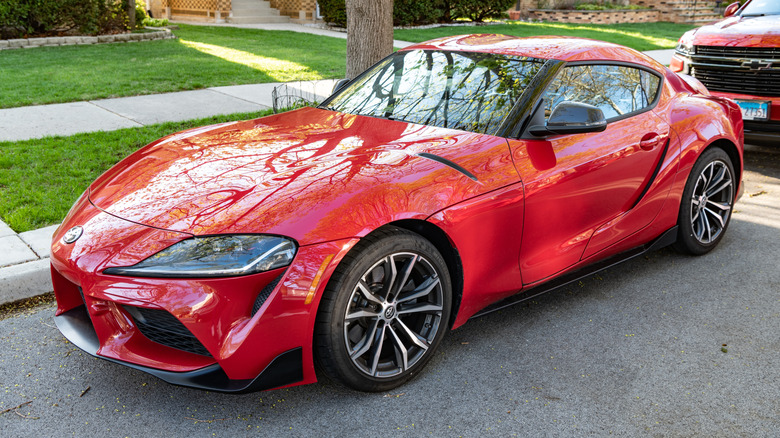
The next car on the list is the Toyota GR Supra 2.0 –- the entry point into a nameplate that spent decades as Japanese Domestic Market (JDM) royalty before its 2020 revival. Co-developed with BMW and built alongside the Z4 in Austria, the 2.0 sits below the six-cylinder Supra 3.0 on the spec sheet, in much the same position the EcoBoost occupies under the Mustang GT.
The Supra 2.0 uses a turbocharged 2.0-liter inline-four sourced from BMW, making 255 horsepower and 295 lb-ft of torque, paired exclusively with an 8-speed automatic — no manual is offered on the four-cylinder car. Car and Driver tested a 2021 Supra 2.0 at 4.7 seconds to 60 mph and 13.3 seconds through the quarter mile at 104 mph.
This puts it 0.2 seconds behind the EcoBoost Mustang at 60 mph and 0.1 seconds behind by the quarter mile. Toyota's own claim for the car is more conservative, quoting a 5.0-second 0-60 mph time, a full half-second off the Mustang's pace. Even against the outlet's more generous tested figure, the four-cylinder Supra can't quite match a Mustang that costs less and doesn't carry a BMW-shared badge to justify the difference.
Comparing the 2-liter Supra versus its 3-liter brother we found the lighter four-cylinder car "hitting the sweet spot for eager drivers not looking to run into tickets," just one that happens to lose a straight-line drag race to a "base" Mustang.
BMW Z4 sDrive30i
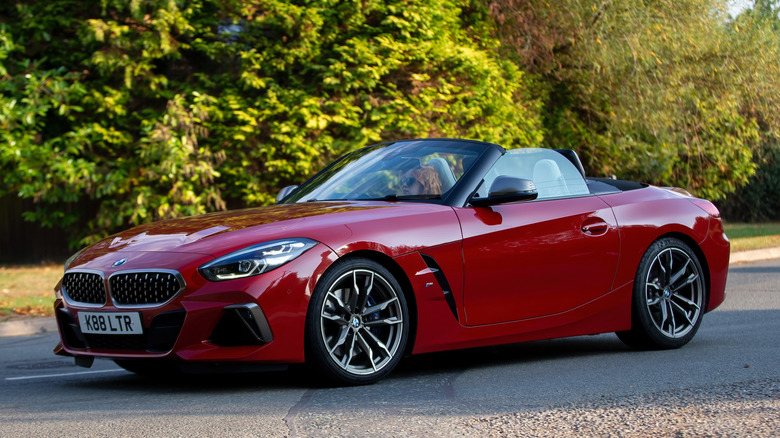
The BMW Z4 sDrive30i serves as the entry point into BMW's small two-seat roadster. It's also the priciest, most premium-badged car on this list. Where the MX-5 and GR86 lean on light weight to make up for modest power, the Z4 relies on BMW's reputation for building "the ultimate driving machine," which makes it an interesting one to line up against a Mustang most people think of as the budget option.
The sDrive30i uses a turbocharged 2.0-liter four-cylinder making 255 horsepower and 295 lb-ft of torque, less power than the EcoBoost Mustang's 315 hp and 350 lb-ft despite the BMW's premium badge and price tag. As tested by Edmunds, the sDrive30i needs 5.3 seconds to reach 60 mph, 0.8 seconds behind the EcoBoost Mustang, and MotorTrend has recorded the Z4 running the quarter mile in 13.8 seconds, roughly six-tenths of a second behind.
BMW badges the Z4 as a genuine sports car, and with a starting price north of $56,000, it costs nearly twice as much as an EcoBoost Mustang. However, if you upgrade to the top-spec BMW Z4 M40i, you will outrun the EcoBoost Mustang because the M40i reaches 60 mph in under four seconds. Still, to even be able to do so, you'll have to pay more than twice the amount you'd pay for the EcoBoost Mustang.
Nissan Z
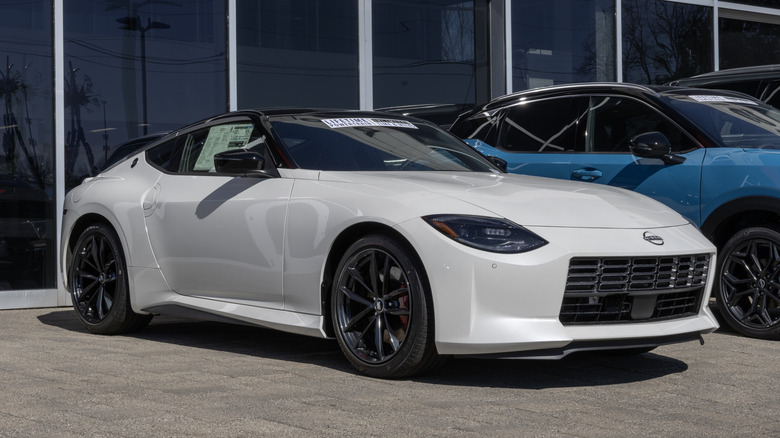
Closing out the list is the Nissan Z, the spiritual successor to the 370Z and, on paper, the most powerful car here by a wide margin. It's Nissan's return to a formula it practically invented: An affordable, rear-wheel-drive coupe built around a big engine and not much else, wrapped in retro-inspired styling that pays tribute to the original 240Z.
The Z pairs a twin-turbocharged 3.0-liter V6 with 400 horsepower and 350 lb-ft of torque, an 85-horsepower advantage over the EcoBoost Mustang. Yet as tested by Edmunds, the manual Z needs 5.0 seconds to reach 60 mph and 13.6 seconds to clear the quarter mile, half a second behind the EcoBoost Mustang at 60 mph and four-tenths of a second behind through the quarter mile.
The gap comes down to the gearbox, not the engine. Nissan's six-speed manual isn't tuned for drag-strip launches the way the Mustang's 10-speed automatic is, and Edmunds put it bluntly: "the gearbox feels a bit cumbersome and not nearly as precise as the manual gearbox in the Mustang."
At the very top of the model range, the automatic-only Z NISMO flips the script entirely: Car and Driver recorded a 3.9-second 0-60 mph run, and when we reviewed the 2024 Nissan Z NISMO, we saw 4.2 seconds ourselves — though we noted that with cars like this, 0-60 isn't really the point, it's the experience that counts.