

Cobra Vs. Apache: What's The Difference Between These Military Helicopters?
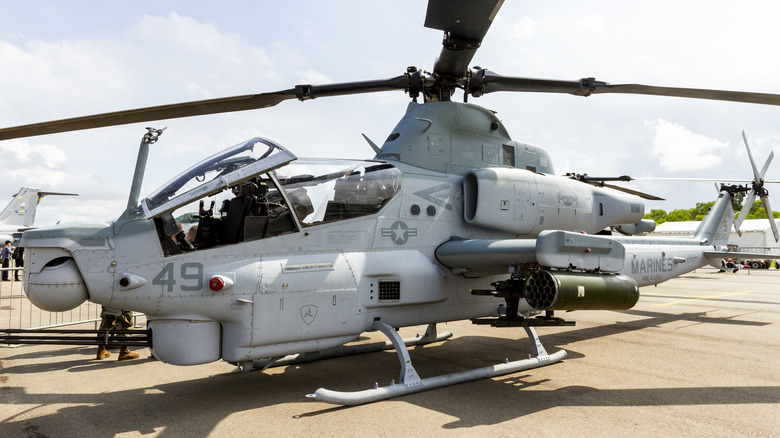
At a cursory glance, the AH-1 Cobra and AH-64 Apache admittedly do look like barely-distinctive variations of the same idea. Both are tandem-cockpit attack helicopters optimized for delivering air-to-surface support fire via a plethora of rocket pods, a chin cannon, and wing-mounted anti-tank missiles. Both carry the attack helicopter "AH" Mission-Design-Series designation, and both are widely known to perform overlapping missions ranging from close air support to anti-armor taskings. However, beneath those similarities lies a pair of immensely different aircraft borne from differing necessities, differing strategic demands, and vastly different design philosophies.
Consider a bayonet and a broadsword. Both are edged weapons designed for combat, yet simultaneously optimized for very different circumstances and approaches. Military equipment works much the same way. Two systems can occupy or substantially overlap within the same broad category, regardless of whether they were designed around completely different assumptions about where, when, and how they will fight. This homogenization of capabilities is a common result of threat-based approaches to war in which a force's strategy, doctrine, and force employment are dictated entirely by who the enemy is, where they are, and how they act.
If we consider the Cobra and the Apache through the lens of their intended function, their individuality becomes much clearer. The Cobra began life as a relatively compact gunship intended to put responsive firepower close to troops on the ground while remaining light, fast, and maneuverable. The Apache, by contrast, emerged from a later generation of requirements shaped by the prospect of high-intensity warfare against increasingly sophisticated air defenses that necessitated helicopter-borne stand-off strike.
A brief historiography of killing tanks from above
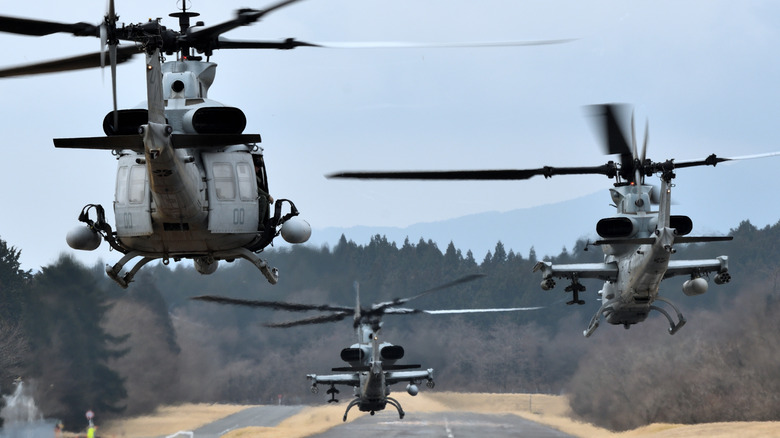
The Cobra's story begins much earlier than the Apache's. In the midst of the Vietnam War, the U.S. military determined that it needed a new type of helicopter capable of supporting troops in contact. The UH-1 Huey could carry weapons, but it was too large and slow for an attack role. What was needed was a gunship. Bell's answer was the Cobra. By recycling a vast amount of the Huey's existing mechanical architecture, Bell developed a faster, smaller attack frame capable of getting into and winning gunfights.
The Cobra was declared operational on October 6, 1967, 32 days after its first recorded kill when a transiting test aircraft stumbled upon and engaged a Viet Cong Sampan. Over the next few years, the Cobra proved an invaluable asset in close air support, escort, and on-call anti-armor missions. But the greatest development in gunship capability came in May 1972 with the arrival of the BGM-71 TOW anti-tank missile.
While far from a perfect weapon, the TOW generated substantial interest as the Cold War reached its peak. With the expectation that Soviet armored columns would charge through the Fulda Gap, TOW (and later Hellfire) missile-equipped attack helicopters could act as agile and accurate anti-armor platforms, devastating advancing armored formations long before they threatened our precious Western capitalism.
But the battlefield was changing. Soviet air defense systems were advancing. Any airborne attack would therefore have to be delivered from outside of Soviet air defense envelopes. To achieve this, attack helicopters would need better sensors, targeting, and fire-control systems. Being in the gunfight was suicide. The new plan was to stay at range, lobbing missiles in using state-of-the-art sensors and techniques. Those requirements needed a new aircraft design. That aircraft was the Apache.
A bayonet and a broadsword
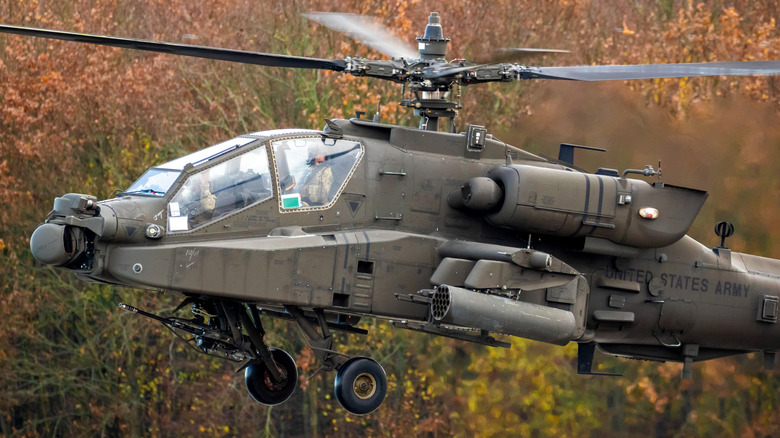
The Apache did not make the Cobra obsolete. Instead, the two aircraft have increasingly evolved, with the current AH-64E Apache Guardian and AH-1Z Viper continuing to reflect their different core design philosophies, and the differing demands of the organizations that operate them.
The Apache remains a much more comprehensive helicopter-borne stand-off strike capability. The inclusion of more sophisticated avionics, advanced fire-control systems, and substantially greater capacity for network integration moved the Apache out of the immediate gunfight, but enabled a much broader field of view to establish dominance across a wider battlefield. Later variants added the AN/APG-78 Longbow fire-control radar, designed to detect, categorize, and prioritize up to 256 targets, while retaining the ability to simultaneously engage 16 within a 10-mile range. This cemented the Apache's primary position in the battlespace as a long-range or pop-up missile truck.
The price of that capability was size, weight, and complexity. Almost twice as heavy as the Cobra, when fully armed the 10.4-ton Apache fits well into the heavy gunship class. It's something large and impactful the Army can swing around the battlefield, overwhelming an enemy while keeping them at arm's length. The Apache is a broadsword.
Conversely, the Marine Corps needed an attack helicopter that could form part of an expeditionary force operating from ships and in confined environments. Something a Marine Expeditionary Unit could take with them, grab at short notice and in the frenzy of battle, and drive between the ribs of an enemy that is already right up and in their face. The Cobra is a bayonet.