

11 High-Tech Bosch Products You Didn't Realize Existed
Though originally founded in Germany, Bosch actually manufactures a lot of its goods here in the U.S. — and the brand makes several things you wouldn't expect. You see, Bosch is one of those companies where people only really see a sliver of the products made. The name might be recognizable from your dishwasher, your garage tool set, or perhaps your windshield wipers. Thus, you would be forgiven for thinking this is just a quasi-German brand making sensible appliances for home use. You would, however, be spectacularly in the wrong in that case; tucked away in the Bosch catalog is an array of strange and high-tech products that sound (and often look) like props from a sci-fi film.
There is a wall scanner that uses a mini radar to peer inside your walls and map them out in two dimensions. There is a device that generates actual plasma to freshen up clothing items without using water. There is a sensor smaller than a fingernail that can smell things, and an attachment that can give robots something approaching the sense of touch. Some of these items are kitchen gadgets, others are for home improvement, and still others are simply not from any mainstream category. What all the Bosch products on this list share in common is that not everyone would have heard of them. So, for the curious, here is a tour of the Bosch back catalog that you never knew existed.
FreshUp Plasma Textile Refresher
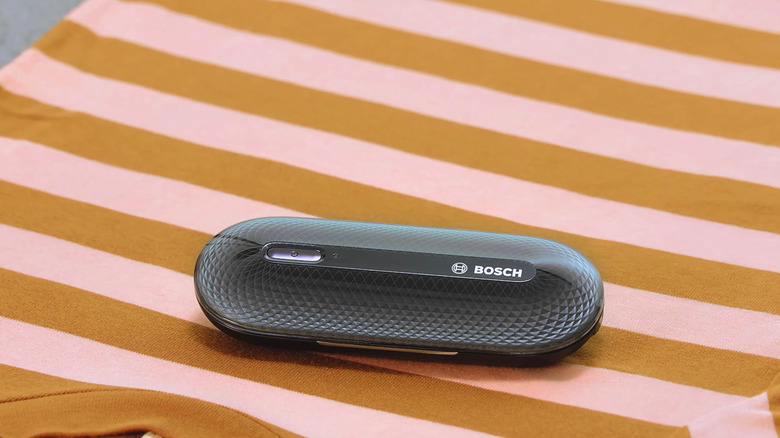
If you've ever detected a funky smell in a garment but didn't feel like washing said garment out, then this extremely niche product is for you. The device itself is incredibly small, coming at just 160 mm in length and is fully wireless, running on an inbuilt battery for up to a claimed 60 minutes. The way it works is by ionizing the air surrounding your clothing item. Once ionized, the plasma that has been created by this process physically breaks up the odor molecules in your garment, including things like tobacco smells, food aromas, and perspiration.
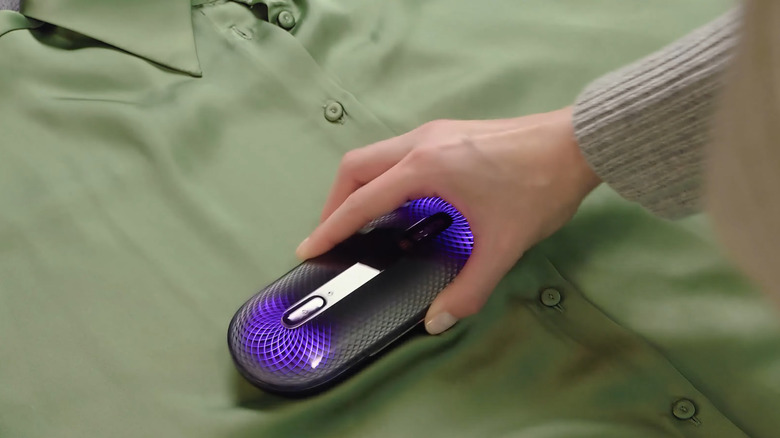
The entire process is completely devoid of chemicals, is water-less, ends up being quite convenient, and delivers on its promise, according to reviews online. There is a rather pretty pattern of light rings on both ends of the device that activate upon turning the FreshUp on; white indicates that the FreshUp is ready to use, and purple indicates that the plasma is working to remove odors.
You use the thing by placing the FreshUp on a garment — preferably on a flat surface — pressing down on the garment until the lights turn purple, and proceeding to rub it around the area that has the undesirable odor until the smell goes away. The thing was unavailable in the U.S when it was released in 2021 but retailed for 199.99 British Pounds in Europe, which was about $275 at the time. It has, sadly, been discontinued, but you may be able to find a used one for sale online.
Cookit
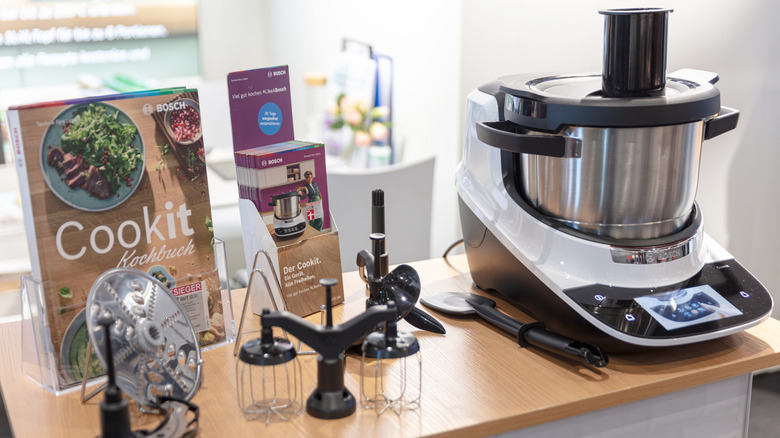
The Bosch Cookit is essentially the brand's version of the ThermoMix. For the unfamiliar, both the Cookit and ThermoMix are supposed to be these smart kitchen-assistant appliances that help you cook featuring inbuilt, follow-along recipes and a number of fully automatic cooking assists. Note that ThermoMix is the name of a brand; its main rival to the Cookit was the ThermoMix TM6, though the TM7 has been released in 2025. Both the Cookit and the ThermoMix are meant to help home cooks eliminate some appliances from the kitchen, at least in theory.
Both would definitely find a place on the list of cool touchscreen gadgets that aren't a tablet or a phone. The Cookit can handle many important functions that a home cook would want, such as pan searing, mixing, whipping, steaming, chopping, stirring, slicing, and grating of ingredients. While online reviewers say that the ThermoMix line has better software and more recipes, Bosch fights back with a couple spec bumps of its own.
For one, the Bosch bowl is larger overall so you can make more food in one go, it comes with more handy-dandy attachments so you can experiment with more tasks, and the Cookit can reach 200 degrees Celsius (392 Fahrenheit) while the ThermoMix TM6 and the newer TM7 both top out at 160 Celsius (320 Fahrenheit) — an important distinction for things like deep frying. The Cookit isn't sold stateside directly; it retails for 1,399 Euros, or about $1,600 as of late 2026.
Series 800 oven with AI food recognition
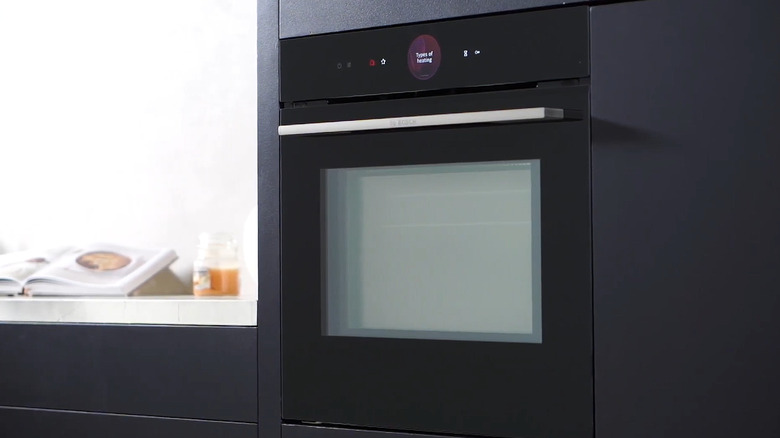
While able to do all that's expected of a traditional convection oven, such as baking, broiling, and roasting, the Series 8 smart ovens can also steam your food and air fry it too, following a recent trend of smart ovens doubling as air fryers. Sensors inside the series 8 can also measure the humidity inside, and thus tracks how "done" your dish is. The humidity is measured by something called a "Lambda probe" that tracks the level of oxygen inside the oven. Additionally, all models come with some sort of touchscreen display, though the size varies from model to model; users can select the dish they want to cook using this display, and the oven will calculate the correct settings and time to cook.
In addition to an inbuilt three-prong meat probe, there is also a camera located in the top left of the oven that uses artificial intelligence to identify things like the level of browning on a baked dish, which the user can select on an app or on the oven itself. So, when a dish reaches the level of browning that has been specified by the user, the oven would automatically turn off. We couldn't confirm if the Series 8 ovens take into account whether or not your dish will continue cooking in the residual heat after the appliance turns off, but it's still pretty futuristic tech that has us impressed. The price tag matches, too; many of these Series 800 ovens are well in the $4,000 range.
D-tect 200C Radar Wall Scanner
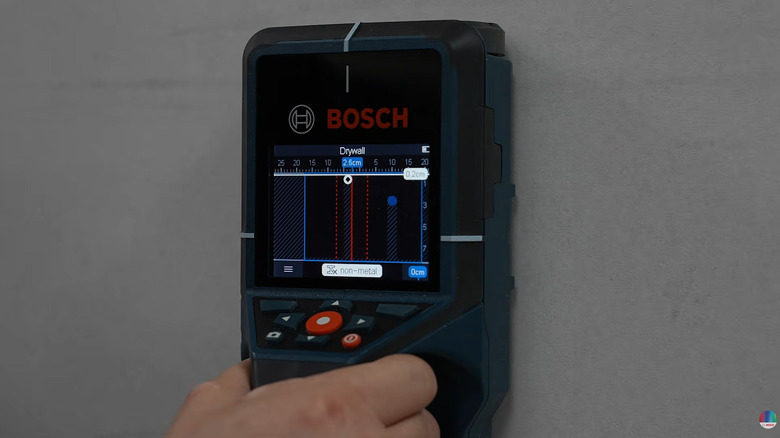
Next up we have the radar scanner that we mentioned in the intro. The Bosch D-tect 200C is a handheld, professional-use tool that can detect various common in-wall objects that you might find on a work site. And this thing is way more than a beefed-up stud finder — for example, wood, water-carrying pipes, live wires, and in-wall metals are just a few of the things that the D-tect 200C is capable of finding within a wall. However, it's worth mentioning that these are limited by how deep the object is located inside the wall. Ferrous metals like copper and steel (rebar, for instance) can be seen up to 7.9 inches deep; copper wire is an exception, with the D-tect 200C only managing to see copper wires that are 3.9 inches deep.
The tool is just under 10 inches in height and weighs in at 1.61 pounds, which isn't too shabby, considering that it can also run wirelessly off 12-volt batteries. It's worth mentioning that the D-tect can also determine whether a cable is actually carrying a current or not, as well as whether an in-wall pipe is carrying water; though, once again, this is likely dependent on the depth. Each handheld D-tect 200C comes with a 3.5-inch color screen, and you can take screen shots of the display for later reference. These can be transferred to your computer via the inbuilt SD card slot or the USB-drive port. You can find one for around $600 online.
Indego LogiCut Robotic Lawn Mower
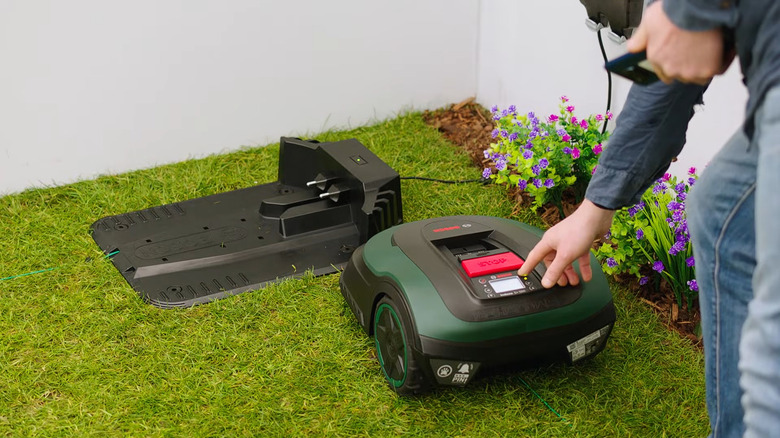
If you've ever seen a Roomba — which, FYI, could also be used as a security camera — buzzing happily about a house and thought to yourself, "they should make a lawn mower like that" — well, you're in luck. Bosch has done essentially just that, with its Indego LogiCut lawn mower robot. We imagine that making an automated lawn mower comes with considerably more challenges than a Roomba; where Roombas can use sonar, lidar, and radar to avoid obstacles and as reference points for turning, a lawn mower has basically none of those.
Once again, it's worth mentioning that Indego LogiCut is the series of robotic lawn mowers, and that there are multiple units within the lineup, each with differing prices and features. The main differences would be in the maximum recommended cutting area — i.e., the size of the lawn that the Indego can handle — and the cutting height and width. The way it works is through the use of a docking station and a perimeter wire held in place with in-ground posts; the Indego mower stays within this area.
It's a pretty neat solution without the need for extremely complicated sensors, and the LogiCut tech in the Indego range is pretty impressive too. It makes the mower move in parallel lines, but it also chooses a different mowing direction each time it cuts your grass so that you won't get those permanent "tracks" on your lawn over time.
Rexroth Smart Flex Effector
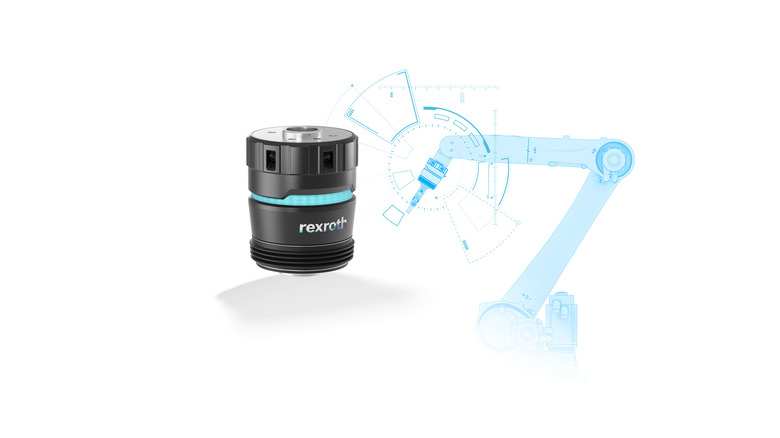
While not technically a consumer-level gadget, we think that the Rexroth smart flex effector is definitely worth mentioning. For the uninitiated, Bosch Rexroth is a subsidiary company that operates in the rather niche field of robot drive technologies, both electronic as well as hydraulic. The company's smart flex effector is a programmed control module that is reverse-compatible with some existing assembly lines — though we're not clear on the prerequisites for this — that can give robots a sense of touch. Of course, robots cannot truly have a sense of touch like we do — that technology isn't mainstream yet, and we cannot think of a current commercial application where it would be useful either.
However, the Rexroth smart flex effector can allow the robot (say, one in an industrial assembly line) to flex on the X, Y, and Z axes, as well as rotate around these. Then, the sensors in the module would record the deviation and exact position of the item that is being handled, and note any changes. Bosch itself says that one of the main intended areas of use for the sensor is processes with "minimal tolerances" — i.e., where precision is key. While it might not immediately get people's hairs to stand on end, recognize that this is the beginning of robots coming close to a human sense of touch and pressure. It is the potential future improvements to this technology that are worth keeping an eye on.
GLM 150-27C Laser Measure
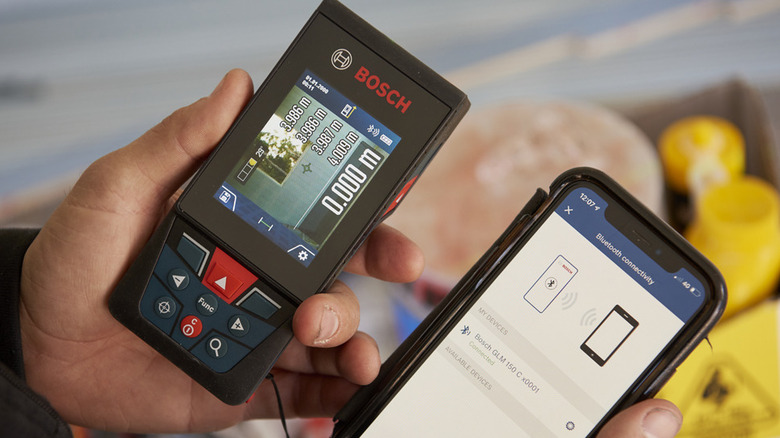
We're back to something far more accessible and useful to the everyday Joe or Jane with the GLM 150-27C laser measure, though Bosch really needs to work on its naming system. As the name suggests, it is a laser measure, which works by shooting a laser at a distant point, capturing the laser after it reflects and returns back to the source, and measuring the time between projection and the return capture. Then, the onboard computer would calculate the distance by using the known speed of the laser light as a proxy; that's how laser measures work in a nutshell. The Bosch GLM 150-27C is like the Rolls-Royce of laser measures though, equipped with a viewfinder, a class two laser, a Bluetooth module for data transfers, and a 2.8-inch color IPS screen, among other things.
The GLM 150-27C can measure things between 0.08 meters (8 cm) and 150 meters (15,000 cm) with a maximum deviation of just 1.5 mm, which is quite impressive. The tool can store up to 50 previous measurements and comes with a quarter-inch tripod mounting bracket. The device is also capable of measuring the full 360 degrees of incline (from 0 degrees), broken up into four brackets of 90 degrees, and the maximum deviance here is a paltry 0.2 degrees in total. The laser measure is also IP54 dust and splash resistant, is powered by a 3.6-volt lithium-ion battery, and weighs 0.21 pounds. You can likely find one at your local big box hardware store for between $200 and $300.
AdvancedLevel 360
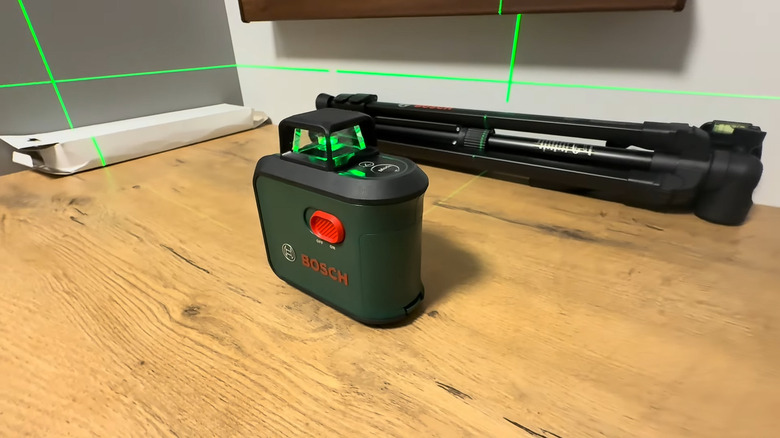
Another useful-for-DIYers kind of tool is the Bosch AdvancedLevel 360, which, as the name suggests, is a laser level. These devices, for the unfamiliar, project a perfectly straight laser (this can be either vertical or horizontal) onto your work site, so you can align whatever it is you're building so that it is straight when finished. The tool can be mounted to a tripod and can also be run off four AA batteries. It projects one 360-degree (hence the name) line horizontally, and two vertical lines, along with a plumb point projection too.
The AdvancedLevel 360 uses green lasers, which, as anyone with experience using these tools knows, are better than the red lasers that some laser levels use as the light is brighter. Additionally, you'll notice that the AdvancedLevel 360 is a nice, dark, matte green in color — and there is actually a difference between green and blue Bosch tools, with the former designed for DIYers and the latter for professionals. There is a more beefed-up version of this one called the GLL 3-80 G 360-Degree Laser Level with additional features, but we estimate that the AdvancedLevel 360 gets you about 80 percent of the way there, which is more than any casual DIYer will ever need in their toolkit. Once again, this particular Bosch offering is not sold domestically here in the States, but costs about $290 in Australian Dollars (approximately $210 U.S.). Buying a unit as a set with the tripod included from Bosch would add a few extra bucks above that price.
GSR 18V-150 C Drill/Driver
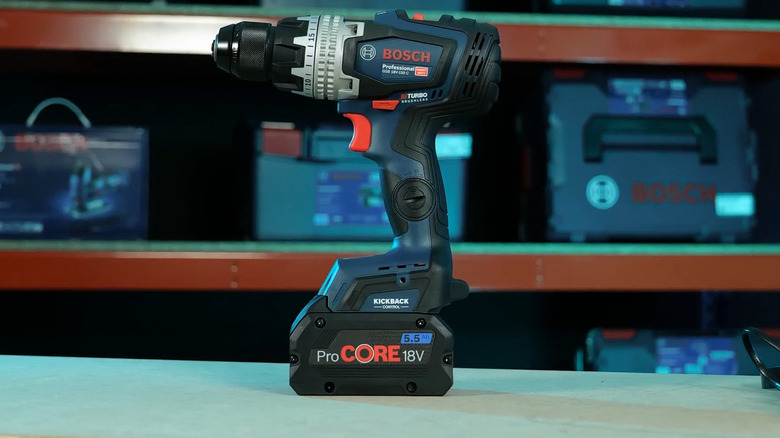
Next up, we have another mouthful with the Bosch GSR 18V-150 C Drill/Driver, which is essentially a handheld cordless drill on steroids. The drill has a brushless motor that has 150 Nm (111 lb-ft) of torque, powered by an 18-volt battery that can spin at up to 2,200 rpm at maximum. Since we mentioned the battery, note that the drill can be powered by any Bosch 18-volt battery as well via Bosch's AMPShare battery system that offers wide compatibility across multiple tool brands.
The drill can accept bits between 1.5 and 13 mm — this is known as the "chuck capacity" of a drill. Speaking of the chucks, both that as well as the gearing system in the GSR 18V-150 are made out of metal (as with many high-end drills), so reliability shouldn't really be an issue unless you're tossing the thing around a lot on the job site. Two major features of this particular drill are Electronic Angle Detection, which can tell you when you're holding it at the correct angle before driving a screw. It also has KickBack Control, which shuts down the tool when it detects a dangerous bind-up. This high-powered drill/driver can be found on Amazon for around $350 in tool-only form; batteries are not included.
Bosch BME688 AI Digital Nose
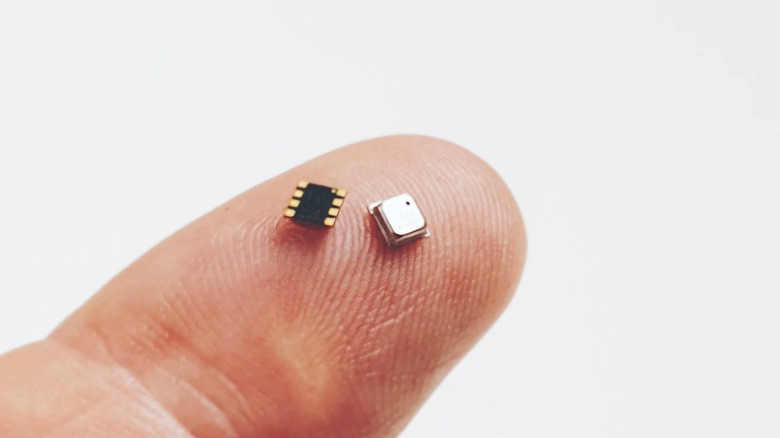
This thing is what is known as a "MEMS sensor" — an acronym for microelectromechanical systems — and is tiny, coming in just 3 mm long by 3 mm wide. This little device can reliably detect a veritable range of different gases and can also measure other environmental factors such as barometric pressure, the ambient temperature, and the level of moisture in the air. The newest of these sensors, built upon the already-proven Bosch BME688 micro-sensor platform is being called a "digital nose" — and is using AI for never-seen-before applications.
It is quite a sensitive unit, able to detect various gases in the parts per billion (ppb) ballpark, so it's quite accurate as far as sensors go. According to Bosch, potential applications for this sensor include the detection of food having gone bad, finding forest fires before they spread too much, and even pinpointing bad breath. The data that the sensor records can be graphically viewed and even split by the channel along the lines of data showcasing gas, pressure, humidity, and temperature, for example. It goes without saying that this specialized little tool isn't available to the general public.
AdvancedCut 18 NanoBlade Saw
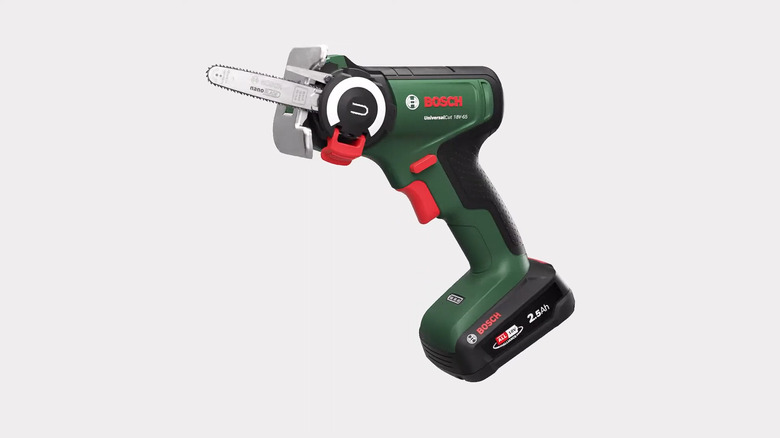
The last Bosch product on our list is the AdvancedCut 18 NanoBlade Saw, which, unlike your run-of-the-mill reciprocating saws, is more akin to a small chainsaw. Powered by an 18-volt brushless motor that can rotate at up to 7,000 rpm when not actively cutting through something, the entire package weighs in at just 1.5 pounds, though that's the weight without the battery attached.
The AdvancedCut 18 NanoBlade is also equipped with a quick-release system for its sawblades, allowing for easier swaps and changes, as opposed to the traditional allen-key system required to change a blade. Bosch says that the saw is good for up to a depth of 65 mm in wood as well as in plastic, and has equipped the tool with a speed trigger so that your saw doesn't just rev to the maximum each time you hold down the button. Like many other Bosch tools, there is also a battery charge indicator on the device itself. Overall, it should definitely find a spot among the most underrated home improvement tools – this $225 micro-chainsaw isn't something you'd absolutely need, but it certainly helps.