

5 Tanks That Are Quicker Than The M1 Abrams
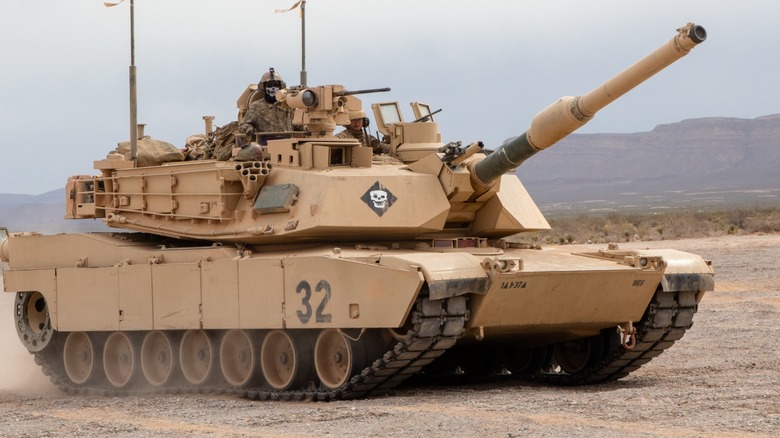
Ever since 1915, tanks have maintained a significant role in ground combat operations around the world. After World War I's era of so-called "landships," tank technology steadily improved into and throughout World War II. By the 1980s and '90s, tank design had advanced by leaps and bounds, thanks to the incorporation of jet turbine engines, depleted uranium armor, and reactive armor. All of these innovations came together to produce one of the most powerful and capable tanks in the world, the long-dominant M1 Abrams.
The Abrams first saw combat during Operation Desert Storm, and since then, the M1 platform has improved steadily with new tech and lessons-learned upgrades brought about by decades of combat. One of the key factors that makes the M1 Abrams so deadly is its incredible speed, thanks in large part to its Honeywell AGT1500 gas turbine engine capable of delivering 1,500 horsepower. This gives the M1 a top speed of 45 mph on smooth, even terrain. While that's fast for a tank, it's not the fastest in the world, or even historically.
Several tanks of various types, including armored reconnaissance vehicles, main battle tanks (MBT), and even a tank destroyer, managed to move across the world's battlefields at a faster pace. That's not to say they could outrun your family's car on the highway, but there's a big difference between moving something that weighs 2 tons and something that weighs as much as 73 tons. Here are five tanks of various sizes and configurations that manage to outpace the M1 Abrams, presented in order from the slowest to the fastest.
Tanque Argentino Mediano (TAM)
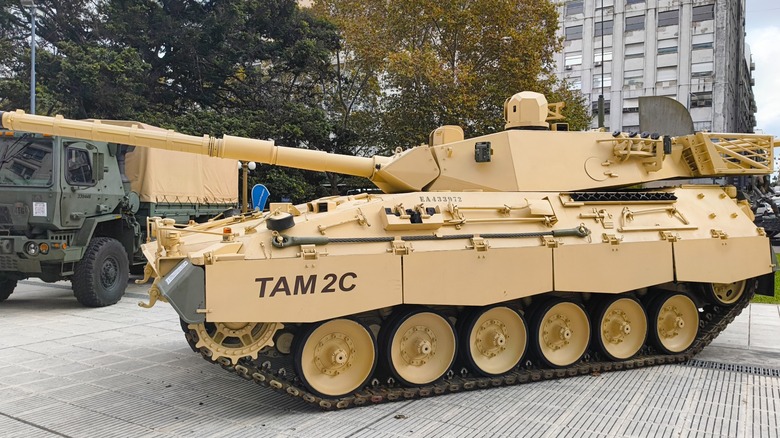
When Argentina introduced the Tanque Argentino Mediano (TAM), which translates to "Argentine Medium Tank," it produced a vehicle capable of filling numerous roles. The tank entered service in 1979 and continues to operate for the Argentine military; thanks to its impressive design, the TAM family of vehicles fills numerous roles. Most notably, it's Argentina's primary tank, though it's classified as a medium tank and not an MBT, as it weighs only 30.5 tons.
Regardless, TAMs dominate the Argentine Military's armored units, and 280 have been produced. Given its comparatively small size, which places it at more than half the total weight of the M1 Abrams, it shouldn't come as a surprise that it has a significant top speed on flat, even terrain. TAMs are powered by an MTU-MB 833 Ka-500 6-cylinder diesel engine outputting 720 horsepower, which gives it a top speed of 46.6 mph, though that depends on various factors, including the TAM variants.
Argentina utilizes seven different configurations of the TAM, and they all have their own specifications and characteristics. These include an Infantry Fighting Vehicle (IFV) capable of carrying 12 fully kitted-out troops, a 155mm self-propelled artillery gun, a mortar carrier, a command vehicle, a rocket launcher version that makes it into a multiple launch rocket system (MLRS), a combat ambulance, and, of course, a medium tank Argentina uses as its primary armored vehicle.
Type 100 MBT
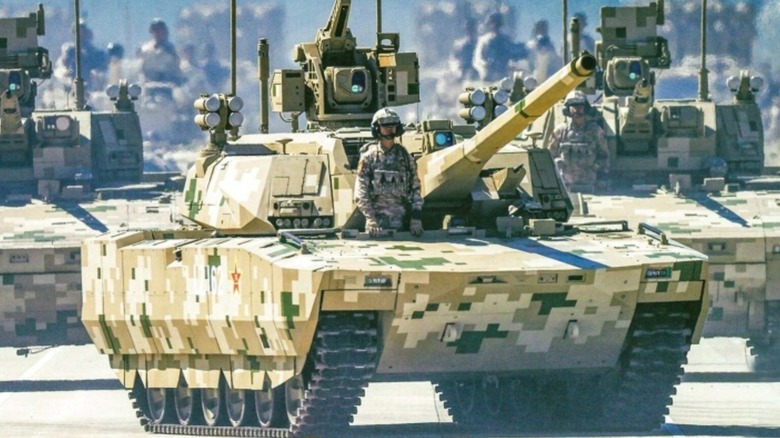
On September 3, 2025, China celebrated the 80th anniversary of the end of World War II in the Pacific, and as usual, the massive military parade gave the world its first look at a host of new weapon systems. One such piece of hardware was an entirely new 4th-generation tank, the Type 100. This included two vehicles, the Type 100 MBT and the Type 100 IFV. The former is based on the chassis of the Soviet-made T-72, and while China doesn't exactly post its weapons' specs online for the world to see, experts in the West have identified several notable features.
The Type 100 is relatively light, weighing between 35 and 40 tons, making it a medium tank. This is a doctrinal shift over previously developed MBTs that weighed considerably more. The low weight, coupled with the tank's primary diesel engine, electric motors, and batteries, pushes the tank to a probable top speed of 50 mph on flat, even terrain.
While it's unclear what type of diesel engine or other internal components get it to that speed, it's believed that they combine to produce 1,500 horsepower. Despite the Type 100's smaller size when compared to the M1 Abrams, it features numerous upgrades and enhancements that make it a modern platform. The Type 100 has a reduced crew of three down from four, thanks to several automation features. It also utilizes AR goggles to provide greater situational awareness, and its computer is augmented with artificial intelligence for a variety of crew interfaces.
FV101 Scorpion
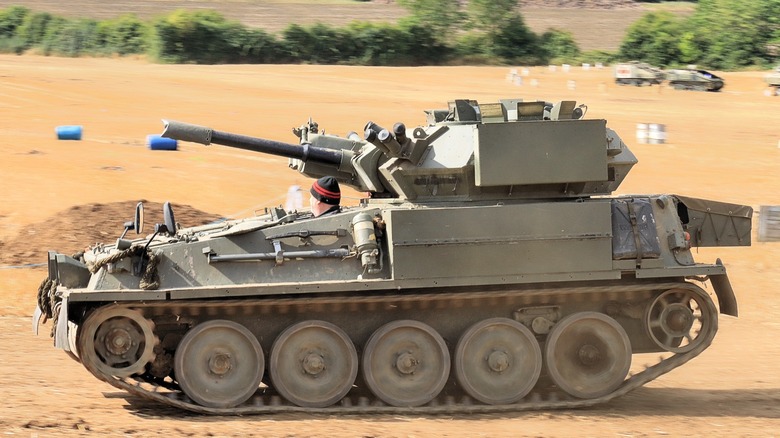
The FV101 Scorpion is an armored reconnaissance vehicle that most tankers would insist isn't a proper tank. That said, its overall design, large turret and gun, and tracked mobility classify it as such, and it's a powerful armored beast. The vehicle is a British light tank that entered service with the U.K. Army in the 1970s. Its small design was meant to keep it highly mobile and deliverable by air, and it proved its worth during the 1982 Falklands War. While the United Kingdom no longer uses it, the FV101 Scorpion is in use by other nations around the world.
Being a light tank, the FV101 Scorpion weighs only 7.8 tons, and when it debuted, it was powered by a six-cylinder Jaguar J60 4.2-liter gasoline engine. The vehicle's top speed is 51.1 mph, which the Guinness World Records acknowledged, calling the Scorpion the world's fastest tank in January 2002. Granted, the variant used an upgraded diesel engine and was operated on a closed track, but the achievement still counts. Still, as there are two more tanks to dive into, the FV101 Scorpion no longer holds that record.
Regardless, there's no denying the tank's speed, which outclasses almost every modern one in operation today, including the M1 Abrams. The speed advantage is largely thanks to its small size, especially when compared to the M1, but the tank's design and choice of aluminum armor helped keep the weight low, resulting in one of the fastest tanks ever made. Throughout its time, more than 3,000 FV101 Scorpions of several variants were produced, many of which remain in service around the world.
T-14 Armata MBT
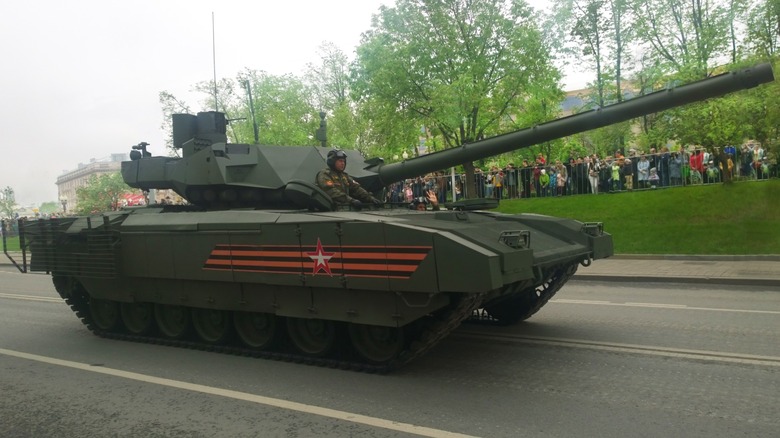
The Soviet Union and then the Russian Federation produced more tanks than any other country, and today, Russia has the most tanks in its military compared to every other nation. Whenever a new model arises, it's a pretty big deal, and the introduction of the T-14 Armata MBT in 2015 is no exception. The tank's angular hull gives it a modern look, and its purported systems and capabilities suggest that the T-14 Armata could be an especially well-designed tank in future wars.
Still, while it looks impressive, Russia hasn't spilled many details about its design, leaving those in the West to analyze what's available. As a result, the Armata's top speed isn't confirmed, though it's believed to be between 50 and 55 mph on flat, even terrain. Russia hasn't used them for full-scale combat operations in the ongoing Russo-Ukrainian War, leaving them well-defended so they could fire on positions without endangering the new, expensive pieces of hardware.
It's believed that the tank's engine produces 1,500 horsepower, though it's not clear which engine is installed in the T-14 as of this writing. The tank's high speed is likely related to its reduced weight of 48 to 55 tons. While that's hardly a light tank, it's significantly lighter than the M1 Abrams at its lowest configuration weight of 62 tons. Still, while the T-14 Armata appears to be a formidable, fast-moving tank, it will take time for more details to emerge; as of this writing, it's currently the world's fastest MBT.
M18 Hellcat
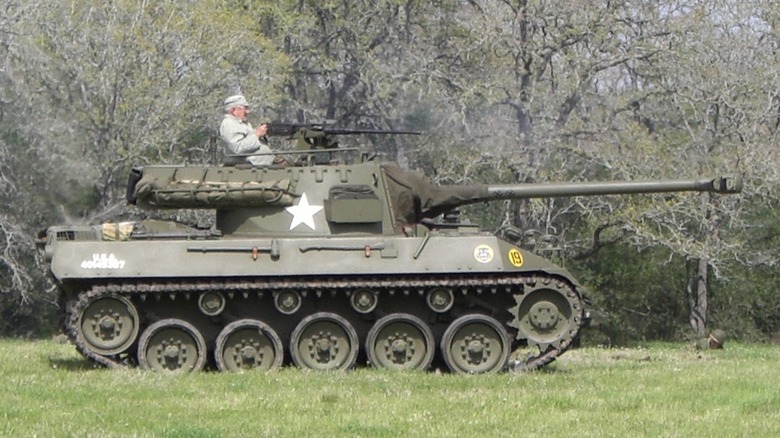
During WWII, the concept of an MBT hadn't yet materialized, so there were many different classifications of tanks throughout the conflict. One of these classifications was the tank destroyer, which wasn't always a tracked vehicle. Regardless, many of them were, including the M18 Hellcat, which was designated as the 76mm Gun Motor Carriage during its service life. The goal in creating the M18 Hellcat was to produce an armored vehicle that could move quickly across the battlefield, engaging enemy tanks before they had a chance to react.
Given its extensive use in combat in WWII and the Korean War, the M18 Hellcat lived up to expectations. The vehicle weighed 16.76 tons, making it significantly lighter than the M4 Sherman medium tank the U.S. used to great success throughout the war. Speaking of that tank, the Hellcat utilized the same 16.0-liter supercharged radial nine-cylinder Continental R975 engine capable of producing 400 horsepower.
This is what gave the M18 its incredible top speed of 60 mph on flat, even terrain. That would classify the M18 Hellcat as the fastest tank in history, but because folks can get hung up on the now defunct tank destroyer classification, it's often overlooked. This is despite it featuring the same engine and main gun as some of the M4 Sherman variants. However modern scholars classify the M18 Hellcat, its speed is not in dispute, and it achieved great success thanks to its high-speed capabilities and large main gun designed to destroy enemy armor.