

10 Trucks From The '70s That Look Better Than Today's Pickups
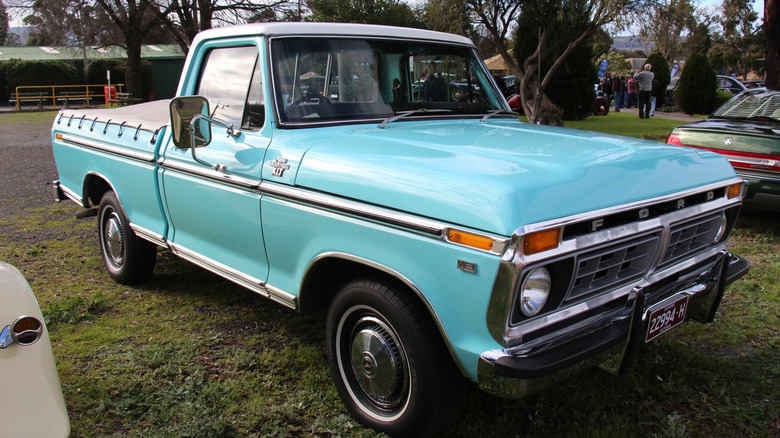
If you're of a certain age, the thought has probably crossed your mind: "They just don't make 'em like they used to." While boomer nostalgia is often mocked, it comes from a real place. Sometimes, classic cars are just better.
Take, for instance, cars. Not just cars, but pickup trucks in particular. Today's vehicles across the board are sleek, aerodynamic, and fuel-efficient. They're also kind of homogeneous, lacking in distinct silhouettes. In the 2020s, a car is a car. Some are big, some are small, but they don't have the same character as they did back in the old days. In the modern era, everything has become so streamlined and scientifically engineered for maximum efficiency. Consequently, some charm and character have been lost.
In the realm of Americana, few images are more iconic than the classic American pickup truck, particularly those of the 1970s. They had a distinct dignity, a righteous grit, and an effortless sense of rugged style that today's trucks simply can't match. Let's take a look at ten trucks from the 1970s that make today's pickups look like plastic Tonka toys.
Chevrolet El Camino
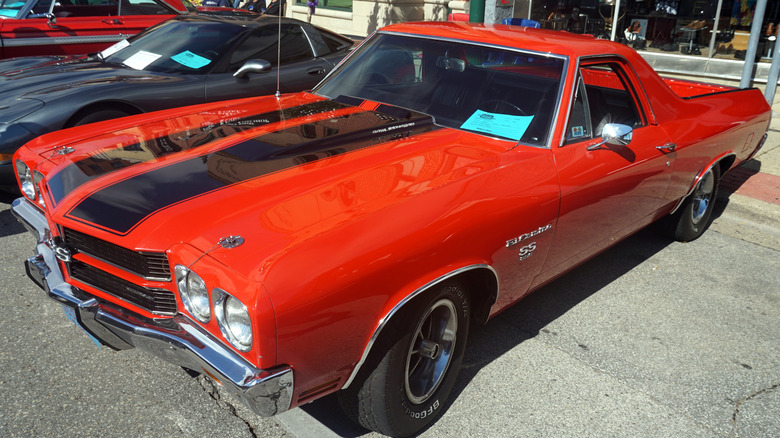
Before we get into proper trucks, we have to look at one of the coolest cars of all time, the Chevrolet El Camino. Is it an old-school muscle car? Or is it a full-on pickup truck? In practice and utility, it's both.
Initially developed as a response to the Ford Ranchero, another "coupe utility vehicle," the El Camino looked like a sedan from the front, but boasted a pickup-style flatbed in the back. So it's like a sedan with a badonkadonk, if you'll forgive the lowbrow nomenclature. Designed to haul heavy loads, the El Camino was given the power of a 1970s muscle car to accommodate its heavy-duty sensibilities.
Compared to the other vehicles featured in this story, the El Camino is pretty small, but it has a glorious profile. It's just small and sleek enough to evoke its muscle-car power while still having enough room in the back to serve as a genuine pickup truck. Put simply, there's nothing else quite like it. That iconic mix of shapeliness and utility was put to good use in the hit AMC TV series "Breaking Bad" and its epilogue movie, fittingly named "El Camino," which debuted as a Netflix original in 2019.
Ford F-250 Highboy
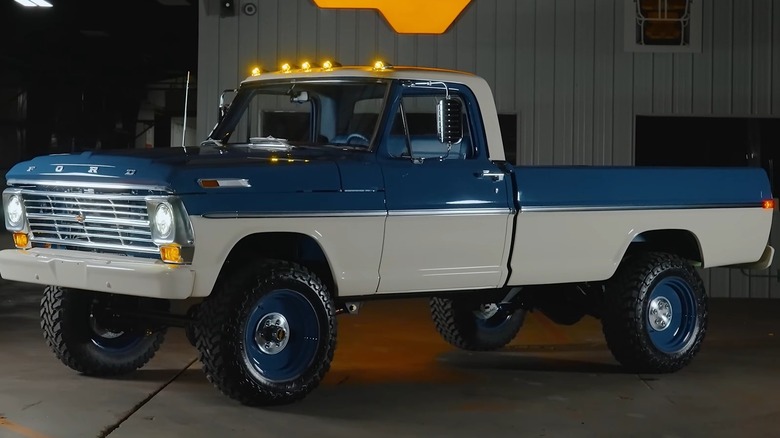
All you need to do is look at this truck to understand why it's called the "Highboy." This thing is closer to a monster truck than a traditional road vehicle, with hefty wheels supporting a raised suspension on which the chassis sits. If you're short, you might need Air Jordans or a stepladder just to climb into the driver's seat.
Unless you drive a bus or a fire truck for a living, getting behind the wheel of one of these Highboys is likely the closest you'll get to feeling like the most powerful driver on the road. There's a special, indescribable power that comes with driving a vehicle like this, with tires that can flatten anything they roll over while you sit comfortably, meters above every other driver. Just have a little empathy for drivers behind you who can't see anything in front of them, especially if you have a load of junk in the flatbed.
Sure, today's trucks are even bigger, and Hummers are basically army cars modified for civilian use, but they lack the raw character of a 1970s Ford. Maybe it's nostalgia talking, but there's something special about seeing those four letters, F-O-R-D, written across the nose of a truck. Overall, it's one of the coolest trucks of the 1970s. It's worth noting that, after 1972, Highboys didn't quite sit as high anymore, so look for a 1972 Highboy if you want the maximum effect.
Dodge D-Series
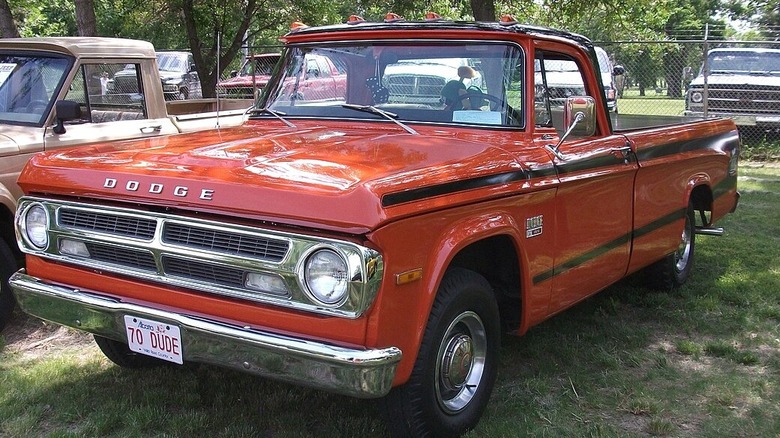
Even in the 1970s, the Dodge D-Series was old-school. From 1960 to the early 1990s, the basic philosophy of the D-Series remained unchanged. Eventually, the whole line was replaced with the decidedly more modern Dodge Ram. While reliable and beloved in their own way, drivers of a certain age will always have a soft spot in their hearts for the rugged sensibilities of the D-Series.
In 1973, the D-Series was upgraded with a 'club cab' space. If you're not hip to trucks, that's the little bit of extra space behind the front seats for extra storage or even extra passengers, provided they don't mind a terribly uncomfortable ride with no leg room. It's a half-measure that's useful in a pinch, but there's a reason you don't see many club cab trucks in the 21st century. Four doors with proper passenger room are generally seen as the correct choice, even though it eats into the flatbed space.
If you were really plugged in back in the day, you surely remember "The Dude." No, not from "The Big Lebowski," but a particular trim of the 1970 and 1971 versions of the D-Series. "The Dude" was promoted through a 15-minute short film starring Don Knotts, who also appeared in Dodge television advertisements at the time.
International Scout Terra
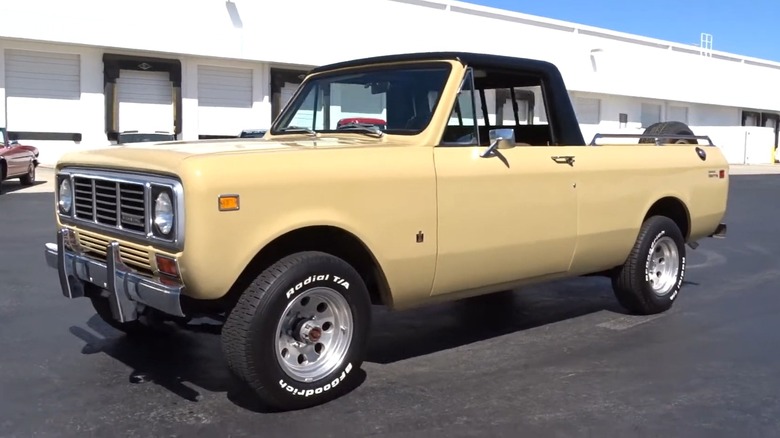
If there's an elephant in the room of any conversation about big trucks of the 1970s, it's the issue of fuel economy. The 1970s were arguably defined by the energy crisis, which led to unpopular speed-limit laws and a push for fuel efficiency. This push would eventually lead to the rise of cheap, lightweight, and fuel-efficient Japanese cars in the 1980s, but in the '70s, big trucks were increasingly viewed negatively because of their size and gas-guzzling nature.
While a viable electric car was still decades away, vehicles like the 1976 International Harvester Scout Terra found a way to improve fuel efficiency, at least a little. While not a "solution" to the problem, the addition of new engine options was implemented to allow drivers to save face and gas money, if not enough to save the planet. One of these engine options was an 81-horsepower Nissan diesel engine, which was the first American diesel-powered pickup truck.
Of course, if you're regularly hauling heavy loads, 81 hp might not be enough to safely navigate steep hills and rugged terrain. For that, you probably would have gone for the V8 options that offered up to 163 hp. Whatever engine you choose, the International Scout Terra was big and spacious, though its overtly 1970s style might be something of an acquired taste for some.
GMC C2500 Sierra
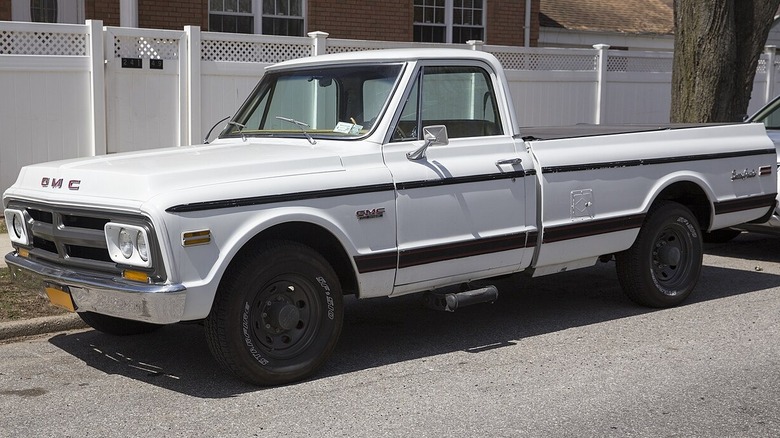
A luxury trim might seem antithetical to the blue collar sensibilities of a pickup truck. Nevertheless, "Sierra" was the term given to high-end trims of the GMC C2500 trucks. Eventually, the name became popular enough to serve as the catch-all for all of GMC's full-sized pickups.
But back in 1973, the trucks were known as either "C" for two-wheel drive or "K" for four-wheel drive, with "Sierra" being used to identify a specific premium trim package. Other variations included "Sierra Grande," "High Sierra," and "Sierra Classic."
For this story, let's look at the 1975 model, which marked the first year Sierra became the generic name for the base model. While just a naming distinction, it's a special year for GMC since the Sierra name is still in use to this day. This also marked the first year that the GMC truck was outfitted with a catalytic converter to reduce emissions. But in terms of sheer style, this is a gloriously beefy truck with a six-foot flatbed that gives it a distinct profile. If you're miles away and see this truck as little more than a tiny dot on the horizon, you can still tell it's a GMC Sierra.
Chevrolet C-10
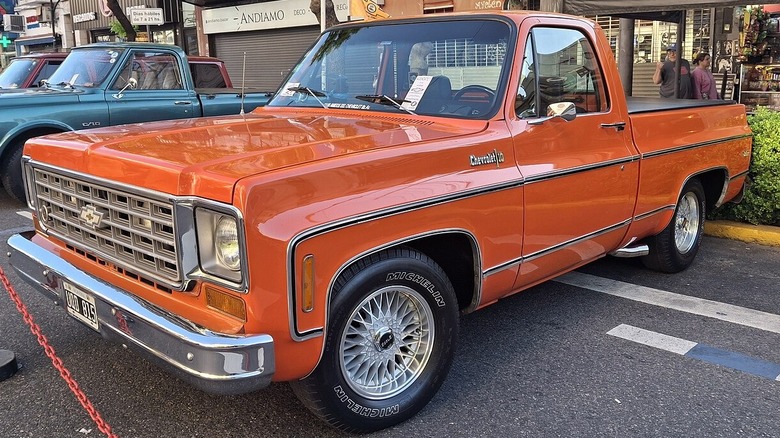
In the late '60s and early '70s, Chevrolet released a series of trucks dubbed the "Action Line," with the C10 pickup truck as its crown jewel. This vehicle was massive and had a versatile lineup of engine options, from an inline-six for basic utility to a mighty V8 producing 240 horsepower.
The C10 was tremendously popular because Chevrolet finally saw the pickup truck as an everyday consumer vehicle rather than a utilitarian workhorse. By 1972, the C10 was outfitted with options for air conditioning, AM/FM radio, and a tilt steering wheel. These seem like obvious amenities, but they were tremendously uncommon on pickup trucks of the day. Back then, nobody thought of this class of vehicle as anything but a blue-collar worker's tool. By showing the pickup truck some love and respect, Chevrolet modernized, and thus revolutionized, the public's perception of pickups.
To this day, the C10 is beloved as an all-time legendary pickup truck. All you need to do is look at it to see why. It's a hefty vehicle with a pleasant profile and a massive size that screams "Americana."
Dodge Lil' Red Express
By the late 1970s, catalytic converters had become the norm. They cleaned up emissions, but they impacted acceleration, so hardcore auto purists were annoyed by the mandate to put them on all cars, to say nothing of Americans and our stubbornly righteous indignation against government mandates.
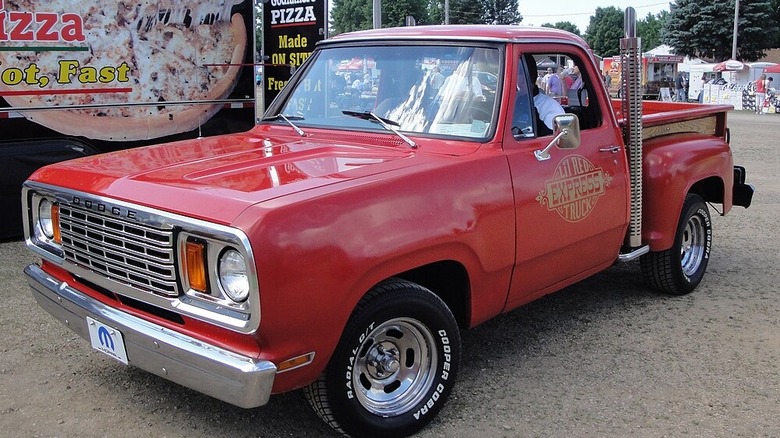
However, there was a loophole. Catalytic converters were optional, not mandatory, on trucks of a certain weight. Thus, Dodge was free to make the Lil' Red Express, which was one heck of a powerhouse truck. This beast boasted a 360-cubic-inch V8 engine that revved to 225 horsepower. Those are awesome specs, especially in the environmentally conscious 1970s.
But where the Lil' Red Express literally shined was in its distinct look. The truck was billed as part of Dodge's line of "Adult Toys," a phrase that I can only imagine didn't have the same 'after dark' sensibilities that it does today. Or with the provocative name, "Lil' Red Express," maybe it was supposed to be a little tongue-in-cheek. Regardless, with its striking red color scheme and epic chrome exhaust stack, the Lil' Red Express comes across as the ultimate 1970s pickup hot rod.
Unfortunately, despite early success, the vehicle was discontinued after the energy crisis worsened in 1979, and with gasoline prices out of control, the Lil' Red Express became arguably immoral for Dodge to produce anymore. The Lil' Red Express was only produced for two years in the late 70s, but it certainly made the most of its limited run.
Ford F-150
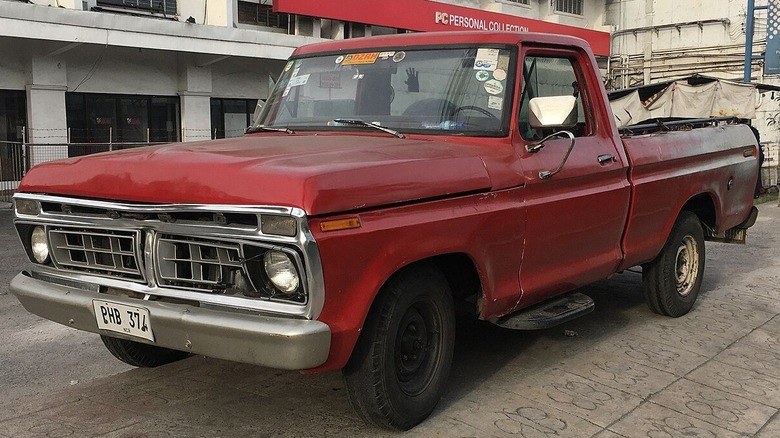
Like the Lil' Red Express, the Ford F-150 was created to exploit the emissions loophole. In the environmentally conscious 1970s, only trucks surpassing a certain GVWR (Gross Vehicle Weight Rating) threshold could avoid being saddled with a catalytic converter. Thus, Ford made the F-150 truck, which was bigger and heavier than the F-100, but not quite as massive as the F-250.
As a result, the F-150 was just big enough to avoid the catalytic converter without being so massive that it had its own zip code. In addition, Ford used the F-150 to introduce upgrades over the F-100, such as improved suspension, more engine options, and other bells and whistles, for a more versatile vehicle than either the F-100 or the F-250, while still looking like a big ol' American pickup truck.
Today, both the Ford F-150 and F-250 are still in production, though the F-100 was discontinued in the 1980s, with its utility largely usurped by the F-150's immense popularity. In the modern era, if you want a massive, heavy-duty truck for long hauls with heavy loads, you get the F-250. If you want the exact same thing but with relatively better fuel efficiency and a slightly slimmer profile, you can get the F-150. It's a truck that occupies a middle ground, able to both work hard and play hard. Even so, the 1970s versions of both trucks look more distinctly rugged than their (still admittedly awesome) modern counterparts.
Jeep J10 Honcho
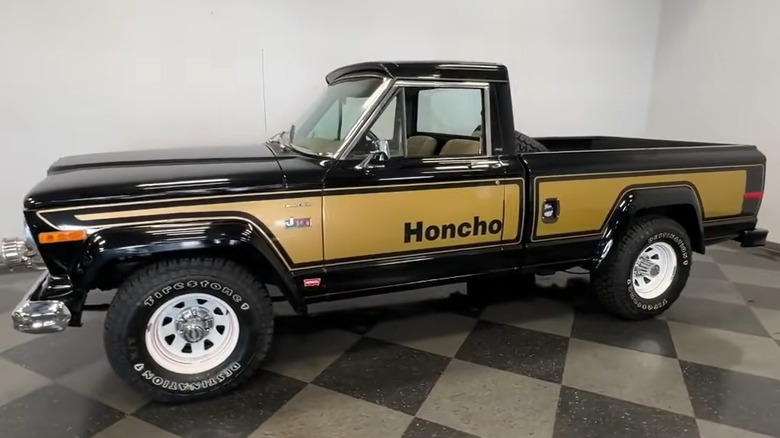
It would be a sin to write a story about rugged, off-road vehicles without including a Jeep. The original Jeeps were made to carry American soldiers on foreign soil during World War II, so the pedigree for a 1970s pickup truck was there, just waiting to fulfill its potential. When Jeep introduced the Honcho trim package of the J-10 in 1976, the vehicle did not disappoint.
Armed with the J-10's powerful four-wheel drive, the Honcho added chrome bumpers, gold decal highlights, and other amenities designed for comfort and ease of use. Upgrades like the Honcho really went a long way toward making the pickup truck feel like a regular car that anyone could use, rather than just something for farmers or movers. Even with the looming energy crisis putting a dent in the plans, pickup trucks managed to become mainstream in a way few could have predicted in the '50s and '60s.
While the Honcho came in multiple color options, I'd argue that the simple black paint job looked best with the gold decals. Black and gold are always a good color pairing. This particular shade of gold manages to avoid being gaudy thanks to restraint and subtlety. The color does not draw unnecessary attention, and the shape is not over-designed for the sake of drawing attention to itself. It's a cool look that adds the perfect amount of style to the J-10's efficient design.
Ford F-100
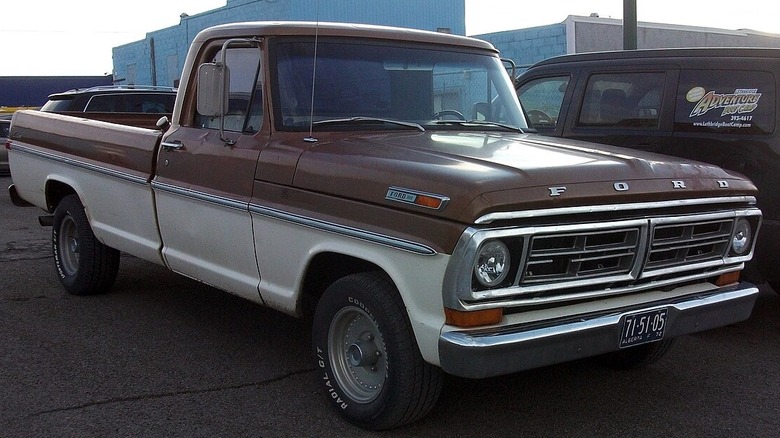
Finally, we have the ultimate retro pickup truck, the Ford F-100. The first version rolled off the assembly line in 1948, and while it certainly evolved over the decades, its overall look remained more or less unchanged, or at least instantly recognizable. Remember Sylvester Stallone's big black truck in The Expendables? Yeah, that was a 1955 Ford F-100.
Let's look at the 1973 F-100, which marked the debut of the truck's sixth generation. While this version lacked the hot rod-adjacent bulky shapeliness of earlier generations, it traded it for a streamlined form, resulting in a sleek silhouette. Well, sleek for a 1970s pickup truck, that is.
This is not a gimmicky truck. The tires are not oversized monster truck tires. The cabin is not elevated in the sky. The rear flatbed isn't flashy, either. Maybe this might seem generic to some and lacking in character compared to 1950s versions, but I'd say the lack of superfluous flash makes the 1973 Ford F-100 the first and ultimate pickup truck, the vehicle you immediately conjure when asked to imagine a pickup truck.