

5 Auto Parts And Accessory Brands Owned By ZF Transmissions
ZF Transmissions — or, to use its proper name, ZF Friedrichshafen AG — was founded as Zahnradfabrik GmbH in 1915 and focused initially on manufacturing gears and transmissions for Zeppelin airships. The end of WWI necessitated a shift toward road-going vehicles, though, and the company had a three-speed vehicle gearbox on the market by 1919.
In the years that followed, ZF grew by leaps and bounds, surviving WWII and expanding its portfolio and operations significantly. As of 2025, ZF has 162 facilities in 29 countries worldwide, with annual sales of $45 billion (38.8 billion euros). The brand's transmissions have become common staples in modern vehicles, with its ultra-reliable eight-speed automatic proving particularly popular with automakers and hot-rodders alike. And the company doesn't just make one of the best-ever transmissions on a production car; it also has an aftermarket presence, selling a selection of transmission parts and vehicle fluids under its own name.
Perhaps predictably, ZF has also acquired a handful of other auto parts brands over the years. While it can't compete with other automotive brands like Michelin, which owns nine tire brands alone, ZF's portfolio includes a healthy range of brands operating in the aftermarket and original equipment (OE) spaces.
Sachs
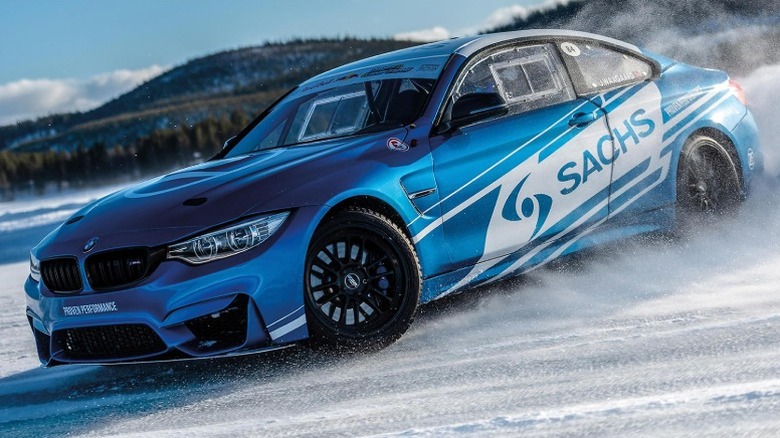
Sachs traces its history back more than a century, initially founded as Schweinfurter Präcisions-Kugellager-Werke Fichtel & Sachs by Ernst Sachs and Karl Fichtel in 1895. Yes, that's before even its current parent company was established. Sachs, in its various forms, has dabbled in many markets over the years, including bearings (which it stopped making in 1929), clutches, engines, and shock absorbers.
Mannesmann AG acquired a majority stake in Fichtel & Sachs in 1987, at which point the brand had already hoovered up some smaller companies and made its first foray into the North American market. The brand's shock absorber program would bolstered by the transfer of Boge's shock absorber buisness to Sachs after parent company Mannesmann purchased the latter in 1991. Fichtel & Sachs was renamed Mannesmann Sachs in 1997, and was later purchased by a Bosch-Siemens joint venture in 2000. ZF, in turn, purchased Sachs in 2001, after which it was renamed ZF Sachs AG.
Sachs continues to make factory shock absorbers and dampers for all sorts of vehicles, including high-end bikes like the Ducati Hypermotard 698 we reviewed in 2024. It also has a performance division that provides clutches and coilover suspensions for racing and tuner applications, which appears to be a continuation of the Sachs racing division first established in 1998.
Lemförder
Lemförder is a manufacturer of original eqiupment (OE) chassis and steering parts, such as ball joints, control arms, engine mounts, and sway bars. The company makes parts for European carmakers like Land Rover, Mercedes-Benz, Audi, Volkswagen, and Jaguar, among others. It was founded in 1947 and by 1950, the brand was supplying tie rods to major brands such as Daimler-Benz and Auto Union, predecessors to the current brands it works with now.
ZF became Lemförder's majority shareholder in 1984, purchasing 51% of the company and bringing its global operations under ZF's administration. Thus, while it's one of the company's youngest brands, it's also the one it's owned the longest.
The years following ZF's takeover saw Lemförder debut the first mass-produced aluminum control arms for BMW vehicles, introduce a multi-axial vehicle test bench that could simulate real-world conditions, and, once the 1990s came around, start building axle systems for BMW vehicles like the Z3 and X5. Lemförder has continued in this vein ever since, expanding its offerings significantly over the years and even entering the hybrid and EV market in 2019 by offering parts for the BMW i8, Volkswagen e-Golf, and Audi A3 e-Tron.
TRW
Like many of ZF's subsidiaries, TRW can trace its roots quite a ways back. The company started in 1901 with the establishment of the Cleveland Cap Screw Company, renamed to Thompson Products in 1926. Thompson merged with electronics firm Ramo-Wooldridge in 1958, giving birth to Thompson Ramo Wooldridge (later shortened to TRW). Up to that point, TRW had not been involved with automobiles at all; it was an aerospace and defense company. In fact, it was the first such private entity to build a spacecraft, the lunar satellite Pioneer 1. The craft didn't quite succeed at its mission, but that's a story for another time.
Northrop Grumman, builder of the legendary B-2 Spirit stealth bomber, purchased TRW in 2002, and subsequently sold the brand's automotive divisions to Blackstone Group for $4.73 billion in 2003, establishing TRW Automotive as an independent company. TRW Automotive grew significantly, even through the 2008 financial crisis, with $189 million in profit in 2010. ZF stepped in to buy the brand 2014, and the $12.4 billion deal was completed in the middle of 2015.
The purchase brought TRW's wide-ranging expertise in everything from transmissions to brake parts and driver assistance into the ZF fold, with the company operating as ZF's Active & Passive Safety Technology division. TRW continues to manufacture aftermarket parts as well, including suspension components and brakes for a range of brands including Toyota, Volvo, Audi, Hyundai, and BMW.
Wabco
Wabco was founded as the Westinghouse Air Brake Company all the way back in 1869, making it easily the most historic of all ZF's current subsidiaries. And, yes, the Westinghouse in question was the same George Westinghouse of Westinghouse Electric Company fame. As its name suggests, Wabco was founded to build air brakes, specifically for trains, but it branched out to vehicle air brakes in 1921.
American Standard Companies purchased Wabco in 1968, by which point the company had made several acquisitions itself, including paying $30 million for heavy machinery company LeTourneau Works in 1958. Wabco's simultaneous involvement in rail and vehicle brakes eventually birthed two companies. A new Wabco, focusing on rail brakes, split off from American Standard in 1990, and later merged with MotivePower to form Wabtec in 1999.
The Wabco that ZF owns, which focuses on heavy vehicle brakes and pioneered both ABS and electronic brake systems for trucks, stayed with American Standard until 2007, when its owners spun it off as an independent publicly traded company. In 2020, ZF purchased Wabco for an undisclosed sum, and took it private in the process. It has stayed true to its roots and currently offers a wide selection of components for heavy vehicles, with the primary focus being, of course, brakes.
Boge
The history of Boge is rather complex, intertwined as it is with ZF subsidiary Sachs, plus a handful of mergers and restructurings that have resulted, as of 2026, in two Boges. There's the Boge brand that ZF uses to sell shock absorbers, for one, but there's also Boge Rubber & Plastics, which was established after China's Times New Material Technology purchased ZF's rubber business, formerly Boge, for $399.3 million in 2013.
Boge was founded in 1931, specializing in shock absorbers — including those that featured on, amongst others, the classic BMW 2002 Turbo — and rubber-to-metal products. In 1991, Mannessmann AG purchased 50.01% of Boge's shares, becoming the company's majority shareholder. By 1993, Boge exited the shock absorber market to double down on its rubber products, with Mannesmann subsidiary Fichtel & Sachs taking over.
In 2001, ZF bought Mannesmann Sachs AG — the name under which Fichtel & Sachs had been operating since 1997 — from then-owners Siemens, bringing Boge's rubber-metal product manufacturing into the ZF fold. Boge would later merge with another ZF subsidiary, ZF Lemförder Elastmetall, to create ZF Boge Elastmetall, officially ZF's Rubber-Metal Business Unit. While ZF would later sell that operation to Times New Material in 2013, the company looks to have retained the Boge brand for shock absorbers. That said, some retailers lump Boge and ZF's other shock absorber brand, Sachs, together, which suggests that they're probably the same products, just with different branding.