

12 Experimental US Aircraft That Broke Unbelievable Records
Ever since the early 20th century, people have taken to the skies in aircraft that grow faster and more maneuverable as time passes. What was considered to be the height of technology in 1920 would have been considered ancient by the 1940s, and this is true as each decade passes. To achieve faster speeds and higher altitudes, pilots around the world tested their planes to the limits, hoping to push the envelope and achieve new world records for themselves and their aircraft.
These test pilots often put themselves and their aircraft in great danger. Not every flight resulted in success, as some ended in death and destruction. Still, the ones that succeeded often achieved something that hadn't been done before as humanity moved from the subsonic days of flight to supersonic, hypersonic, and beyond. While many nations employed test pilots and experimental aircraft, some of the most notable achievements in aviation came out of the United States of America.
The nation employed brave men and women throughout the 20th and 21st centuries to see just how fast and high its machines could reach. The result produced some of the most impressive experimental U.S. aircraft ever made, and many of them set or broke previously unattainable records. These 12 experimental U.S. aircraft, arranged in chronological order of their achievements, accomplished some of the greatest feats of aeronautical engineering, going faster, higher, and further than anything that came before.
Wright Flyer
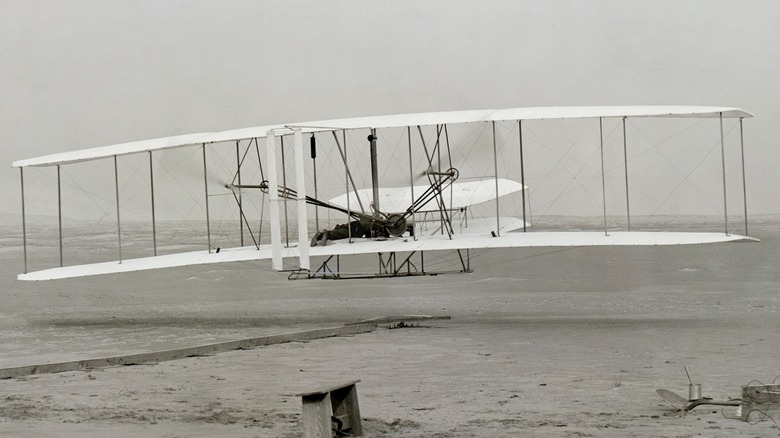
When it comes to experimental American aircraft that set or broke records, you can't skip over history's most important one, the Wright Flyer. Brothers Orville and Wilbur Wright constructed the single-place biplane out of spruce and ash with the wings covered in cotton muslin fabric, keeping it light, as the aircraft weighed only 605 lbs. without a pilot. For power, the Wright brothers installed a bespoke 12 horsepower gasoline engine.
This was attached to two pusher propellers which rotated in opposite directions. This was done to neutralize the propellers' gyroscopic effects, as the brothers took every measure they could to ensure the Flyer's stability. On December 17, 1903, Orville Wright lay down in the pilot's position while his brother watched. At 10:35 am, the Wright Flyer achieved the distinction of being the first powered aircraft to successfully take to the sky.
Granted, the Flyer only flew 120 feet in about 12 seconds, but the record was established regardless of duration or altitude. The brothers' remarkable achievement launched the age of aircraft, forever changing travel, war, and aviation technology. To honor their achievement, the Wright Flyer is on display at the Smithsonian's Air and Space Museum in Washington, D.C. Additionally, a small portion of the Wright Flyer flew on Mars via the NASA Ingenuity helicopter, the first heavier-than-air vehicle to fly under its own power on another planet.
Hughes H-1 Racer
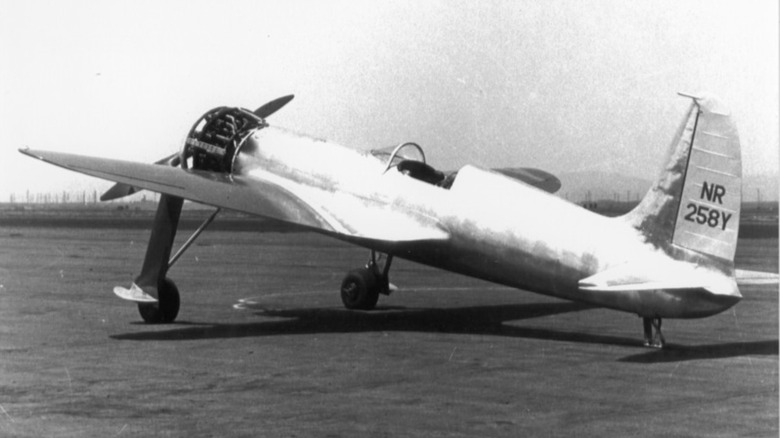
Numerous companies and individuals produced racing aircraft in the early 20th century, and one of the most famous was the Hughes H-1 Racer. The plane was the first to come out of Howard Hughes' Hughes Aircraft Company, and it took its first flight on August 17, 1935. The H-1 Racer is notable for setting numerous records, but it's also the last plane owned and operated by a private individual to break the world speed record, as future aircraft belonged primarily to the military.
On September 13, 1935, Hughes achieved his goal of setting a new world speed record, reaching 352 mph during a flight at Santa Ana, California. The H-1 Racer was modular, possessing two sets of wings. One set was shorter than the other, spanning 25 feet, which was used to set the world speed record. For longer-duration flights, the H-1 Racer used longer wings spanning 31 feet, 9 inches. These were used to achieve a new transcontinental speed record.
On January 19, 1937, the H-1 Racer flew from Los Angeles, California, to Newark, New Jersey, in 7 hours, 28 minutes, and 25 seconds. Throughout the 2,490-mile flight, the H-1 Racer maintained an average speed of 332 miles per hour. Like many of history's notable aircraft developed and flown in the United States, the H-1 Racer is on display at the Smithsonian's Air and Space Museum.
Douglas D-558-I Skystreak
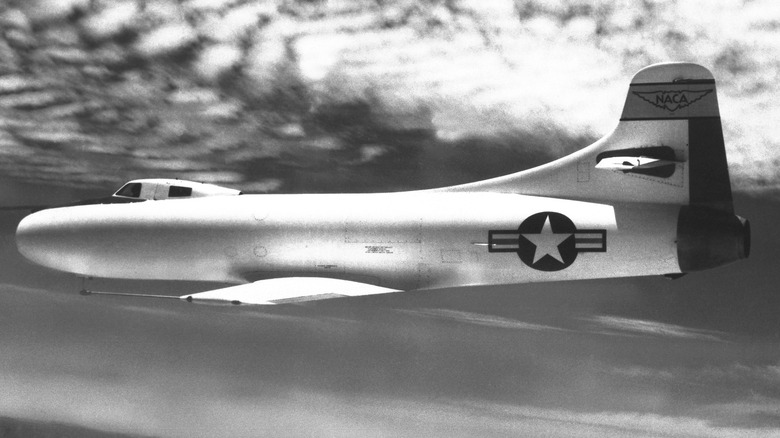
World War II ended with the introduction of the first fighter jet, the Messerschmitt Me 262, paving the way for the jet age. Seeing the writing on the wall, the Navy's Bureau of Aeronautics and the National Advisory Committee for Aeronautics (NACA, NASA's predecessor) teamed up with the Douglas Aircraft Company to produce three D-558-I Skystreaks. The experimental aircraft tested the use of jet engines and high-speed flight as the U.S. military sought to improve its air power after the war.
Thanks to its 5,000-lb. static thrust Allison J35-A-11 engine, the D-558-I Skystreak could takeoff and land under its own power. It featured a large intake in the nose and integral fuel tanks in the wings' forward areas. On August 20, 1947, Cmdr. Turner F. Caldwell flew the D-558-I Skystreak to a record-setting top average speed of 640.743 mph, overtaking the P-80R Shooting Star's previous record set only a month earlier.
Five days later, U.S. Marine Corps Lt. Colonel Marion Carl maintained an average speed of 650.796 mph. Caldwell's record-setting flight handed the world speed record to the U.S. Navy for the first time since 1923, but the Marine Corps overtook it in less than a week, flying the same type of plane. One is on display at the Naval Aviation Museum in Pensacola, Florida, and another is at the Marine Corps Air Ground Museum in Quantico, Virginia.
Bell X-1 Glamorous Glennis
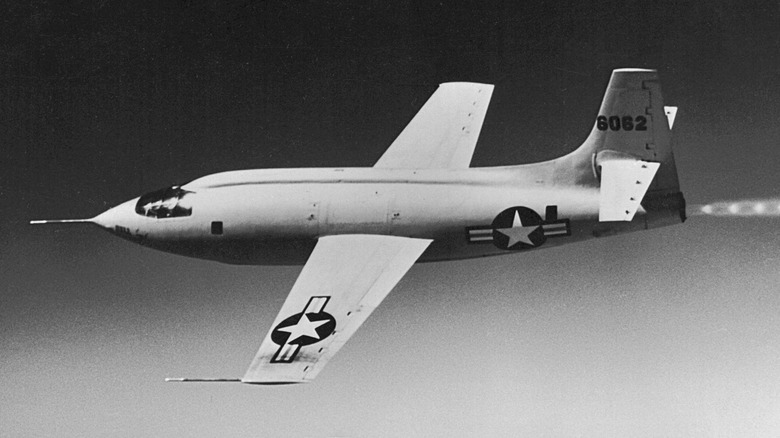
Of all the experimental aircraft flown in the United States, the Bell X-1 is probably the most well-known to the public. The historic aircraft came into being in the mid-1940s, when Bell Aircraft produced it and two others as transonic and supersonic research aircraft. Famed test pilot Capt. Charles "Chuck" Yeager flew the X-1, which he named "Glamorous Glennis" in honor of his wife.
On October 14, 1947, Yeager became the first person to exceed the speed of sound when he flew the X-1 over the Mojave Desert outside of Muroc Dry Lake, California. The test flight saw the X-1 reach Mach 1.06 (700 mph) at 43,000 feet, proving that the so-called "sound barrier" was nothing but a myth. Yeager's flight began in the belly of a B-29 Superfortress, which took the X-1 up to 23,000 feet, where it dropped and engaged its rocket, taking off at incredible speed.
The X-1 beat its own record on March 26, 1948, when it achieved Mach 1.45 (957 mph) at 40,130 feet. The X-1 was a single-engine, single-seat, mid-wing plane powered by a a Reaction Motors, Inc., 6.000-pound-thrust rocket engine, and its success in exceeding the speed of sound helped pave the way for all transonic and supersonic aircraft that followed. These days, you can see the X-1 on display at the Smithsonian's Air and Space Museum.
Bell X-2 Starburster
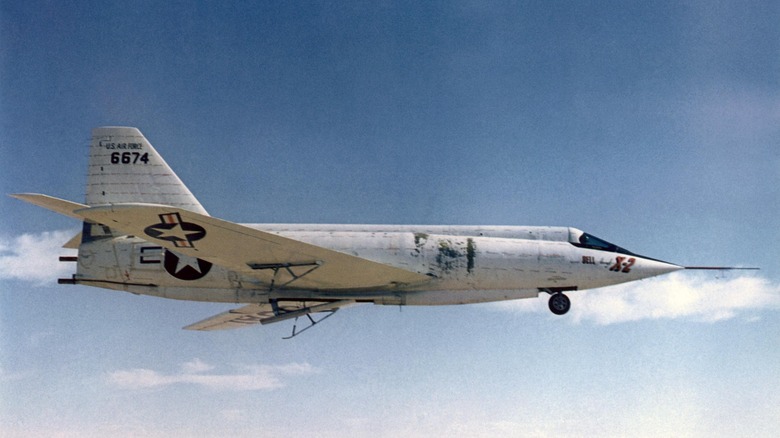
While breaking Mach 1 was a monumental achievement, NACA and the U.S. Army Air Forces wanted to push the envelope as far as possible. To that end, the Bell Aircraft Corporation and NACA created two versions of the X-2 Starbuster in the mid-1940s. On August 5, 1954, Lt. Col. Frank "Pete" Everest completed its first unpowered flight after being dropped from a B-50 Superfortress bomber.
On July 23, 1956, Lt. Col. Everest earned the title of being the "Fastest Man Alive" when he broke the world speed record by breaking the so-called "thermal barrier" by taking the X-2 to Mach 2.87 (2,202 mph) at an altitude of 68,000 feet. On September 27, 1956, Capt. Milburn Grant "Mel" Apt flew the X-2 to Mach 3.196 (2,452 mph), becoming the first person to fly three times faster than the speed of sound.
Sadly, the X-2's place in the history books is marred by an accident that killed both test pilot Skip Ziegler and B-50 crewmember Frank Wolko over Lake Ontario, resulting in the loss of the X-2 on May 12, 1953, 15 miles north of Rochester, New York. Subsequent X-2 flights, including one on September 7, 1956, which set an altitude record of 126,000 feet, were completed in Bell's second X-2. That aircraft also perished during Mel's Mach 3+ flight, resulting in his death as well.
Lockheed YF-12
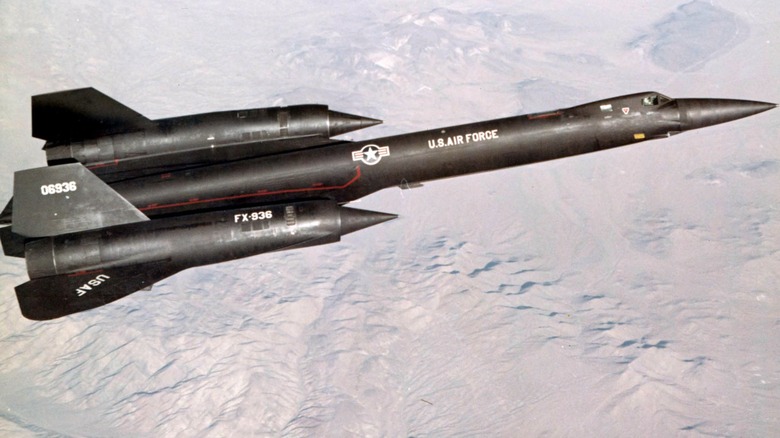
Most aviation enthusiasts know of the SR-71 Blackbird, which is the fastest air-breathing jet ever produced. There's a version of that aircraft that many don't know existed, called the YF-12, which was a Mach 3+ high-altitude fighter-interceptor prototype. While the SR-71 was used as a reconnaissance aircraft, the YF-12 was meant to fly operations against enemy aircraft during the Vietnam War but it wasn't ready as a production aircraft in time to do so.
That made it the largest, fastest, and heaviest interceptor aircraft, and while it remained experimental, it set numerous records. Lockheed produced three YF-12s in the 1960s, which flew in a joint NASA and U.S. Air Force research capacity through the 1970s. On May 1, 1965, while flying for the Air Force, a YF-12 broke a speed and altitude record by flying at Mach 2.7 (2,070 mph) at 80,257 feet. Further testing placed the YF-12's top speed at Mach 3.2 (2,455 mph).
This significant achievement helped in the eventual development of the SR-71 Blackbird, which mirrors many of the same design choices in its fuselage. While one YF-12 was lost to a fire, another made its way to NASA, which tricked the U.S. government into believing that an improperly delivered SR-71 was actually a YF-12. The only surviving YF-12 is displayed at the U.S. Air Force Museum at Wright-Patterson Air Force Base (AFB) in Dayton, Ohio.
Convair NB-36H Crusader
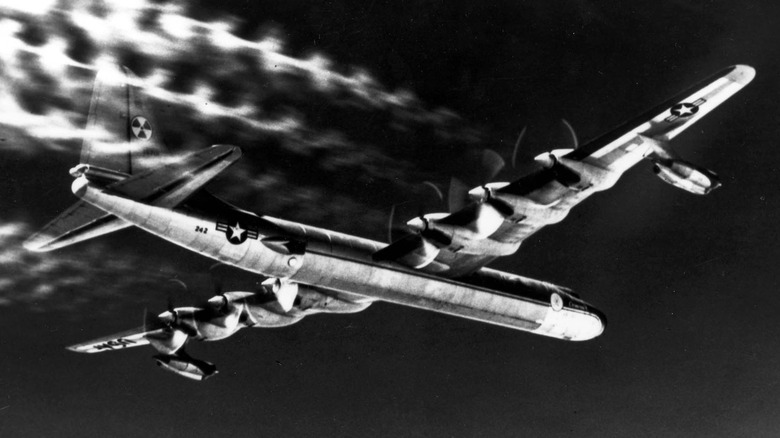
World War II ended with the beginning of the Atomic Age. For decades, nations produced all manner of nuclear weapons, but that wasn't the only use of atomic energy. In addition to powering large U.S. Navy ships like the USS Enterprise (CVN-65), nuclear power was directed at other means of conveyance, including aircraft. To test the possibility of nuclear-powered airplanes, the U.S. Army Air Forces launched the Nuclear Energy for the Propulsion of Aircraft (NEPA) program in 1946.
The ambitious project resulted in the development of the Convair NB-36H Crusader, which holds the world record for carrying the the first airborne nuclear reactor. The heavily modified B-36 Crusader looked like any other, though if you look closely at the tailfin, you'll see a trefoil symbol for radiological materials. That's because the heavy bomber carried a bespoke 35,000-pound, one-megawatt nuclear reactor as its power source.
The record-setting achievement was made on September 17, 1955, when Fitzhugh L. "Fitz" Fulton Jr. flew the NB-36H Crusader from Carswell AFB, Texas, to Roswell, New Mexico, a distance of 460 miles. While the aircraft worked as designed and flew 215 hours throughout its test period, the U.S. opted not to pursue nuclear-powered bombers. Instead, advances in intercontinental ballistic missiles coupled with the danger of flying nuclear reactors over land resulted in the project's cancellation in 1961.
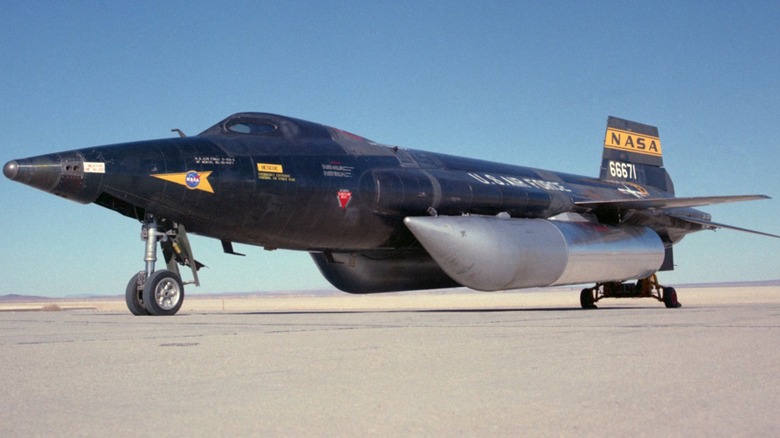
North American X-15
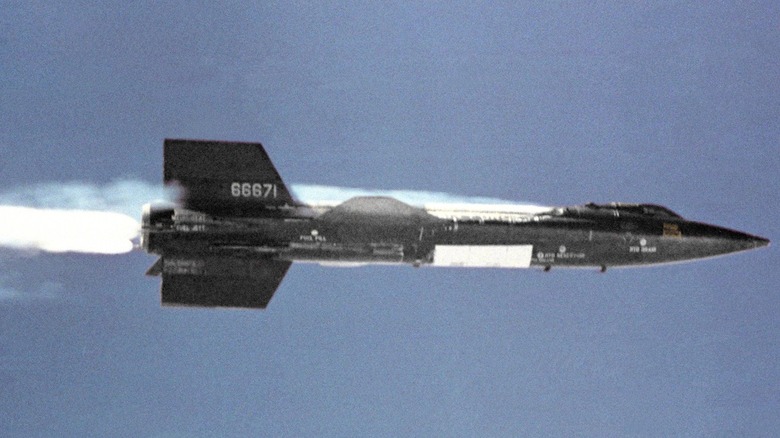
Another collaboration between the U.S. Air Force and NASA resulted in the North American X-15 hypersonic rocket-powered spaceplane. The experimental aircraft was designed to push the limits of crewed flights by going as high as possible while attempting to cross the Kármán line, the boundary between Earth's atmosphere and space. The Air Force defines this as 50 miles in altitude, while the Fédération Aéronautique Internationale sets it at 62 miles.
Regardless, the X-15 broke and set numerous records during its use throughout the 1960s. Most notably, it achieved a maximum speed of Mach 6.7 (4,534 mph) at 102,100 feet, setting the official world record for a crewed, powered aircraft. Prior to that, the X-15 became the first winged aircraft to reach Mach 4, 5, and 6, so it racked up a lot of noteworthy achievements throughout its many flights in the '60s.
Three X-15s were built and operated, conducting a combined 199 research flights. The first of these is on display at the National Air and Space Museum. The second, the X-15A-2, was the fastest X-15 flown, having achieved the aforementioned speed of Mach 6.7. The highest altitude an X-15 reached was an astounding 354,200 feet, or just over 67 miles. Each X-15 pilot who passed the Kármán line qualified as an astronaut, and this included none other than Neil Armstrong.
Rutan Model 76 Voyager
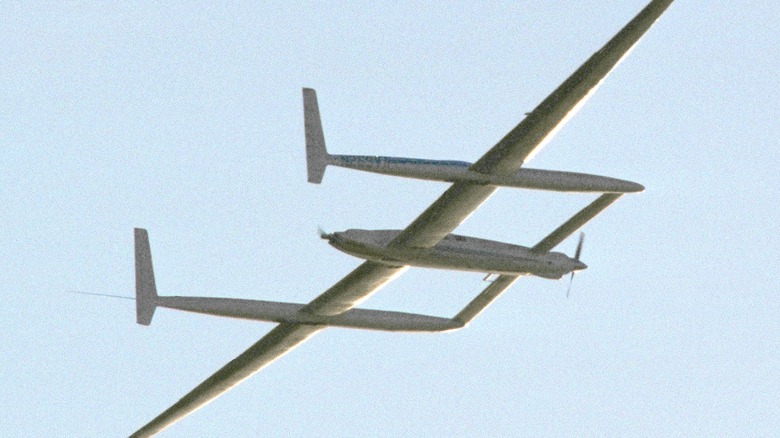
Flying around the world is a milestone that the U.S. Army Air Service achieved all the way back in 1924. While impressive, the feat required a team of personnel and numerous stops for refueling and maintenance. A new attempt to aerially circumnavigate the globe launched on December 14, 1986, when Dick Rutan and Jeana Yeager, who has no relation to Chuck Yeager, successfully traveled around the world in their Rutan Model 76 Voyager.
What's so impressive about their circumnavigation is that they did it without landing or refueling over a period of 9 days, 3 minutes, and 44 seconds. That meant that the Voyager remained aloft while covering a distance of 24,986.578 miles. This was made possible by the Voyager's unique design, which featured a wingspan of 110.8 feet, a total weight of 2,250 lbs. without fuel, and 17 fuel tanks.
When the Voyager took off from Edwards Air Force Base, California, it weighed 9,694.5 lbs., including everything from provisions and people to fuel. It returned to Edwards AFB after more than a week, earning the pilots, designer, and crew chief the coveted Collier Trophy, which is the most prestigious award in aviation. The Rutan Model 76 Voyager belongs to the National Air and Space Museum, though as of writing, it's not on display at the Smithsonian in Washington, D.C.
Grumman F8F Bearcat Rare Bear
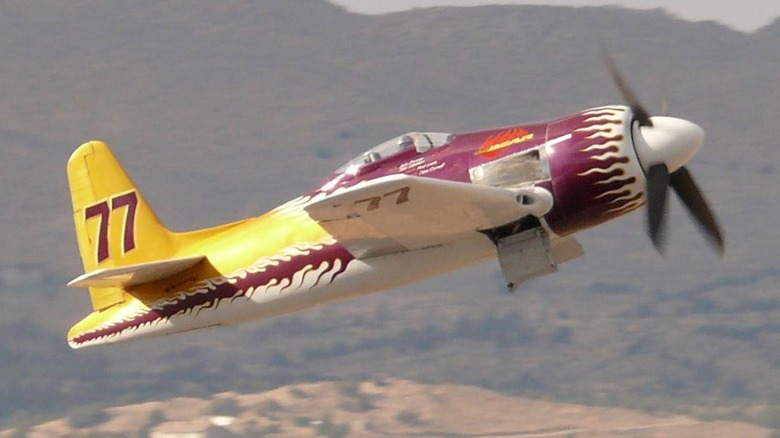
Typically, when most people think of the fastest aircraft, they picture jets, which makes sense. Jets have the power needed to push a plane beyond the speed of sound, but that doesn't mean that a propeller-driven aircraft isn't incredibly fast. Perhaps to prove this point, Lyle Shelton took a wrecked Grumman F8F Bearcat and modified it to the extreme, making it as fast as possible. He replaced the original engine with a Wright R-3350 radial engine and the propeller came from a Douglas A-1 Skyraider.
This provided more power than the standard Bearcat used by the U.S. Navy and Marine Corps during WWII. With his modifications and a complete rebuild, the aircraft received a new name, "Rare Bear." It went on to compete at various air races, earning plenty of prestige for its speed and climbing rate. Rare Bear became an iconic aircraft through its impressive performance, building up a cult of followers.
Rare Bear's most impressive achievement stems from its record-breaking flight, where it achieved the three-kilometer speed record of 528.33 mph(Mach 0.68). This record-breaking speed earned Rare Bear the title of being the fastest piston-powered, propeller-driven aircraft in the world. The speedy aircraft has also won more Unlimited races than any other airplane. These days, Rare Bear is retired as part of the Lewis Air Legends collection in San Antonio, Texas.
NASA X-43A
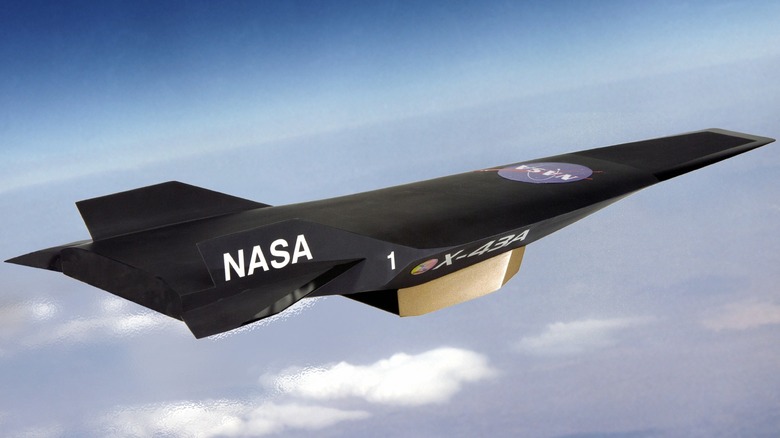
In the late 1990s, NASA launched its Hyper-X program to test hypersonic flight with a variety of aircraft, resulting in the NASA X-43 series of airframes. Hypersonic speeds exceed Mach 5 (3,836 mph), and testing beyond that limit saw the construction of three X-43As, which set some seriously impressive speed records. The single-use vehicles were uncrewed, and on November 16, 2004, an X-43A fired up its scramjets, achieving the breakneck speed of Mach 9.64 (6,363 mph).
That flight happened at 110,000 feet, and it resulted in the NASA X-43A becoming the world's fastest jet-powered vehicle. No other air-breathing vehicle has broken that record — at least not yet. While Mach 9.6 is unimaginably fast, NASA had hoped to reach Mach 10, but none of the X-43As achieved that speed during their one-time flights. After the X-43A flights, NASA canceled its Hyper-X program to focus on different areas of space exploration.
Because NASA didn't build the X-43As to be used more than once, they purposefully crashed into the Pacific Ocean. As a result, they aren't on display anywhere, though the National Air and Space Museum has a full-scale model. It took some time, but in June 2013, the Guinness World Records officially recognized the X-43A project with the new world speed record for a jet-powered aircraft, which is a record that's yet to be broken by NASA or another agency in or outside of the U.S.
Boeing X-37B
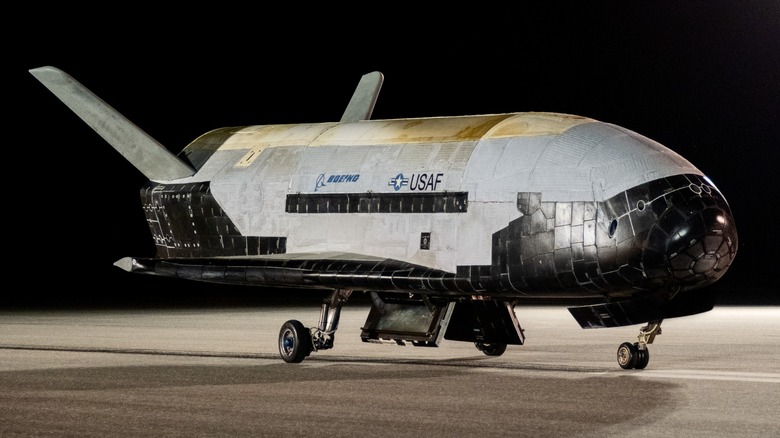
The Boeing X-37B is a U.S. Air Force-operated reusable uncrewed orbital test vehicle. It launches like a rocket but lands as a spaceplane, similar to the Shuttles operated by NASA from 1981 to 2011. The purpose of the X-37 program is to test and demonstrate reusable space technologies, and the X-37B conducted seven missions throughout the 00s, 10s, and 2020s with its most recent mission launch occurring in 2025.
When the X-37B conducted a mission, it often set a new record by remaining in orbit for extended periods of time. On its fifth mission, the X-37B remained in space for 780 days, landing on October 27, 2017. While impressive, the spacecraft had more records to set because its sixth mission racked up an astounding 908 days of continuous orbit before returning to Earth on November 13, 2022.
Collectively, the X-37B has spent more than 4,000 days in orbit, which amounts to nearly 11 years and more than 1.3 billion miles traveled. As of this writing, the X-37B is conducting its eighth mission, having launched on August 21, 2025, though it's unclear how long it will remain in orbit before landing. While the world knows of these achievements, much about the X-37 project remains classified, so its mission payloads and onboard scientific equipment aren't known to many, though it did win the Collier Trophy in 2020.