

5 Powersports Brands Owned By BRP
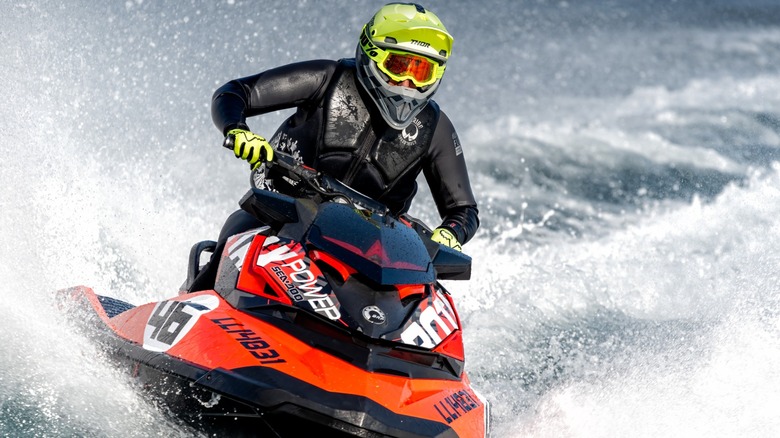
BRP is short for Bombardier Recreational Products, a Canadian manufacturer of a wide range of vehicles, from motorcycles and ATVs to snowmobiles and personal watercraft. While the name BRP itself might not immediately ring a bell, there's a good chance you know or even own a product from one of its brands. There's Ski-Doo, which makes snowmobiles, Sea-Doo, which makes personal watercraft, and Can-Am, which makes ATVs, side-by-sides, motorcycles, and three-wheelers. BRP also owns Rotax, which makes the engines that power many of these vehicles.
Interestingly, the company's story goes all the way back to Quebec in the early 1900s, when Joseph-Armand Bombardier began experimenting with vehicles that could travel over snow. That eventually led him to found his own company in 1942. And while snow vehicles were where it all started, Bombardier would eventually branch out far beyond them, getting into everything from aircraft to trains. In 2003, however, Bombardier sold its recreational products division, and BRP became an independent company.
Since then, BRP has established itself as a powersports company, with a pretty extensive collection of brands. Between them, there's a vehicle for just about every terrain you can ride on, whether that's snow, water, dirt, or pavement. Some of these brands started in-house and grew out of Bombardier's original recreational vehicle business. Others were acquired over the years as BRP expanded into new corners of the powersports market. Here are five of the brands currently under the BRP parent company, what they specialize in, and how each one came to be.
Ski-Doo
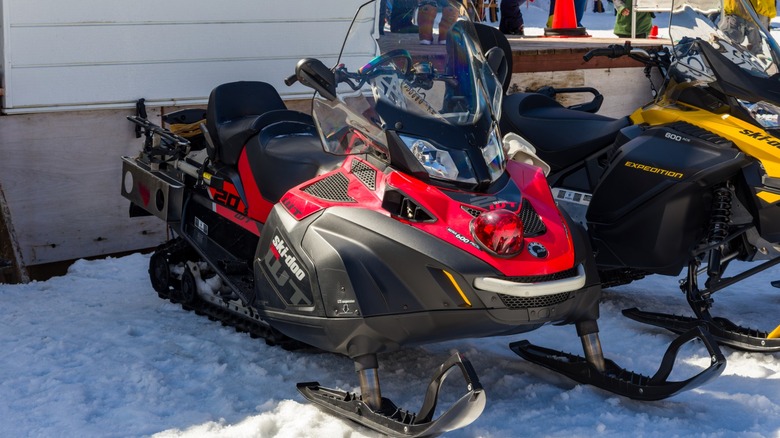
Joseph-Armand Bombardier spent much of the company's early years building larger snow vehicles that could help people commute more easily during winter. Those early models, like the B7 and B12, were closer to compact buses than to the snowmobiles we know today. They mainly transported doctors, ambulance crews, school children, and supplies. It wasn't until 1959 that Joseph-Armand introduced something much smaller: the Ski-Doo, which some sources claim was initially named "Ski-Dog." This was supposed to be the motorcycle for snow, and it ended up democratizing winter travel for a lot of people.
As the tech improved, it became more than a practical means of transportation and evolved into a recreational sport of its own. In fact, Ski-Doo became so closely associated with snowmobiling in Canada that ski-dooing became a verb, just like you might say Google it when searching for something online. From Canada, the vehicles spread across North America and into Europe. By 1973, the brand had already produced a million units.
Of course, the Ski-Doo of today has come a long way from the machine Joseph-Armand introduced in 1959. One of the biggest changes came with the REV platform in 2003. Traditionally, snowmobile riders sat farther toward the back of the sled. The REV chassis, however, moved the rider about 12 inches forward. It sounds like a relatively simple adjustment, but it completely changed the way riders interacted with and controlled the sled. Today, we have a wide range of Ski-Doo snowmobiles to choose from, whether you need a crossover, touring, utility, mountain, or performance-oriented snowmobile.
Sea-Doo
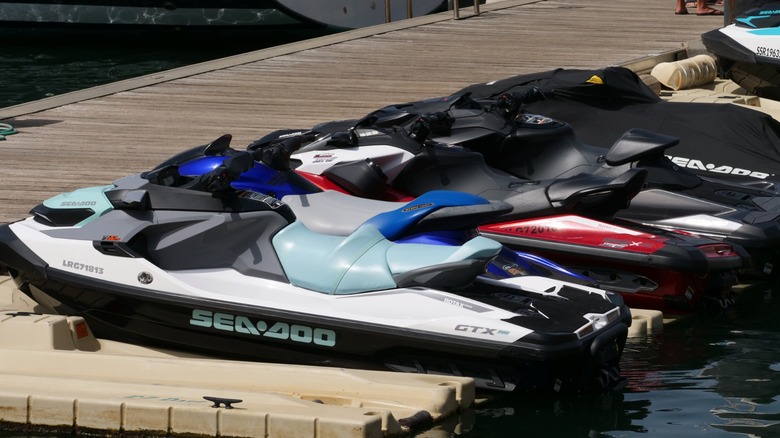
After figuring out how to make a motorcycle for snow, Bombardier thought: what about water? And that was how the Sea-Doo personal watercraft (PWC) came to life. Mind you, this was well before the Jet Ski entered the market. Bombardier introduced the first Sea-Doo in 1968, after working with American inventor Clayton Jacobson II. Jacobson would later license his technology to Kawasaki, which eventually launched the Jet Ski in 1973.
The goal with the Sea-Doo was to offer a small vehicle that was fun and easy to operate on water. Novel as the idea was, though, the first Sea-Doo wasn't perfect. There were quite a number of issues, from overheating to rider comfort, and they persisted enough that production had to stop for a while. In 1988, the brand resumed production, and once it had gotten the basics right, it started experimenting with ways to make these vehicles better. This led to a number of industry firsts. One example is the Intelligent Brake and Reverse system, better known as iBR. Traditional personal watercraft don't slow down like cars or bikes because there is no conventional wheel and brake setup. Sea-Doo's system introduced a more intuitive way of braking and reversing. Another example was suspension seats (now discontinued) that absorbed some of the impact of bouncing across the water.
Since then, the Sea-Doo brand has expanded with options for just about everyone. Just want something small for solo recreation? There's the Rec Lite lineup. Want something a little bigger for you and the family? There's the Recreation lineup. You've also got a ton of options for touring, tow sports, and even fishing.
Lynx
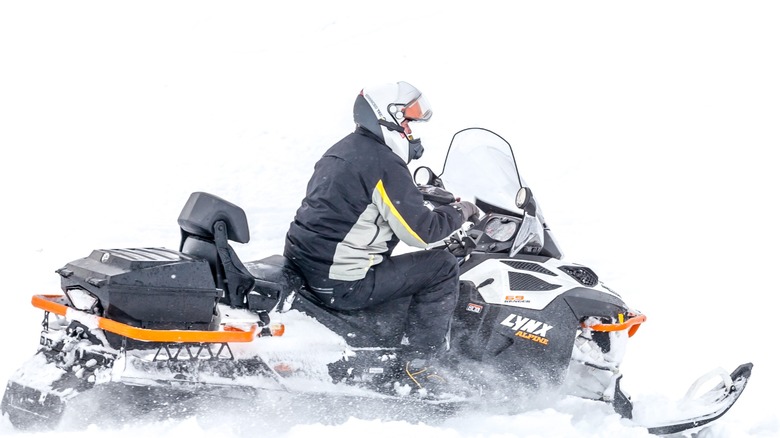
Lynx makes snowmobiles. So if BRP already has Ski-Doo, doesn't that make Lynx redundant? Well, not quite. For starters, Lynx was not Bombardier's original brainchild. It started as a small brand in Kurikka, Finland, in 1968, with the goal of providing rugged snowmobiles that could handle the particularly rough conditions in Scandinavia. Bombardier only entered the picture in 1988, when it decided to buy Nordtrac, the company that made Lynx snowmobiles. At the time, Lynx snowmobiles were being produced in Rovaniemi in Finnish Lapland, where they are still assembled today.
A little earlier in that timeline, Lynx had taken an interest in the racing scene. In the early 1980s, the brand started experimenting with sleds built purposely for racing. Those experiments paid off, and Lynx won the first race it entered with motocross rider Pauli Piippola in 1983. They would go on to win many more championship titles.
For years, though, Lynx wasn't available in North America. That changed in 2021, when BRP introduced Lynx snowmobiles to the North American market. The first lineup included the RAVE RE, designed for trail riding, and the Boondocker DS, made specifically for deep snow. The idea here is that you're getting a snowmobile with Nordic character, and that is the primary difference between Lynx and Ski-Doo. The terrain in northern Scandinavia can be particularly brutal, so Lynx snowmobiles are engineered for aggressive handling and, perhaps most importantly, an active riding style where the rider isn't just cruising but moving around and working with the sled, herding reindeer, for instance.
Can-Am
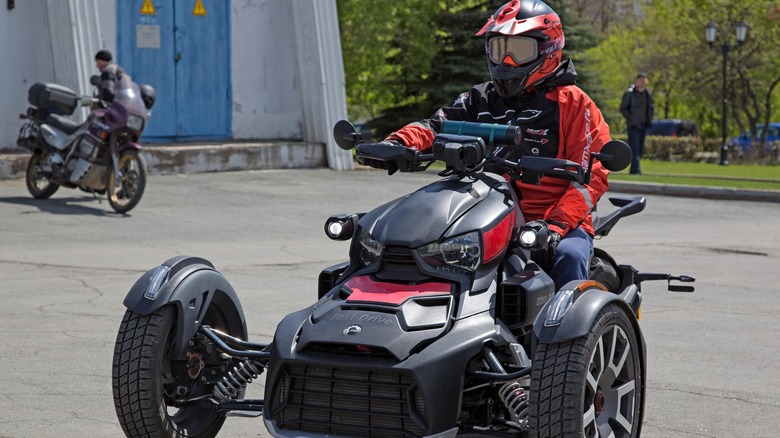
In terms of the types of vehicles it makes, Can-Am is arguably BRP's biggest, or at least its most diverse, brand today. But it actually started out as a motorcycle brand. Can-Am debuted in 1973, making motorcycles specifically for motocross and endurance racing. And it didn't take very long for the bikes to prove themselves. Can-Am riders picked up gold, silver, and bronze medals at the International Six Days Trial, and in 1974, the brand swept the top three spots in the AMA 250cc motocross championship.
The motorcycles weren't limited to racing either. Can-Am bikes were also picked up for military use, including by the British Army. But eventually, the original motorcycle business fizzled out. Then BRP gave it a new lease on life. Except this time, it wasn't dirt bikes. BRP revived Can-Am for its 2007 ATV lineup. And from there, Can-Am started expanding into one category after another. Soon, bikers got the Can-Am Spyder. Instead of a normal motorcycle with two wheels, the Spyder had a pretty unusual reverse-trike layout, with two wheels in front and one at the rear. Then, in 2010, Can-Am entered the side-by-side market with the Commander. And by 2018, it had introduced the Ryker, a smaller and more affordable three-wheeler.
Today, though, Can-Am has come full circle. After decades away from two-wheel motorcycles, BRP brought them back with the Pulse and Origin. Only this time, they're electric. However, the electrification isn't limited to motorcycles. For 2026, Can-Am added an electric option to the ATV lineup.
Rotax
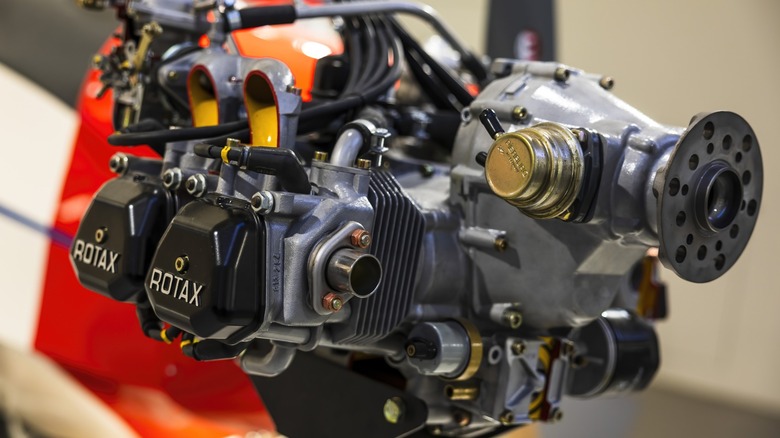
If you've ever wondered who makes Can-Am engines, well, now you have your answer: it's Rotax. In fact, Rotax is pretty much the beating heart of a huge chunk of BRP's product lineup across Can-Am, Sea-Doo, Ski-Doo, and Lynx. It might even interest you to know that the brand is much older than BRP itself. We traced its history back to 1920, when Rotax-Werk AG was founded in Dresden, Germany. It originally made things like bicycle freewheel hubs before expanding into propulsion systems. During World War II, the operation moved to Austria, first to Wels in 1943 and then to Gunskirchen in 1947, where it still is today.
Bombardier's relationship with the brand actually began before acquisition. Joseph-Armand Bombardier needed a lightweight engine that could hold up in extremely cold conditions, and Rotax turned out to be a pretty good fit. He placed the first order for Rotax engines in 1962 for Ski-Doo snowmobiles. Eight years later, in 1970, Bombardier acquired the Austrian engine maker.
Rotax, however, isn't just an in-house engine supplier for BRP vehicles. Rotax got into aircraft engines in the 1970s after realizing that people were already taking some of its lightweight snowmobile engines and adapting them for airplanes. That eventually became a proper business, with engines like the Rotax 912 going on to power ultralight aircraft around the world. Rotax also makes engines specifically for racing karts and even runs its own Rotax MAX Challenge racing series. The brand has also made engines for things outside of aviation and powersports, like portable fire pumps. In 2021, Rotax produced its 10 millionth engine.