

SlashGear's Best Of IFA Awards: The Best Tech We Found In Berlin

Every year, thousands of tech companies descend on Berlin to showcase their ideas, innovations, and products at the Internationale Funkausstellung, or IFA. The trade fair features a broad range of products, including smartphones, laptops, smart home devices, and creator tools, to name a few. There were a ton of products at IFA 2026, so I got my boots on the ground to identify the truly outstanding ones for our best-of-show awards.
The products I've chosen either do something really remarkable in their fields or, more simply, strike me as particularly cool. They're mostly consumer products that launched at the show, with some interesting concepts thrown into the mix as well. IFA is a European show, but I tried to focus mostly on products that will come to the United States. However, it's worth reiterating that this is a trade show, and that some of these products may well die on the vine. Without further ado, here's the best tech I saw at IFA 2026 in Berlin.
Lenovo Project Aeroblade
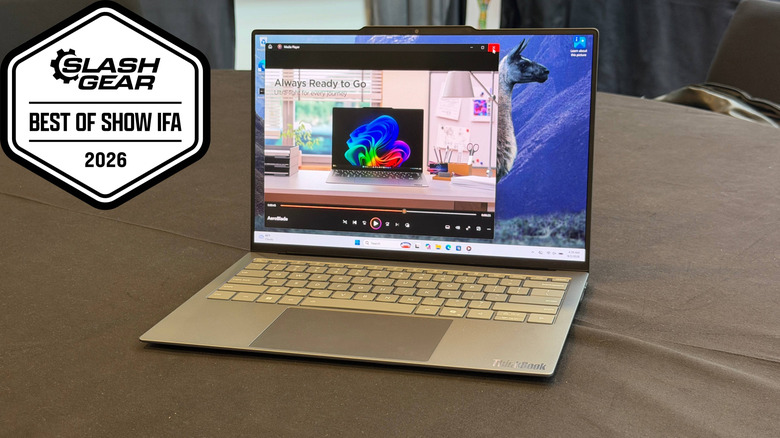
Lenovo is famous for bringing concept devices, such as the transparent laptop from MWC 2024, to trade shows like IFA, CES, or MWC. This year was no exception, though this concept has immense practical value. The laptop is called "Project Aeroblade," with the highlight being its solid-state cooling that replaces fans with ultrasonic conductors that force air through the laptop.
Lenovo developed this technology, called Active Flow, along with a company called Frore Systems. It allows sustained performance while remaining ridiculously thin, at around 10 mm when closed. For context, that's just over the thickness of a closed Samsung Galaxy Z Fold 8 (including the camera bump), all without sacrificing performance or cranking up the noise levels. Project Aeroblade is extremely light, too, weighing in at just 830 grams. To date, the lightest laptop I've tested has been around 970 grams, and the lightest one I've held has been a concept device from MSI that checked in at 899 grams. This is even lighter.
Of course, this is a concept, so who knows if it'll see the light of day, but I'm optimistic about our chances. The only roadblock would probably be if it doesn't hold up in long-term, sustained testing. I'll also give an honorable mention to Lenovo's Project Swan, which uses a rolling screen to extend horizontally to either side, turning a 14-inch laptop into a 17-inch one.
Bvio Violoop AI Hardware
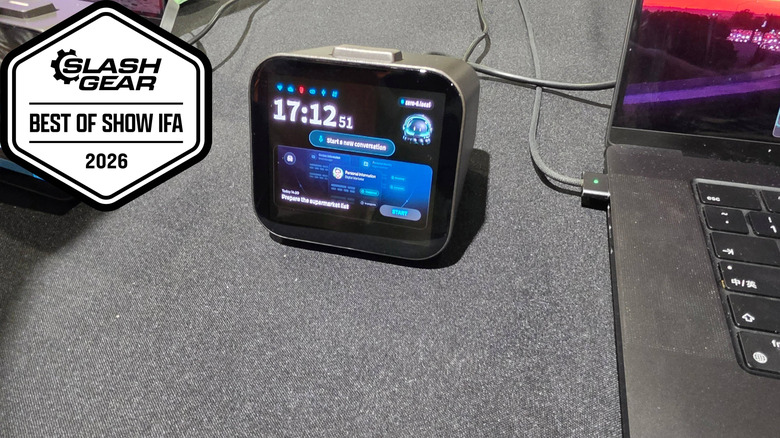
It's 2026, so of course there's AI on this list, but before you stop reading, hear me out. I worked my way past a lot of AI talk to arrive at Violoop, because it's one I could imagine myself using — possibly. Bvio's Violoop is agentic AI hardware that physically connects to your computer, reads and understands what's on your screen, and can act on your behalf. It's a form of automation, but it goes beyond that.
Instead of setting up a series of commands for the machine to repeat, you can use natural language to ask Violoop to perform tasks. When you connect the device to your computer, it can see your screen and act as your mouse and keyboard. Access is granted on a screen-to-screen basis, and you'll have to press a physical button to grant Violoop access. That means you can allow it access to your calendar but not your email, for example.
Violoop also offers visual cues to indicate what the device is working on at any given time, so there are no surprises. I'm not a fan of AI, but this device could be pretty interesting. Of course, like all automation, it will take time to set up and get working correctly. The device launches on Kickstarter in mid-September — another potential red flag, so proceed with caution.
Hoverair Versa

HoverAir is the drone company behind great beginner-friendly drones like the X1 Pro, and rivals DJI in functionality, if not sheer size and scale — at least, on the consumer end of the spectrum. But now it's doing something DJI isn't, and it's doing it in a fun way, albeit with one big caveat attached.
The HoverAir Versa is a 4K 60fps gimbal camera, similar to those you see from Insta360, DJI, and others. The camera's mounted on a 3-axis gimbal that keeps your picture smooth and steady while also tracking subjects on a rotating head. But the Versa does something no other gimbal camera can do — fly. Slide a latch down, and you can connect a set of drone wings that let it get airborne like HoverAir's other drones. You can control it with hand gestures and get shots like a 360 rotation around you. When it's done, you can detach the wings and go back to shooting with just the camera and the gimbal.
I absolutely love the versatility, but there's the caveat. The U.S. has banned all foreign-made drones from entering the country, with HoverAir's approval still pending at the time of writing. Of course, the company is optimistic that it can get the clearance needed to sell the drone in the U.S., but it is prepared to sell just the gimbal camera without the drone attachment. We'll need to wait and see what happens, but if it can clear the red tape, this is an exciting device.
Hohem Eyepic
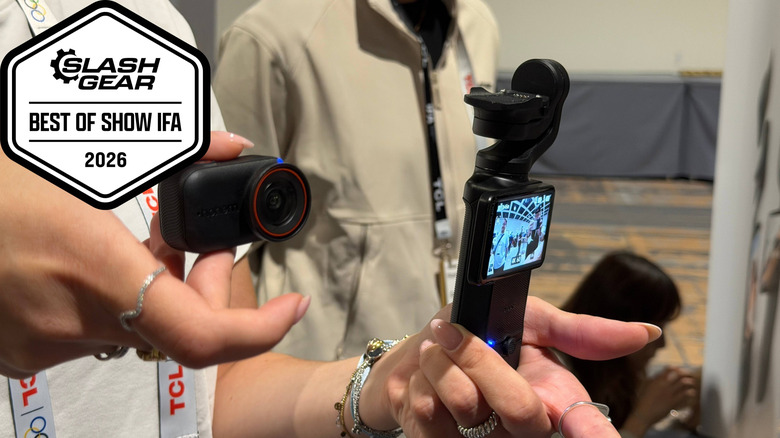
Not to be outdone by HoverAir, Hohem is also looking to do something new and different with a gimbal camera. Just like the HoverAir Versa, the camera can detach and find new life as a second device. In this case, however, the camera detaches from the gimbal and becomes an action camera you can attach to another accessory.
The camera back is magnetic, and the device has a pendant it attaches to. There's also a whole ecosystem of accessories that work with the camera, like a helmet for hands-free video recording. When detached, the 2.51-inch screen can remotely monitor the camera's image, so you can use it to aim and frame your shot.
The camera shoots at 2160 × 3840 and 60 fps, and it can also capture native vertical 4K video for TikTok or Instagram Reels. The camera is also waterproof up to 10 meters, so you can bring it along on aquatic adventures as well. This is another gimbal camera that comes packed with extra capabilities, a combo that's near and dear to my heart. The Eyepic is slated to hit the market in Q1 2027.
Tecno Next-Gen Bezelless Concept Phone
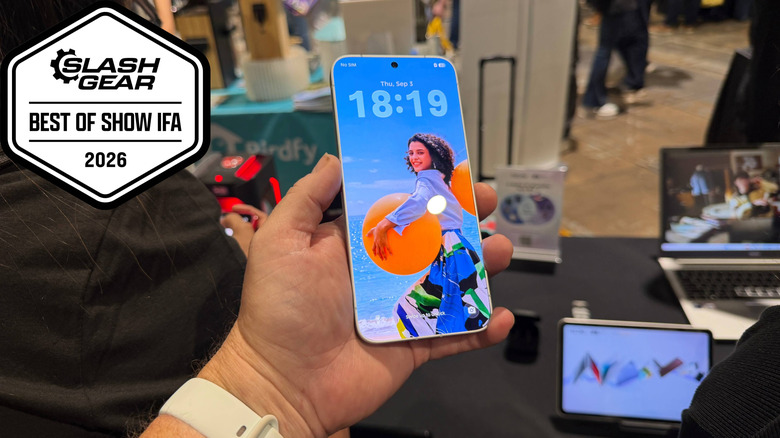
Smartphone bezels used to be a big thing and, to some extent, they still are. Try as they might, phone makers haven't been able to get rid of the bezel — until now. Tecno, a Hong Kong-based budget phone maker, has showcased a prototype that eliminates those bezels.
Of course, the first question you might ask of the concept is, "Why?" The answer is, pretty much, "because they could." From a strictly hands-on perspective, it doesn't add much value to the phone or to the experience of using it. But it is pretty cool. We've grown so desensitized to phone bezels that it's quite startling when they're not present.
Tecno redesigned the display elements that normally form the periphery of a screen and stacked them, allowing it to extend the display right up to the phone's silver edge. I don't think this will necessarily become a trend, but it's really great to see it in person, and it's yet another feather in the cap of a company that people in the U.S. may not otherwise hear about. Note that Tecno is no stranger to interesting concept phones, having showcased a very cool trifold prototype at MWC 2025.
Aurzen Zip Pro
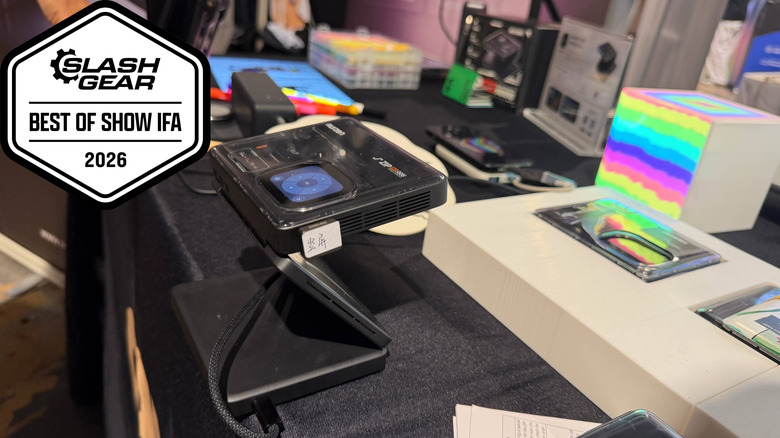
At IFA, Aurzen unveiled its latest projector, the Zip Pro. Aurzen first introduced its tri-fold portable projector, the Zip, at CES 2025; one year on, the Zip Pro addresses most of that initial model's limitations.
The Zip Pro projects a full 1080p picture, which was definitely a necessary upgrade. The picture is sharp, clear, and surprisingly bright for such a small device. It also has built-in dual 2W speakers, which I unfortunately couldn't test on the show floor, as it was much too loud. You can connect to the projector over Wi-Fi, and it also supports DisplayPort Alt Mode via USB-C, so you can connect a Nintendo Switch or other compatible devices. The tri-fold design allows the projector to act as its own tripod, so you can aim it where you need, without extra hardware. It's also very light, weighing just 586 grams.
The highlight is the cool design — it looks futuristic, and it has a touchscreen menu on top for controlling the projector, which is another cool upgrade. The projector will be available in mid-to-late October if you're interested in picking one up.
Xgimi Aura 3 Max
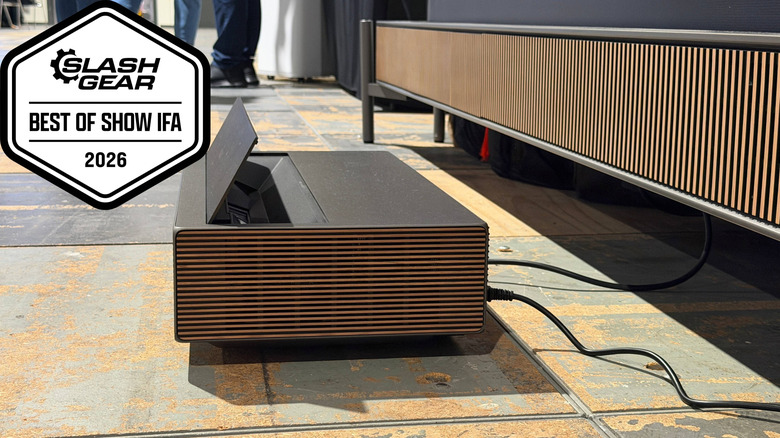
I've been a fan of Xgimi for quite some time, having reviewed more than a few of its projectors. The Xgimi Ascend Projector was one of my CES 2025 highlights, but the device on the floor in front of it, the Xgimi Aura 3 Max ultra-short-throw projector, was brand new at IFA this year. This projector can display up to a 120-inch image when set back just 8 inches from the surface it projects to, which is great.
The Aura 3 Max casts its image at 5,700 ISO lumens using a triple-laser RGB light source. It outputs 4K at 120Hz, with an 8000:1 contrast ratio. I had no trouble viewing the image even in a brightly-lit room, which is quite impressive for a projector. Of course, it helped that it was casting an image on the Ascend projector screen, which is purpose-built for projector images, instead of a blank white wall, for example. But even so, Xgimi projectors have been slouches there — brightness is king, and the Aura Max 3 carries on that trend.
The projector also comes with 80W of Harmon Kardon sound and plenty of ports for all of your devices. It has three HDMI ports, one of which supports eARC, one USB 3.0 port, and two USB 2.0 ports. You also get an Ethernet port alongside Wi-Fi connectivity. It runs on Google TV and has Netflix support out of the box. That last one isn't impressive in the grand scheme of things, but it's a recent development with Xgimi projectors. Overall, this is an impressive device that you can add to your living room.
PlantSenso Pro
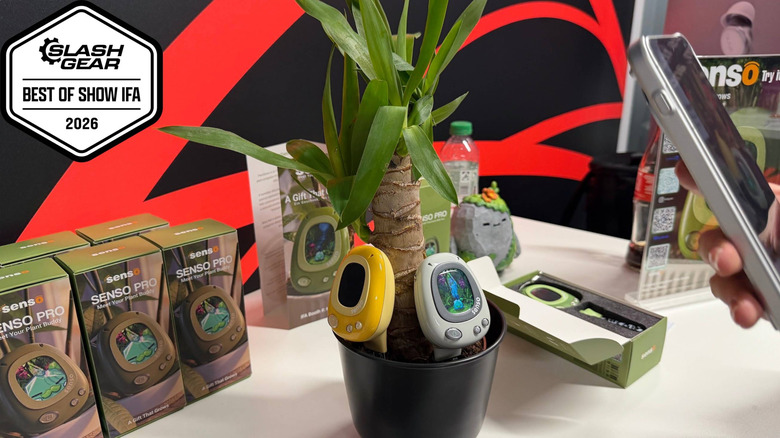
This adorable little device helps you grow plants via a Tamagotchi-like character that grows with your plant. The device has two spikes that stick into the dirt, combined with water, light, and temperature sensors to help keep your plant alive and thriving.
Take a photo of the plant, and the app will identify it, then load up the conditions the plant needs to grow. Your digital pet reflects these needs, using a chat box to tell you what to do. If it needs water, it'll tell you it's thirsty. If it needs more light, it'll tell you it's too dark. The character on the screen also shows you what's wrong. For example, if you gave the plant too much water, the character will be covered in water on the screen.
The device comes in green, grey, or yellow, and sells for $89.99. That might seem a little steep for a plant sensor, but the extra fun of the Tamagotchi-style digital pet might make it worth it. I think it's adorable, and I plan to get one for my wife, who likes to think she has a green thumb — even if our household plants disagree.
Honorable mentions from Motorola and N+
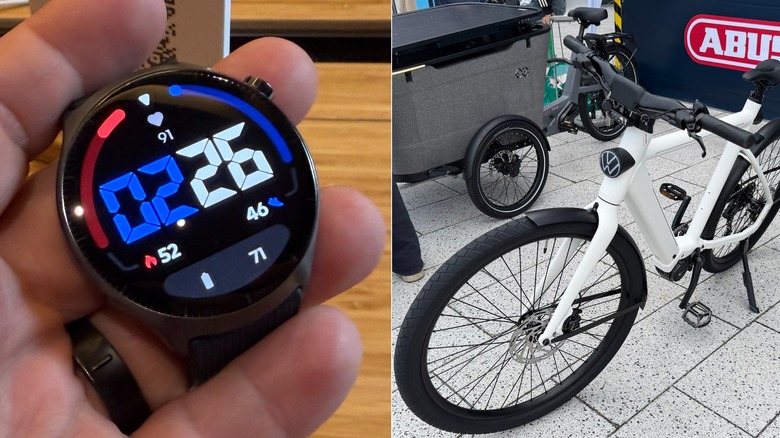
Finally, these two devices didn't quite do enough but deserve recognition nonetheless. The first is the Moto Watch Ultra. It's a pretty big watch — bigger than the Samsung Galaxy Watch 2 Ultra, in fact — running Wear OS. It looks like it shared a parts bin with the OnePlus Watch 3, sporting two buttons on the side and a domed OLED screen. Moto worked with Polar to handle its health tracking, which is great, but this watch can't offer the blood pressure and insulin tracking of Samsung's and Google's watches. Motorola is still a ways away from competing with the very best in the space, then, but it's still great to see this watch.
The other device is the N+ Volkswagen smart e-bike, which was at the show sans batteries due to a shipping faux pas. But the technology it promises — when it has power, that is — is very impressive. It has rear-facing radar, like the Segway Myon I reviewed, plus a rear-facing camera so you can see cars coming up behind you. The bike has all the usual indicators, including turn signals, and smart connectivity. One version has a range of over 200 km, or about 124 miles in pedal-assist-only mode on a single charge.
It also connects to a smart helmet and glasses. The helmet mirrors the turn signals on the bike's built-in LED lights, while the glasses provide a full-color HUD that displays your speed and navigation. It's an expensive bike at over $4,000 with all the bells and whistles, but it definitely offers an impressive array of tech.