

12 Classic RadioShack Electronics That Are Pure Nostalgia Today
We may receive a commission on purchases made from links.
For much of the late 20th century, RadioShack was one of the most popular stores to purchase all kinds of components, gadgets, and gizmos. The retailer, owned by the Tandy Corporation, popped up all over the United States, and featured a plethora of popular products, from batteries to home computers, RC cars, and video game systems.
RadioShack spent a good chunk of its history as the best place for hard-to-find electronics, and as a result built up a great deal of nostalgia around its products. While the company has since fallen into decline financially and closed many of its locations, it's still around, though mostly outside of the U.S. Today, RadioShack has a large online retail space, where it sells tons of nostalgia-themed items. Despite the company's financial hardships, many people have fond memories of shopping at RadioShack, where plenty of parents scored holiday gifts for their children.
Looking back through the decades, some products truly stand out. These are the RadioShack exclusive items that couldn't be found anywhere else, and much of what RadioShack sold included good, long-lasting items. Each of these is a nostalgic reminder of the 20th century's best electronics store, and they're arranged in chronological order from when they first hit store shelves, beginning in the 1970s.
TV Scoreboard
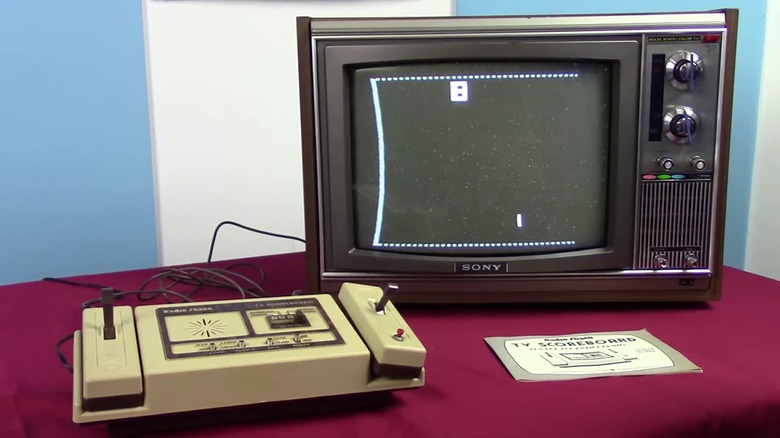
In 1975, Atari teamed up with Sears to release the "Pong" Home Console, an incredibly popular home video game system that let people enjoy the arcade game at home. It took almost no time for "Pong" clones to flood store shelves, and over at RadioShack, that took the form of the TV Scoreboard. Like many RadioShack devices, Tandy made the TV Scoreboard, and it offered a bit more than the competition, namely in the form of additional games.
The TV Scoreboard came with two controllers with paddles or dials. Players could fire up the "Pong" clone or play a shooting game using controller attachments similar to what's available for the Nintendo Switch and Switch 2's controllers. The TV Scoreboard supported 10 games, including "Motorcycle," "Motocross," "Drag Race," "Hockey," "Squash," and "Tennis," among others, and players could mess with the difficulty via manual switches.
RadioShack began selling the TV Scoreboard in 1976, less than a year after the "Pong" Home Console launched. It remained available into the early '80s, but was supplanted when the first generation of video game consoles gave way to the second. It's unclear how popular the TV Scoreboard system was, but being from Tandy, it was sold exclusively at RadioShack, which sold it in a six-game version for $29.95 and a four-game one for $19.95 ($175 and $120 in 2026 dollars, respectively).
Duōfone Telephone Answering System
These days, calling someone and being able to leave a message on their voicemail is a ubiquitous feature of cellphones. Back in the analog days, leaving messages typically meant telling your friend's mom that you called, but it wasn't like that for everyone. Answering machines were common throughout the late 20th century, beginning with analog tapes before making the switch to recording voice messages on digital memory.
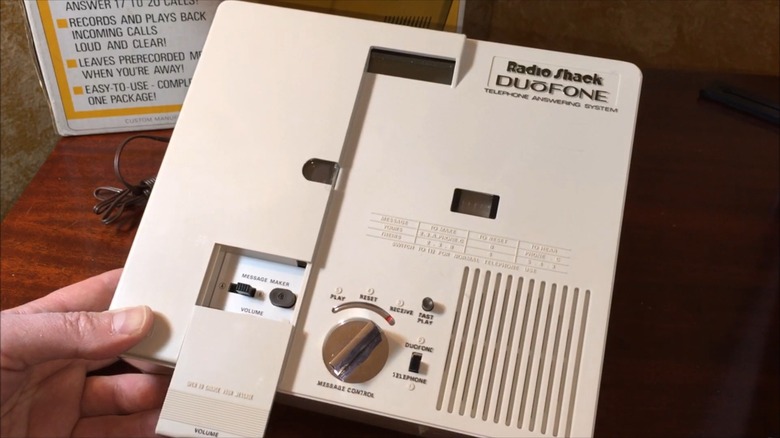
The Duōfone Telephone Answering System released in 1975, and if you had one, you were the envy of your peers. RadioShack sold the answering machine for $79.95 ($500 in 2026), and it could answer up to 20 incoming calls, playing back a 15-second message of your own. Callers could leave a 30-second message, which could be easily played back through an onboard speaker.
The Duōfone was also battery powered, so it would keep working during power outages, which was certainly useful. Believe it or not, this wasn't the first answering machine; far from it. The technology dates back to a 1935 patent for the Tele-Phonograph. The first commercial device made available in the United States was the Ansafone, released in 1960. Still, it was the Duōfone that drove sales for RadioShack, and it's a classic piece of tech that's closely associated with the brand.
Tandy TRS-80
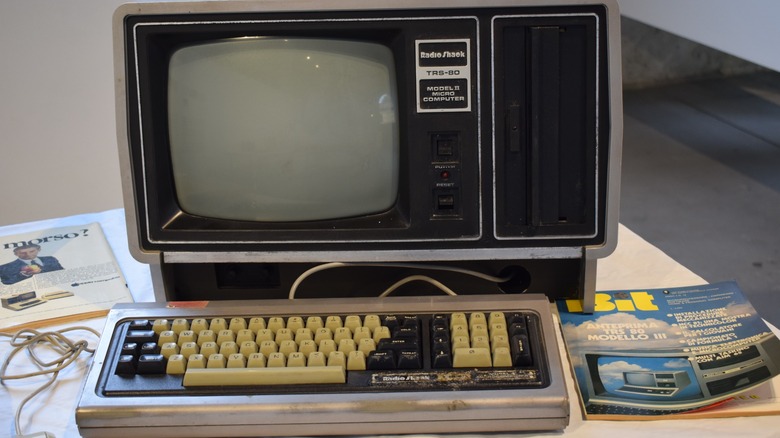
Another RadioShack exclusive device was the Tandy TRS-80, a home computer released in 1977. It is among the so-called "Holy Trinity" of home computers alongside the Apple II and Commodore PET, though RadioShack only sold the TRS-80 in its stores. Compared to today's systems, it's a dinosaur, but for the time, the TRS-80 was an exceptional system that introduced home computers to millions of people. It used a Z80 processor, 4 kB of DRAM, and Level I BASIC as its programming language.
Compared to the Apple II and Commodore PET, the TRS-80 was relatively inexpensive, costing $599.95 upon release. That might sound like an inexpensive computer, and it is by today's standards, but adjusted for inflation, that comes out to around $3,300 in 2026. The computer itself was contained within the keyboard, so adding a disc drive, printer, or anything else required the purchase of the Expansion Interface, which reduced the overall cost a bit.
Like its counterparts, the TRS-80 was among the most influential pieces of tech to come out of the '80s, as it was continuously upgraded with new models well into the decade, with the TRS-80 Model III in 1980, and the Model 4 in 1983, which premiered alongside the Model 100, which was an early portable, not quite "laptop" computer. The TRS line ended in 1985 with the TRS-80 Model 600, but Tandy continued releasing computers after that.
Monkey See
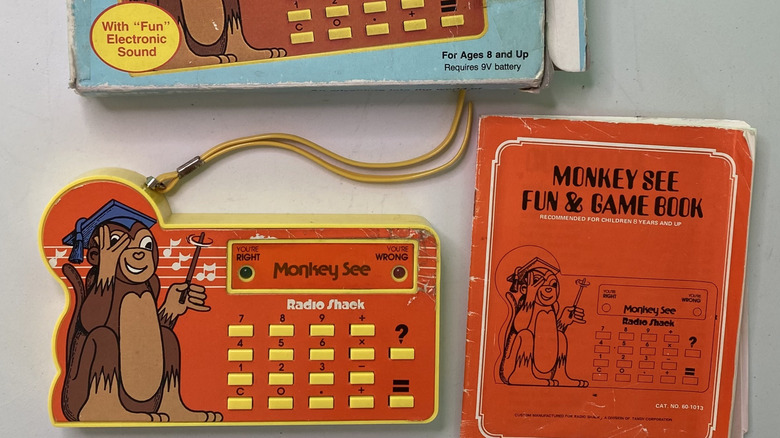
Many decades ago, if you needed a calculator, you got it at your local RadioShack. The company sold all kinds, from standard devices used for the basics to more complex graphing calculators. It also sold a line of calculators aimed directly at children called Monkey See. This was a sort of math game that utilized a calculator to teach children basic arithmetic.
RadioShack began selling Monkey See in 1977, and in the years that followed, the system became more advanced in subsequent models. The Monkey See would play sounds and light up LEDs to indicate whether or not an entered answer was correct. RadioShack also sold a similar device manufactured by Texas Instruments called Heathcliff Math. This was essentially the same type of device, but outfitted with graphics from the "Heathcliff" comic strip.
As far as the Monkey See system, it started out in the late '70s in a portrait format, while subsequent editions shifted to landscape. When you answered correctly, the "You're Right" light would turn on, while an incorrect response would fire up the "You're Wrong" light. Tandy produced the Monkey See line, which continued popping up on RadioShack store shelves for many years throughout the early 1980s. Eventually, Tandy moved on to other types of educational toys for children, thanks to improvements in technology that enabled more functions.
Armatron
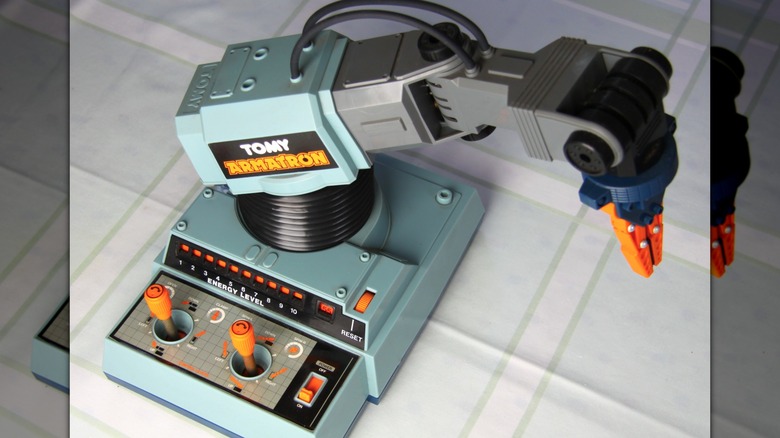
RadioShack sold a lot of toys over the years, and while it moved all kinds of RC vehicles, most were actually educational products. This was a common theme throughout RadioShack's existence, and one of the more popular options was the weird 1980s gadget known as the Armatron, first sold in 1984. For only $31.95 ($103 in 2026), parents could purchase a robotic arm meant to pique a child's interest in engineering.
Outside of that, the Armatron was a fun toy kids could use for a variety of things, from annoying a sibling to picking up a nearby object. It was controlled by two joysticks, enabling forward, backward, and side-to-side movement. Additionally, the grip could pick up, rotate, move, and release objects. It had a built-in energy level meter that could also function as a countdown timer to see who could manipulate objects the quickest.
Canisters, cones, and globe modules came bundled in, so you weren't limited to interacting with whatever was on hand at the time. The Armatron was a successful product for RadioShack, and it remained a staple of holiday sales. Subsequent models were called the Armatron II, Super Armatron, Mobile Armatron, and the Z-707 Iron Claw, which was an RC tank with a grip. Despite the different designs, the fundamental aspect of the toy's operation remained largely the same.
Robie Jr. & Robie Sr.
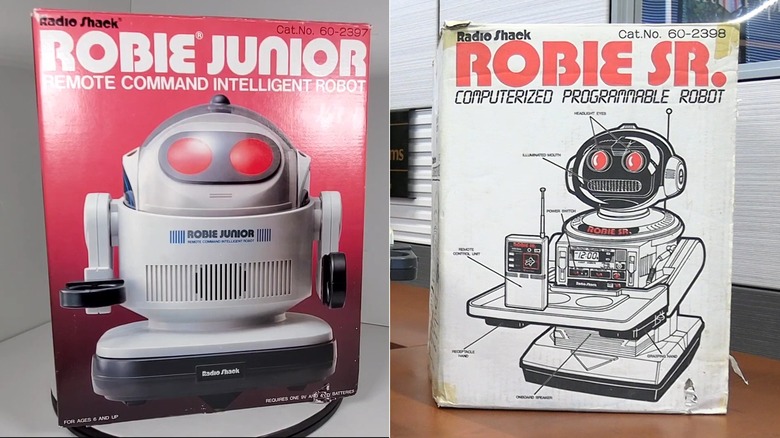
While a robotic arm is a fun toy, the absolute height of 1980s consumer robotics sold at RadioShack came in the form of the Robie Junior and Robie Sr. The first models were released in 1986, and both were licensed versions of Tomy Omnibot robots.
Robie Junior was the smaller of the two, and came with a remote control for issuing commands. It could roll about on its rubber tires and treads or sit there and look adorable with its big red eyes. The Robbie Sr. was larger and came in the form of a robot butler that sat atop your desk. Its arms could move and accommodated a removable serving tray you could put drinks on if desired.
The Robie Sr. also differed from its counterpart in that it was programmable, so you could come up with new things for it to do, once again meant to instil an interest in robotics and engineering. This was facilitated by a programmable cassette deck, which you could use to set the movements it made and the sounds it emitted. If you wanted, you could record your own voice and have Robie Sr. play it back for you. The Robie Junior cost $79.95, while the Robie Sr. cost $179.95 ($244 and $550 in 2026, respectively), putting them on the high end of toys that dads likely bought for themselves.
Illuma-Storm High-Energy Light Display
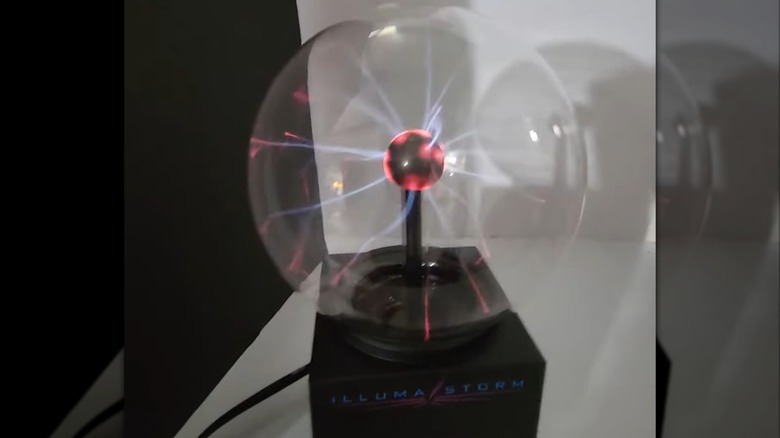
Back in the 1980s, you couldn't go to a local science museum without seeing some sort of plasma lamp. They were all the rage, showing up in movies and TV shows, but they were also relatively expensive and not many people had them. Nowadays, you can get a USB-powered one on Amazon fairly cheaply, but that wasn't the case in the '80s. Still, you could find them for sale in 1988.
RadioShack sold its Illuma-Storm High-Energy Light Display for $149.95 ($425 in 2026). While not cheap, there's no denying how cool it must have been to own your very own plasma lamp in the late '80s. The RadioShack catalog describes the lamp as being filled with a "mixture of very rare but safe gases." It came with a built-in microphone, so you could switch that on, and the plasma would dance around in response to voices or music it picked up.
This added an interesting interactive component outside of touching the glass to attract the plasma. Over the years, RadioShack sold various forms of these lamps, including the Illuma Storm Sound Reactive Lightning Simulator, which worked the same way, but appeared different. Because the plasma is generated towards the top of the globe, the plasma arcs down, looking like lightning.
Refrigerator Pig
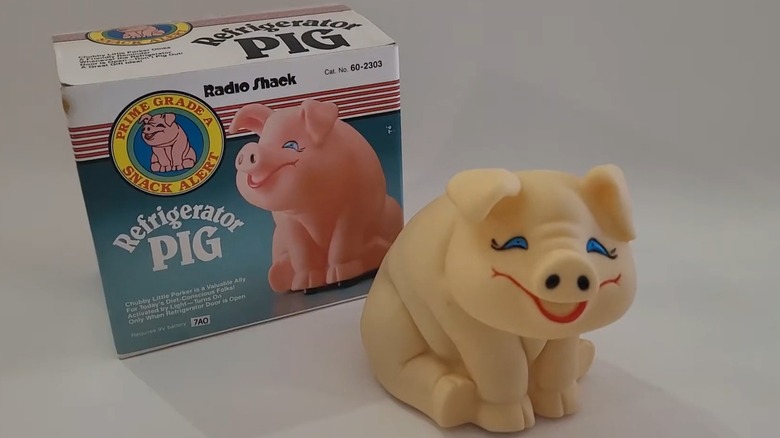
One of the weirdest products consumers could find at their local RadioShack in the 1980s and '90s was the Refrigerator Pig. This small pig-shaped device sat in your fridge waiting for you to open the door. When you'd wake up at 3:00 am wanting a late-night snack, you'd have to face the Refrigerator Pig's judging sounds, as it oinks at you whenever the door opens.
Basically, it's an annoying device meant to remind you that you skip that slice of cheesecake and go back to bed. The Refrigerator Pig was powered by a 9-volt battery and could hold a charge for a long time. It turned on when the light did, though you could move its tail to block the light sensor. Doing so would stop the pig from oinking at you repeatedly, but then all you had was a judgmental plastic pig that sat there doing nothing each time you opened the fridge.
The oink sound the device made wasn't particularly good, but it got its message across. It also sounded eerily similar to the noise the alien ships make in "Space Invaders," but that's probably a coincidence. RadioShack sold the Refrigerator Pig for around $12.95 in 1989 ($35 in 2026), and it was a staple of the company for several years.
PocketVision 22 LCD Color TV
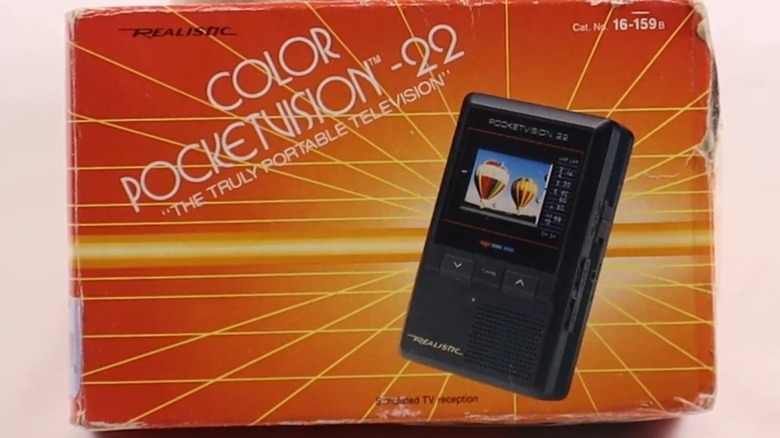
One of the more popular pieces of technology sold at RadioShack in the late '80s and throughout the 1990s was the PocketVision line of portable televisions. These were handheld devices with small screens, averaging only 2 by 2 inches in most models, that played analog broadcast television. One of the more popular models was the PocketVision 22 LCD Color TV, and if you had one of these, you probably used it to watch football or other sporting events while on the go.
RadioShack began selling this model in 1989 for $199.95 ($540 in 2026), making it a premier item not many could afford. Today, we take mobile broadcasts for granted, as it's incredibly easy to pull up a streaming service or watch pretty much whatever you want on your cellphone. That wasn't the case in '89, and it wouldn't be for some time. RadioShack sold PocketVision devices throughout the decade, and they were incredibly popular.
The PocketVision 22 featured a 2-inch color LCD screen, and it boasted digital-electronic tuning. You didn't have to muck about trying to settle on a frequency because, at the push of a button, the PocketVision 22 automatically scanned for up to 69 channels of VHF and UHF television signals. It required four AA batteries to operate and included an external telescoping swivel rod antenna and a leatherette carry case.
Go-Anywhere Transportable Cellular Telephone
Cellphones are ubiquitous nowadays, but prior to the 21st century, only the richest of the rich could afford a cell phone. Sure, there were car phones and different types of mobile phones, but they mostly looked like big black bricks, rather than the latest iPhone.
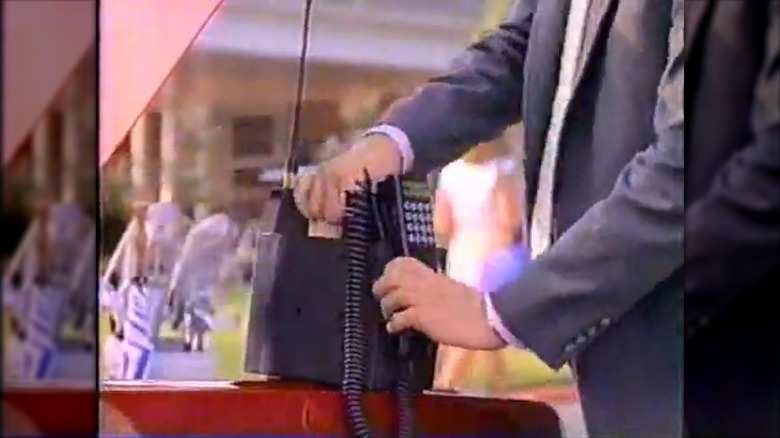
RadioShack sold a lot of cellphones over the years, including the "Go-Anywhere" Transportable Cellular Telephone in 1989. The so-called "Affordable, Transportable" phone wasn't exactly a cellphone, nor was it a car phone because it was both. It sold for $999.99 ($2,700 in 2026), so it was certainly a high-end item. It's listed in the RadioShack catalog as being easily convertible from a mobile phone into a full 3-watt transportable. It worked wherever cell service existed, which wasn't as robust in '89 as it is these days.
The phone stored up to 98 numbers, had adjustable volume, so-called "on-hook" dialing, and came with an attached box sporting a handle and its own antenna. It's unclear how much the service cost, but, like with today's phones, you needed to pay a monthly or per-minute rate to use it. In one analysis, if you spend $75 per month today, that would likely equate to more than $200 in 1989 ($540 in 2026), reducing the number of customers who could afford such a phone.
4.5 B&W TV with AM/FM Radio and Cassette Recorder
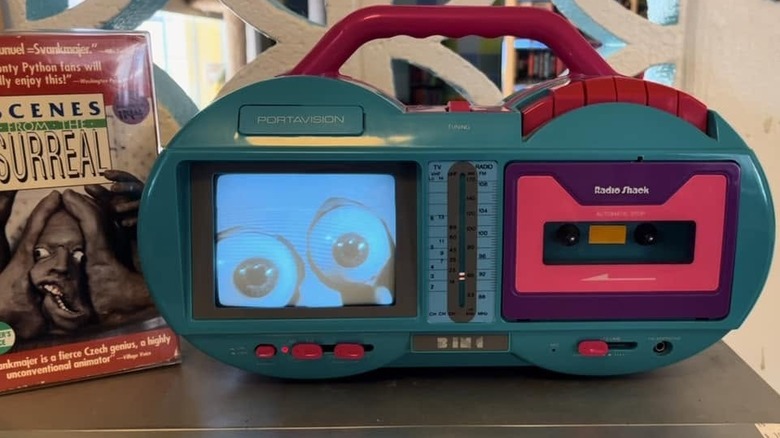
One of the most common products seen in RadioShack throughout the 1980s and '90s was the boombox. These are likely unknown to anyone born in this century, but for most people, it was a statement of pride to carry around the biggest boombox they could find. While there are plenty of old models to choose from, the PortaVision line included boomboxes that could be found only in RadioShack, and they were incredibly advanced all-in-one entertainment systems.
The 4.5-inch B&W TV with AM/FM Radio and Cassette Recorder did precisely what its name implies: it's a television, AM/FM radio, and a cassette recorder. It cost $119.99 in 1995 ($265 in 2026), and was decked out in blue, pink, and purple colors. The cassette recorder could copy whatever was playing on the radio or television.
While it included its own speaker, you could easily plug in your favorite pair of headphones to listen to something in private. Unsurprisingly, like most boomboxes of the era, this thing consumed batteries like they were going out of style. It required 10 D batteries, though it came with a standard AC adapter as well as a 12VDC adapter you could plug into your car's cigarette lighter (when cars still had them). If you had one of these as a kid, you were the envy of everyone around.
Electronics Learning Lab
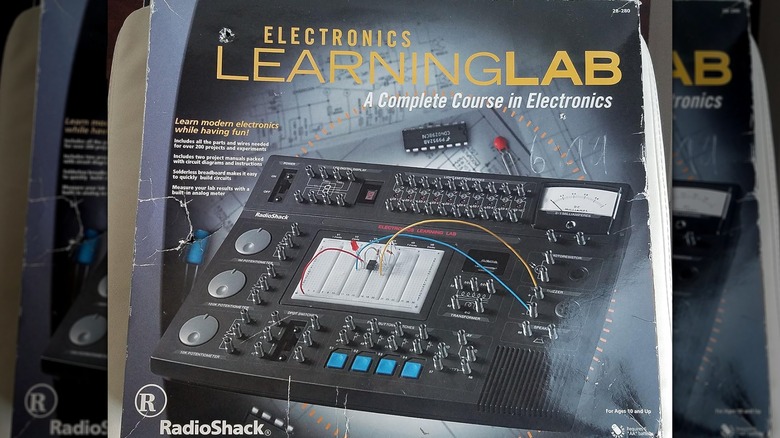
Of all the educational toys RadioShack sold over the years, its popular line of learning labs stuck around the longest. RadioShack began selling what it called its Science Fair line in the 1960s, and it produced new models every year, upping the systems' capabilities and the number of functions they could perform. These were safe kits designed for children to learn about electricity and how it functions, and it eventually evolved into the Electronics Learning Lab.
These first surfaced in the late 1990s and early 2000s, offering several hundred functions on a breadboard electronic project kit. The primary feature that likely enticed parents was the absence of soldering. Instead of using liquid metal to bond wires, connections could easily be slotted into place via springs. Some of the kit's functions included a battery checker, a burglar alarm, a motion detector, and a Morse Code transmitter.
The Electronics Learning Lab could also produce electronic animal sounds, sirens, movie sound effects, and it even had a plant growth stimulator. All it required was six AA batteries, so it didn't pull energy from an outlet, further reducing the potential danger of a shock. These kits and the ones that came before were incredibly popular for decades. It's likely that many electricians and engineers got their start sitting down and playing with a RadioShack Science Fair kit long before attending school to learn their trade.