

5 Of The Cheapest Body-On-Frame SUVs You Can Buy In 2026
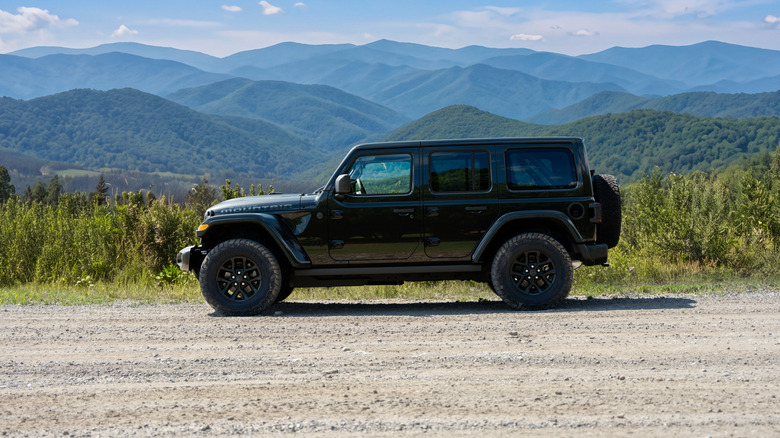
Body-on-frame construction refers to vehicles made of two separate parts: the frame and the body. An SUV's sturdy steel frame has the engine, transmission, suspension, wheels, and tires installed into it, while its body sits on top of the frame and is supported by it. Back in the day, nearly all vehicles were body-on-frame, but today unibody construction is the norm for cars and some SUVs. And while there are some downsides of body-on-frame SUVs, there are also many benefits to this type of construction over that of its main competitor, unibody construction.
Particularly important for SUVs that venture off the road, body-on-frame constructions are strong and rugged, which makes them more resistant to the twisting forces that can act on the vehicle while traversing obstacles and uneven trails. Body-on-frame vehicles also usually have more ground clearance because they sit higher off the ground, which comes in handy during off-road activities. In addition, the inherent strength of body-on-frame vehicles makes them better suited for towing and hauling heavy loads.
Of course, body-on-frame vehicles are not perfect, as evidenced by their negative qualities. They tend to be more expensive, heavier, and larger than unibody vehicles. As a result, they will usually have poorer fuel economy, cruder handling qualities, and less interior space compared to their exterior size than unibody SUVs. Let's now explore some of the cheapest body-on-frame SUVs you can buy.
Chevrolet Tahoe — $63,495
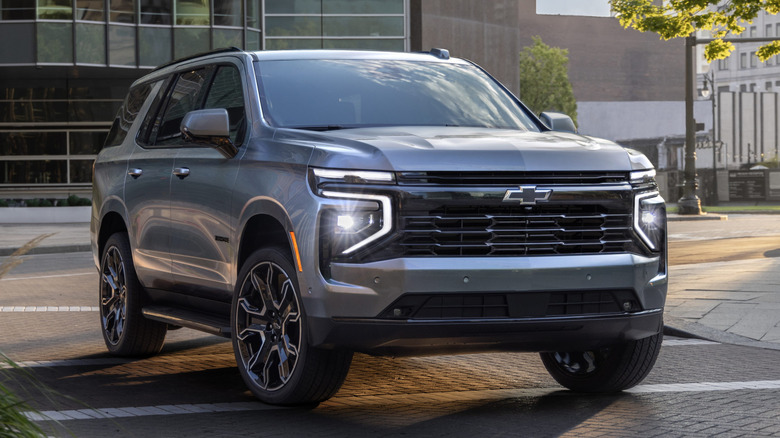
The 2026 Chevrolet Tahoe is the smaller option compared to Chevrolet's other full-size SUV the Suburban. The Tahoe has been around since the 1992 model year, introduced as a shorter version of the Suburban, offering either two or four doors. Today, only the four-door remains. One of our articles on this vehicle has focused on the Chevy Tahoe engine you should steer clear of.
The 2026 Chevrolet Tahoe lineup starts with the Tahoe LS with rear-wheel drive. The Tahoe LS is powered by a 5.3-liter V8 engine that produces 355 hp that is connected to a 10-speed automatic transmission driving the rear wheels through a mechanical limited-slip differential. A larger 6.2-liter gas V8 with 420 hp is also available, as is a 3.0-liter turbodiesel inline-six with 305 hp, depending on trim level. The Tahoe's performance was tested by Car and Driver and generated a 0-60 mph time of 6.7 seconds with the standard engine and 5.8 seconds with the bigger V8, which also did a quarter-mile time of 14.3 seconds at 98 mph.
Pricing of the Chevrolet Tahoe LS with rear-wheel drive starts at $63,495 including destination. Add $3,000 for four-wheel drive. Standard equipment inside includes cloth front buckets with power adjustment, center console, tilt/telescoping steering column with steering-wheel controls, 17.7-inch LCD with Google built-in, keyless open, remote start, adaptive cruise, USB ports throughout, tri-zone climate control, wireless Apple CarPlay and Android Auto, and Wi-Fi hotspot. External features include 18-inch aluminum wheels with all-season tires, trailer sway control, and external oil and transmission coolers.
Nissan Armada — $61,085
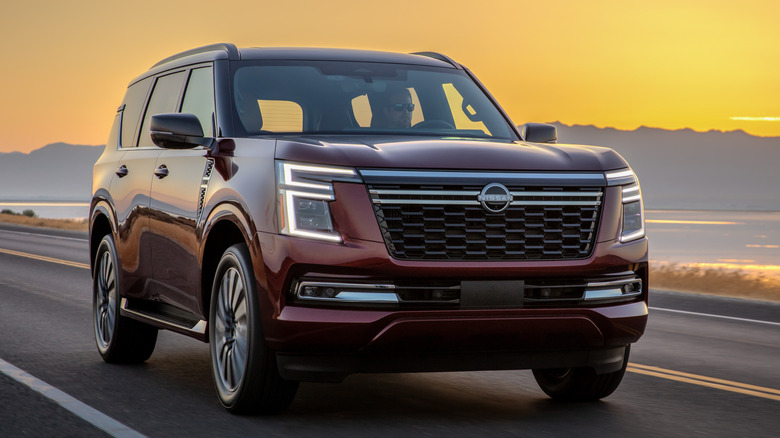
The 2026 Nissan Armada is a larger body-on-frame vehicle that comes only as a four-door SUV. The lowest rung on the Armada pricing ladder is reserved for the Nissan Armada SV with rear-wheel drive. The Armada has been in the Nissan lineup since 2004, when it debuted as the Pathfinder Armada. Our review of the current Nissan Armada led us to believe in its strengths — it is powerful, comfy, and quick.
The Nissan Armada SV, as well as all other Armadas with the exception of the high performance Nismo model, is powered by a 3.5-liter twin-turbocharged V6 engine with an output of 425 hp (the Nismo is boosted to 460 hp). The V6 is mated to a nine-speed automatic transmission, driving either the rears or all four wheels. An Armada that was tested by Car and Driver put down a 0-60 mph time of 6.1 seconds, with the quarter-mile going by in 14.5 seconds at 98 mph.
Pricing of the Nissan Armada SV with rear-wheel drive starts at $61,085 including shipping, with an upcharge of $3,000 if you wish to add four-wheel drive. The standard equipment list on the Armada SV includes interior items like leatherette seats, tri-zone automatic temperature control, 12.3-inch touchscreen display, wireless Apple CarPlay and Android Auto, six-speaker audio system, reconfigurable LCD instrument cluster, illuminated steering wheel-mounted audio controls, rain-detecting wipers, adaptive cruise control, USB ports, keyless entry, and push-button start. On the outside, you get 18-inch alloy wheels, rear privacy glass, LED headlights and taillights, fixed running boards, and an integrated roof antenna.
Toyota 4Runner SR5 — $43,865
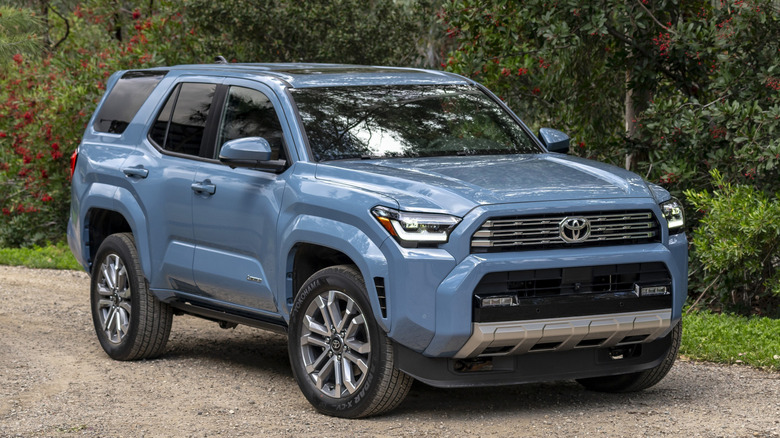
The 2026 Toyota 4Runner comes in many different trim levels, of which the SR5 is the entry-level version. The Toyota 4Runner has been around since 1984, when it started out as a pickup truck with two solid axles that had a rear seat added and a removable cap over its bed. Fast forward to today, and our review of the latest 4Runner found that this body-on-frame vehicle almost offers too many choices.
The Toyota 4Runner SR5 comes with rear-wheel drive as standard, while part-time 4WD is a $2,000 option. The standard engine is a 2.4-liter turbocharged inline four-cylinder engine that produces 278 hp, mated to an eight-speed automatic transmission. There is also a hybrid powertrain on six trims, which takes the same four-cylinder turbo and electrifies it, boosting output to 326 hp. With the non-hybrid, the 4Runner gets from 0-60 mph in 7.5 seconds, according to Car and Driver, while the hybrid improves it to 6.7 seconds. Quarter-mile times are 15.7 seconds at 90 mph for the non-hybrid and 15.3 seconds at 88 mph for the hybrid, showing a smaller difference at higher speeds.
Selected standard equipment inside the 4Runner SR5 includes cloth seats, leather-trimmed tilt/telescopic steering wheel with audio controls, eight-speaker audio system, digital gauge cluster, push button start with remote keyless entry, single-zone climate control, eight-inch multimedia display, and electric parking brake. Outside, there are 17-inch painted alloy wheels with all-season tires, LED headlights, taillights, and fog lights, rear spoiler with concealed rear wiper, integrated towing receiver hitch and wiring harness, and heated power outside mirrors.
Ford Bronco — $42,790
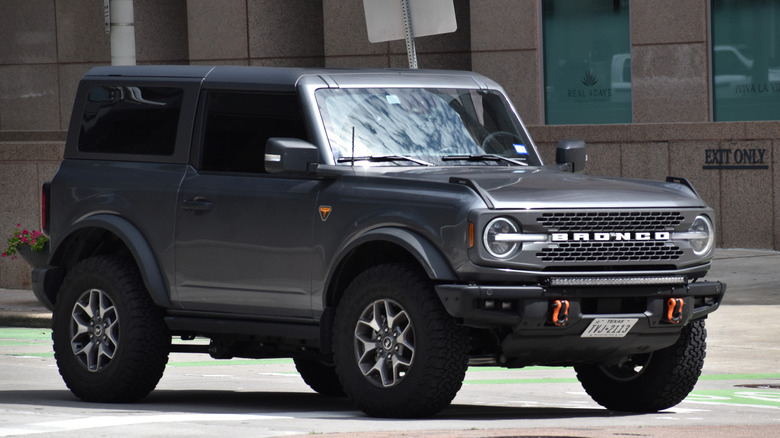
The latest version of the Ford Bronco, whose origin story goes all the way back to 1966, has been in production since the 2021 model year. It comes in both two-door and four-door versions, which are priced exactly the same for those trim levels that offer both styles. Our review of the Ford Bronco showed that its appeal goes beyond nostalgia.
The 2026 Ford Bronco offers a standard 2.3-liter EcoBoost turbocharged inline four-cylinder engine that produces 300 hp, mated to a seven-speed manual transmission that sends its power to all four wheels. A larger 2.7-liter turbo V6 is an option, as is a 10-speed automatic. In instrumented testing performed by Car and Driver, the Ford Bronco managed a 0-60 mph run in 7.4 seconds with the manual and 7.1 with the automatic, while the optional engine with the mandatory automatic did it in 6.2 seconds. The standard engine with the automatic did the quarter-mile in 15.7 seconds at 85 mph.
Pricing for the base Ford Bronco, in either two-door or four-door versions, starts at $42,790 including destination charges. For that price, you get LED headlights, automatic high beams, a hard top and doors that are removable, heated sideview mirrors, 16-inch polished steel wheels, and 30-inch all-season tires on the outside. Inside, standard equipment includes single-zone climate control, carpeting, USB charging ports, remote keyless access, seven-speaker stereo with subwoofer, 12-inch center display screen, cloth seating, electric parking brake, tilt and telescoping steering column, 4G modem, wireless Apple CarPlay and Android Auto compatibility, and terrain management system with five G.O.A.T. modes.
Jeep Wrangler — $38,030 for the two-door, plus $3,005 for the four-door
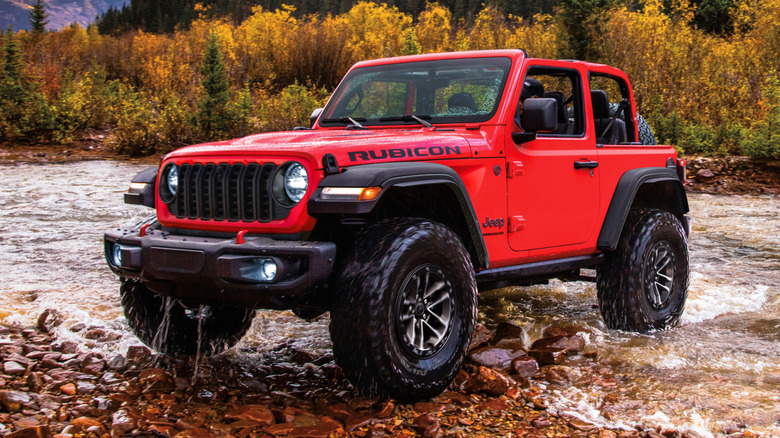
The 2026 Jeep Wrangler has a significant price differential between its two-door and four-door variants, so we will focus on the two-door Sport as the lowest-priced Wrangler. The Wrangler traces its origins back to the original Willys MB World War II Jeep of the 1940s. And while many improvements have come in the ensuing decades, our first drive of the latest generation of Wranglers indicates that it retains its Jeep-ness.
The basic Wrangler Sport comes equipped with a standard 3.6-liter V6 that makes 285 hp, sending its power through a six-speed manual transmission to all four of its wheels. An eight-speed automatic is optional, as are a turbocharged inline-four with 270 hp, and a big 6.4-liter V8 putting out 470. Performance testing by Car and Driver produced 0-60 mph times of 6.1 seconds with the Wrangler Sport's standard powertrain, going down to 4.0 seconds with the big V8. The Wrangler Sport went on to do the quarter-mile in 14.9 seconds at 90 mph.
Pricing for the Jeep Wrangler Sport two-door starts at $38,030 including destination charges. That will get you the mechanical benefits of the Command-Trac part-time 4WD system, fuel tank skid-plate shield, engine oil cooler, transmission skid-plate, transfer case skid-plate shield, and 17-inch black steel wheels with all-season tires. Outside, there's a black Sunrider soft top, solar glass, molded fender flares, and a "Trail-Rated" badge. Inside the Wrangler Sport, you get cloth bucket seats, air conditioning, folding rear seat, 12.3-inch touchscreen display, remote keyless entry with push-button start, 4G hot spot, plus Apple CarPlay and Android Auto.