

Gullwing Doors Look Slick, But They're Uncommon For A Reason
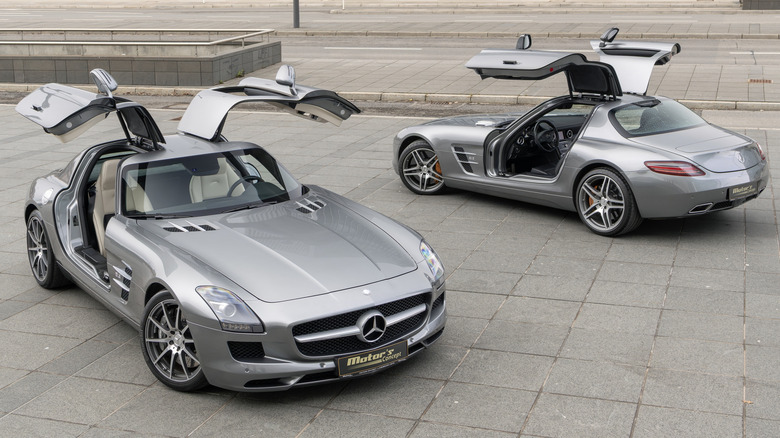
Gullwing doors make a potent visual statement, and although a number of cool cars have them, there are a number of reasons gullwing doors haven't be widely adopted and aren't likely to show up on, say, a Toyota Corolla. For one, they require more complex engineering. In addition to requiring a hinge-and-strut combination that can move and safely keep the door overhead, they also require more complicated weather sealing than a regular car door. Manufacturers also have to include an emergency release mechanism in case the car rolls or ends up on its roof. All of that adds to the cost of production, which is why gullwing doors are more common on sports cars, supercars, or concept cars.
Depending on their dimensions, gullwing doors can also pose a problem in tight parking spots or under low ceilings, as they may create a wide arc when opened. Tesla aimed to solve this problem with the Falcon Wing doors on its Model X by double-hinging them. Instead of only having a hinge at the top, Model X doors have a second hinge halfway up. This allows the doors to open in narrow spaces, while an array of sensors stop them from hitting low ceilings or adjacent walls, vehicles, or people.
Born of necessity, but still largely a novelty
When designing the Mercedes-Benz 300SL (first released in 1954) the German carmaker's engineers were faced with a problem: The car had a tubular chassis modeled on the W194 race car. The door sills were so high that regular doors were both impractical and potentially unsightly, neither of which were compromises the designers wanted to make on a vehicle intended to be luxurious and highly desirable. The solution was to make the doors open upward instead, and the result was a striking and unique silhouette that instantly turned the 300SL into a design classic. This inspired other carmakers to toy with gullwing doors on cars like the 1974 Bricklin SV-1, one of the worst sports cars ever made, and the 1979's Aston Martin Bulldog.
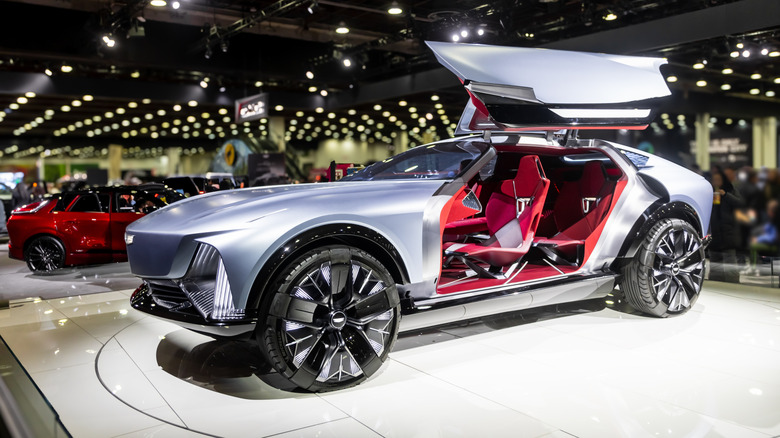
Tesla's choice to include a similar door design on the Model X was borne out of pragmatism. Falcon doors make accessing the second and third row of seats easier, but the company has faced numerous reliability issues with the Model X, which includes the doors. Nonetheless, the Model X is the only EV SUV in production in the U.S. to include vertically opening doors. The Cadillac Elevated Velocity Concept and Nissan Hyper Adventure Concept both include them, but they're not slated for production. Meanwhile, Chinese automaker GAC makes an EV SUV called the Hyptec HT that looks just like a Tesla, and the six-year-old Chinese startup, HiPhi, makes a gullwinged crossover of its own called the X.