

5 Of The Fastest Compact Cars You Can Buy
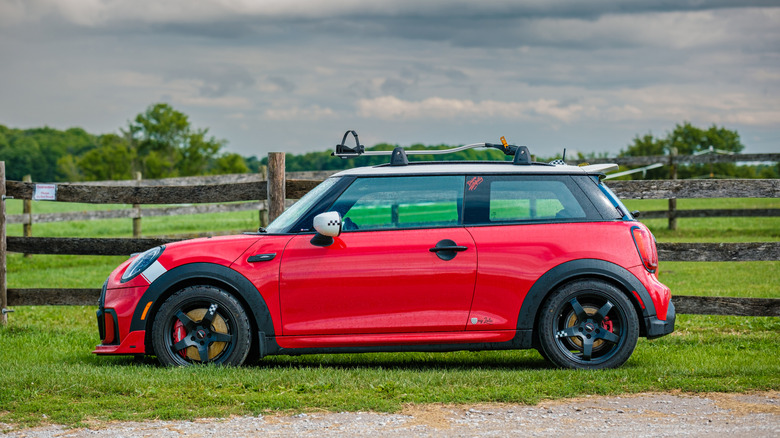
Sometimes less really is more. A car that weighs less doesn't just accelerate quicker for the power it's got — it stops shorter, changes direction faster, and generally feels more alive doing it, because there's less mass to manage every time you turn the wheel or stab the brakes. That's a lesson a lot of bloated modern performance cars seem to have forgotten, chasing bigger numbers on a spec sheet instead of a smaller number on the scale.
Although power and speed go hand in hand, a modest little engine bolted to a diet-conscious chassis can often embarrass something packing many more horses. Compact cars are built for this fight. Cut the excess sheet metal, ditch the plush interior padding, shrink the frame down to something sensible, and suddenly every drop of fuel is worth a lot more.
Some compact cars aren't just light — they're properly powerful on top of it, packing enough output to embarrass cars two or three classes above them on paper. Forget what the brochure says — these cars prove fast isn't about how much power you've got, it's about how little you're carrying around while you use it. Sometimes, in those perfect circumstances, it's about both. Here are some of the fastest compact cars you can buy.
BMW M2 CS
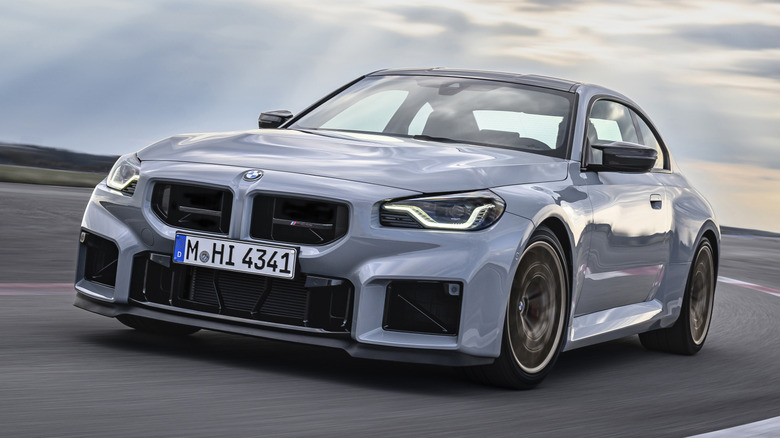
The BMW M2 in its standard guise uses an S58 3-liter inline-six engine you typically find in its bigger and more powerful brothers, the M3 and the M4. Power-wise, the regular M2 pushes out 473 horsepower and 443 pound-feet of torque, numbers that already put it ahead of plenty of cars a full class above it. The BMW M2 CS, one of the best cars to come out in 2026, pushes those numbers even further.
BMW rates the M2 CS at 530 horsepower and 479 pound-feet of torque, a jump of 50 horsepower and 36 pound-feet over the standard automatic M2, all of it sent to the rear wheels through an eight-speed automatic — no manual is offered on the CS. BMW claims a 0-60 mph time of 3.8 seconds and a top speed of 188 mph. Independent MotorTrend testing has clocked the quarter-mile time at 11.2 seconds at 127.1 mph and the 0-60 mph at Car and Driver was clocked at just 3.3 seconds.
BMW also used the M2 CS to set a Nürburgring Nordschleife lap record for its compact class, running a 7:25.5 lap around the Green Hell, a time that beat the previous record by eight seconds. For a spot of context, a 7:25 is within a second of the new Porsche Panamera Turbo S e-Hybrid, a car that pushes out 782 horsepower and 737 pound-feet of torque.
Audi RS3
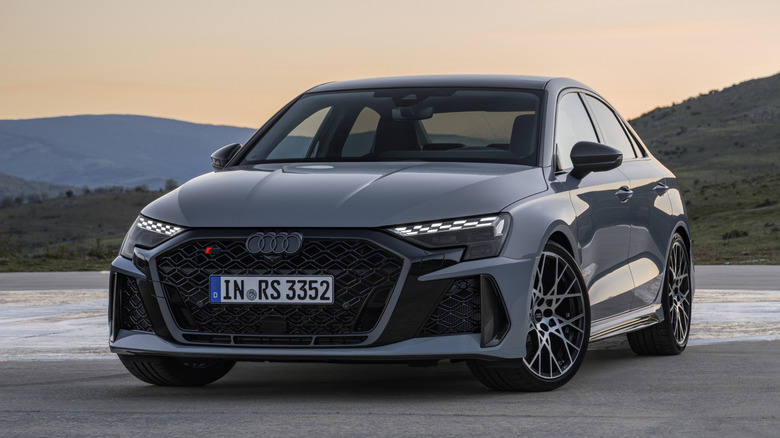
Audi's only U.S. compact car is now the A3 because the Audi TT was discontinued. The Audi RS3 shares its bones with the Volkswagen Golf R, riding on the same MQB platform, but Audi drops in something the Golf R doesn't get: a turbocharged 2.5-liter inline-five engine, often called, the baby V10. In U.S. spec, that engine makes 394 horsepower and 369 pound-feet of torque, sent to all four wheels through a seven-speed dual-clutch transmission and Audi's Quattro all-wheel-drive system with a rear torque-splitting differential.
That differential is the piece that separates the RS3 from a standard all-wheel-drive setup. Rather than simply splitting power evenly front to rear, it can send up to 100 percent of the rear axle torque to either individual rear wheel. This is a system Audi carried over from the previous-generation car and refined for this one. The result is a compact sedan that can be pushed into a drift on command, something not typically associated with all-wheel-drive Audis. Americans only get the RS3 as a sedan; Europe also gets a Sportback hatchback body style that will not be sold in the U.S.
Car and Driver's fastest tested RS3 ran 0-60 mph in 3.2 seconds and covered the quarter mile in 11.7 seconds at 118 mph. Top speed sits at 180 mph. On track, Audi sent the RS3 around the Nürburgring Nordschleife in 7 minutes 33 seconds, a lap that set the record for the compact segment at the time it was run (see BMW above), and one that came more than seven seconds quicker than the pre-facelift car's time on the same track.
Mercedes-AMG CLA 45 S
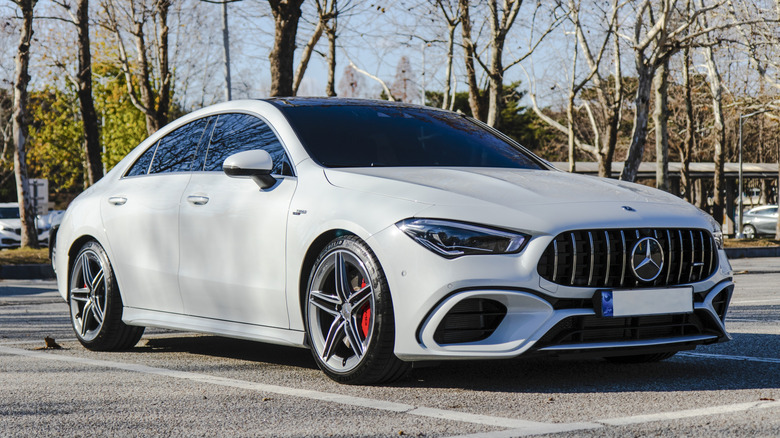
The outgoing CLA 45 S is powered by AMG's M139 engine, a 2-liter turbocharged four-cylinder that Mercedes calls hand-built, with each one assembled by a single technician who signs a plate on the engine when it's complete. It makes 416 horsepower and 369 pound-feet of torque, output that makes it one of the most powerful four-cylinder engines in series production, more per liter than many V6s and even some V8s manage.
Power goes to all four wheels through an eight-speed dual-clutch transmission and AMG's 4Matic+ system, which under normal conditions sends most of its torque to the front axle but can redirect up to 50 percent to the rear wheels for a more balanced, rear-biased feel in corners. The CLA 45 S also comes with a drift mode, which shifts torque distribution further rearward and loosens stability control to allow controlled oversteer, an unusual feature for a car that's front-wheel-drive-based underneath the AWD hardware.
Mercedes claims a 0-60 mph time of 4.0 seconds and an electronically limited top speed of 155 mph, but Car and Driver managed to clock a 3.7-second 0-60 mph time. Still, that's slower to 60 than the RS3 or M2 CS, but it's also the outlier on this list in another way: 2026 is the CLA 45 S's send-off year. Mercedes has just revealed the new, 680-horsepower all-electric CLA 45 AMG, and it should soon hit testing, and we'll see just how quick it goes.
Volkswagen Golf R
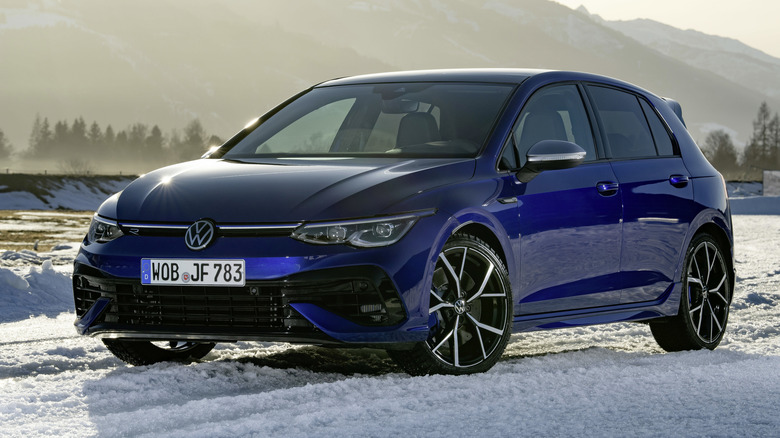
The Golf R gets its power from the same MQB platform as the Audi RS3, but where Audi drops in a five-cylinder, VW sticks with a turbocharged 2.0-liter four. That engine makes 328 horsepower and 310 pound-feet of torque, up 13 hp and 15 lb-ft over the prior model year. All of it goes through a seven-speed DSG dual-clutch transmission — VW discontinued the six-speed manual for this generation.
This decision was driven by low global demand rather than a performance shortfall, even though American buyers had been choosing the manual at a roughly 40 percent take rate across the GTI and Golf R lineup combined. When we drove the 2026 Volkswagen Golf R, we noted how the lack of the manual gearbox made it less of a hot-hatch, and more of a fast daily driver, something you don't necessarily want from a top-spec performance variant.
Either way, power reaches the ground through VW's R-Performance 4Motion all-wheel-drive system, which uses active torque vectoring on the rear axle to split power between the two rear wheels individually, not just between the front and rear axles. The system also underpins a dedicated Drift mode, one of several selectable drive modes alongside Eco, Comfort, Sport, Race, and Special.
Car and Driver's own long-term test car ran 0-60 mph in 4.0 seconds flat, quicker than VW's figure. Top speed sits at 155 mph, or 167 mph with the optional Performance Package, but a GPS-verified real-world run clocked a Performance Package-equipped Golf R at 172 mph. On a quarter-mile run, MotorTrend clocked the Golf R at 12.8 seconds at 108.7 mph.
Toyota GR Corolla
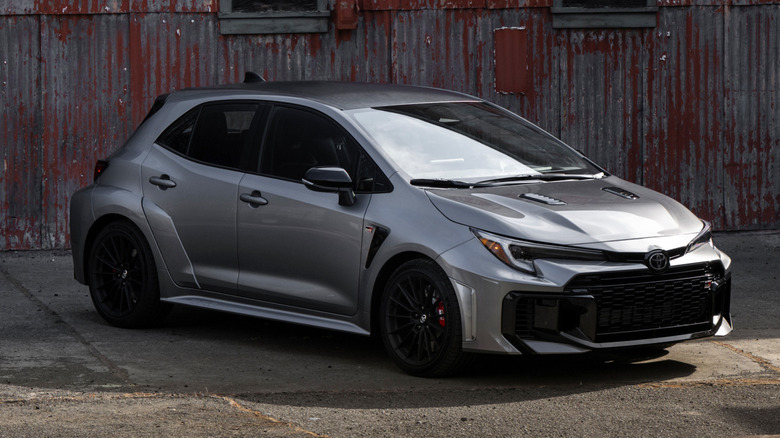
The GR Corolla is the only car on this list not built on a European platform — it's derived from the standard Corolla hatchback, and unlike everything else here, its engine only has three cylinders. That 1.6-liter turbocharged inline-three makes 300 horsepower and 295 pound-feet of torque, the lowest output of the group.
The GR drives all four wheels through Toyota's GR-FOUR system, with selectable torque-distribution modes: 60:40 front-rear for daily driving, 50:50 for maximum stability, and a rear-biased 30:70 for track use. Toyota offers both a six-speed manual and an eight-speed automatic, a rare pairing among modern hot hatches, most of which have dropped the manual.
Car and Driver's fastest tested GR Corolla, a Premium-trim car mechanically identical to the Circuit edition, ran 0-60 mph in 4.2 seconds and covered the quarter mile in 12.8 seconds at 108 mph. Top speed is electronically governed to roughly 143 mph.
Against the rest of this list, it's the slowest to 60, but the gap to the Golf R is under half a second — closer than the raw horsepower figures alone would suggest. When we reviewed the 2025 Toyota GR Corolla, we gave it a perfect ten out of ten because it is fast, fun, looks good, is practical, and handles beautifully.