

The 12 Most Innovative Main Battle Tanks From Every Generation
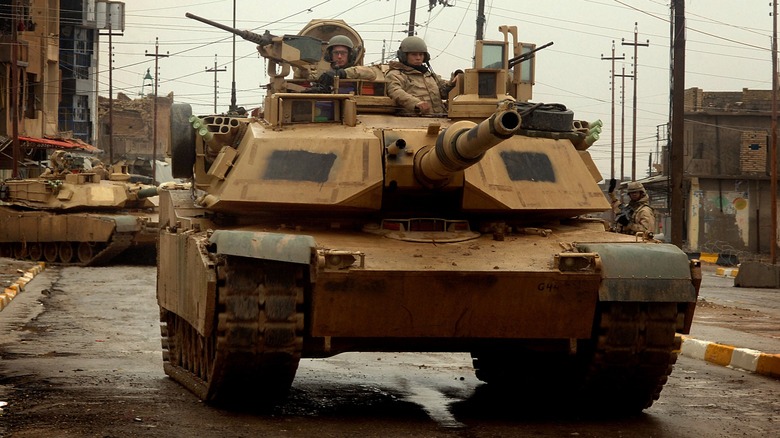
Tanks have been around since World War I, when Little Willie rolled out onto the battlefields of Europe. Since then, tank design has evolved considerably with different types of armor, larger and more accurate guns, better engines, and more. There are several types of tanks, ranging in size from weighing just a few thousand pounds to 70-plus tons. And after World War II, a new class of tank arose: the Main Battle Tank (MBT).
Generally, MBTs have several defining characteristics. They typically weigh between 40 and 70 tons, function as a universal tank, combining firepower and armor into a nearly unstoppable machine, and they are a primary offensive force of ground warfare. Since the first MBT, there have been four generations built by various nations all over the planet. Each new generation brought innovations in armor, guns, defenses, and more, making every new generation of MBT superior to its predecessors.
Nations that were hostile to one another, like the United States and Soviet Union, played a game of one-upmanship in tank design for decades. While there are dozens of examples covering over 80 years of tank history, only a handful offered true innovations that pushed tank and armor technology forward. These 12 MBTs all fit that description, and they're among the greatest tanks ever designed from each of the four MBT generations.
1st generation: FV4200 Centurion
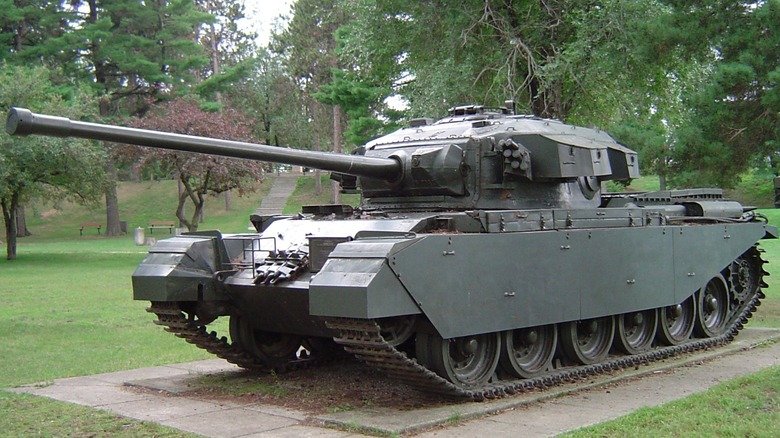
The first generation of MBT kicked off in 1945 with the FV4007 Centurion, one of the most important tanks in British military history. Being first earns it some recognition, but there are other reasons to note the Centurion. The tank was informed by lessons from WWII, where armies fielded different types tank designs across battlefields in Africa, Europe, and Asia. Initially, the Centurion was meant to participate in that conflict, but it wasn't completed in time.
The Centurion became the British army's MBT during the post-war period, and this so-called "universal tank" brought several innovations that became standard in the tanks that followed. The driver was placed in a supine position, allowing for the tank's forward hull to be lower and sloped. The Centurion also featured a mantletless turret in later variants.
When the British deployed this new type of tank, other nations began taking notes. Many of its design choices were emulated in both allied and hostile nations' militaries, making the Centurion an incredibly influential tank. Throughout its service life, which extends to today, the Centurion underwent several revamps and upgrades, building on lessons learned as tank design continued to evolve. While the British moved on years ago, South Africa continues to operate modified derivatives of the Centurion's design called the Olifant (The African Elephant).
1st generation: T-54/T-55
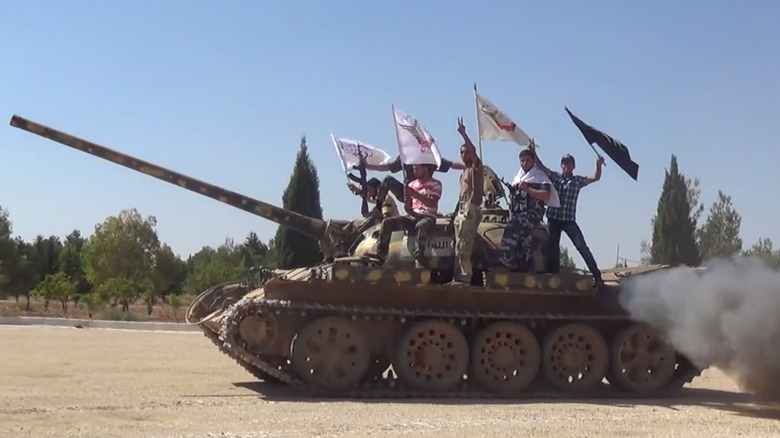
The Soviet Union saw the British Centurion and decided to create its first MBT, the T-54/T-55. The T-54/55 became the most-produced tank in history, with more than 100,000 having been built. Over 50 nations operated them, so it was also one of the most successful tank designs in history. Some have dubbed it "the AK-47 of tanks," due to its ubiquity.
While the T-54 is ancient compared to modern tanks, it's still in operation in Ukraine and elsewhere, making it one of the longest-serving tanks in history. The T-54 entered service for the Soviet Union in 1949, and by 1958, it received some modifications and upgrades to improve the survivability of its crew from nuclear attacks via the PAZ (Protivoatomnoy Zaschita, "Anti-nuclear protection") system. The two models are similar, which is why they're often grouped together.
Regarding innovations, the T-54/T-55 MBT was a medium tank, weighing in at 45 tons, but it packed a lot of firepower via its 100mm cannon. It also utilized relatively lightweight armor for protection, which was installed in a sloping configuration. The PAZ overpressure system offered significant survivability from nuclear attacks, and the tank was outfitted with infrared vision, enabling better operation at night. Another significant innovation was the tank's snorkel, which enabled it to cross rivers completely out of sight.
1st generation: M48 Patton
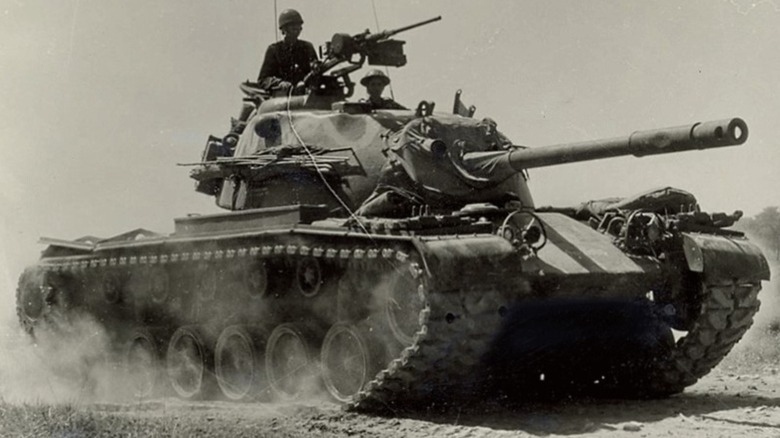
Over the years, the U.S. utilized a series of Patton tanks, and the first was designed specifically to replace the various tanks used during WWII, including the M4 Sherman, M26 Pershing, and the M46 and M47 Patton MBTs. With its introduction in 1952, the M48 Patton became the U.S. Army and Marine Corps' MBT for the Vietnam War.
Nearly 12,000 were produced, and successive generations saw improvements to the tank's design and capabilities. The tank innovated in several ways, including using a cast-armor hull. It also featured an egg-shaped turret, and it cut the crew down to four by removing a forward machine gunner position. This was a significant change, as it freed up more tankers while establishing a precedent in American tank design that remains to this day.
Another innovation was the tank's enclosed commander's cupola, which allowed the commander to reload the tank's machine gun while protected. Later variants adopted more efficient diesel fuel over gasoline. At the tank's center was its 90mm gun, offering a powerful weapon capable of taking on enemy tanks of its era. Like many American tanks, there were variants of the M48 Patton, including a flame-thrower option that soldiers dubbed "Zippo," used throughout the Vietnam War.
2nd generation: M60 Patton
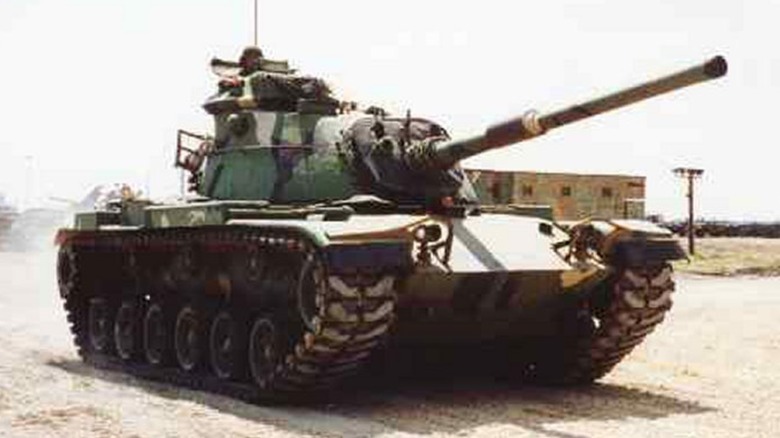
The Patton line of tanks evolved over the years into the M60 Patton, first introduced in 1959. More than 15,000 M60s were produced, with production ceasing in 1983. The M60 remained in service for decades, ultimately being replaced in the 1990s, which is also when it ended its service after many years across numerous campaigns. The tank's design improved over its predecessors by increasing its mobility and range, while significantly upgrading its gun.
The M60 Patton utilized an M68 105mm rifled gun that fired armor-piercing shells. While the U.S. military stopped using the tank in 1997, it remains in operation with several militaries, showing just how powerful and adaptable the 2nd-generation tank is. The tank's design offered several key improvements over its predecessors, including a larger crew space, a single-piece steel casing for its hull, and better armor protection for the personnel inside.
The M60 Patton owes its existence to the aforementioned T-54. After one was captured and sent to NATO, it was determined that U.S. tanks couldn't penetrate its armor. That's why the M60 was given a 105mm gun, which had no problem piercing the T-54's impressive armor, making the M60 Patton's design largely reactionary. This is not uncommon in tank design, as building a tank to outmaneuver and outclass a specific type of enemy armor drove tank innovation throughout the 20th century.
2nd generation: Leopard 1
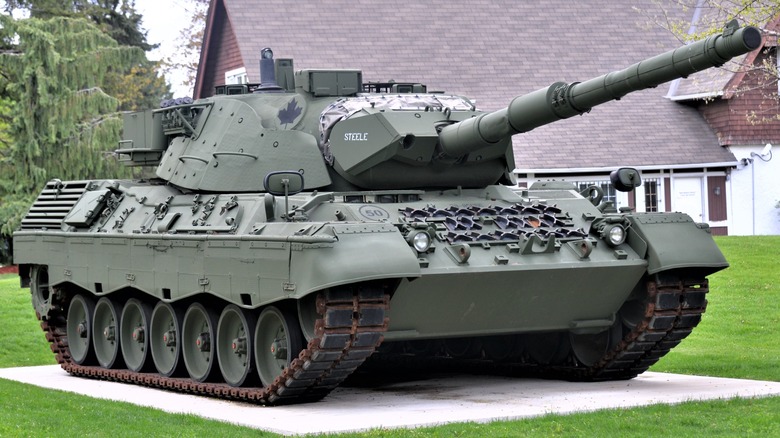
Following WWII and Germany's division by the Allies, West Germany created its own MBT, the Leopard 1. The Leopard 1 entered service in 1965 as a medium tank weighing 46.7 tons. It saw use in West Germany and elsewhere, becoming one of Europe's predominant MBTs. The Leopard 1 saw combat in several conflicts, including the Bosnian War and others. The Leopard 1's design deviated from previous MBTs by favoring mobility over protection, making up for it with incredible firepower.
High explosive anti-tank (HEAT) rounds pushed the Leopard 1's designers to focus on greater offensive power over traditional defensive characteristics. The result was a highly mobile MBT that packed a punch via its 105mm Royal Ordnance L7A3 L/52 rifled gun, which can fire on the move, thanks to a new stabilization system. The tank, nicknamed "Leo," was innovative largely in its focus on firepower and mobility.
This was an interesting decision because tanks had largely been designed around the use of heavy armor plating. That's not to say that the Leopard 1 isn't well-armored, but compared to other MBTs of the 1960s, it was unusual. It was also incredibly successful, as it was NATO's primary tank used to counter hostilities posed by the Soviet Union. While it's largely been supplanted by the Leopard 2, the Leopard 1's innovative features keep them employed, as they're still used in the Russo-Ukrainian War.
2nd generation: T-64
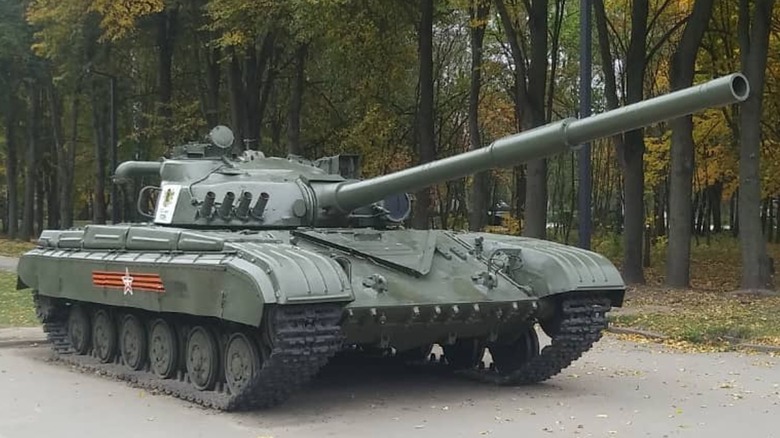
The Soviet Union continued to innovate with its tank design, producing the T-64, which entered service in 1966. Around 12,000 to 15,000 were built, and found its way onto many battlefields as part of tank divisions. Unlike the T-62, which supported infantry divisions, the T-64 required one fewer crew member, and it was faster and lighter, weighing in at 41.8 tons.
The removal of one crew member was accomplished with the installation of an autoloader, reducing the need for a loader. That reduction in crew capacity allowed the tank to be made much smaller and lighter than other MBTs of the era. Regardless, the T-64 was well armed with a smoothbore 125mm gun capable of unleashing mass destruction on whatever it targeted.
The most innovative aspect of the T-64 was its armor, as it was the first tank behind the Iron Curtain to use composite armor in its design. Composite armor is made of layers of different materials, including plastics, different types of metals, and ceramics. Composite armor was designed to counter HEAT rounds, and with its introduction on the T-64, it's never truly gone away. The same can be said of the T-64, which is among the oldest tanks in service, as it's being used in the Russo-Ukrainian War with some modernization upgrades.
3rd generation: T-80
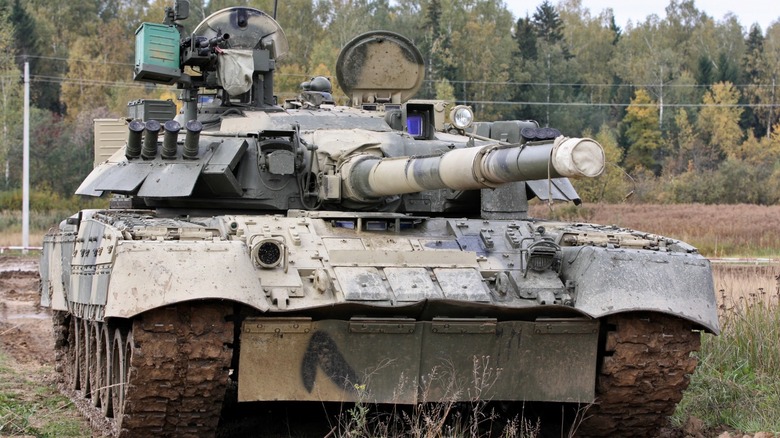
Tanks have always required a great deal of power to move across the battlefield, thanks to their immense size and weight. Modern tank propulsion looks nothing like what it did in the mid-1970s and earlier. That's because one of the biggest tank innovations came in 1976 when the Soviet Union began using the T-80, the first MBT to be solely powered by a gas turbine engine.
This design gave the tank a high power-to-weight ratio, though it guzzled a lot of gas. The turbine engine offered several advantages over the T-64's diesel engine, as it could start in the extreme cold of Northern Europe and Asia. The T-80 was the last tank designed by the Soviet Union, and it built on the lessons learned from the T-64. This ensured that it had as many modern features as possible, including composite armor and an autoloader.
Despite its innovative design, the T-80 was actually one of the worst military tanks ever built. This was primarily due to how much gas it consumed. Additionally, its cost was around triple that of the T-64A, which matched the T-80 in firepower. T-80s served in Chechnya, where they didn't do well when they ran out of fuel. Despite its overall failure, the T-80 remains in service 50 years after its introduction. Russia drove them into Ukraine, where over 1,200 met an untimely end.
3rd generation: M1 Abrams
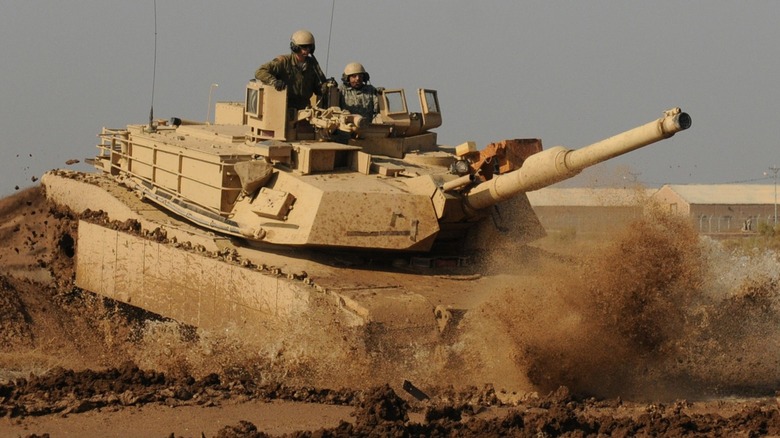
Not long after the Soviet Union unleashed the T-80, the United States began using its own turbine-powered MBT, the M1 Abrams. It came about following an American-West German plan to replace the aging M60 Patton, which only produced the MBT-70 prototype. Similar to the T-80, the M1 was powered by a multifuel turbine engine, but unlike its Soviet counterpart, fuel consumption wasn't a fatal flaw.
The M1 Abrams first saw combat in 1991 during Operation Desert Storm, where it proved to be superior to Soviet-era tanks operated by Iraq. The M1's design featured numerous innovations over MBTs of the era, including the use of Chobham composite armor, a separate blowout compartment for ammunition to keep the crew safe, protection from nuclear, biological, and chemical (NBC) attacks, and more. The M1's primary armament was an upgraded version of the M60's 105 mm gun.
The initial plan was to use the M256 120mm smoothbore gun, but it wasn't ready in time for the M1's fielding, though subsequent models, the M1A1 and M1A2, feature the desired armament. The M1 Abrams MBT is widely considered to be one of the best tanks ever made. It has been utilized in five major wars, and never been destroyed by another tank. That said, several were destroyed by other means in the Russo-Ukrainian War, including via modern anti-tank guided weapon systems and specialized drones.
3rd generation: FV4034 Challenger 2
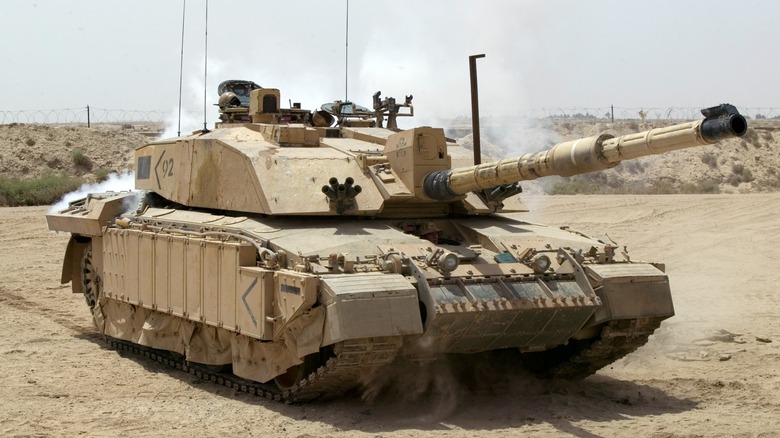
British tank design continued to improve, and by the third generation, the FV4034 Challenger 2 became the United Kingdom's dominant armor. First introduced in 1994, the Challenger 2 was built around a modern design, taking the lessons learned from the development of the M1 Abrams and other tanks. It incorporated several notable features, including 2nd-generation Chobham armor and a chrome-lined L20A1 120mm rifled gun.
The new gun was superior to the one used in the FV4201 Chieftain and FV4030 Challenger 1, as it can fire a wider range of different types of ammunition. The Challenger 2's composite armor protects the MBT from HEAT rounds and other ordnance that would otherwise pose a danger to it. The tank also features a hydrogas suspension and hydraulic track tensioner to provide greater stability, enabling the tank to cross all manner of terrain.
The Challenger 2 weighs 62.5 tons, putting it in the upper-middle-range of MBTs and it packs a lot of power. They've been used in combat operations in Kosovo, Iraq, and in the Russo-Ukrainian War. The U.K. has plans to phase out the Challenger 2 in favor of its successor, the Challenger 3. Still, it's unlikely that the older MBT won't continue to be used elsewhere for some time, as it's superior to most tanks it'd meet on a battlefield. As of writing, the Challenger 3 is expected to enter service in 2027.
4th generation: Type 10 Hitomaru
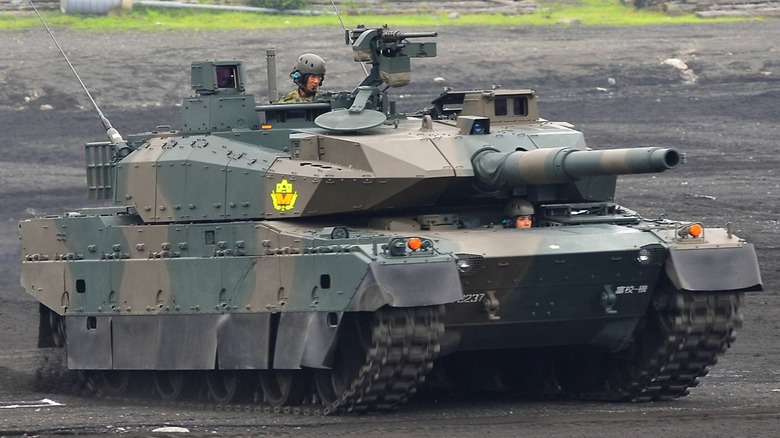
The 4th generation of MBTs kicked off in 2012 with the introduction of Japan's Type 10 Hitomaru MBT. The Type 10 is a fully digitized tank, and while the M1A2 Abrams is considered to be the pioneer of that aspect of tank design, it's less a new tank and more of an upgraded, modernized variant. The Type 10 was designed from the ground-up as a digital tank.
This is one of the most technologically advanced tanks thanks to its communications gear, an integrated C4I (Command, Control, Communications, Computers, and Intelligence) system, interchangeable armor plating, and features that reduce its infrared signature. Top-of-the-line communications gear networks Type 10s, enabling commanders to find and fix targets, as one tank can spot a target and relay its location across the network for another tank to engage.
The Type 10 only requires three personnel to operate, helping to reduce its overall size by eliminating the loader. The MBT weighs 52.9 tons when fully loaded and uses a 120mm smoothbore cannon with an autoloader. The Type 10 is a new tank, and only around 130 have been produced, though the ones in operation have already undergone some upgrades to improve survivability from modern man-portable anti-tank weapon systems as well as drones, which pose a significant threat to tanks, as the Russia-Ukraine war has demonstrated.
4th generation: T-14 Armata
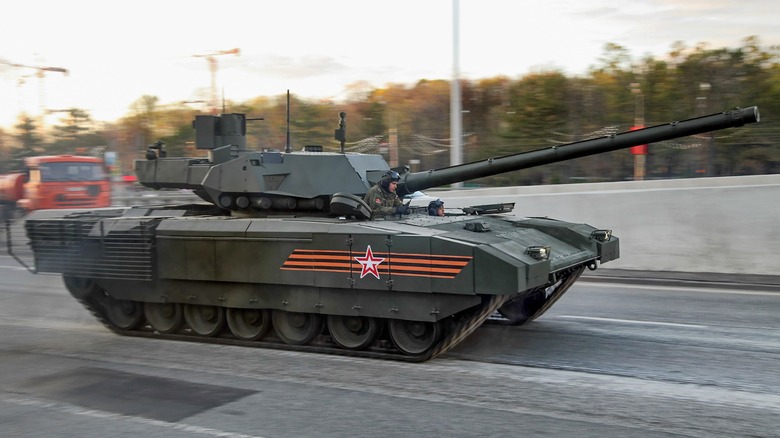
The Russian Federation's latest MBT, the T-14 Armata, is unlike anything designed by the Soviet Union. It came about after the planned T-95 failed to materialize, and as of writing, it's unclear how many have been built or are in operation. That's primarily due to how the Russian government holds onto its production numbers, but also because the T-14 hasn't been fully fielded in the war in Ukraine.
Since Russia has lost thousands of tanks in the conflict, the absent T-14 suggests it isn't ready for action. That said, several were believed to appear in Ukraine, but only for testing, and they didn't engage in combat. While the T-14 hasn't fully manifested as of writing, it is nonetheless an innovative tank design that. Should it disengage from development hell and enter the inventory, it could pose a great threat to other tanks on the battlefield.
Unlike previous Russian tanks, the T-14 features an Afghanit active protection system (APS), providing 360-degree radar coverage capable of taking out incoming rounds. While APSs are nothing new, the Afghanit system looks to be superior to what's currently available, which could make the T-14 a dangerous tank wherever it deploys. Of course, much of this is conjecture, as the T-14's combat record is unknown or likely nonexistent. Regardless, the T-14's innovative design could make it a major player as the 4th generation of MBTs develops.
4th generation: Type 100
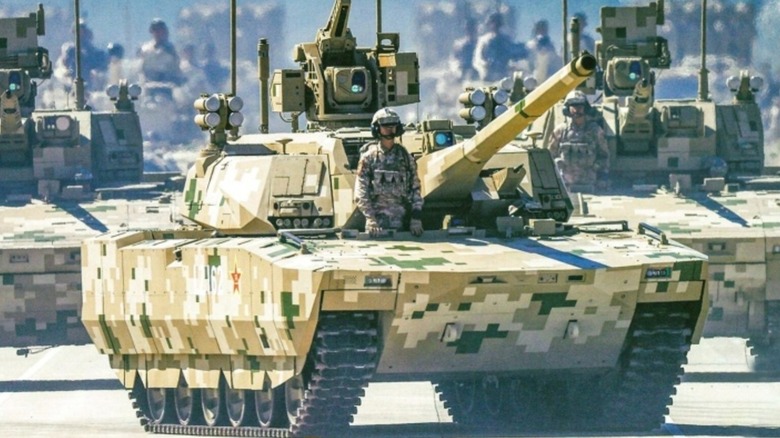
The People's Republic of China is hard at work developing modern combat systems, and one of its latest is the Type 100 MBT. The Type 100 is the newest MBT to be revealed, shown off at China's Victory Day Parade in September 2025. Because China isn't in the habit of revealing the technical specifications of its equipment, much that is known about the Type 100 is conjecture based on glimpses of the tanks shown at public events.
The tank is believed to require three crew members, who sit in a separate compartment from its ammunition. This provides greater crew survivability should the ammo explode inside the tank. It likely has 360-degree coverage, provided by at least 12 optical-lidar sensors, providing greater situational awareness to the commander. Much of the tank is believed to be digitized, bringing it up to the standards of the M1A2 and the Type 10.
The Type 100 likely weighs between 35 and 40 tons, placing it on the lower end of the MBT scale. This should aid in mobility and speed, but lethality is also a factor. The tank likely features a 105mm smoothbore gun, though the potential of a 125mm variant could develop. Type 100 tanks haven't been shown off much since their debut, though China released video of one operating during a field training exercise for the first time in May 2026.