

5 SUVs Quicker Than The Ford Mustang Mach-E
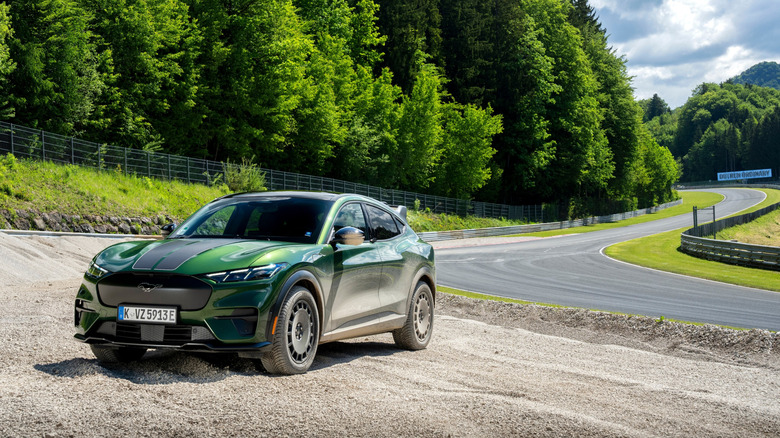
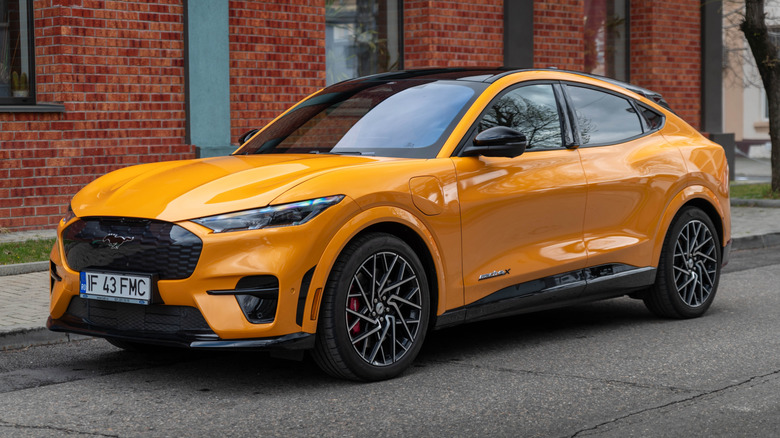
In many people's eyes, the Ford Mustang is, and always was, a prime symbol of American V8 sports cars. The Mustang is different from many other Ford mainstream models because it has been loved by enthusiasts for decades. The Mustang nameplate carries real weight, and it probably surprised a lot of people when Ford took the Mustang name and decided to make a four-door crossover family EV from it.
Before the Mustang Mach-E, Ford thought about building a four-door pony car, but the project never advanced past a full-size clay model. If there is one thing the two Mustangs share, it's speed and performance, although the Mach-E does not get its performance from a good old 5-liter Coyote V8. Thanks to electric motors, the Mach-E pushes 480 horsepower and up to 700 lb-ft of torque in its top-spec GT model.
This is enough to propel the GT to 60 mph in just 3.3 seconds, quicker than any ICE Mustang ever. When autoevolution compared it to the Mustang Dark Horse, the Mach-E GT even managed to outrun it in the quarter mile — 12.3 seconds against the Dark Horse's 12.8. However, the world of performance SUVs in 2026 is truly impressive, so much so that the Mach-E is nowhere near the top. Here are five SUVs quicker than the Ford Mustang Mach-E.
Tesla Model X Plaid
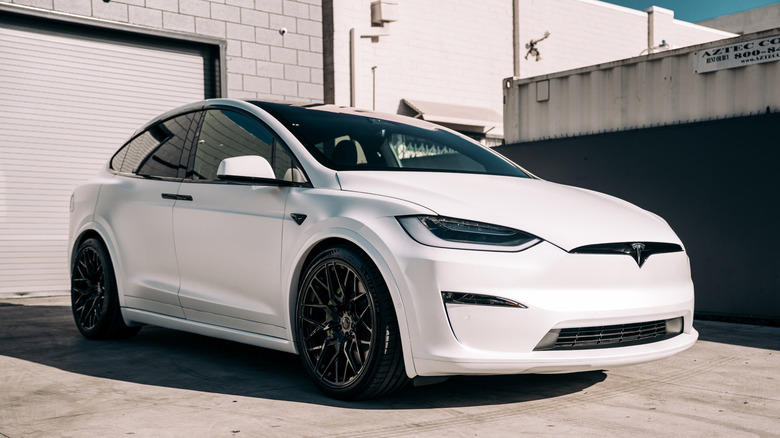
Tesla's own spec sheet lists the tri-motor Model X Plaid at 0-60 in 2.5 seconds and the quarter mile in 9.9 seconds, putting it well ahead of the Mach-E GT's 3.3-second sprint. Independent testing backs that figure up: using a VBOX performance recorder, InsideEVs clocked a stock Model X Plaid at 2.3 seconds to 60 mph and 9.75 seconds in the quarter mile at 144.88 mph, both quicker than Tesla's claimed numbers.
The three-motor setup produces a combined 1,020 horsepower and 1,050 lb-ft of torque, routed to all four wheels, and the SUV can seat up to six people across three rows. That's more than double the Mach-E GT's 480 horsepower, and 350 lb-ft more torque than the Ford's 700 lb-ft peak. Despite a curb weight north of 5,000 pounds, the Model X Plaid draws power from a 100-kWh battery pack and tops out at an electronically limited 149 mph.
Where the Mach-E GT needed 12.3 seconds to clear the quarter mile against the Mustang Dark Horse, the Model X Plaid covers the same distance in well under 10 seconds — a gap of more than two and a half seconds. At a starting price around $130,000, it undercuts plenty of gas-powered performance SUVs while out-accelerating nearly all of them in a straight line.
The Model X won't be around much longer to enjoy that title, though — Tesla confirmed both the Model X and Model S will end production in 2026, with Fremont's plant space shifting to Optimus robot manufacturing instead.
Porsche Cayenne Turbo GT
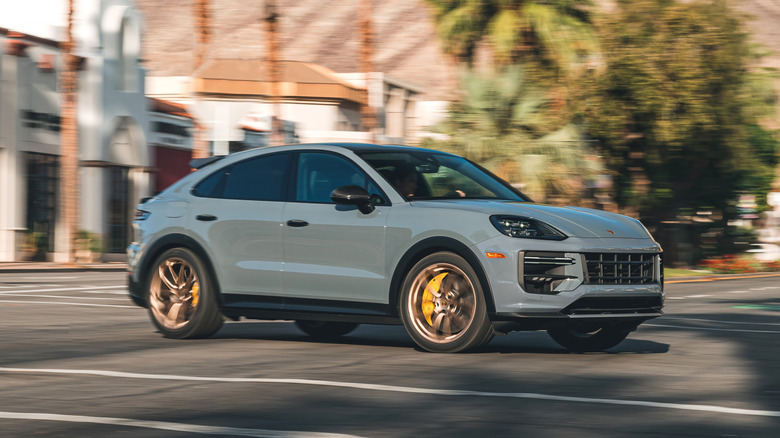
Who says that you need electrons to make an SUV go quick? The top-spec ICE Porsche Cayenne Turbo GT, the quickest ICE SUV Porsche has ever made, represents the very top-end of what dinosaur juice can give you in terms of speed. MotorTrend's instrumented testing recorded a 2.9-second run to 60 mph for the Cayenne Turbo GT Coupe, along with a quarter-mile time of 11.21 seconds at 121 mph
Both of these are comfortably ahead of the Mach-E GT's 3.3-second and 12.3-second marks. Porsche's twin-turbo 4.0-liter V8 produces 650 horsepower and 626 lb-ft of torque, sent to all four wheels through an 8-speed automatic transmission, and the Turbo GT tops out at a manufacturer-claimed 190 mph. That's 170 more horsepower than the Mach-E GT's 480, though 74 lb-ft less torque than the Ford's 700 lb-ft
This also shows the Porsche leans on raw power and a lighter curb weight rather than outright torque to close the gap. At under 5,000 pounds, the Cayenne Turbo GT is roughly 300-ish pounds lighter than the Mach-E GT, and it backs its straight-line numbers up on a track: Porsche set a Nürburgring Nordschleife SUV lap record with the Turbo GT, a benchmark the Mach-E GT has never targeted.
Pricing starts north of $200,000, positioning it well above the Mach-E GT on cost as well as capability. We do have to note that Porsche just recently came out with the very first electric Cayenne which promises performance metrics that go beyond the Turbo GT, but since it's a brand-new model that hasn't been nearly as tested, we decided to skip it for now.
Aston Martin DBX707
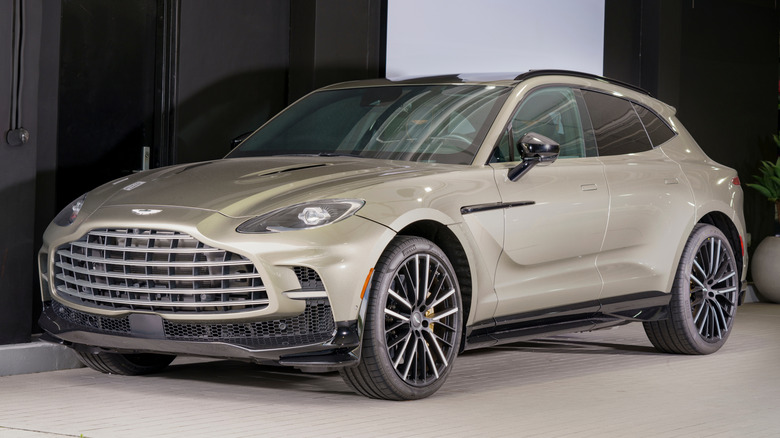
The Porsche Cayenne Turbo GT isn't the only super expensive ICE SUV that manages to outrun the Mach-E. Coming from the U.K., the top-spec, all-out Aston Martin DBX 707 super SUV can even top out at a claimed 193 mph. Car and Driver's testing clocked the DBX707 at 3.1 seconds to 60 mph, with a quarter-mile time of 11.5 seconds at 119 mph — both quicker than the Mach-E GT's 3.3-second and 12.3-second figures.
Aston's 4.0-liter twin-turbo V8 sends 697 horsepower and 664 lb-ft of torque through a 9-speed automatic to all four wheels. That's 217 more horsepower than the Mach-E GT's 480, though 36 lb-ft short of the Ford's 700 lb-ft max. The V8 layout also brings extra mass: at 4,940 pounds, the DBX707 is a heavier machine than most rivals on this list, yet it still out-accelerates the Mach-E GT thanks to raw output and Aston's aggressive launch tuning.
Aston built the DBX707 around a bonded-aluminum architecture developed specifically for this model, distinguishing it from the shared platforms other automakers use for their SUVs. Pricing starts at north of $270,000 – enough to buy a Mach-E for every one of Snow White's seven dwarfs. Either way, when we reviewed the 2025 Aston Martin DBX707, we gave it a near perfect nine out of ten, and even included it in our Editor's Choice list.
Lotus Eletre R
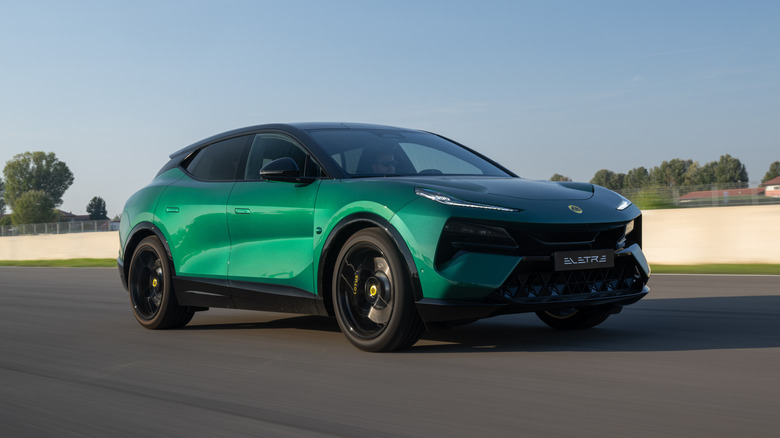
Lotus was never really about mainstream crossover EVs, but rather small, nimble Exiges, Evoras, and the lot. However, when EVs started popping up left, right and center and many legacy brands found themselves at a crossroads of whether to go more EV or stick with ICE, Lotus took the former. A direct product of that is the Lotus Eletre R.
To drive home just how fast the Eletre R is, Top Gear tested it at a 2.94-second run to 60 mph, along with a quarter-mile time of 10.77 seconds at 133.9 mph — both well ahead of the Mach-E GT's 3.3-second and 12.3-second figures. Two electric motors power the Eletre R — 905 horsepower and 726 lb-ft combined — with a rear-axle gearbox that shifts through two ratios instead of one, unusual for an EV.
That's 425 more horsepower than the Mach-E GT's 480, and 26 lb-ft more torque than the Ford's 700 lb-ft peak. Unlike the gas-powered entries on this list, the Eletre R draws power from a 109-kWh lithium-ion battery pack. An 800-volt architecture lets it accept up to 350 kW of charging power, well above the 400-volt systems most EV rivals use.
The top speed comes in at a claimed 165 mph, the lowest ceiling of any SUV on this list, since Lotus prioritized off-the-line acceleration over sustained high-speed running. The Eletre R also carries a curb weight north of 5,800 pounds, proof that even a machine that heavy can out-accelerate a Mustang. When we took the 2024 Lotus Eletre for a first drive, we noted that it didn't feel overly fast on the road, in spite of the numbers.
Ferrari Purosangue
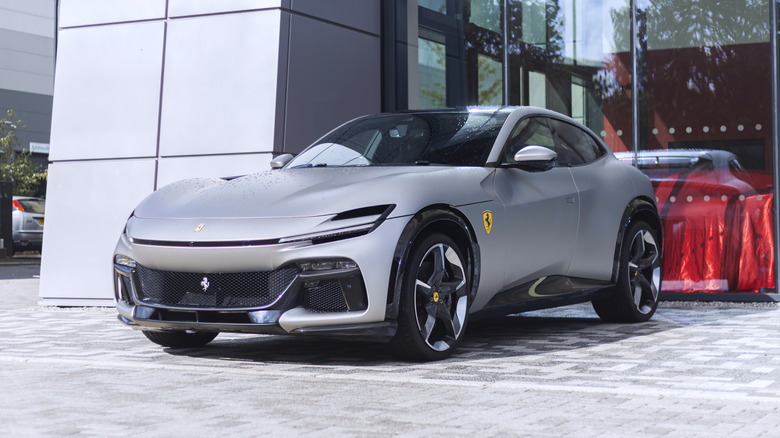
Most ICE cars that keep pace with EVs lean on turbochargers, hybrid assist, or superchargers to do it. The Ferrari Purosangue skips all of that. No hybrid assist, no forced induction of any kind — yet it still outruns the Mach-E. That's why it earns the title of thoroughbred SUV — although Ferrari really does not like it when you call it an SUV.
When we took the Ferrari Purosangue for a first drive, we agreed because while it is absolutely amazing, it does not really do SUV things all that well. The Purosangue runs on a naturally aspirated 6.5-liter V12, a genuinely non-existent setup in a segment now dominated by turbos and hybrids. Car and Driver's testing recorded a 3.2-second run to 60 mph, ahead of the Mach-E GT's 3.3-second mark, with a claimed top speed of 193 mph.
The V12 revs to 8,250 rpm and produces 715 horsepower and 528 lb-ft of torque, sent through an 8-speed dual-clutch transmission to all four wheels. That's 235 more horsepower than the Mach-E GT's 480, though 172 lb-ft short of the Ford's 700 lb-ft of torque — a gap the Ferrari closes by revving harder instead of leaning on low-end muscle.
At 4,784 pounds, it's also the lightest SUV on this list by a wide margin, thanks to heavy use of carbon fiber in the body. Pricing starts north of $393,000, which is enough to buy a Mach-E for all nine members of the Fellowship of the Ring, with a spare left over for Gollum to call his precious.
How we made the list
Putting this list together, we wanted more than five ways to hit the same number. That's why you'll find a naturally aspirated V12 sitting next to twin-turbo V8s, a six-seat family EV, and a plug-in hybrid SUV all on the same page. Each entry represents a genuinely different way of going fast: forced induction, electrification, raw displacement, or some combination of the three. If an SUV only proved that turbochargers work, we didn't need five of those.
To keep it honest, we leaned on manufacturer specs only where independent testing is not available, and flagged those cases directly in the text. Wherever possible, we pulled tested 0-60 mph and quarter-mile figures from outlets with a track record of running their own instrumented tests — Car and Driver, MotorTrend, Top Gear, InsideEVs, KBB, and autoevolution among them — rather than relying on secondhand aggregator numbers.
Every figure in this list is sourced and linked, so you can check our math yourself. This piece also builds on groundwork laid by other writers on our team who've covered and tested these SUVs individually over the past few years, and their reporting helped shape which vehicles made the cut here.