

TP-Link Tapo C675D KIT Review: Solar-Powered Dual-Lens Pan/Tilt Security Camera In Action
We may receive a commission on purchases made from links.
I have a long history of trying and failing to find a security camera that works for my home. That's why I got rather excited when the opportunity came my way to test and review the TP-Link Tapo C675D KIT Solar-Powered Dual-Lens Pan/Tilt Security Camera Kit (quite possibly the longest product name I have ever encountered). This camera promises a number of really exciting features that potentially solve key issues which I have previously found intractable in other security cameras.
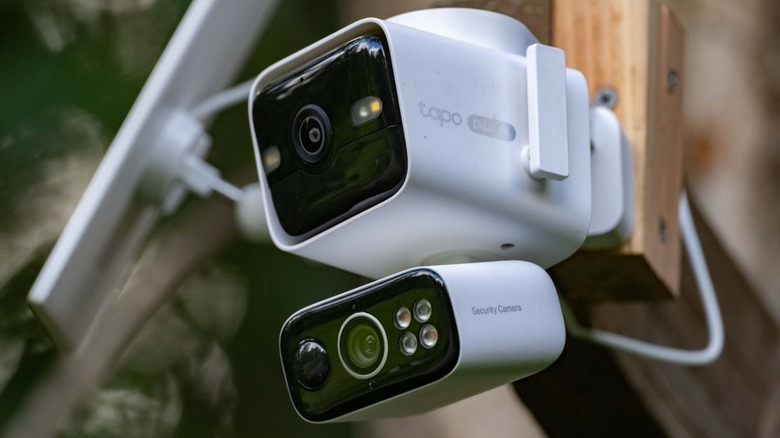
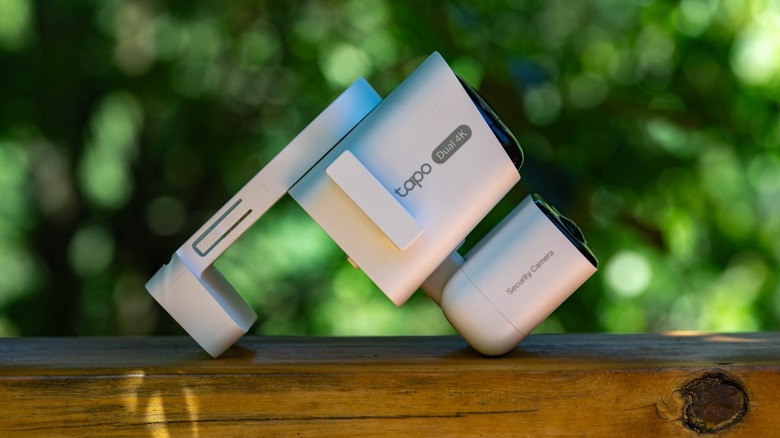
For a start, this isn't just a single camera; in fact, you're getting both a wide angle camera and a motorized telephoto camera. That means you can observe a wide area, and get close up shots of moving people or vehicles at the same time.
It's also wireless and solar powered, which is essential for me, given that the location where I need such a camera most is inaccessible by a cable connection. Thirdly, and perhaps most importantly, most of the camera's functionality is available without a subscription, which is certainly something to celebrate in this space. On paper, the TP-Link Tapo C675D (provided by TP-Link for this review) seems to be the perfect security camera for monitoring my driveway, keeping a watchful eye out for ne'er-do-wells.
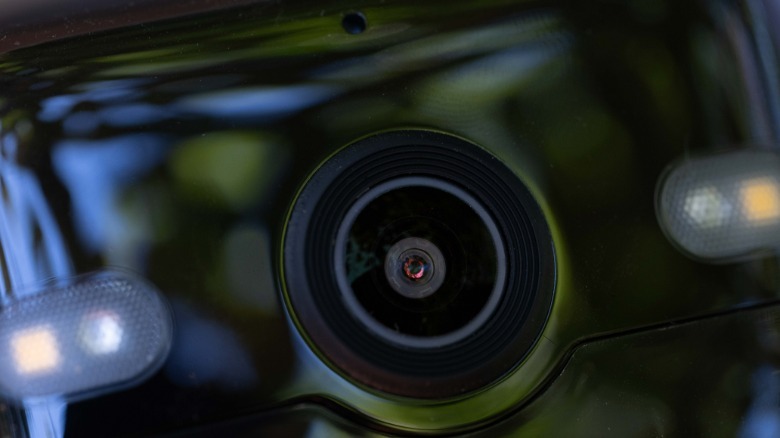
Real 4K quality delivers a high level of detail
A frequent issue I run into with security cameras, as well as with trail cameras, is that the image quality tends to be quite poor. This honestly isn't surprising given the low price point and utilitarian purpose of such cameras, but this nonetheless can be very frustrating. In the case of security camera, you will obviously want to be able to identify intruders and the license plates of vehicles. The TP-Link Tapo C675D is the first such camera where I've actually been content with the quality of the video it records (which captures actual 4K video). It's obvious no Nikon Z8 or GoPro Mission 1 Pro, but for a relatively low cost dual-lens security camera, it's pretty good.
 Andy Zahn/SlashGear
This is true both of daytime footage, of twilight, and of infrared after-dark recording. It's particularly impressive how well the TP-Link Tapo C675D is able to illuminate a large area with infrared, and how well it's able to resolve the significant contrast between the dark environment and bright headlights. My one complaint here is that there is a considerable amount of compression artifacting in video clips.
Sound recording quality is also remarkably good, so you can expect to be able to pick up noises clearly through the camera. I was surprised to find myself enjoying listening to birdsong through the camera in the mornings when I checked in on the feed.
Clever design and straightforward installation
The dual-camera format of the C675D makes a lot of sense from a surveillance perspective, and it has an intimidating, slick appearance that should itself help to deter ill-intentioned visitors. Getting it connected to Wi-Fi, getting the software up and running, and mounting it in a suitable location is fundamentally a simple undertaking, unless you're like me and you make the whole process into a day-long circus of clumsy DIY.
For context, I live on a small farm way out to the West of the middle of nowhere, and unfortunately my neighbors are of the criminal persuasion, so keeping on eye on our shared driveway is essential. However, it also means that the only place to locate a camera is a fair distance from the house, and it has to be fairly high up in a tree to prevent tampering (we have had people attempt to steal security cameras in the past).
With this in mind, I set out to manufacture a gantry for the camera, which would be placed about 20 feet up in a half-dead cottonwood. My woodworking strategy for this was to take two random pieces of wood leftover from another project, and screw them together at roughly the correct angle, with another block screwed into the end to provide a mounting point from the camera.
Next, I scaled a wobbly ladder as high as it would go, and forced the whole unsteady edifice to stick by sheer weight of screws driven into it. After considerable struggle with this contraption, looked upon by many concerned members of the household, the whole thing was in place and ready to go. All of the strife was a result of my own excessive ambition, and I do not recommend that anyone try and replicate my shenanigans.
Solid wireless connection, but app interface is a bit clunky

Fortunately for me, the TP-Link Tapo C675D has a decent wireless range, which is why I was able to mount it in a tree out in the forest and still get a connection that's more reliable than with previous wireless cameras I've tested. For context, I use a Netgear Orbi WiFi range extender to reach this location, which even still is right on the edge of the transmission range for that unit, so it's a real test of any camera wireless connection.
On the software side, the companion app is OK, if slightly annoying in some of its operation. It's functional for checking alerts or monitoring/controlling the camera remotely, but reviewing older footage is tedious due to the navigation system. Also, you're only able to line up 10 clips at a time for download, which made assembling the hundreds of clips for my timelapse video of the burying of the power line to our house a highly time consuming task. Neither of these issues is likely to affect the average person in daily use as much as it did me during testing for this review, but they are something to be aware of.
Useable without a subscription, but lack desktop software is a problem

The subject detection seems to be very capable, with the system being able to automatically detect whether a car, person, or pet is in the video, and it does this without requiring a subscription. It isn't entirely reliable, some of the detection modes are in beta, and the reliability of subject identification falls noticeably at night, but it's nonetheless very impressive for an automated consumer security camera. Some features, such as cloud backup, are locked behind a subscription paywall, but the Tapo C675D is the least aggressive system in terms of monetization that I've encountered.
Perhaps the most significant issue with the Tapo C675D is the fact that TP-Link does not offer desktop PC software for the system. Only iOS and Android apps are available, so if you want to access and control the camera from a computer you'll either need to use an Android emulator to run the app, or utilize third-party software.
Fortunately, the Tapo C675D does support Real-Time Streaming Protocol (RTSP) and Open Network Video Interface Forum (ONVIF), so it's compatible with software such as VLC, or you can connect it to Network Attached Storage (NAS), or a Network Video Recorder (NVR). Such advanced functionality is great, and in many ways preferable to a proprietary app, but for a lot of people this represents a significant technological hurdle, and having the option of a streamlined first party PC application with as simple a setup process as the mobile app would help smooth out the learning curve.
Also important, on that note: announced on July 9, 2026, and enacted as of August 1, 2026, TP-Link will be ending IFTTT services for this device (and all other Tapo and Kasa products).
Solar power easily keeps the battery charged
Battery life and the ability of a solar panel to keep that battery topped-up, even in the face of frequent activation of the camera, is a critical component of a remote, wireless security camera such as the TP-Link Tapo C675D. It has been my experience that given the the large amount of shade in my yard and the dim, cloudy conditions typical of Western Washington, that solar-powered security cameras tend not to fare very well here.
Keeping in mind that I did test this camera during the sunniest part of the year with the most daylight hours, I was really impressed by how easy it was for the camera to keep its battery topped-up to 100% despite frequent recording. I even installed and activated it at just 60% battery, and it quickly filled itself up over a few days, despite that period of time being dark and overcast.
The camera is in a location where it only gets direct sunlight for a short time in the morning, and otherwise the solar panel is shaded by the trees. This is by far the best performance I've encountered from a solar-powered security camera system, and I'm fairly confident that it may even hold up to the much more challenging conditions come winter.
Reasonable price point
With a price tag of $255 at time of writing, the TP-Link Tapo C675D is certainly not the least expensive security camera out there, but that seems like a very reasonable price point for camera featuring such impressive capabilities. I've previously purchased various solar powered security cameras from brands such as Reolink, and typically expect to pay at least $120 for a very basic camera.
For example, the Reolink Argus PT kit is available for $130 on Amazon, but only features a single camera and doesn't boast a nearly comparable range of capabilities as are found in the TP-Link Tapo C675D. Given my experience with low-end security cameras, I would definitely recommend spending the extra money on a more powerful system such as this.
With that said, $255 may be too steep for some people, and not everyone is going to be in the situation I am where the area they need monitored has some very specific requirements. If you're able to mount a camera on a building and wire it into your home network, then a less expensive and elaborate camera kit is probably a more financially responsible option.
Conclusion
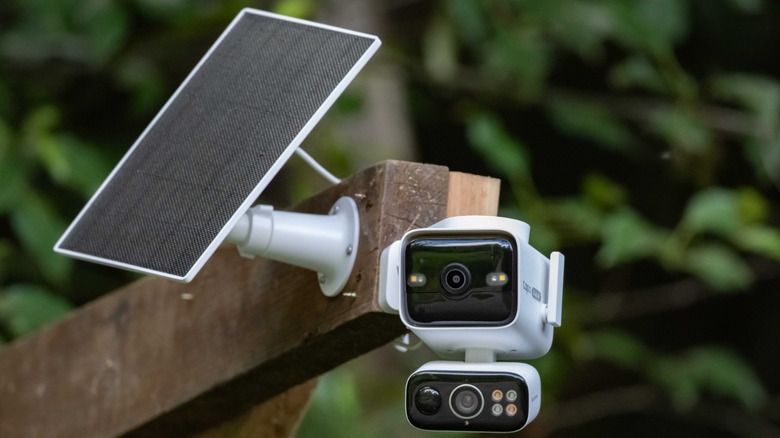
TP-Link Tapo C675D KIT Solar-Powered Dual-Lens Pan/Tilt Security Camera Kit is exactly what I've been looking for in a security camera. If your situation precludes the ability to provide a wired connection for power and data, and you need to capture a wide field of view, as well as a detailed, relatively narrow image of objects passing through that area, then I can heartily recommend the Tapo C675D without hesitation. My only minor comment against it would be that for some scenarios it's probably overkill, and it's definitely on the pricier side as security cameras go. However, for me, it's exactly what I need.
The Tapo C675D provides a real feeling of safety that I haven't experienced with any other security camera system. Those I have used previously in the past have been hobbled by subscription models I couldn't stomach, or technical issues that rendered them unreliable. This is not the case with the Tapo C675D. Given the sketchy nature of my neighborhood, I am happy to no longer be quite as vulnerable as I once felt here.
The TP-Link Tapo C675D KIT Solar-Powered Dual-Lens Pan/Tilt Security Camera Kit starts at $255 from the Tapo online store or $229.99 from Amazon.