

GoPro's Mission 1 Pro Makes Some Huge Claims: We Put Them To The Test
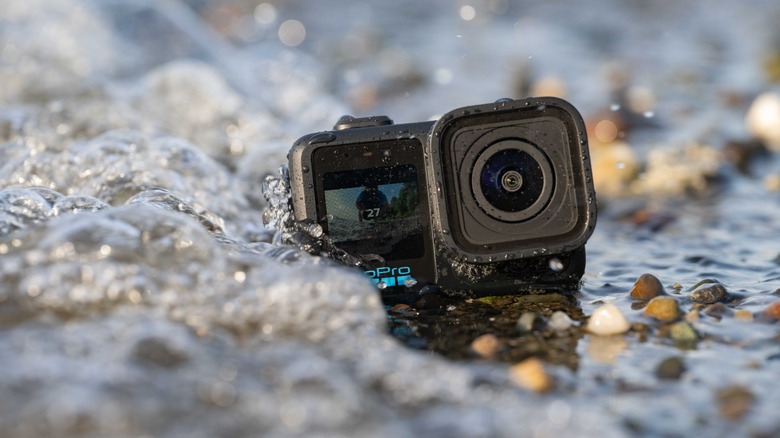
When GoPro didn't launch their annual Hero camera last year, it was clear they were cooking up something special — now we finally get to see what they've been working on all this time, and whether or not all that R&D has paid off. On paper, everything about the GoPro Mission 1 Pro represents a massive leap over every GoPro that's come before it, and that's exactly what GoPro needed to do right now.
The 1-inch size sensor alone is enough to get me excited, but it's important to note that it's paired with a new processor that greatly expands what the camera is capable of. While the Mission 1 Pro is superficially very similar in appearance and form factor to the Hero line of cameras, they have supercharged everything under the hood. This is actually pretty important, as it means the Mission 1 Pro can potentially fill the same role as a standard action camera while delivering what should be a much higher level of quality. However, it was necessary to thoroughly test the Mission 1 Pro (provided by GoPro for this review) to see if it lives up to all the hype.
A massive imaging upgrade
With a new 1-inch sensor and an upgraded processor, the Mission 1 Pro is absolutely the generational leap that GoPro needed in terms of imaging capability. Put simply, the video that comes out of this thing looks great, and so do the photos. It can shoot at up to 8K at 60fps, as well as 50MP still images. You can definitely still tell that this is action camera footage, but that GoPro look is still part of the appeal of a GoPro camera.
The camera has enough dynamic range that I never encountered a scenario where it suffered from serious overexposure, and this is the first GoPro camera I've used that delivers decent results after sunset. It is particularly well suited to capturing starlapses, being able to last on a single battery throughout most of the night, though at the time I was testing it the short nights and bright moon were not conducive to impressive imaging of the stars.
 Andy Zahn/SlashGear
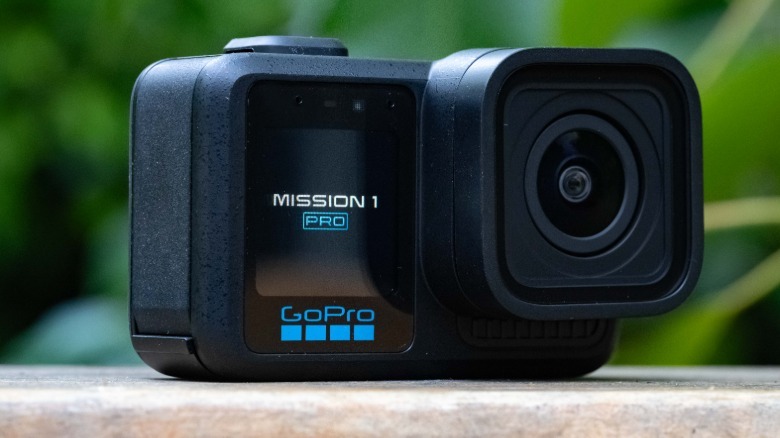
The downside here is that the fixed focal length of the Mission 1 Pro is not as close as the Hero 13, which took some adjustment to get used to. Also, the f2.8 aperture of the lens is a bit on the dark side, and I wish it featured a variable aperture as well. These caveats are likely a result of design restrictions, and while I think GoPro should implement closer focus, a variable aperture, and brighter aperture in the next generation of the Mission 1 series, it is worth noting that the optical design of the lens is of comparatively superior quality.
 Andy Zahn/SlashGear
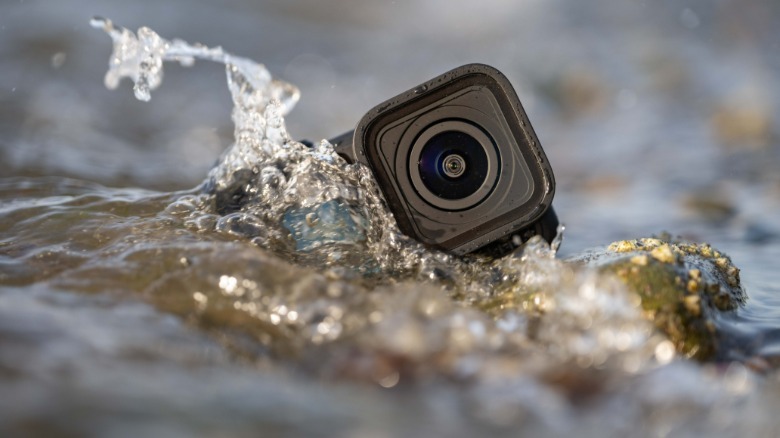
After weeks of in-depth testing, extensive comparison to other cameras, and a lot of pixel-peeping, I believe the GoPro Mission 1 Pro features the best image quality of any camera in this genre.
Fantastic slow motion capability
One of the real highlights of my time with the Mission 1 Pro was filming using the extreme slow motion features of the camera. Going into testing the camera, I was excited for the 4K 240fps capability, but was skeptical of the 1080p 960fps recording. Often, lower resolution ultra-high framerate recording is too low quality to be much more than a novelty. However, with the Mission 1 Pro, I was surprised to find that the 960fps looks amazing, even on my large desktop monitor. It's obviously still kind of mushy, compared to the 4K output, but it is by far the best ultra-high framerate recording I've personally used in a camera. You can only record 10 second clips at 960fps, but when you slow them down to 30fps, those 10 second clips extend to over 5 minutes long!
The 4K 240fps is great if you want to prioritize image quality, but still get really impressive slow motion, while recording without a time limit. The camera even does 2X slow motion in 8K at 60fps, though if I'm recording 8K at 60fps, it is for the high level of realism that such high framerate, high resolution footage yields.
It would be nice if GoPro could add some extra features here, perhaps through GoPro Labs, such as the ability to do pre-capture in ultra slow motion, and capture higher bitrate 960fps footage, even if that means only being able to shoot a couple seconds at a time. Being able to shoot high bitrate 960fps video with pre-recording could potentially deliver incredible results.
Remarkable still image capture performance

Normally, I rarely use an action camera to capture still images. It's typically a nice capability to have, but between the ultra wide angle and what is usually less than amazing image quality, it's not a function I often take advantage of. However, as I'm wrapping up this review, I'm surprised by how much I've enjoyed taking photos with the Mission 1 Pro due to how great those photos look.
 Andy Zahn/SlashGear
 Andy Zahn/SlashGear
 Andy Zahn/SlashGear
With the ability to capture 50MP RAW images, the Mission 1 Pro is able to deliver the sort of detail I expect from cameras these days, and I appreciate that it doesn't aggressively sharpen or saturate the images, even in the case of JPEGs. Of course, it's still an ultra-wide angle view, but often that's exactly what you want. There's a reason most phones these days feature an ultra-wide angle lens in their camera array. In my case, I am often shooting with longer lenses; super telephoto wildlife lenses, macro lenses, fast primes lenses, or even just standard range zooms. Having the Mission 1 Pro in my pocket gives me an ultra wide option that doesn't mean swapping lenses and carrying heavy/bulky extra gear.
A familiar design that's surprisingly compact
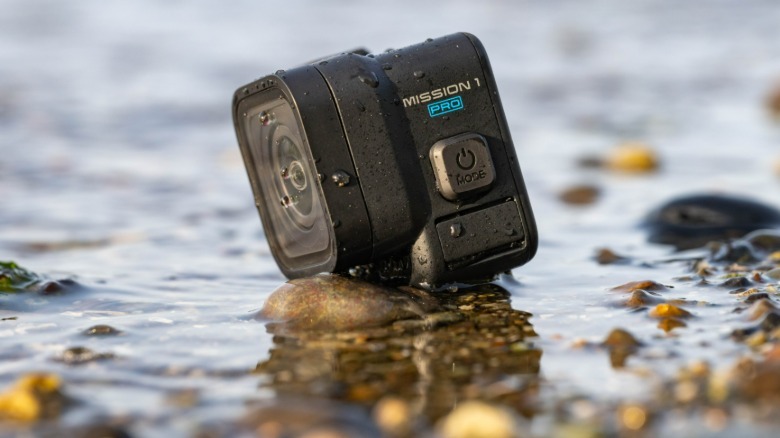
I had expected the Mission 1 Pro to be much larger than it is. The lens protrudes more than the Hero 13, but other than that it is about the same size. This is excellent, as it meant I was able to use the Mission 1 Pro as I would any other GoPro. One key upgrade is the buttons, which have been redesigned to be easier to press when wearing gloves, and to enable the camera to dive farther underwater (up to 20 meters). I love the tactility of these new buttons, and they are very clearly superior to anything that's come before.
 Andy Zahn/SlashGear
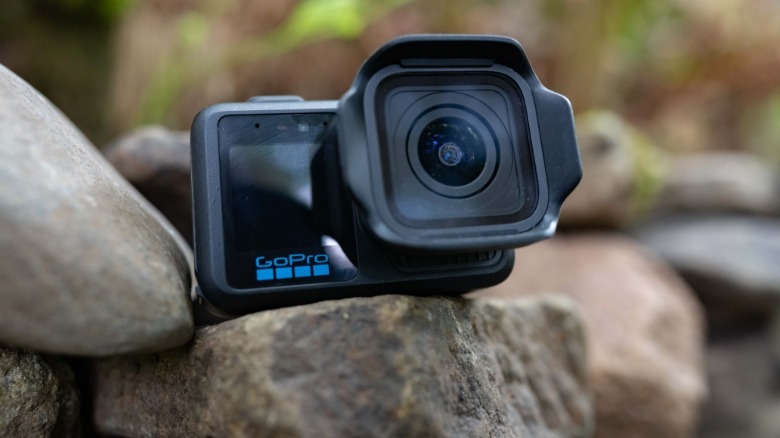
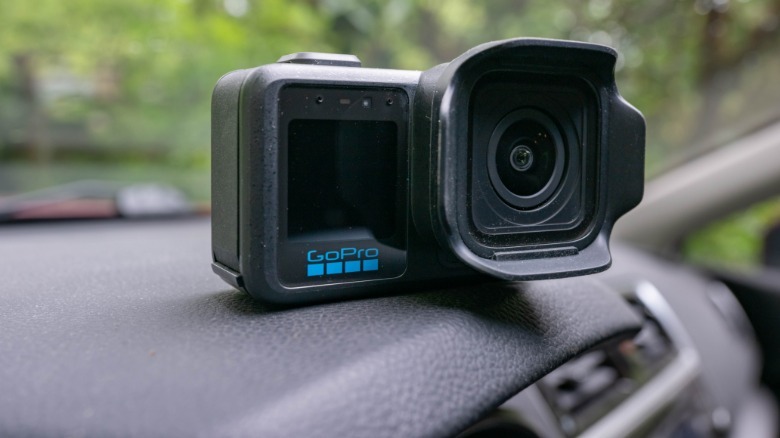
The Mission 1 Pro also comes with a rubber lens hood, which I recommend using whenever possible. Without it, the lens is prone to flaring in the presence of bright night sources, but with the lens hood this is solved entirely, and as a result, if you're using a lens hood, the Mission 1 Pro exhibits less flaring than any other action camera. It fits on securely too, and won't fall off easily.
 Andy Zahn/SlashGear
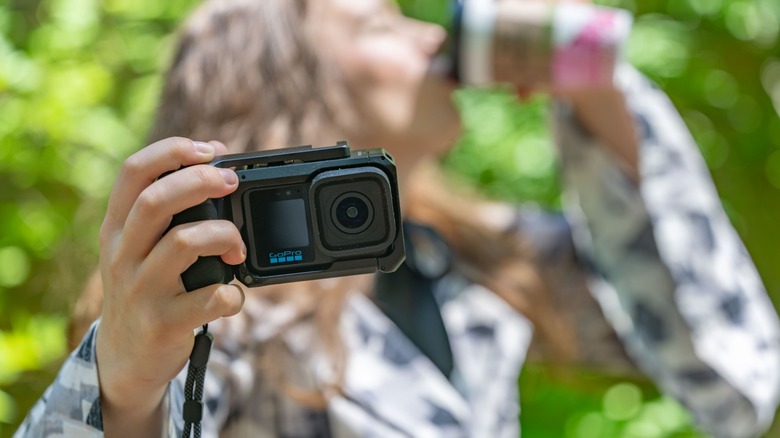
I also had the opportunity to try out GoPro's new grip cage for the Mission 1 Pro, which essentially transforms it into a point-and-shoot, making it much easier to shoot handheld. I very much enjoyed using this while hiking or out walking, grabbing B-roll or taking photos.
Improved software, but with one little hiccup
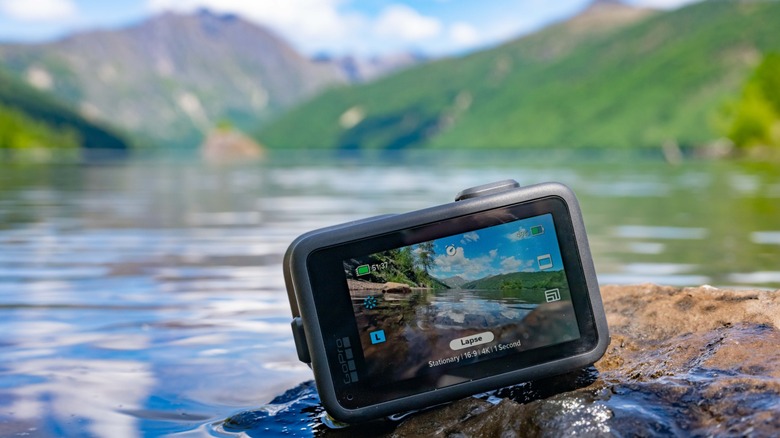
The new menu system of the Mission 1 Pro is really user friendly, yet it still retains all the customization options which I've always appreciated in GoPro cameras. You also have the ability to expand the camera's capabilities through GoPro Labs, including crazy high bitrate options.
The GoPro companion app, Quik, is excellent, though a bunch of key features are locked behind a subscription paywall. At $59.99 per year, it gains you access to such features as unlimited and automatic cloud backups of your GoPro footage, so it's actually a good value, but the integration of the subscription into aspects of the app is frustrating if you decide not to purchase that subscription.
 Andy Zahn/SlashGear
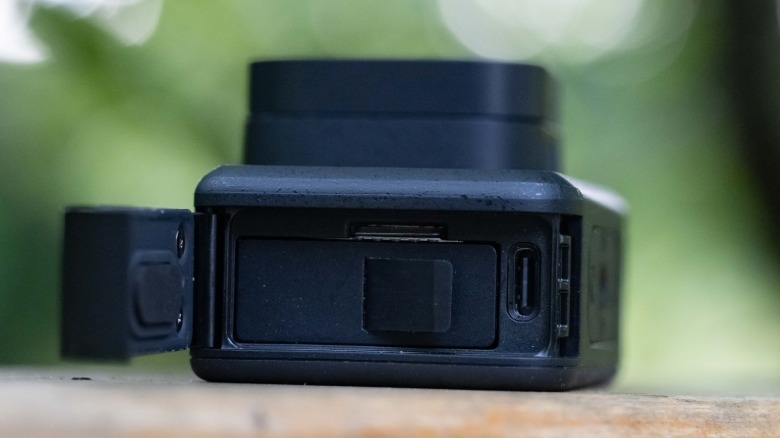
My biggest gripe here is that a firmware update is required before first using the camera. Fortunately, there isn't any requirement to register the camera or bind it to an account, but it is disappointing to not be able to use the camera straight out of the box without first going through the firmware update. This was an aspect of GoPro cameras for which I have frequently praised them in the past. I hope that they will ship the camera with more current updates later on in its production, and allow users to bypass the firmware update requirement.
Battery life and heat dissipation
Over the years, one frequent complaint leveled against GoPro cameras was a tendency to overheat in warm conditions without airflow. I personally never really experience overheating with GoPros, but then I live in a region that's generally pretty cool, and I mostly test GoPros outdoors in fast moving environments, or doing timelapse photography. However, with the Mission 1 Pro I decided to really put its battery life and heat management capabilities to the test.
 Andy Zahn/SlashGear
I took the camera along to multiple live music recording sessions, where I set it down to record the whole show. For one of these shows, I recorded over an hour of 4K 30fps 10-bit footage shot at a high bitrate, yet the camera was only mildly warm afterwards. What's more, it still had 22% of its battery left. That is very impressive indeed, and I am fairly confident that GoPro has finally escaped such criticisms.
Regarding those recordings, I was blown away by the audio quality of the microphone array in the Mission 1 Pro. Since I reviewed the Nikon Zr, its internal microphones have been my primary tool for recording live music. I was shocked to find that the Mission 1 Pro is very nearly as good in this regard as the Nikon Zr, and even has some characteristics to its microphones that I prefer. GoPro has finally integrated 32-bit float recording here too, so you can easily adjust volume in post and not worry about the volume of what you're recording.
The competition
The Mission 1 Pro is going up against some formidable cameras. The DJI Osmo Action 6 and Insta360 Ace Pro 2 are both very good, and have their own unique features which make them appealing options.
The Osmo Action 6 has a brighter aperture at F2, so does deliver a small improvement in low light conditions. It also features a variable aperture, which helps with controlling light transmission, as well as delivering cool sunstars.
The Insta360 Ace Pro 2 benefits from a particularly well developed modular accessory system. It's also the only action camera with a flip-up rear display, which is great for filming at an angle or for vlogging.
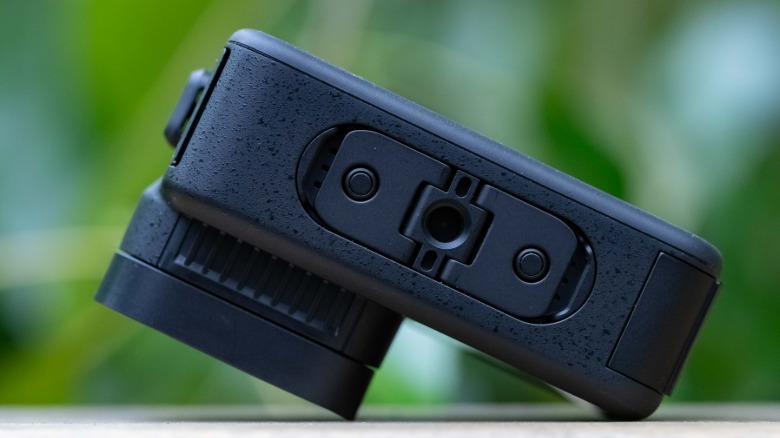
However, the GoPro Mission 1 Pro is miles better for slow motion video capture. Another big advantage is the mounting system, which is superior to the others due to its integrated ¼-20 screw mount and action camera fingers. The DJI and Insta360 cameras are both fully reliant upon magnetic quick release systems, which just aren't as convenient and dependable.
Additionally, after closely analyzing a mountain of comparison footage I filmed between these cameras, I came to the conclusion that GoPro wins overall in terms of image quality. The Mission 1 Pro delivers more natural looking and detailed imagery than the Ace Pro 2 and Osmo Action 6. While DJI and Insta360 may look superficially more appealing in some scenarios, this appears to be largely a result of more aggressive processing algorithms.
Pricing and GoPro subscription
The Mission 1 Pro starts at $699, and there's no getting around the fact that this is a very high price point. While I believe it is in fact worth the money, it's still a lot of money for many people to spend. However, there are some factors which may help alleviate that cost. For a start, existing GoPro subscribers get $100 off the price of the camera, which brings it down to a significantly less painful $599.
It's also worth noting now that there is a less expensive model of the camera called the GoPro Mission 1 (no "pro" on the end), which starts at $599, and with a GoPro subscription discount is just $499. This non-pro camera scales back on the slow motion capabilities (8K 30fps, 4K 120fps, 1080p 240fps), but is very nearly as good as the "pro" model, and at a price that's much closer to other action cameras on the market.
It's worth noting that it is likely these cameras are more expensive now than they might have been due to the shortage of components, which is a consequence of the generative AI data center boom. Existing products which were launched before component prices shot up still have large stockpiles available, which helps to account for the price disparity between a new camera like the Mission 1 Pro and older action cameras. If shortages continue and component prices remain high, then we can unfortunately expect camera prices to go up across the industry. This is all to say that while the Mission 1 Pro may seem expensive now, in another 6 months to a year it may be closer to the "new normal".
Conclusion
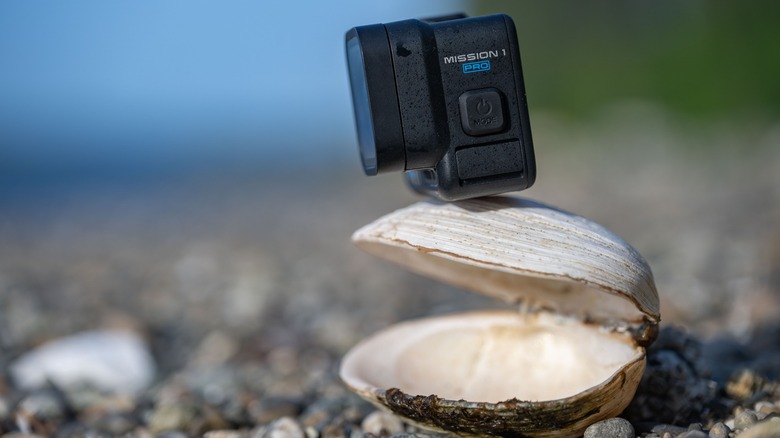
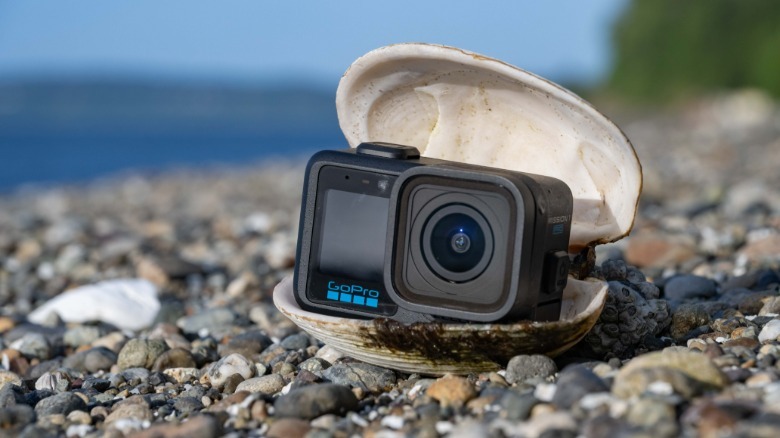
It is really good to see GoPro make such a triumphant comeback with the GoPro Mission 1 Pro. It's clear that the company listened to its customers, and acted decisively to respond to what GoPro users need. I can now say without hesitation that the Mission 1 Pro is the best action camera currently available. This is not to say it's perfect, because there are clearly some areas where it could be improved, and other brands do still offer some things GoPro doesn't. It is also very expensive, which erodes its advantage over less expensive cameras. However, when considered as a whole, the Mission 1 Pro is the overall best in its genre, and if price isn't an object, this is the action to choose.
 Andy Zahn/SlashGear
It also has to be said that GoPro still retains the color science for which they are known. The way these cameras render things is special, and that's still baked into the DNA of the Mission 1 Pro. It's a massive upgrade over everything GoPro has ever made, and at the same time it retains what people love about these cameras. Perhaps most importantly, the Mission 1 Pro delivers the best quality imaging capability of any action camera on the market today.
The GoPro Mission 1 Pro is available starting at $699 from GoPro's online store.