

15 Of The Coolest Jaguar Designs Of All Time
It isn't unusual for carmakers to launch new models or even new sub-brands in an attempt to push their lineup upmarket. Relaunching an entire brand to push upmarket is another matter entirely, but that's exactly what Jaguar is currently in the process of doing. Sales of its existing models were slow, so Jaguar wiped the slate clean and is now replacing its entire lineup with the all-new Type 00 EV.
To say the Type 00 has proved polarizing would be an understatement. Its unusual design attracted a huge wave of criticism, although plenty of people eventually came around to the car's looks. At the time of writing, it remains to be seen whether or not this unprecedented gamble will pay off, but given the controversy surrounding the design of Jaguar's new-era electric GT, it seems like a great time to look back at some of the brand's coolest designs to date.
Jaguar CX-75
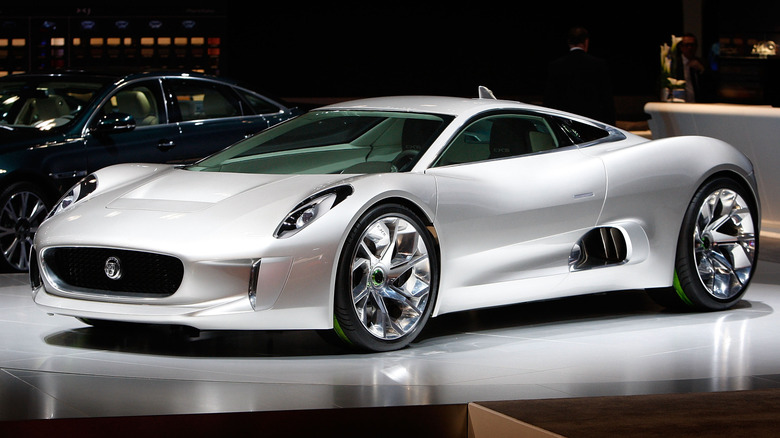
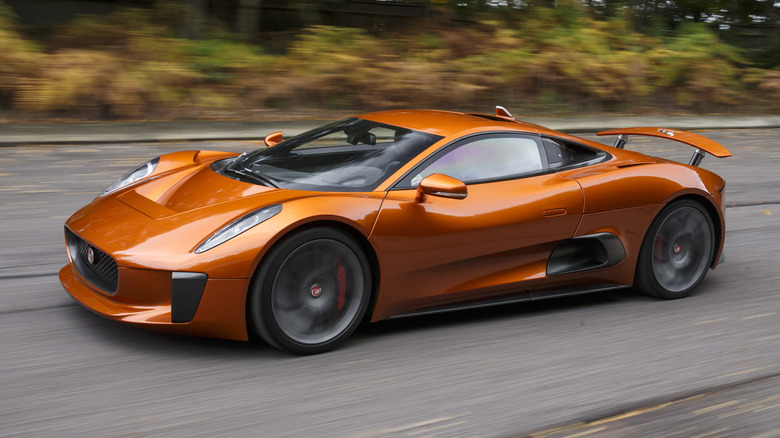
About a decade before Jaguar staked its future on large, luxury all-electric GTs, it previewed a car that could have seen the company head down a very different path. The CX-75 is arguably one of the biggest what-ifs in Jaguar's history, and it has continued to attract plenty of attention from both enthusiasts and collectors even 15 years after its unveiling. The first CX-75 concept car broke cover in 2010, and by 2012, Jaguar had built several fully working prototypes with assistance from Williams Advanced Engineering.
The car was unlike anything Jaguar had built before, with an F1-inspired powertrain and a carbon monocoque chassis. Its 1.6-liter gas engine produced 500 horsepower and it was assisted by electric motors that pushed its top speed to over 200 mph. Jaguar executives greenlit the car for production in 2011, only to backtrack a year later and scrap the project entirely. Speaking to Autocar at the time, brand director Adrian Hallmark blamed the economy, saying that "we feel we could make the car work, but looking at the global austerity measures in place now, it seems the wrong time to launch an £800,000 to £1 million supercar."
Although it never reached production, the CX-75 did end up featuring in the James Bond movie "Spectre." Seven replica cars were built for filming, albeit with a 5.0-liter supercharged V8 engine rather than the complex F1-style hybrid system of the planned production car. Former Jaguar chief designer Ian Callum also built a one-off road legal CX-75 from a former stunt car, unveiling it in 2024.
Jaguar E-Type Series I
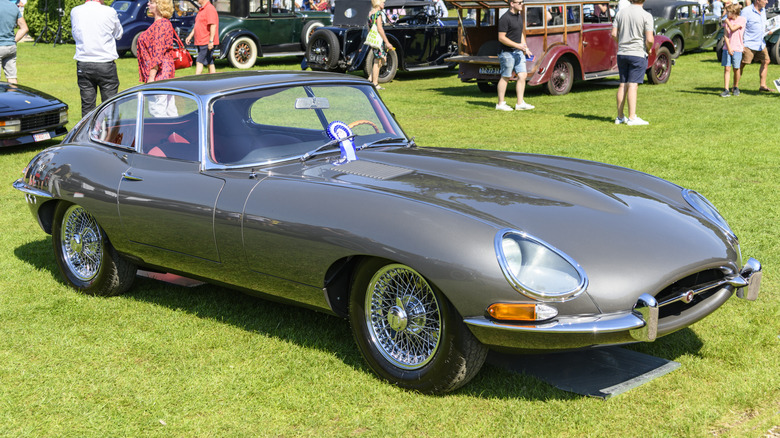
One of the most commonly repeated pieces of trivia about the Jaguar E-Type is that Enzo Ferrari once called it the most beautiful car in the world. Whether Ferrari actually ever uttered those exact words is debated, since the only surviving accounts of his quote come from people who allegedly overheard them at the 1961 Geneva Auto Show. Either way, Ferrari was clearly impressed with the Jaguar when he first saw it, and it hasn't lost any of its charm in the intervening decades between then and now.
While the original Series I design is arguably still the most iconic, Jaguar continually tweaked the car over the course of its production. It also boosted the car's power output to keep it competitive with its ever-changing roster of competitors. The car proved hugely popular with celebrities and collectors when it launched, and it remains that way today. Many high-profile collectors like Jay Leno have their own restored E-Types, and the most pristine examples can fetch more than $200,000 at auction.
Jaguar XJS
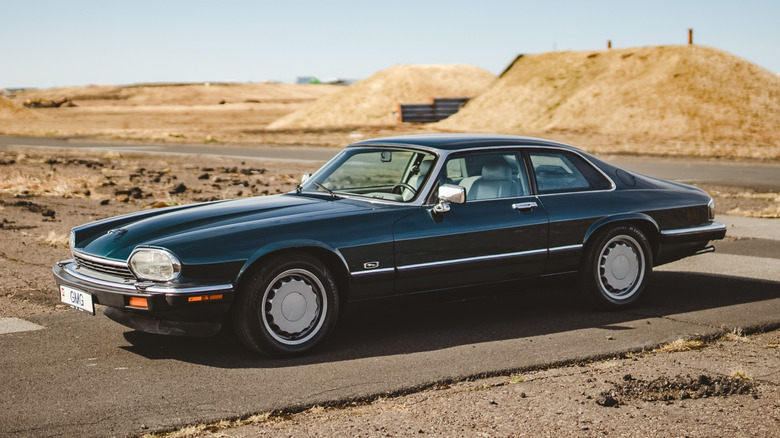
Designing a follow-up to an icon like the E-Type was always going to be a difficult task. It didn't help that the XJS (initially known as the XJ-S) was a different kind of car to its predecessor, focusing more on luxury cruising than traditional sporting prowess. Like many Jaguars since, the XJS also suffered from build quality issues, and it developed a reputation for being especially difficult to maintain and repair.
Its mixed reputation kept prices for used examples low for decades, but in recent years, the XJS has started to gain increasing momentum as a collectors' car. Prices are up and interest in restomods like the TWR Supercat is high, with V12-engined versions carrying a premium.
In recent decades, V12 engines in general have become increasingly rare, and it certainly helps that the XJS' looks have aged much better than most of its mechanical components. Less well looked after examples still have a tendency to fall apart and rack up eye-watering repair bills as a result, but when they're working, few other cars at their price point offer the same combination of power, sophistication, and style.
Jaguar F-Type Project 7
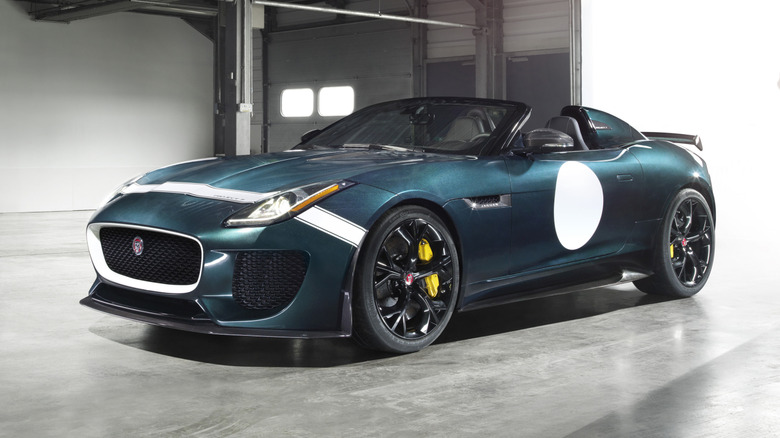
The original F-Type was already a good-looking car, but Jaguar added in some extra design touches from the Le Mans-winning D-Type when it launched the F-Type Project 7. The graphics on the front and side are a tribute to the classic racer, as is its lack of a roof. It does technically come with a removable soft top, but it can only be used at lower speeds. That makes it highly impractical for the wet, windy British weather that usually blankets the country during the winter months, but the Project 7 was never meant for daily use.
Unlike the regular F-Type, the Project 7 was designed more for the track than the road. It was priced like an exclusive track day toy, too, with a retail price of £135,000 at launch, equivalent to around $214,000 at the time. Its 567 horsepower V8 engine wasn't much more powerful than an F-Type R, but with a production run of just 250 examples, it was far more rare than any other F-Type variant. Arguably, it looked better than all of them too, with its classic racer-inspired design elements being blended with cutting-edge aero and carbon-ceramic brakes.
Jaguar XK120
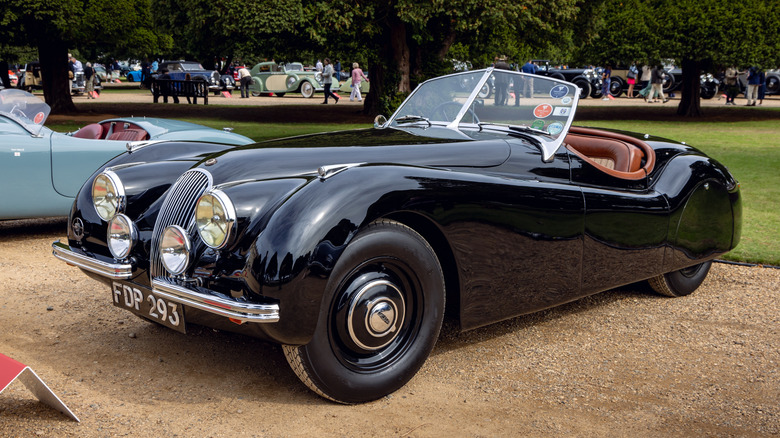
Alongside the E-Type, the XK120 is one of the most instantly recognizable cars in Jaguar's history. It was first unveiled in 1948 and takes its name from the XK engine under its hood and its claimed top speed. In the end, it turned out to be even faster than its 120 mph claim, reaching 126.448 mph in testing. That was a record for a production car at the time, and it made what was already a very desirable car even more appealing to buyers.
Jaguar originally intended to build only 200 examples of the car, but it became so popular that more than 12,000 examples were eventually sold. The last example left the factory in 1954, with the car's replacement, the XK140, debuting shortly after. The XK140 featured heavier bumpers to meet the demands of the U.S. market, as well as a new grille. Although it was a more capable car, it's arguably not quite as good looking as the original XK120.
Jaguar XKR-S GT
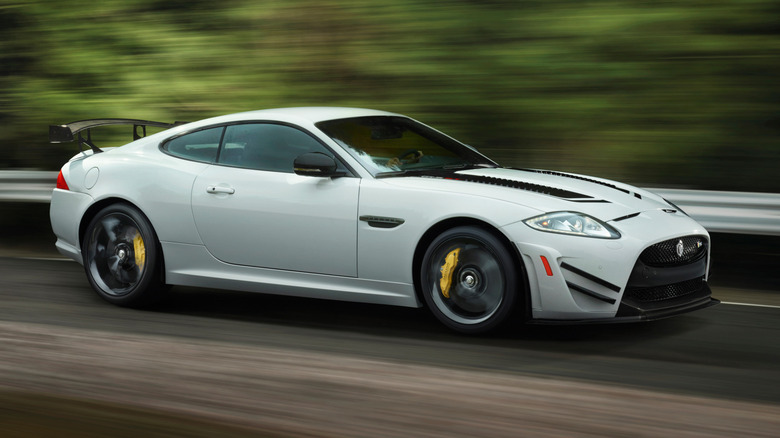
Before the F-Type came along, there was the XK grand tourer. In top-spec XKR-S form, it featured a supercharged V8 engine with around 540 horsepower on tap. It was relatively under-the-radar compared to most of its competition, but still had plenty of appeal to those in the know. To celebrate the end of its production run, Jaguar gave the car a racing-inspired makeover, and the result was the limited-edition XKR-S GT.
It was described by Jaguar at launch as being "the ultimate track‑focused but road‑going iteration of the XK," with a laundry list of changes compared to the regular XKR-S. The rear wing and additional aero bits were the biggest visual differences, but Jaguar's engineers also created a bespoke suspension for the car, as well as adding new carbon-ceramic brakes, revised steering, and plenty of other smaller tweaks.
To reduce the car's weight, Jaguar also removed the car's rear seats, and swapped the front seats to racing-style bucket seats. One of the few things that wasn't changed was the supercharged V8, although it sounded even better thanks to the reduced soundproofing in the XKR-S GT. These alterations helped make the car far more expensive than its series-production counterparts, and it was much rarer too. Jaguar built 30 examples for the U.S. market out of a total of 50 cars, and charged around $175,000 for the privilege of owning one.
Jaguar C-Type
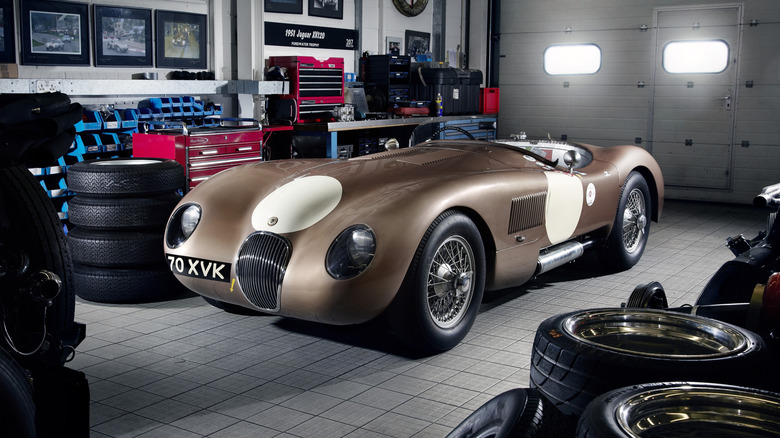
Today, Jaguar's only global-level motorsports team competes in Formula E, but historically, it has been most closely associated with endurance racing. The company won the 24 Hours of Le Mans seven times, making it the fourth most successful brand in the race's history. Only Ferrari, Audi, and Porsche have more overall wins. The first Le Mans-winning Jaguar was the C-Type, which took the crown in 1951.
The car was designed using a mix of brand new parts and parts borrowed from the XK120. Its engine and transmission both came from the latter, but its bodywork was all-new. Its shape was the work of Malcolm Sayer, a former aircraft designer who, before he was commissioned to work on the C-Type, had just returned from Baghdad University in Iraq.
According to historian Philip Porter as reported by the BBC, it was during this time teaching in Baghdad that Sayer met a German professor who taught him "a system of designing shapes mathematically" that he'd subsequently employ when designing the C-Type. Sayer later played a key role in designing both the D-Type and E-Type. He reportedly never cared much for the aesthetics of his cars, instead preferring to focus on their aerodynamic efficiency. Nonetheless, the C-Type and its successors are arguably among the best looking cars of their respective eras, as well as being fiercely competitive on track.
Jaguar Mark II
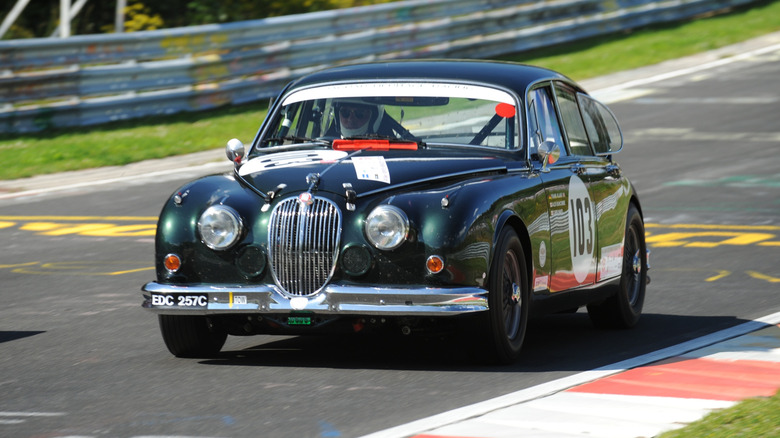
One of Jaguar's best-known classics is the Mark II, which was produced between 1959 and 1967. Rather than being an all-new car, it was instead a facelift of the brand's older saloons, which are collectively known today as Mark I models. The Mark II was a significant improvement over its predecessors both in looks and in performance, and it was far more popular with buyers.
It's still a favorite among collectors who like to regularly drive their cars, because it's both comfortable and fast by the standards of the era. Decades after its unveiling, in 1993, the Mark II's design became the subject of an unusual tribute, when Japanese boutique carmaker Mitsuoka borrowed its looks for its Viewt city car. It is, to put it nicely, a bit of a head-scratcher.
Bizarrely, the Viewt was based on the JDM Nissan Micra, and only produced a little over 100 horsepower. That means a well-specified Mark II, particularly one with the 220 horsepower 3.8-liter six-cylinder engine, would still be able to comfortably outpace a Viewt, despite being roughly half a century older than its cheap Japanese imitator.
Jaguar XK180
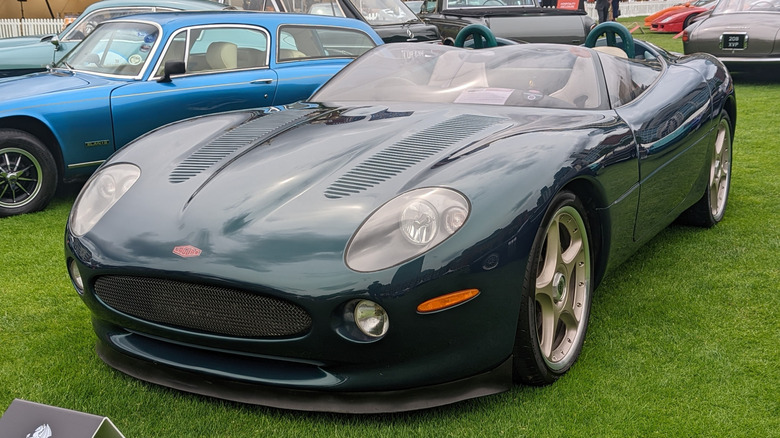
Long before the CX-75, Jaguar built another forward-thinking prototype that never ended up making it to production. The XK180 was built in 1998 to celebrate the 50th anniversary of the XK120, and it took design inspiration from Jaguar's legendary C-Type and D-Type. The company even used the same panel supplier for the XK180 as it did for its Le Mans-winning race cars. Two prototypes were constructed, with one being right-hand drive and the other being left-hand drive. The left-hand drive prototype was sent off to be showcased in the U.S., while the other stayed in the U.K.
Under the hood of the XK180 was a 4.0-liter supercharged V8 engine, which had been borrowed from the XKR and tweaked to be substantially more powerful. With 450 horsepower on tap, the car had around 70 extra horses compared to Ferrari's V8 supercar of the era, the F355. It's not clear how much faster than the Ferrari it would have been, though, since Jaguar never released official performance figures for the car.
Several journalists, including Top Gear's Jeremy Clarkson, were given the keys to the XK180 to show off its capabilities. Despite its publicity drive, Jaguar never considered the car for production. The XJ220, launched around half a decade before, had proved to be much harder to sell than Jaguar had anticipated. Its poor sales meant there simply wasn't enough development budget left for the brand to make the XK180 a production reality.
Jaguar XKR (X100)
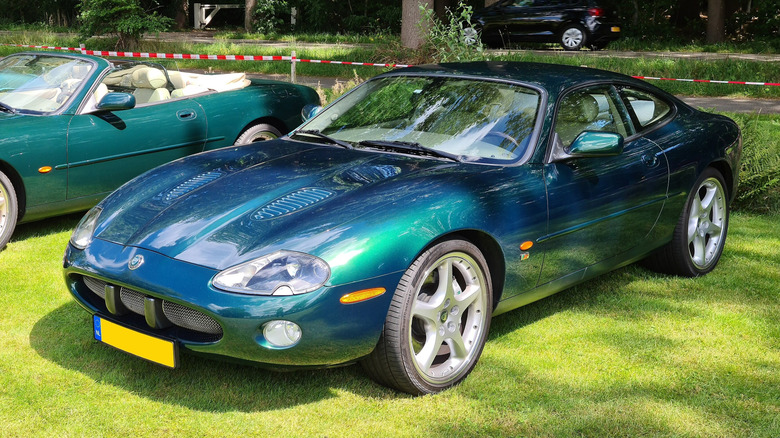
By the time it reached the end of its production run, the XJS was getting long in the tooth. Its successor, the X100 generation XK, was a much more modern car, with sleek bodywork and a brand-new V8 engine. It first debuted in 1996, and it would take another two years for the faster, more aggressive-looking XKR to arrive in dealerships.
At launch, the XKR made 370 horsepower, but later models pushed that figure up to roughly 400 hp. Alongside its power boost, the XKR also featured various exterior tweaks, as well as larger wheels.
It served as Jaguar's range-topping performance car — when it worked, of course. Earlier models suffered engine issues thanks to the Nikasil that lined the cylinders, with the engine failing altogether in extreme cases. That patchy reputation has helped keep used prices down compared to many of its rivals from the era.
Jaguar D-Type
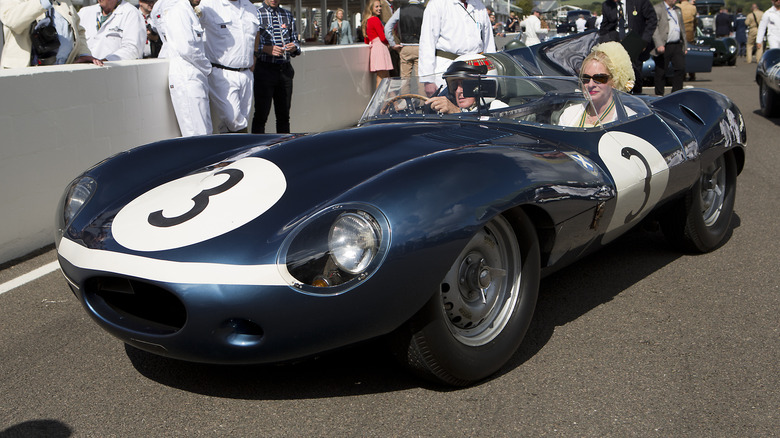
Fresh off the glory of two wins at Le Mans with the C-Type, Jaguar engineers developed the follow-up using a similar formula. Much like the C-Type, the D-Type used a revised version of the XK engine that was initially launched in the XK120. It was paired with a lighter chassis and the most aerodynamic bodywork that Jaguar could accommodate, then sent straight back to Le Mans for testing.
The C-Type took its Le Mans wins in 1951 and 1953, with the D-Type's first win arriving in 1955. It won again in 1956 and 1957, making it even more successful than its predecessor. Further adding to its trophy cabinet, the D-Type also took wins at Spa, Silverstone, and Sebring, among others. Despite being a cutting-edge race car, Jaguar wasn't choosy about who could own a D-Type. It was available in the brand's dealerships alongside its other models, and it retailed for a low £1,895, which meant Jaguar took a loss on every D-Type it sold.
Jaguar XE SV Project 8
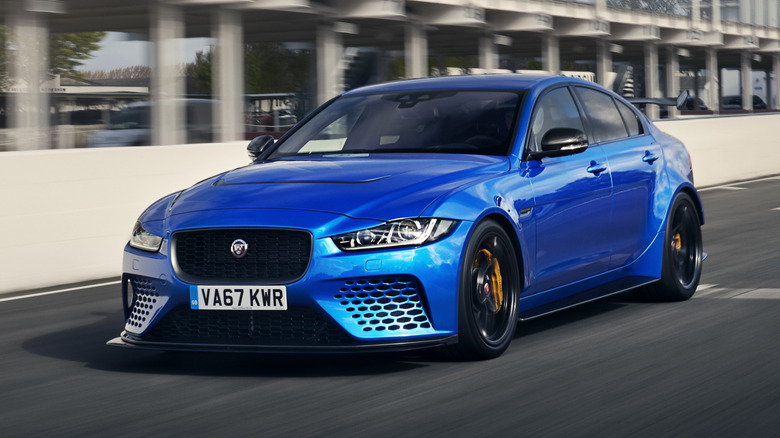
The regular Jaguar XE is not an especially interesting car. It's an entry-level luxury sedan that competes against the likes of the BMW 3-Series and Mercedes-Benz C-Class, and it never made much of an impact against its class-leading German rivals. But the XE SV Project 8 is a very different beast.
Jaguar handed an XE to its engineers and instructed them to turn it into a Nordschleife-conquering track car, and so they fitted it with a V8 engine that churned out around 600 horsepower. Then, they stripped out anything that they could to reduce its weight and fitted a motorsport-derived suspension and an all-wheel drive system.
After adding in carbon fiber racing seats, carbon-ceramic brakes, and a huge rear wing, they sent it round the Nordschleife and promptly achieved the lap record for a four-door sedan. The car was put into limited production so that wealthy owners could see what all the fuss was about. In total, just 300 examples were built.
Jaguar XJ220
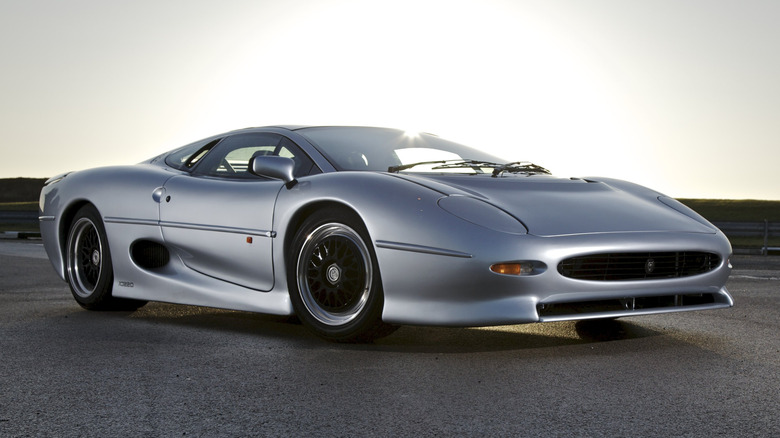
Jaguar's XJ220 supercar holds the unusual distinction of both being a ground-breaking world record holder and also not living up to buyers' expectations. It achieved a Guinness World Record for the fastest production car, hitting 217.1 mph, slightly short of its original 220 mph goal. It's also rare, with just 282 examples built. That wasn't a deliberate move on Jaguar's part though. Originally, the plan was to sell 350 examples, but with such low demand from buyers, Jaguar ended production early.
The lack of demand mostly stemmed from the differences between the XJ220 concept and the production version. The concept featured a 6.2-liter V12 engine, while the production version borrowed a 3.5-liter V6 engine from the MG Metro 6R4 rally car. The concept also included all-wheel drive, active aero, and adjustable suspension, none of which were present in the production version. It was still an incredibly fast and very good-looking car, just not quite as ground-breaking as Jaguar initially promised.
Jaguar XJ13
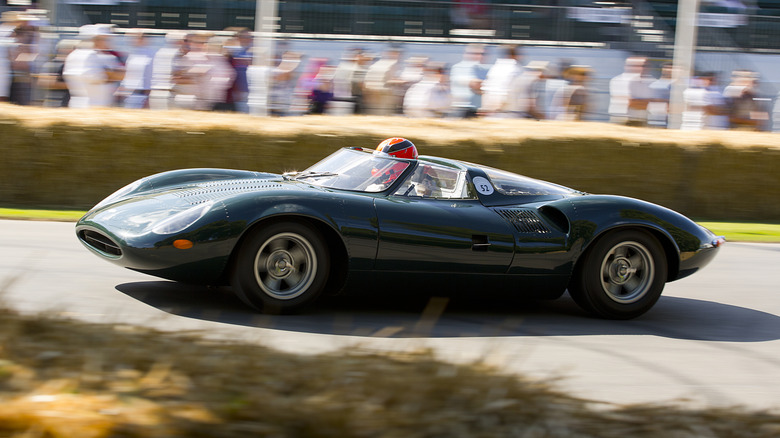
After proving itself as a force to be reckoned with at Le Mans in the '50s, it would take Jaguar several decades to once again take the winner's crown. Its sixth win would arrive courtesy of the XJR-9 in 1988, but in between those two winning eras, Jaguar developed the XJ13.
It was originally intended to mark Jaguar's return to Le Mans, but it never ended up making it to the start line. Development took longer than initially planned, and Le Mans homologation rules changed during that time.
Jaguar would have needed to build 50 production cars in order to enter the XJ13, which wasn't a financially viable option for the cash-strapped company. And anyway, rival carmakers like Porsche and Ferrari had already developed faster race cars in the time between the start of the XJ13's development and its completion. As a result, the XJ13 was shelved, with only one, stunning prototype ever built.
Jaguar XJR-15
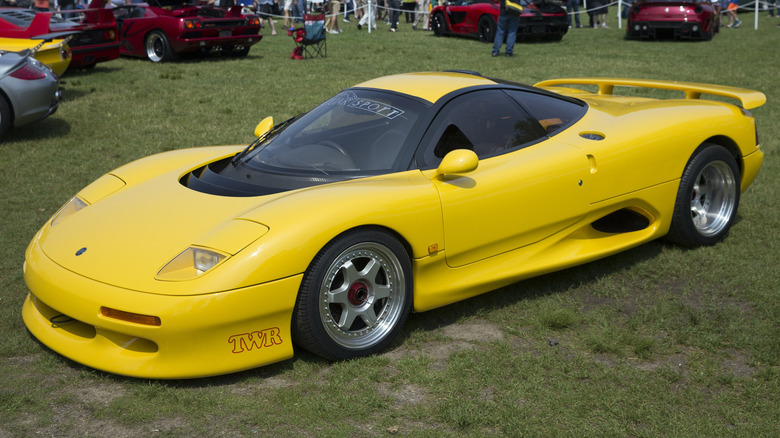
A few years before the XJ220 concept took collectors by storm, the lesser-known XJR-15 supercar was Jaguar's apex predator. In total, around 50 examples were built, but only 27 were road legal. Unlike the XJ220, the production XJR-15 featured a V12 engine under its sleek bodywork, as well as a cutting-edge carbon fiber chassis.
Confusingly, the Jaguar XJR-15 was not actually built by Jaguar. It was instead built by Jaguar Sport, a subsidiary of Tom Walkinshaw Racing. Walkinshaw wanted a road-legal version of the Le Mans-winning XJR-9, and so set about building one without asking Jaguar first.
Jaguar was quietly developing the XJ220 at the time, but allowed the XJR-15 to go ahead on the basis that it would be used for a racing series. TWR subsequently obliged and created a one-make series specifically for the XJR-15. The roadgoing version was essentially a race car with the bare minimum changes needed to get a license plate, making it one of the most extreme Jaguar-badged cars ever, as well as one of the coolest.