

5 V6-Powered Cars Quicker Than Ford's New Mustang GT
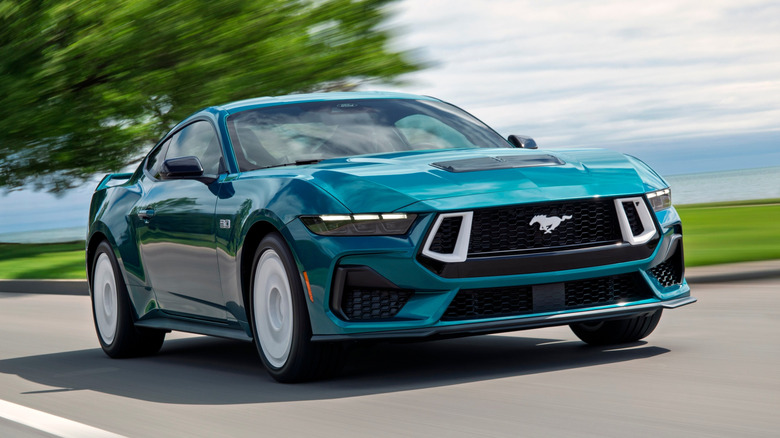
Even though its price has climbed steadily in the last decade, the Ford Mustang GT is still one of the more exciting performance cars on the market. There are lots of reasons buyers might be drawn to it, and its 5.0-liter V8 engine is surely one of the big ones. A naturally aspirated V8 once represented the backbone of the American performance car scene, and with Chevy axing the Camaro and Dodge's V8 models all currently on hiatus, the Mustang has become the only (relatively) affordable game in town.
However, part of the reason V8s are otherwise so few and far between is that manufacturers have increasingly shifted to smaller-displacement engines, including turbocharged V6s. And in some cases, these V6s can actually outgun the 480-hp V8 Mustang GT in straight-line performance.
The Mustang's acceleration will vary depending on which transmission it has, but the average figures for the GT show a 0-60 time in the low to mid four-second range and a quarter-mile run in the low to mid 12-second range. Those are stout numbers, and for many buyers, the Mustang GT's V8 soundtrack is non-negotiable — but if you compare the Mustang to modern V6-powered performance cars, you'll find several that can edge it out in straight-line acceleration.
Cadillac CT4-V Blackwing
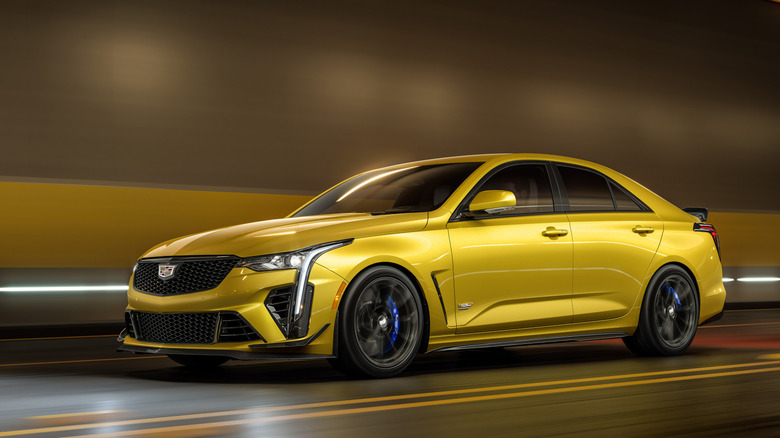
With General Motors discontinuing the Chevrolet Camaro, those looking for a front-engine, rear-drive GM performance car now have to move up to Cadillac's Blackwing-branded sport sedans. When it comes to V6-powered performance sedans, the Cadillac CT4-V Blackwing is one of the hottest around, with its twin-turbocharged 3.6-liter engine rated at 472 hp and 445 lb-ft of torque.
The CT4 has slightly less horsepower than the Mustang GT, but at the track it can hit 60 mph in four seconds flat and run the quarter mile in 12.4 seconds, with the automatic being slightly quicker than the manual version. While the acceleration battle between the two cars is close, the Mustang GT gets the win in the value department with its sub $50,000 starting MSRP coming in substantially cheaper than the CT4-V Blackwing's mid $60,000s base price. This isn't surprising given the Blackwing's more luxurious persona and branding.
The Cadillac may not have the V8 engine that so many associate with American performance cars, but the numbers show the CT4-V Blackwing is more than capable of running with larger-displacement rivals. Better yet, our review of the manual transmission-equipped CT4-V Blackwing also showed the car to have an engagement and fun factor that goes beyond its performance figures.
Nissan Z Nismo
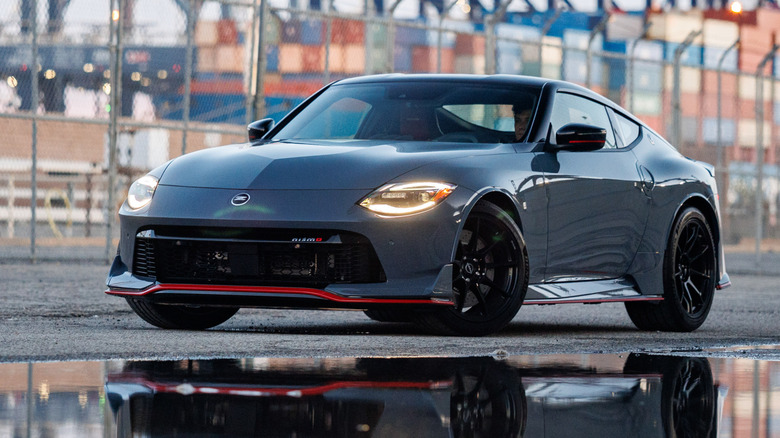
As a two-door rear-drive sports car from a mainstream brand with a starting price in the mid-$40,000s, the Nissan Z is actually one of the Mustang's most direct competitors in this group. And unlike other cars, which have downsized their engines in the modern era, a V6 engine has been a key part of the Nissan Z formula going all the way back to the mid-1980s. Today, all versions of the Z are powered by 3.0-liter twin-turbocharged V6 engine, but it's the high-performance Nismo variant that makes the most of that V6 powerplant.
In its Nismo trim, the Z makes 420 hp and 384 lb-ft of torque — and when mated to an automatic transmission, testing has shown that combo is good for a 0-60 run of 3.9 seconds and a quarter-mile time of 12.4 seconds. These are impressive figures given the Z's horsepower figures are actually fairly modest by mid-2020s performance car standards.
While we had some mixed feelings about its price, our review of the Nissan Z Nismo, showed that this machine has a lot to offer for fans of modern Japanese sports cars. If the Nismo Z's price seems too high, the cheaper, non-Nismo version isn't far off performance-wise, with low four-second 0-60 times and high 12-second quarter-mile ETs that put it pretty close to the Mustang GT.
Audi S5 and RS5
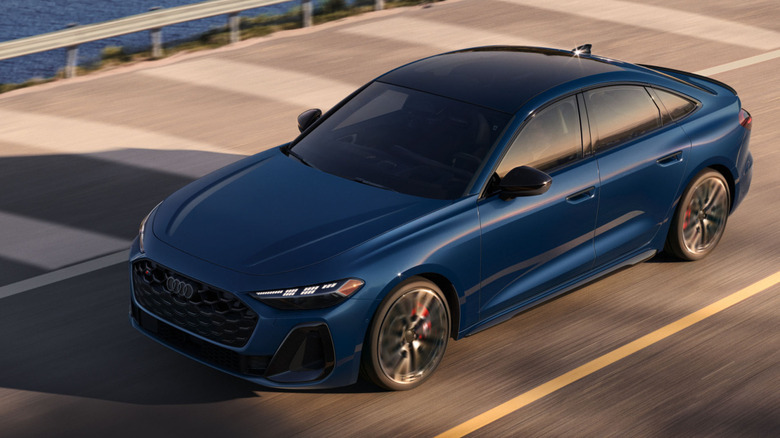
Comparing the Mustang GT to the Audi S5 shows just how varied the modern performance car can be. The cars are of a comparable weight and size, but that's about where their similarities end. The Mustang GT has a naturally aspirated V8 and rear-wheel drive, while the S5 has a twin-turbocharged V6 and all-wheel drive — and a price that starts in the mid $60,000s.
Rated at 362 hp, the S5's 3.0-liter twin-turbocharged V6 engine is down by over 100 hp compared to the Mustang, but it claws back an acceleration advantage at the track thanks to that aforementioned all-wheel-drive system. Testing has shown the S5 to hit 60 mph in just 3.9 seconds, with the quarter-mile coming in 12.5 seconds.
Our review of the S5 Sportback showed the car to be a competent and quick luxury machine, but if that's not enough for you, there's always the new Audi RS5. The RS5 also has a twin-turbo V6 engine, but adds a plug-in hybrid electric boost for a total of 630 hp. This makes the car good for 0-60 times in the low three-second range and a quarter-mile time in the mid 11s. Just know that you can purchase two new Mustang GTs for the Audi's $100,000-plus starting price.
Nissan GT-R R35
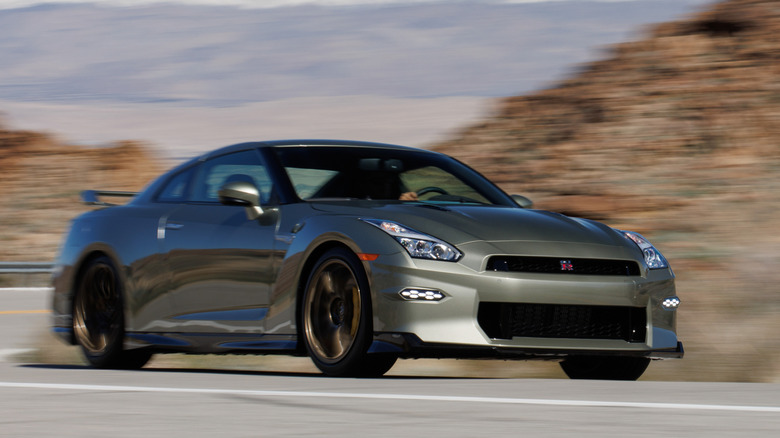
You could say the R35 Nissan GT-R is an unfair addition to this list. For starters, you can't actually buy a new one anymore, as Nissan ended production of the GT-R in 2025. And, going back to its debut in the late 2000s, the GT-R always played in a completely different segment than the Mustang GT, with a much higher price, and its sights set on high-end European supercars.
However, as an enduring symbol of the V6 engine's performance potential, the GT-R is more than deserving. Earlier iterations of the GT-R used the legendary RB26 inline-six, but the R35's switch to a new 3.8-liter twin-turbocharged engine showed just how capable a V6 could be. The R35 GT-R was in production for a long time, with a lot of updates along the way — and the Nismo variants of the car were rated at an impressive 600 hp and 481 lb-ft of torque.
At the track, the GT-R was capable of hitting 60 mph in 2.9 seconds and running the quarter-mile in the low 11s. Price aside, those are incredible numbers for a V6-powered car that was originally developed back in the 2000s. By the time Nissan pulled the plug on the R35, the GT-R was showing its age in many ways, but its raw performance figures still hold up against today's best, no matter how many cylinders they may be packing.
Porsche Macan GTS
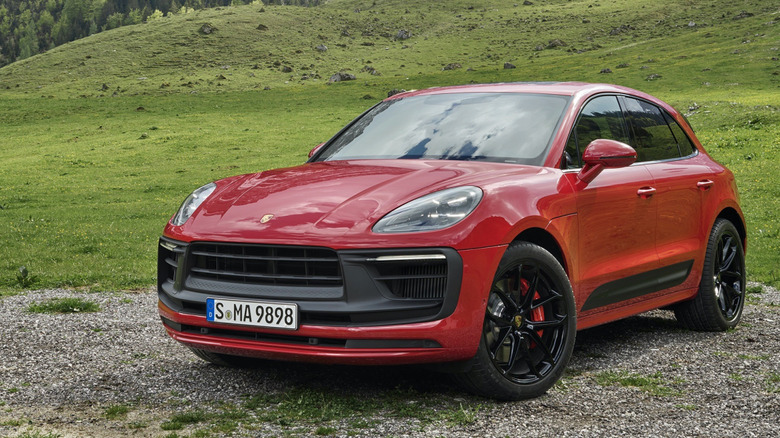
Looking back through the Porsche brand's long history of building performance cars, the V6 probably isn't the first engine type that comes to mind, but it's what powers — or powered – the higher-end versions of the brand's popular Macan crossover SUV in recent years. With V6 power, the Macan is one of the more potent and practical performance machines on the market.
The high-performance Macan GTS variant gets its power from a 2.9-liter twin-turbo V6 that makes 434 hp and 405 lb-ft of torque, sending that power to all four wheels. In performance testing, the gasoline Macan GTS delivers, hitting 60 mph in 3.5 seconds and running the quarter-mile in just 12.1 seconds. On top of that, it also has handling that blurs the lines between crossover SUV and serious sports car.
In the real world, are there any buyers seriously cross-shopping any trim of the Porsche Macan against any trim of the Ford Mustang? Most likely not, but the fact that this V6-powered crossover SUV can show the V8 Mustang its taillights at the drag strip shows just how much the performance car has evolved in the modern era. Speaking of evolution, the gasoline-powered Macan is now on its way out, to be replaced by the new all-electric Porsche Macan, which has some big shoes to fill.